GRC Team Roles and Responsibilities: A Brief Guide
An effective governance, risk, and compliance(GRC) program is a vital tool for organizations striving to maintain a competitive edge while staying compliant with regulations.
At the heart of the program is the GRC team, a group of dedicated professionals working together to safeguard business operations, ensure compliance, and mitigate risks.
But how do these teams function, and what roles are crucial to their success? In this comprehensive guide, we’ll dive deep into how GRC teams operate, the key roles and responsibilities that drive them, and the common challenges they face.
We’ll also explore practical steps for building a GRC team tailored to your organization’s needs. And if you’re seeking a reliable cybersecurity platform, we’ll show you how Cyber Sierra can help you manage your GRC program effectively.
Key Takeaways
- GRC teams are responsible for governance, risk management, and compliance, ensuring organizations operate within legal and regulatory frameworks while aligning with strategic objectives.
- A GRC team typically includes roles like the Chief Risk Officer (CRO), Chief Information Security Officer (CISO), compliance officers, and security analysts, each focusing on specific areas like cybersecurity, financial risks, and regulatory adherence.
- Common challenges in GRC include siloed functions, lack of leadership support, complex regulations, and cultural resistance. Overcoming these requires integrated frameworks, executive buy-in, and technology solutions.
- Creating a well-structured, cross-functional team with clear roles and utilizing technology is essential for a successful GRC program tailored to an organization’s needs.
What is a GRC Team?
A GRC team in cybersecurity is responsible for aligning governance, risk management, and compliance efforts to protect an organization from security threats while ensuring adherence to industry regulations.
This team plays a crucial role in developing and maintaining the GRC framework, which outlines the policies and practices needed to mitigate cyber risks and promote compliance.
The team also helps in implementing a robust GRC strategy, for organizations to identify vulnerabilities, manage risk, and ensure that security measures are in line with both internal objectives and external regulations.
A typical GRC team structure includes roles such as security analysts, compliance officers, and risk managers, each of whom has specific roles and responsibilities like policy creation, risk assessments, and incident response planning.
How GRC Teams Work?
GRC (Governance, Risk, and Compliance) teams are responsible for managing an organization’s governance, risk, and compliance efforts to ensure that it operates within legal and regulatory frameworks while achieving its strategic objectives. A GRC team plays a critical role in aligning business practices with internal policies and external laws, while also mitigating risks.
A typical GRC team consists of professionals from various disciplines such as legal, IT, finance, and operations. These professionals may include risk managers, compliance officers, auditors, and information security experts. These teams often report to executive management or a board committee to maintain oversight and accountability.
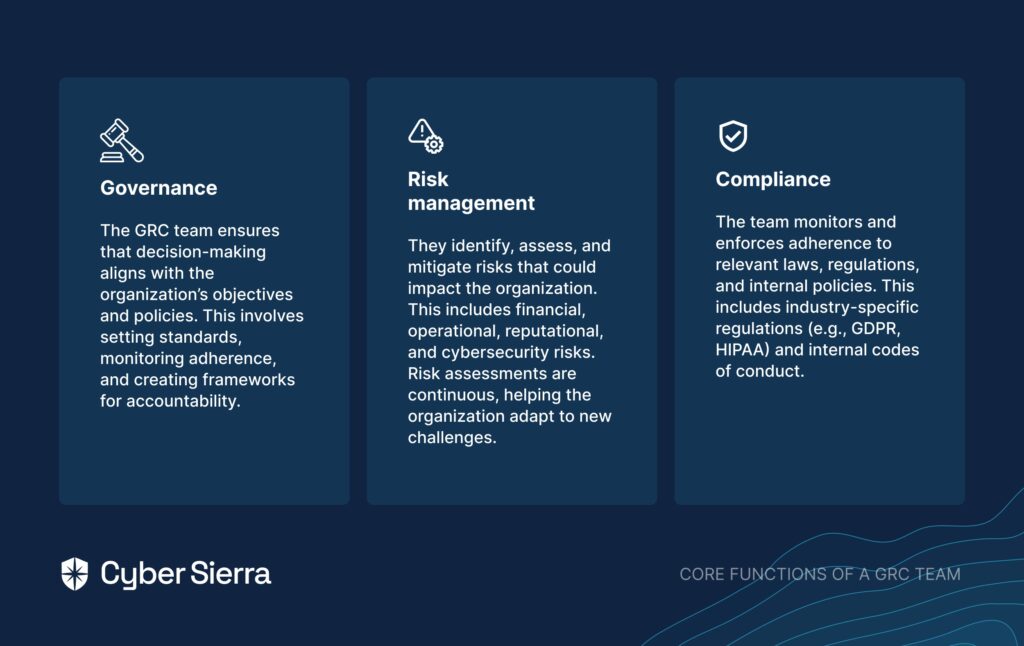
The core functions of a GRC team include:
- Governance: The GRC team ensures that decision-making aligns with the organization’s objectives and policies. This involves setting standards, monitoring adherence, and creating frameworks for accountability.
- Risk management: They identify, assess, and mitigate risks that could impact the organization. This includes financial, operational, reputational, and cybersecurity risks. Risk assessments are continuous, helping the organization adapt to new challenges.
- Compliance: The team monitors and enforces adherence to relevant laws, regulations, and internal policies. This includes industry-specific regulations (e.g., GDPR, HIPAA) and internal codes of conduct.
What are the Key GRC Team Roles and Responsibilities?
Key roles and responsibilities within a GRC (Governance, Risk, and Compliance) team typically include the following:
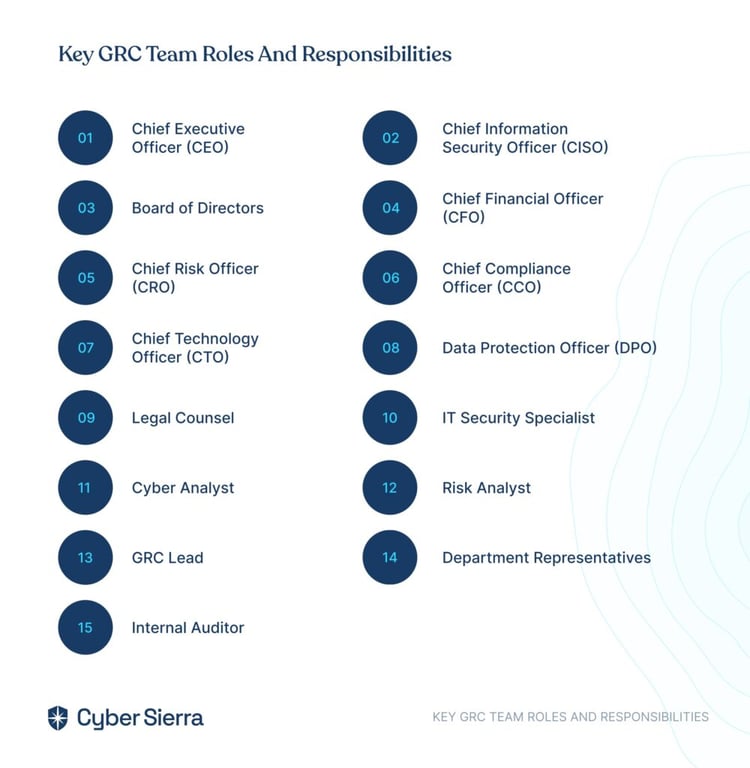
1. Chief Executive Officer (CEO)
The CEO oversees the organization’s GRC strategy, ensuring alignment with business objectives. They provide leadership to the GRC team in cybersecurity, ensuring adherence to the GRC framework. Generally, the CEO is responsible for establishing governance policies and practices to mitigate risks and maintain compliance with regulations.
The CISO leads the organization’s cybersecurity efforts, ensuring the GRC framework addresses information security risks. They implement security policies, oversee risk management, and collaborate with the GRC team to protect data assets.
3. Board of Directors
The Board of Directors ensures the GRC team structure aligns with the organization’s risk appetite. They oversee the development of governance policies and practices, ensuring compliance with regulations. The board supports the GRC team in cybersecurity by approving strategic initiatives and monitoring risk management practices.
4. Chief Financial Officer (CFO)
The CFO team manages the financial risks and ensures that the organization’s GRC framework supports sound financial decision-making. The team oversees internal controls, ensures compliance with financial regulations, and collaborates with the GRC team to mitigate financial and operational risks through robust policies and practices.
5. Chief Risk Officer (CRO)
The CRO is responsible for identifying, assessing, and managing organizational risks within the GRC framework. They develop risk management policies and collaborate with other GRC team members to ensure the company adheres to its risk appetite while implementing a comprehensive GRC strategy across departments.
6. Chief Compliance Officer (CCO)
The CCO ensures that the organization complies with regulatory requirements and internal policies. They implement compliance programs, monitor adherence, and collaborate with the GRC team to mitigate compliance risks. Their role is vital in aligning governance practices with the organization’s overall GRC strategy.
7. Chief Technology Officer (CTO)
The CTO focuses on technology risk management within the GRC framework. They ensure that technological infrastructure supports the organization’s GRC strategy and complies with security and regulatory policies. The CTO also collaborates with the CISO to safeguard technological assets and align technology with risk management goals.
8. Data Protection Officer (DPO)
The DPO ensures compliance with data privacy regulations, implementing policies to protect personal and sensitive data. They work closely with the GRC team in cybersecurity to ensure that data handling aligns with the GRC framework, focusing on minimizing risks related to data breaches and regulatory penalties.
9. Legal Counsel
The Legal Counsel provides guidance on regulatory and legal issues impacting the GRC framework. They ensure that governance policies and practices align with laws and industry standards, mitigating legal risks. Legal counsel works with the GRC team to ensure compliance with evolving regulations, especially in cybersecurity.
10. IT Security Specialist
The IT security specialist supports the GRC team by implementing and maintaining security controls. They are responsible for managing technical defenses, performing risk assessments, and ensuring cybersecurity policies are enforced. Their work is crucial for strengthening the GRC team structure in technology and information security.
11. Cyber Analyst
The cyber analyst monitors, detects, and analyzes cybersecurity threats within the GRC framework. They help the GRC team in cybersecurity by conducting threat assessments, identifying vulnerabilities, and supporting the development of protective policies and practices. Their role enhances the organization’s overall cybersecurity posture.
12. Risk Analyst
The Risk Analyst evaluates risks associated with business processes and IT systems. They assist in the GRC strategy by identifying potential risks, assessing their impact, and recommending mitigation tactics. Their analysis is vital for the GRC team in implementing effective risk management practices.
13. GRC Lead
The GRC Lead coordinates the overall governance, risk, and compliance activities within the organization. They ensure the GRC framework is applied across departments, aligning policies with business objectives. The GRC lead also plays a critical role in implementing the GRC strategy and ensuring smooth communication across the team.
14. Department Representatives
Department representatives ensure that GRC policies are followed within their respective departments. They act as liaisons between their teams and the GRC team structure, ensuring compliance and risk management efforts are integrated into daily operations. Their involvement helps align the GRC framework across all business units.
15. Internal Auditor
The Internal Auditor evaluates the effectiveness of governance, risk management, and compliance practices within the GRC framework. They provide independent assurance on the effectiveness of controls, identify gaps, and recommend improvements, ensuring that the GRC team structure supports the organization’s overall objectives.
Challenges in GRC Operations and How to Overcome Them
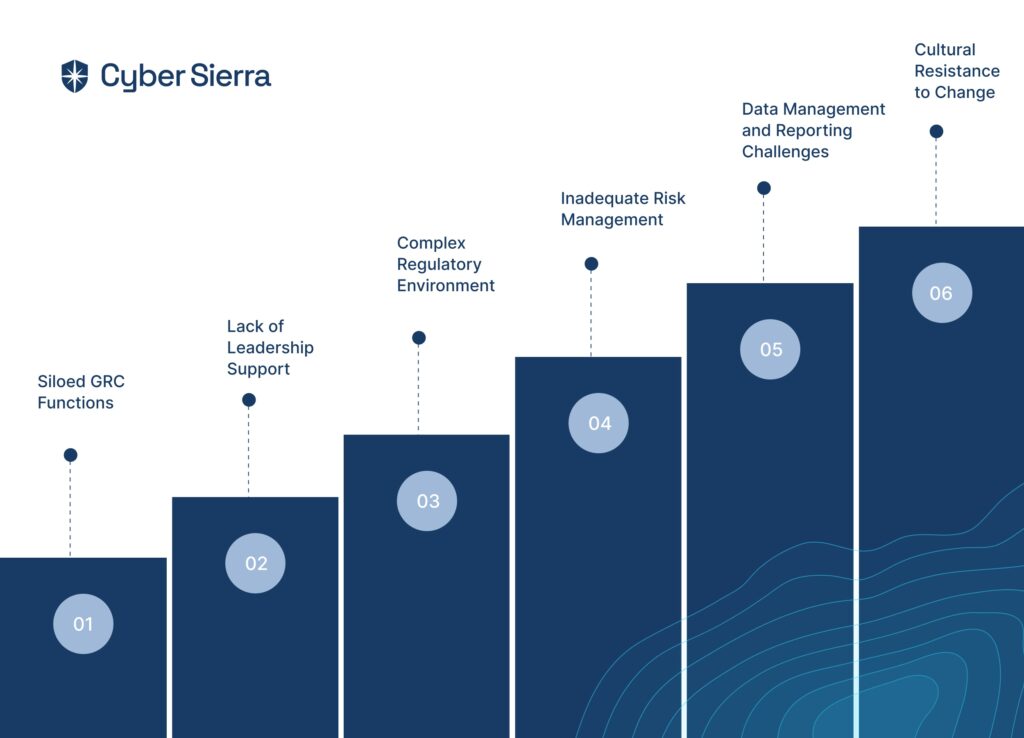
Governance, Risk, and Compliance (GRC) operations are crucial for organizations to manage risks, ensure compliance, and maintain effective governance practices. However, organizations often face challenges in implementing and maintaining a GRC framework. Below are six major challenges in GRC operations and ways to overcome them.
1. Siloed GRC Functions
One of the most significant challenges in GRC operations is the siloed nature of governance, risk, and compliance functions. Often, different departments handle GRC activities independently, which results in a lack of coordination, inconsistent policies, and redundant processes. This siloed approach hinders the ability of the GRC team in cybersecurity and other areas to collaborate effectively.
ProTip: To overcome this challenge, organizations must establish an integrated GRC framework. This involves breaking down silos and creating a centralized GRC team structure that fosters collaboration between departments. A unified GRC tool that consolidates governance, risk, and compliance data across all departments can also help streamline operations.
2. Lack of Leadership Support
Another common challenge is the absence of leadership support, which can lead to underfunded GRC initiatives and a lack of accountability. Without buy-in from executives like the chief risk officer (CRO), chief compliance officer (CCO), or chief information security Officer (CISO), the GRC strategy can lack the necessary resources and attention to succeed.
ProTip: To address this issue, it is critical to secure executive sponsorship. The GRC team should communicate the business value of an effective GRC framework.
3. Complex Regulatory Environment
The ever-changing and complex regulatory landscape poses a significant challenge to GRC operations. Organizations must constantly stay up-to-date with evolving regulations, such as data privacy laws and industry-specific compliance requirements, making it difficult to maintain a consistent GRC framework.
ProTip: Automating compliance monitoring and using regulatory intelligence tools can help organizations keep track of new laws and changes in regulations. The GRC team in cybersecurity, for example, can use automated cybersecurity solutions to monitor compliance with security standards.
4. Inadequate Risk Management
Many organizations struggle with identifying, assessing, and mitigating risks effectively. This can result from insufficient risk assessment processes, a lack of risk visibility, or inconsistent risk management practices across departments. Without a proper GRC strategy, organizations may overlook critical risks, especially in cybersecurity.
ProTip: Implementing a risk management program that includes comprehensive risk assessments and monitoring tools can help address this challenge.
Besides, a unified GRC team structure that includes risk analysts and cybersecurity experts can ensure that all potential risks are identified and addressed.
5. Data Management and Reporting Challenges
Data is at the core of GRC operations, and managing large volumes of data from various departments can be overwhelming. Inconsistent data collection methods and poor reporting mechanisms often prevent organizations from gaining a comprehensive view of their GRC performance.
ProTip: To address data management challenges, organizations should implement a centralized GRC platform like Cyber Sierra that consolidates data from different sources. This platform should include robust reporting tools that allow for the creation of real-time dashboards and reports.
6. Cultural Resistance to Change
Organizations often face resistance from employees when implementing new GRC strategies. Employees may see GRC practices as overly bureaucratic or burdensome, leading to a lack of compliance and adoption.
ProTip: Creating a risk-aware culture is essential to overcoming resistance to change. The GRC team should educate employees on the importance of governance, risk management, and compliance in achieving the organization’s goals. Training programs and workshops can help employees understand how GRC practices protect the organization and themselves. Additionally, simplifying GRC processes and using user-friendly tools can make it easier for employees to comply with GRC requirements.
How to Build a GRC Team in Your Organization
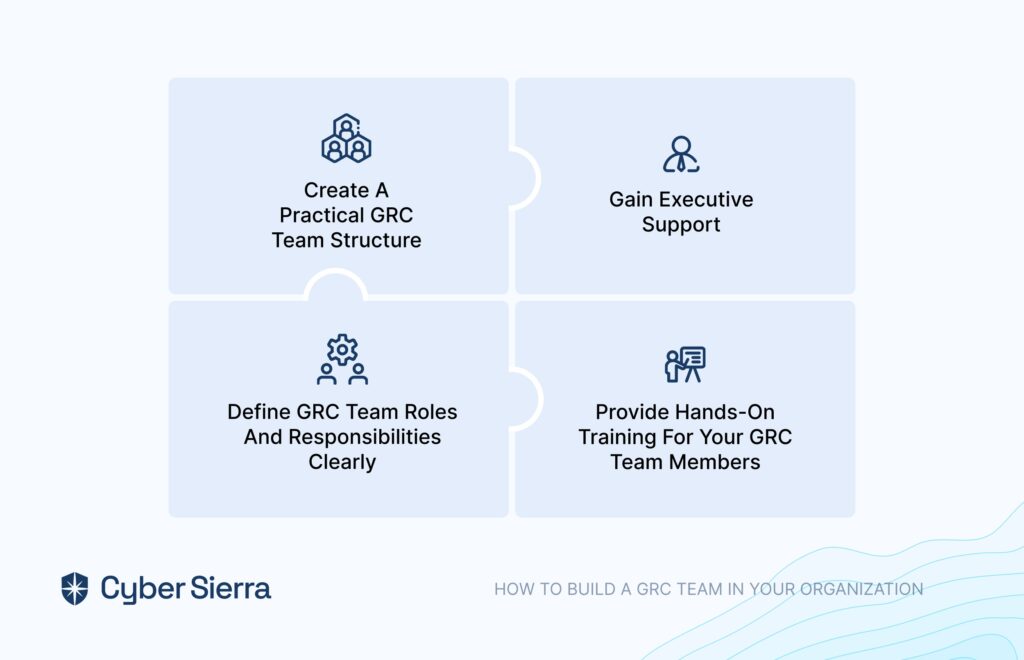
Building an effective GRC (Governance, Risk, and Compliance) team requires a structured, practical approach to ensure it meets the specific needs of your organization. Here’s a step-by-step guide to setting up an effective GRC team:
1. Create a Practical GRC Team Structure
Start by designing a clear GRC team structure that suits the size and complexity of your organization. The structure should include key roles and involve cross-functional members from critical departments such as IT, cybersecurity, legal, finance, and operations.
For instance, you can appoint a chief risk Officer (CRO) or GRC lead who will oversee the entire framework, ensuring governance, risk management, and compliance efforts are aligned with the organization’s goals. Add specialists like a chief information security officer (CISO) to handle cybersecurity risks, and a chief compliance officer (CCO) to focus on regulatory and industry-specific compliance.
2. Gain Executive Support
For your GRC strategy to succeed, it’s essential to have the backing of the executive team. Executives like the CEO or CFO play a critical role in providing the budget and authority your GRC initiatives need to operate effectively.
In practice, getting this support involves presenting the real-world benefits of a strong GRC framework. Use data to show how risks—like data breaches, compliance fines, or operational risks—can result in financial losses and reputational damage. Highlight how an integrated GRC team can prevent these risks, improve decision-making, and enhance efficiency.
3. Define GRC Team Roles and Responsibilities Clearly
To ensure smooth operations, each member of the GRC team must know their specific responsibilities. Start by clearly defining what each role is accountable for, with a focus on practical day-to-day activities.
For example:
- The CISO should be responsible for identifying and managing cybersecurity risks, setting security policies, and ensuring compliance with data protection laws.
- The chief compliance officer (CCO) should handle monitoring regulatory changes and updating compliance processes as needed.
- Risk analysts should actively assess risks, develop mitigation strategies, and provide reports to help executives make informed decisions.
For each team member, provide detailed job descriptions and measurable goals as well.
4. Provide Hands-On Training for Your GRC Team Members
Training is a key element to ensuring that your GRC team remains effective. All team members should undergo initial training to understand the organization’s GRC policies, practices, and their specific roles. In practice, focus on training that includes real-world scenarios.
Conduct regular training sessions, webinars, and refresher courses to keep your team up-to-date with the latest developments in risk management, cybersecurity, and governance. Investing in ongoing professional development is practical because it ensures that your team stays current and competent in managing evolving risks and compliance demands.
Tip: Utilize external resources such as online GRC certification programs or external audits to give your team a well-rounded understanding of modern challenges.
Use Cyber Sierra to Streamline GRC Operations
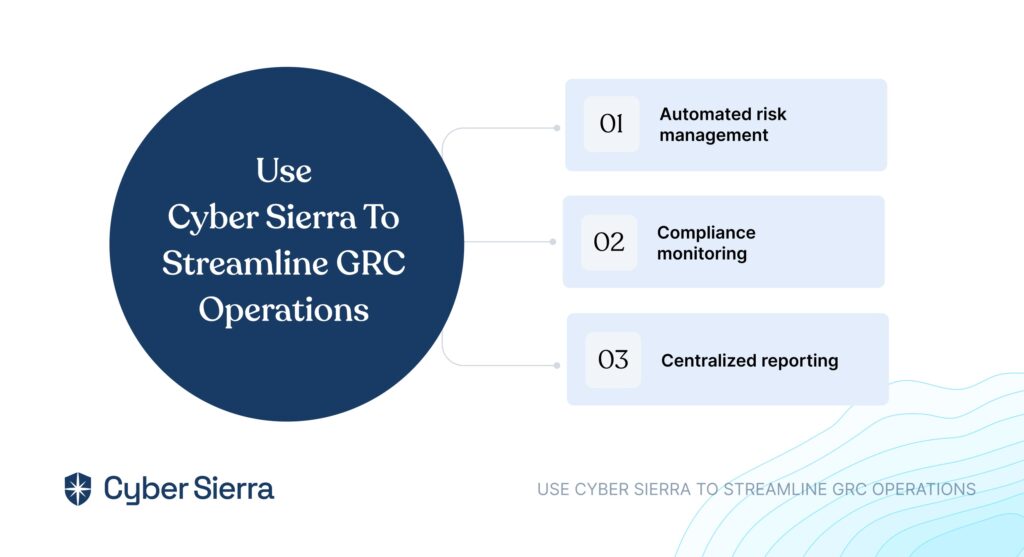
To launch an effective GRC program, you need specialized software that can automate processes and enhance team efficiency.
Cyber Sierra streamlines GRC operations by providing a unified platform that simplifies governance, risk, and compliance management. Its centralized GRC strategy helps organizations manage risks and ensure regulatory compliance efficiently.
Three key features of Cyber Sierra include:
- Automated risk management: It automates the identification and mitigation of risks, reducing manual efforts and ensuring real-time updates.
- Compliance monitoring: The platform tracks and updates compliance requirements, ensuring your GRC program stays aligned with changing regulations.
- Centralized reporting: It offers consolidated reporting tools that simplify monitoring and decision-making, allowing executives to access critical GRC insights easily.
These features enhance efficiency and accuracy, making GRC operations more streamlined and effective.
Book a free demo here to see how Cyber Sierra can improve your GRC team efficiency.
FAQs
1.Who should be in a GRC team?
The GRC team should include diverse professionals such as a Chief Risk Officer, Chief Compliance Officer, Chief Information Security Officer, risk analysts, legal counsel, and department representatives. This cross-functional team ensures comprehensive coverage of governance, risk management, and compliance, effectively supporting the organization’s GRC strategy.
2.What’s the highest priority of the GRC team?
The highest priority of the GRC team is to protect the organization from risks while ensuring compliance with regulations. By implementing a robust GRC strategy, the team identifies, assesses, and mitigates risks, safeguarding the organization’s assets, reputation, and legal standing in a constantly evolving regulatory environment.
3.What are the roles and responsibilities of a GRC committee?
The GRC committee is responsible for overseeing governance frameworks, establishing risk management policies, and ensuring compliance with regulations. Key responsibilities include evaluating risk assessments, approving GRC programs, monitoring compliance activities, and communicating GRC objectives to stakeholders, ultimately supporting the organization’s overall GRC strategy and objectives.