



On-Premise GRC Software on Singapore GCC: A 2026 Guide


Join thousands of professionals and get the latest insight on Compliance & Cybersecurity.
Key Takeaways
- Singapore government agencies require GRC software deployable on the Government Commercial Cloud (GCC) to meet IM8 compliance, but most platforms are SaaS-only, creating a procurement challenge.
- Deployment on the GovTech-managed GCC is a hard requirement for data residency and security, not just a hosting preference.
- Before selecting a vendor, verify they have a live GCC deployment and the mandatory IMDA accreditation to confirm procurement eligibility.
- Cyber Sierra provides an IMDA-accredited GRC platform with a proven, live deployment on Singapore GCC, as well as on-premise and air-gapped options.
Singapore government agencies running compliance workloads under IM8, CCOP, and MAS TRM face a specific infrastructure requirement: GRC software must be deployable on the Government Commercial Cloud (GCC) or an approved on-premise environment. Finding on-premise GRC software for Singapore GCC that actually meets this requirement is harder than it sounds.
Most enterprise GRC platforms are SaaS-only, hosted on commercial infrastructure with no GCC deployment option. For IT Governance Managers and CISOs at Singapore government agencies, this creates a real procurement problem. This guide covers the deployment models available, which platforms support GRC on GCC, and the questions worth asking before committing to a vendor.
What Singapore GCC Deployment Means for GRC Software
The Government Commercial Cloud (GCC) is not simply a Singapore-based AWS, Azure, or GCP region. It is a GovTech-managed platform with a specific set of government-mandated security controls, access policies, and compliance requirements layered on top of commercial cloud infrastructure.
Over 70% of eligible Singapore government systems have already adopted GCC, making it the de facto standard environment for new government workloads.
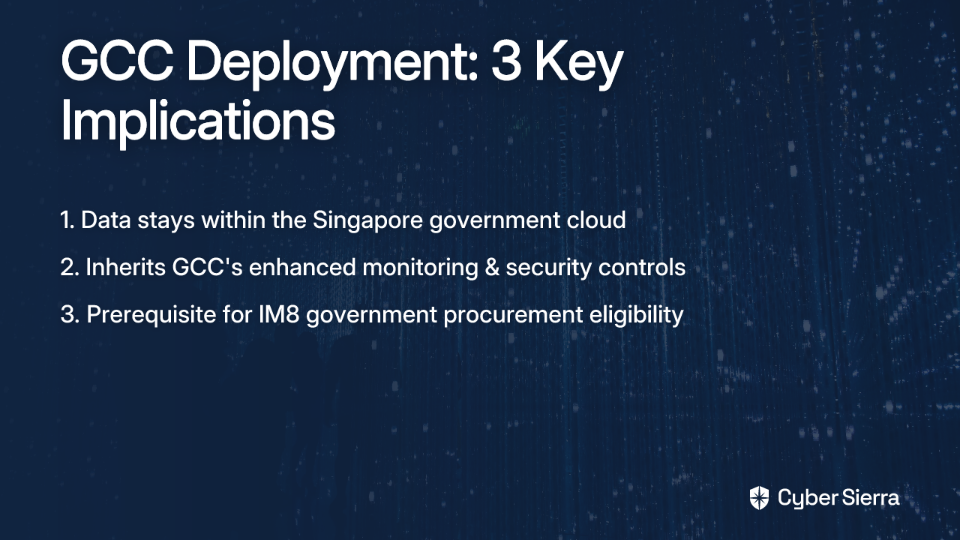
Deploying IM8 compliance software on GCC carries three specific implications. First, data stays within the Singapore government cloud, which is a hard requirement for IM8 Level 1 and Level 2 classified systems.
Second, the hosting environment inherits GCC's enhanced monitoring and security controls, including those managed through CloudSCAPE, GovTech's security automation platform used by more than 70 agencies. Third, GCC deployment is a prerequisite for government procurement eligibility under IM8.
A GRC software on Singapore GCC deployment is therefore not a configuration preference. It is a compliance baseline for agencies handling classified or sensitive government data.
On-Premise and GCC Deployment Options for GRC
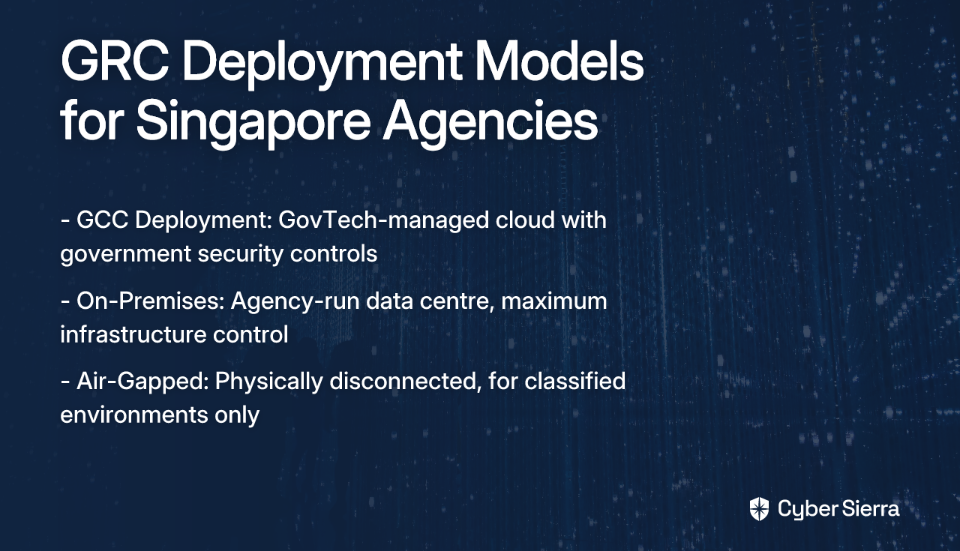
Not all GRC platforms support the full range of deployment models that Singapore government agencies require. The right model depends on the data classification level and the agency's infrastructure posture. There are three primary options.
GCC Deployment is the preferred modern approach. The on-premise GRC software runs on GovTech-managed commercial cloud infrastructure (AWS, Azure, or GCP), with all government security controls applied. This model supports IM8 requirements for most agency systems and is the most operationally practical for agencies that have already migrated to GCC.
On-Premises Deployment places the GRC platform within the agency's own data centre. This on-premise GRC Singapore model gives the agency maximum control over infrastructure security but requires the agency to manage its own patching, uptime, and compliance configuration. It remains a valid option where GCC is not yet available for specific workloads.
Air-Gapped Deployment physically disconnects the system from external networks. This air-gapped compliance platform model is reserved for the most sensitive classified environments, where no external connectivity is permissible. It is the most restrictive but also the most secure option available.
A capable Singapore GCC GRC platform should ideally support more than one of these models. Agencies with mixed workloads at different classification levels need that flexibility.
GRC Software With Singapore GCC Support
The following platforms offer deployment models suitable for Singapore government agencies. They differ significantly in how natively they support GCC, and in how much configuration work falls on the agency.
1. Cyber Sierra
Deployment modes: GCC, On-premises, Air-Gapped
Singapore GCC: Live, government-approved deployment
IM8 support: Yes, full support
Cyber Sierra is built around AI-powered automation that handles control monitoring, vendor risk assessments, and audit evidence collection. For government teams who have dealt with the reality of GRC work being manual and unglamorous, that automation matters.
The platform covers the full governance, risk, and compliance stack without requiring teams to build around spreadsheets or inflexible legacy tools.
What distinguishes Cyber Sierra for Singapore government agencies is its deployment record. It is already live on Singapore GCC for government agency clients, making it one of the only GRC platforms with a proven, working GCC deployment rather than a theoretical one.
It also supports on-premise GRC Singapore deployments and air-gapped compliance platform installations for classified environments. This range covers the full spectrum of government infrastructure requirements in a single platform.
Cyber Sierra holds IMDA Accreditation. Under IMDA's updated procurement framework, which took effect on 1 April 2024, government agencies must consider accredited vendors first. This makes Cyber Sierra a procurement-ready choice, not just a technical one.
The platform also carries CSA accreditation and is listed in the Gartner Hype Cycle for Cyber Risk Management 2024 for both Cyber GRC and Continuous Controls Monitoring.
One feature worth attention for agencies exploring AI in compliance: Cyber Sierra is model-agnostic. It can run any LLM, including locally-hosted models, on GCC. This means agencies can introduce AI-assisted GRC workflows without routing sensitive data through external model providers, preserving data sovereignty on the Singapore government cloud. The continuous control monitoring capability runs in near-real-time, giving compliance teams visibility into their posture rather than relying on point-in-time snapshots.
2. ServiceNow IRM
Deployment modes: SaaS, GCC Variant available
Singapore GCC: Yes, with a government-specific variant
IM8 support: Yes, compliant
ServiceNow has a strong presence in Singapore government IT environments. Its Integrated Risk Management (IRM) module is available in a GCC-compatible variant, making it a viable option for agencies already operating within the ServiceNow ecosystem. For agencies that have standardised on ServiceNow for ITSM or other workflows, consolidating GRC on the same platform reduces integration overhead.
That said, achieving a compliant GRC on GCC setup with ServiceNow IRM typically requires specific configuration work. Agencies should confirm GCC deployment details directly with the ServiceNow government team, as documentation on this can vary. It is a strong candidate where existing investment is already in place, less so as a greenfield purchase.
3. Archer GRC
Deployment modes: On-premises, SaaS
Singapore GCC: Compatible via on-premise equivalent in private cloud; not a native GCC offering
IM8 support: Yes, when deployed correctly
Archer is a long-established name in enterprise GRC. Its on-premise GRC software deployment model is one of the most mature in the market, which makes it relevant for Singapore government agencies with existing on-premises infrastructure.
The platform is designed to manage high volumes of regulatory changes and is used by major global banks, a signal of its strength in tightly regulated industries.
The primary caveat is that Archer is not a native GCC SaaS offering. Agencies deploying Archer on GCC would need to run it via an on-premise equivalent within a government-approved private cloud, which requires additional architectural work.
For agencies with established data centre capability, this is workable. For agencies looking for a ready-to-deploy GRC software on Singapore GCC, the lift is higher.
4. IBM OpenPages
Deployment modes: On-premises, SaaS
Singapore GCC: Compatibility requires direct verification with IBM
IM8 support: Requires confirmation with the vendor
IBM OpenPages is an enterprise-grade on-premise GRC software option with AI-driven capabilities powered by IBM Watson. Its risk and compliance management depth is well regarded, particularly in financial services. The on-premises deployment path is available and documented, which gives it a route into Singapore government environments where GCC deployment is not yet feasible.
However, for agencies evaluating GRC software on Singapore GCC specifically, direct engagement with IBM is necessary. GCC-compatible deployment for OpenPages is not publicly documented in a way that maps clearly to GovTech's managed platform requirements. Agencies should request explicit written confirmation of IM8 compliance posture and GCC deployment specifics before including it in a shortlist.
Questions to Ask Before Choosing Your GRC Software
Choosing a Singapore GCC GRC platform is a strategic decision, not just an IT procurement exercise. The following five questions cut through vendor marketing and surface what actually matters for IM8-compliant deployments.
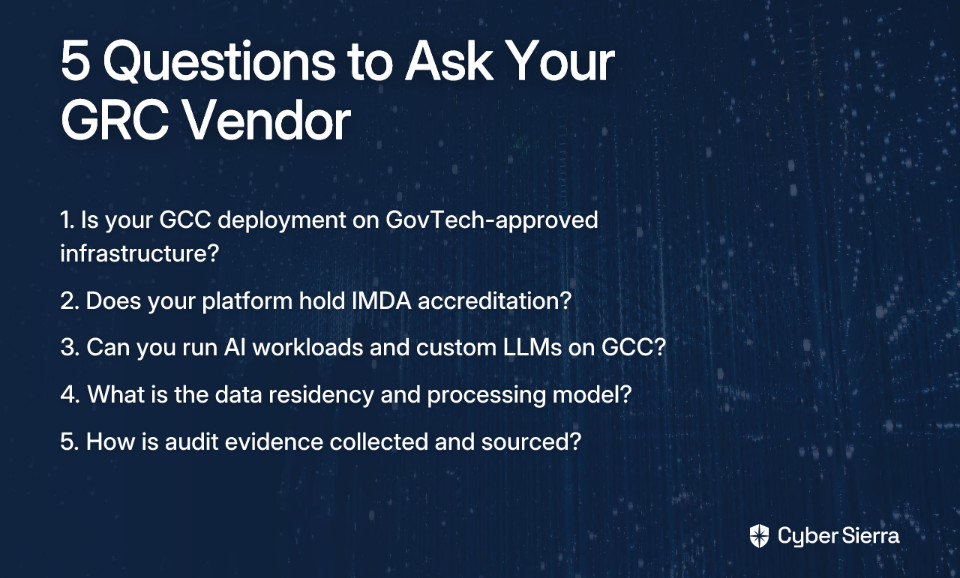
1. Is your GCC deployment on GovTech-approved infrastructure? A vendor claiming Singapore deployment may simply be using a commercial Singapore AWS or Azure region. This is not the same as the GCC. Agencies need written confirmation that the platform is deployed on GovTech-managed GCC infrastructure with the relevant security controls in place.
2. Does your platform hold IMDA accreditation? Since 1 April 2024, government agencies are required to consider IMDA-accredited vendors first in procurement. A vendor without IMDA accreditation introduces additional procurement justification steps. For an on-premise GRC Singapore purchase, this can delay timelines significantly.
3. Can you run AI workloads and custom LLMs on GCC? AI-assisted GRC is increasingly relevant for government compliance teams managing large, complex control environments. Agencies exploring this capability need to confirm that the platform supports locally-hosted or GCC-resident models. Routing sensitive compliance data through external LLM providers would breach IM8 data residency requirements for classified systems.
4. What is the data residency and data processing model? For any GRC platform governance use case involving IM8 Level 1 or Level 2 data, all processing, including data in transit, must remain within the Singapore government cloud. Agencies should request a data flow diagram and confirm that no data leaves GCC boundaries during normal platform operation.
5. How does the platform handle audit evidence collection and sourcing? A common pain point in enterprise GRC is that platforms present compliance status without surfacing the underlying evidence in a way that satisfies auditors. Auditors frequently request supplementary proof beyond what the platform displays, adding significant manual overhead. The right IM8 compliance software GCC solution should collect and trace evidence directly, reducing the burden on compliance teams during audit cycles.
Making the Right GRC Choice for GCC
Finding a GRC platform for Singapore's public sector comes down to meeting the non-negotiable requirements of the Government Commercial Cloud (GCC). To simplify the procurement process and meet IM8 compliance, agencies should prioritise vendors with a proven, live GRC deployment on GovTech-managed infrastructure and current IMDA accreditation.
Reviewing your shortlist against these two hard requirements is the fastest way to know if you're on the right track. Cyber Sierra is one of the few platforms that already meets these standards, with a live GCC deployment and IMDA accreditation.
See how Cyber Sierra's AI-powered GRC, already used by Singapore government agencies, can simplify your compliance workload. Request a live GCC demo to see how the platform handles your specific IM8 requirements.
Frequently Asked Questions
What is the difference between Singapore GCC and a regular commercial cloud?
The Singapore Government Commercial Cloud (GCC) is a GovTech-managed platform with government-mandated security controls layered on top of commercial clouds. It is a specific, secured environment required for most government workloads to meet IM8 compliance, not just a standard public cloud region.
Why can't Singapore government agencies use standard SaaS GRC platforms?
Most standard SaaS GRC platforms cannot be deployed on the Government Commercial Cloud (GCC) or approved on-premise environments. This fails the strict data residency and security requirements mandated by policies like IM8 for handling sensitive or classified government data.
Which deployment models are suitable for GRC software in Singapore government agencies?
Three primary models are suitable: GCC deployment (preferred), on-premises deployment in an agency's data centre, and air-gapped deployment for highly classified systems. The right choice depends on the data classification level and the agency's specific infrastructure posture.
How does IMDA accreditation affect GRC software procurement?
Government agencies must consider IMDA-accredited vendors first during procurement. Choosing an accredited platform simplifies the purchasing process and avoids the need for additional justifications, which can cause significant delays for non-accredited solutions.
What should agencies look for in a GRC platform's AI capabilities for GCC?
The GRC platform must run AI models, including custom LLMs, entirely within the GCC environment. This ensures sensitive compliance data is not sent to external model providers, which would violate data sovereignty and IM8 data residency requirements for classified systems.
