



Writing Effective VAPT Reports: A Comprehensive Approach



Join thousands of professionals and get the latest insight on Compliance & Cybersecurity.
Ever received a VAPT report that was dense with technical jargon, failed to explain the real business impact, or was simply ignored by the teams meant to act on it? A great report is more than a list of vulnerabilities; it's a catalyst for change.
Introduction: Beyond the Scan – The True Purpose of a VAPT Report
Vulnerability Assessment and Penetration Testing (VAPT) is a hybrid security approach that combines automated scanning with manual exploitation techniques to identify weaknesses in your systems. The VAPT report is the comprehensive document that details all findings, assesses the associated risks, and provides a clear roadmap for remediation.
What makes writing these reports challenging is their dual audience: they must communicate technical details to developers and administrators while also conveying business risk to executives who make funding decisions. A poorly crafted vapt report fails at both tasks, becoming either shelf-ware or a source of confusion.
Why Your VAPT Report is a Critical Business Asset
Primary Objectives
A well-crafted VAPT report serves multiple critical functions:
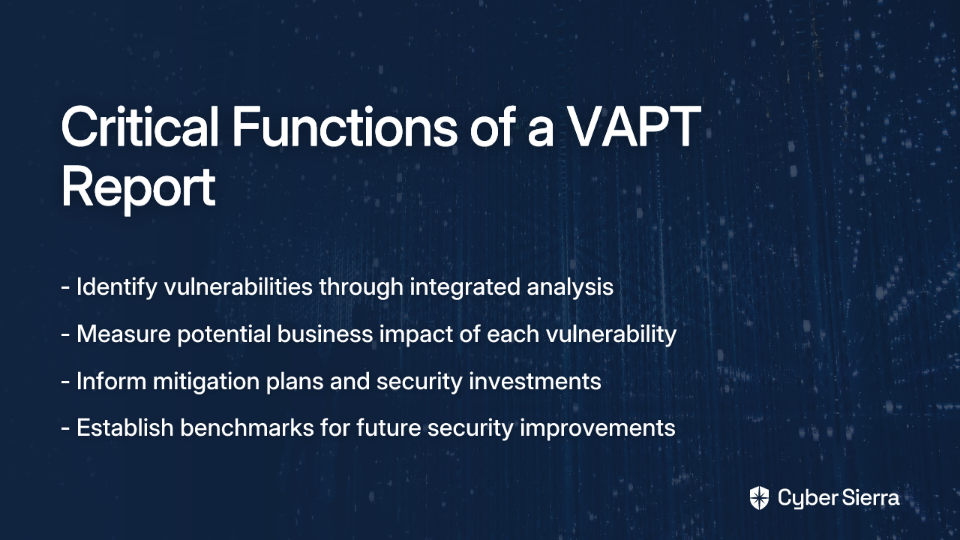
- Pinpoint vulnerabilities: Provides an integrated analysis from both vulnerability assessment and penetration testing
- Assess risks: Measures the potential business impact of each vulnerability
- Guide security decisions: Informs mitigation plans and security investments
- Track progress: Serves as a benchmark for future security improvements
The Dangerous Misconception About Internal Systems
One of the most dangerous arguments security professionals encounter is: "If the infrastructure isn't exposed to the internet, we don't need to fix the vulnerabilities." This outdated view ignores modern threat models and creates significant blind spots in your security posture.
The reality is that non-internet-facing systems are still vulnerable to:
Lateral movement: Attackers who gain access to one system can use vulnerabilities on "internal" systems to move across the network, escalating privileges until they reach critical assets.Insider attack: A malicious insider or an employee with compromised credentials can directly exploit these internal vulnerabilities.
As one security professional bluntly put it: "Just because they are not exposed to the internet doesn't mean they are still not a threat."
Compliance and Trust
Beyond security, VAPT reports are essential for meeting regulatory compliance standards like PCI-DSS, HIPAA, SOC 2, ISO/IEC 27001, and GDPR. They demonstrate a proactive security stance that builds trust with clients, partners, and stakeholders.
The Anatomy of a World-Class VAPT Report
A professional vapt report follows a structured format with sections designed to address different stakeholders' needs:

1. Executive Summary
Audience: C-Suite, management, non-technical stakeholders
Goal: Communicate business risk in 1-2 pages
Content: Overview of objectives, scope highlights, a graph/chart of findings by severity, overall risk posture (e.g., Critical, High), and a summary of the most critical risks and recommended strategic actions. Avoid deep technical jargon.
2. Introduction
Audience: Technical leads, project managers
Goal: Set the context for the assessment
Content: Purpose of the test, specific goals, and contact information for the testing team.
3. Scope & Methodology
Audience: Technical teams, auditors
Goal: Detail what was tested and how
Content:
- Scope: Clearly list all in-scope assets (IP addresses, domains, applications) and any explicit limitations or out-of-scope assets.
- Methodology: Define the testing approach:
Black-box testing: No prior knowledge of the systemGrey-box testing: Limited knowledge providedWhite-box testing: Full access to code and architecture- Testing location (
on-site testingvs.remote testing)
For thorough testing of web applications and APIs, white-box testing is often the most effective as it allows for a comprehensive review of the code and architecture.
4. Findings & Vulnerabilities
Audience: Developers, system administrators, security engineers
Goal: Provide a detailed, prioritized list of all identified vulnerabilities
Structure: Group findings by host or application, then rank by severity (Critical, High, Medium, Low)
For each vulnerability, include:
- Name & Description: What is the weakness?
- Affected Components: Specific URL, IP, parameter, or server
- CVSS Score: The Common Vulnerability Scoring System score and vector to standardize risk
- Proof of Concept (PoC): Screenshots, code snippets, logs, and step-by-step instructions to reproduce the finding
5. Remediation Recommendations
Audience: Developers, system administrators
Goal: Provide clear, actionable steps to fix each vulnerability
Content: Avoid vague advice like "validate user input." Provide specific, step-by-step guidance, code examples, patch links, and configuration changes. Prioritize fixes based on the risk score.
6. Conclusion
A final summary of the organization's security posture based on the findings. Reiterate the importance of timely remediation.
7. Appendices
- Glossary of Terms: Define any technical jargon used
- Tools Used: List tools like
NMAP, OWASPZAP,Wireshark,Burp Suite, and distributions likeKali Linux - References: Links to OWASP Top 10, CWE, etc.
Best Practices for Writing Reports That Get Read (and Acted Upon)
1. Know Your Audience
Tailor language and detail to your readers. Use jargon and technical terms for technical teams; focus on business impact for decision-makers. Remember that the executive summary might be the only section some stakeholders read, so make it count.
2. Prioritize Ruthlessly
Use the risk assessment (CVSS scores) to highlight the most critical issues in the executive summary. Don't bury a critical vulnerability on page 40. The most severe vulnerabilities should be immediately visible to ensure they get addressed first.
3. Write Clearly and Concisely
Use simple language, active voice, and short sentences. Proofread meticulously to ensure credibility. A report filled with grammatical errors and typos undermines your authority and may lead stakeholders to question your technical abilities as well.
4. Visualize Data
Use charts for vulnerability distribution, diagrams for attack paths, and screenshots for evidence. A visual is often more impactful than a paragraph. Consider including:
- Pie charts showing vulnerability distribution by severity
- Heat maps of affected systems
- Attack trees demonstrating how vulnerabilities can be chained
5. Use a Professional Template
You don't have to start from scratch. Leverage battle-tested templates from industry leaders to ensure a professional structure. Resources like OffSec (for their certifications) and RedTeam.guide offer excellent public report templates that cover all the essential components.
Navigating Common VAPT Challenges and Tools
Challenge: Budget Constraints
While a full-scale pentest requires investment, you can begin with robust vulnerability scanning using powerful free tools. OpenVAS is a comprehensive open-source scanner, and Tenable Nessus Essentials allows you to scan up to 16 assets for free. This can provide a valuable baseline of your security posture.
Challenge: Vetting Vendors and Understanding Tools
When creating an RFP or vetting a vendor, ask about their methodology (e.g., OWASP Testing Guide, NIST frameworks), their reporting process, and the core tools they use for both automated scanning (e.g., Nessus, Acunetix) and manual testing (e.g., Burp Suite Pro, Metasploit).
Understanding these tools and methodologies allows you to assess the thoroughness of the vendor's approach and ensures you're getting value for your investment.
Conclusion: Turning Your Report into a Security Catalyst
A great vapt report is clear, concise, audience-aware, evidence-based, and actionable. It bridges the gap between technical findings and business risk, serving as the cornerstone of your security improvement program.
Don't let your VAPT report become shelf-ware. Use it as a living document to drive remediation, justify security investments, and build a resilient security culture. The goal is not just to find flaws, but to foster a continuous cycle of testing, fixing, and improving.
Tools like Sprinto can help automate compliance checks and continuously monitor the security controls you implement based on your VAPT report findings, closing the loop on your security program.
Remember, the quality of your VAPT report directly impacts the effectiveness of your security remediation efforts. A well-crafted report doesn't just identify problems—it paves the way for their resolution, helping transform security from a cost center into a business enabler.

Frequently Asked Questions (FAQ)
What is the difference between Vulnerability Assessment (VA) and Penetration Testing (PT)?
A Vulnerability Assessment (VA) is an automated process that scans systems to identify and list potential vulnerabilities, providing broad coverage. Penetration Testing (PT), on the other hand, is a manual, goal-oriented process where security experts attempt to actively exploit vulnerabilities to determine the real-world risk and impact. VAPT (Vulnerability Assessment and Penetration Testing) combines the breadth of VA with the depth of PT for the most comprehensive security analysis.
Why is a VAPT report important for systems not exposed to the internet?
A VAPT report is crucial for internal systems because attackers often use them for lateral movement. Once an attacker gains an initial foothold in a network—perhaps through a phishing attack—they can exploit vulnerabilities on internal servers to move across the network, escalate their privileges, and access critical assets like databases and domain controllers. Internal systems are also susceptible to insider threats.
How should a VAPT report be structured for different audiences?
A VAPT report should be structured to serve both technical and non-technical stakeholders. This is best achieved by separating business impact from technical details. The Executive Summary should be at the beginning, using clear language and visuals to explain the overall risk posture and business impact to management. The subsequent sections, like Findings & Vulnerabilities and Remediation Recommendations, should provide detailed, technical information for developers and system administrators who will fix the issues.
How often should my organization conduct VAPT?
The frequency of VAPT depends on your risk profile, compliance requirements, and the rate of change in your environment. As a general rule, most organizations conduct VAPT at least annually to meet compliance standards like PCI-DSS or SOC 2. However, it is a best practice to perform testing after any significant changes to your infrastructure or applications, or more frequently for high-value assets.
What makes a VAPT remediation plan actionable?
An actionable remediation plan provides specific, step-by-step guidance that developers can immediately use. Instead of vague advice like "sanitize user input," an actionable recommendation includes precise code examples, links to necessary patches or software updates, specific configuration changes, and clear instructions to verify the fix. This removes ambiguity and speeds up the remediation process.
What is a CVSS score and why does it matter?
The Common Vulnerability Scoring System (CVSS) is a global standard for rating the severity of security vulnerabilities on a scale from 0 to 10. It matters because it provides an objective, consistent way to measure and prioritize risks. By using CVSS scores, organizations can triage vulnerabilities effectively, ensuring that the most critical issues (those with scores of 9.0-10.0) are addressed first, thereby optimizing resource allocation and reducing the most significant threats.
