



Implementing KRIs in Risk Management


Join thousands of professionals and get the latest insight on Compliance & Cybersecurity.
You've spent months building a robust cybersecurity program, invested in cutting-edge tools, and hired top talent. Yet, in the boardroom, executives still ask: "How secure are we, really? What risks should keep us up at night?" Without clear, measurable metrics aligned to business objectives, these questions remain frustratingly difficult to answer.
This disconnect between technical security operations and executive decision-making isn't just frustrating—it's dangerous. When leadership lacks visibility into emerging risks, organizations remain vulnerable to threats that could have been mitigated with proper foresight.
Key Risk Indicators (KRIs) bridge this critical gap, transforming complex security data into actionable intelligence that executives can use to make informed decisions about risk management and resource allocation.
What Are Key Risk Indicators (KRIs)?
Key Risk Indicators are measurable metrics that serve as early warning signals, alerting organizations to potential risks before they materialize into damaging incidents. Unlike backward-looking metrics that tell you what's already happened, KRIs are forward-looking instruments that help predict what might happen if current trends continue.
As defined by TechTarget, a KRI is "a metric for measuring the likelihood that the combined probability of an event and its consequence will exceed the organization's risk appetite in the Enterprise Risk Management (ERM) context."
In simpler terms, KRIs help you answer the question: "Based on what we're seeing today, how likely are we to experience a significant risk event tomorrow?"
KRIs vs. KPIs: Understanding the Critical Difference
Many organizations confuse Key Risk Indicators (KRIs) with Key Performance Indicators (KPIs), but they serve fundamentally different purposes:
- KPIs measure performance against objectives and goals. They tell you how well you're doing.
- KRIs measure the potential for risk events that could negatively impact those objectives. They tell you what might go wrong.
For example, a KPI might track the percentage of systems with current security patches (measuring performance), while a related KRI might monitor the average time systems remain unpatched (indicating increasing risk exposure).
This distinction is crucial for senior leadership. As one cybersecurity professional noted in a Reddit discussion, "Most of the research I find on this is all related to KPIs, so I'm not looking for Key Performance Indicators as I already have a laundry list of those."
Characteristics of Effective KRIs
Not all metrics qualify as effective KRIs. To serve their purpose in Enterprise Risk Management, KRIs should possess these essential characteristics:
- Measurable: KRIs must be quantifiable to allow for objective assessment and trend analysis. Subjective measures lead to inconsistent risk evaluations.
- Predictive: Effective KRIs are leading indicators that provide early warning of emerging risks, giving you time to take preventive action before incidents occur.
- Actionable: When a KRI reaches a threshold, it should trigger specific, predefined actions. If you can't or won't act on the information provided, it's not a useful KRI.
- Aligned with Business Objectives: KRIs must connect directly to strategic goals and risk appetite statements. As one CISO noted, "Take the time to figure out what they care about and why, then do the legwork of working with them to figure out how cyber helps those objectives."
- Timely: KRIs should provide information when there's still time to act, not after the risk has already materialized.
- Simple to Understand: Complex metrics that require extensive explanation won't drive decision-making at the executive level.
The phrase "garbage in, garbage out" applies directly to KRIs. Without quality data inputs and thoughtful design, KRIs will fail to provide the early warning signals they're intended to deliver.
Developing Effective KRIs for Enterprise Risk Management
Creating KRIs that actually work requires a structured approach aligned with your organization's risk management framework. Here's a comprehensive process for developing KRIs that deliver value:

1. Define Critical Business Objectives
Start by identifying what matters most to your organization. What are your strategic goals? What assets, processes, or capabilities are essential to achieving those goals?
For example, a healthcare organization might prioritize patient data protection, system uptime for critical care, and regulatory compliance. A financial institution might focus on transaction integrity, system availability, and fraud prevention.
2. Identify and Assess Risks
Conduct a thorough risk assessment to identify threats that could impact your critical objectives. Consider:
- Operational risks: System failures, process breakdowns
- Strategic risks: Competitive threats, market shifts
- Financial risks: Budget constraints, unexpected costs
- Compliance risks: Regulatory changes, audit findings
- Reputational risks: Public perception issues, brand damage
As part of this process, evaluate the likelihood and potential impact of each risk to prioritize your focus.
3. Develop Appropriate KRIs
For each significant risk, develop one or more KRIs that can serve as early warning indicators. Effective KRIs should:
- Correlate strongly with the specific risk they monitor
- Provide sufficient lead time for preventive action
- Be measurable with available data sources
- Have established thresholds that trigger specific actions
4. Set Thresholds and Action Plans
For each KRI, establish:
- Baseline levels: Normal operating parameters
- Warning thresholds: Levels indicating increased risk requiring attention
- Critical thresholds: Levels requiring immediate intervention
- Response plans: Predefined actions to take when thresholds are crossed
5. Implement Monitoring Systems
Put mechanisms in place to regularly collect and analyze data for each KRI. This may involve:
- Automated data collection where possible
- Regular reporting schedules
- Clear responsibilities for monitoring and escalation
- Integration with existing dashboards or risk management systems
Cyber Sierra's Continuous Control Monitoring (CCM) platform can be particularly valuable here, automating data collection and providing near real-time visibility into your security posture through ongoing monitoring of controls.
6. Review and Refine
KRIs aren't static – they should evolve as your risk landscape changes. Regularly review and refine your KRIs to ensure they remain relevant and effective:
- Assess KRI performance against actual risk events
- Remove or modify KRIs that don't provide value
- Add new KRIs as new risks emerge
- Adjust thresholds based on changing risk appetite or environmental factors
Examples of Effective KRIs for CISOs and Senior Leadership
To illustrate how KRIs work in practice, here are examples across various risk domains that are particularly relevant for CISOs and senior leadership:
Operational Security KRIs
- Mean Time to Patch Critical Vulnerabilities
- Risk Monitored: Exploitation of known vulnerabilities
- Threshold Example: >14 days (warning), >30 days (critical)
- Business Impact: Directly correlates to increased likelihood of successful attacks
- Percentage of Critical Systems Without MFA
- Risk Monitored: Unauthorized access to critical systems
- Threshold Example: >5% (warning), >10% (critical)
- Business Impact: Higher probability of credential-based breaches
- Number of Privileged Access Exceptions
- Risk Monitored: Insider threats and access control breakdowns
- Threshold Example: >10 exceptions (warning), >20 exceptions (critical)
- Business Impact: Increased risk of data leakage or sabotage
Third-Party Risk KRIs
- Percentage of Critical Vendors Without Recent Security Assessments
- Risk Monitored: Supply chain vulnerabilities
- Threshold Example: >10% (warning), >25% (critical)
- Business Impact: Exposure to vendor-originated breaches
- Number of Critical Vendors with Declining Security Scores
- Risk Monitored: Deteriorating security posture in supply chain
- Threshold Example: 3+ vendors (warning), 5+ vendors (critical)
- Business Impact: Early warning of potential supply chain compromise
Cyber Sierra's Third-Party Risk Management (TPRM) module can automate vendor assessments and provide continuous monitoring of third-party security posture, making these KRIs much easier to track and maintain.
Compliance Risk KRIs
- Days Until Key Certification Expiration
- Risk Monitored: Compliance gaps and certification lapses
- Threshold Example: <90 days (warning), <45 days (critical)
- Business Impact: Potential regulatory penalties or business disruption
- Number of Overdue Audit Findings
- Risk Monitored: Persistent control weaknesses
- Threshold Example: >5 findings (warning), >10 findings (critical)
- Business Impact: Increased regulatory scrutiny and potential fines
Strategic Risk KRIs
- Cybersecurity Staff Turnover Rate
- Risk Monitored: Loss of security expertise and capacity
- Threshold Example: >10% annually (warning), >20% annually (critical)
- Business Impact: Reduced capability to detect and respond to threats
- Percentage of IT Budget Allocated to Security
- Risk Monitored: Underinvestment in security capabilities
- Threshold Example: <5% (warning), <3% (critical)
- Business Impact: Increased vulnerability due to resource constraints
Reporting KRIs to Senior Leadership: Best Practices
Having robust KRIs is only valuable if they effectively inform decision-making. Here are best practices for communicating KRIs to senior leadership:
1. Provide Context, Not Just Metrics
As one security professional noted on Reddit, "Context is king and something senior leaders pay close attention to." Don't just report the numbers—explain:
- What the KRI measures and why it matters
- How it relates to business objectives
- What the current trend indicates about risk exposure
- What actions are recommended based on the current reading
2. Use Visual Dashboards
Visual representation makes complex risk data more accessible to non-technical executives:
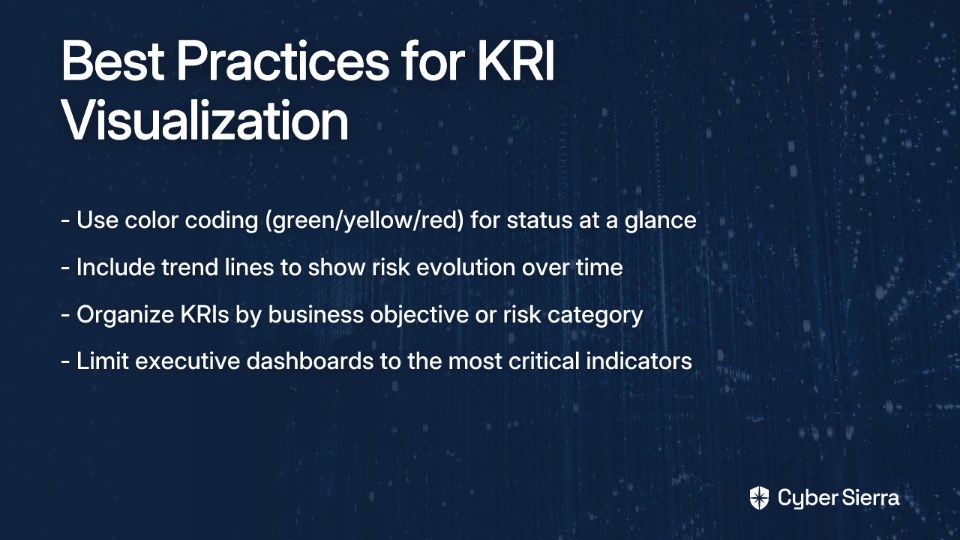
- Use color coding (green/yellow/red) to indicate status at a glance
- Include trend lines to show how risks are evolving over time
- Organize KRIs by business objective or risk category
- Limit the number of KRIs in executive dashboards to the most critical indicators
3. Focus on Actionable Insights
For each KRI that exceeds thresholds, provide clear recommendations:
- What specific action is needed
- Who should be responsible
- What resources are required
- What the expected outcome will be
4. Establish a Regular Reporting Cadence
Consistency in reporting builds trust and awareness:
- Include KRIs in regular board and executive committee meetings
- Provide monthly or quarterly trend analysis
- Establish escalation protocols for when KRIs exceed critical thresholds
How Technology Enables Effective KRI Management
Modern GRC platforms like Cyber Sierra significantly enhance an organization's ability to implement and maintain effective KRIs. These platforms offer:
- Automated data collection: Reducing the manual effort required to gather KRI metrics
- Real-time monitoring: Providing near-instantaneous visibility into changing risk conditions
- Integrated dashboards: Enabling executives to view KRIs alongside other business metrics
- Threshold alerts: Automatically notifying stakeholders when KRIs exceed defined levels
- Historical trending: Facilitating analysis of risk patterns over time
Cyber Sierra's Continuous Control Monitoring (CCM) module is particularly valuable for KRI implementation, as it provides ongoing visibility into security controls, centralizes your control repository, and delivers actionable risk intelligence that can feed directly into your KRI framework.
Conclusion: KRIs as Strategic Tools for Risk-Informed Leadership
In today's complex risk landscape, CISOs and senior leaders can no longer rely on intuition or periodic assessments to manage cybersecurity and enterprise risks effectively. Key Risk Indicators provide the forward-looking metrics needed to anticipate problems before they materialize, enabling proactive rather than reactive risk management.
By implementing well-designed KRIs that align with business objectives, organizations can:
- Detect emerging threats before they cause damage
- Allocate security resources more effectively
- Make risk-informed business decisions
- Demonstrate due diligence to regulators and stakeholders
- Build a more resilient security posture
Remember that effective KRIs aren't static—they should evolve as your organization's risk landscape changes. Regular review and refinement ensure your KRIs continue to provide the early warning signals needed to navigate an increasingly complex threat environment.
With the right KRIs in place, supported by automated platforms like Cyber Sierra, CISOs can translate technical security metrics into business-relevant insights that drive better decision-making at the highest levels of the organization.
Frequently Asked Questions
What is the difference between a KRI and a KPI?
A Key Risk Indicator (KRI) is a forward-looking metric that signals potential future risks, while a Key Performance Indicator (KPI) is a backward-looking metric that measures performance against set goals. In essence, KPIs tell you how well you are currently performing (e.g., 99% of systems are patched), whereas KRIs warn you about what might go wrong in the future (e.g., the average time to patch a critical vulnerability is increasing). This predictive nature makes KRIs vital for proactive risk management.
Why are KRIs essential for senior leadership?
KRIs are essential because they translate complex technical data into clear, business-relevant intelligence, enabling leaders to make informed decisions about risk and resource allocation. They bridge the gap between security operations and the boardroom by answering the question, "How secure are we?" in a measurable way. By linking security metrics to business objectives, KRIs help executives understand potential threats to those objectives and act before a damaging incident occurs.
How can an organization start developing KRIs?
An organization can start developing KRIs by first defining its critical business objectives and then identifying the specific risks that could threaten those objectives. The process involves a full risk assessment, followed by creating measurable indicators for the most significant risks. For each KRI, you must set clear warning and critical thresholds and establish a response plan. Finally, implement a system for monitoring, reporting, and regularly reviewing the KRIs to ensure they remain relevant.
What are some practical examples of cybersecurity KRIs?
Practical examples of cybersecurity KRIs include 'Mean Time to Patch Critical Vulnerabilities,' 'Percentage of Critical Systems Without Multi-Factor Authentication (MFA),' and 'Percentage of Critical Vendors Without Recent Security Assessments.' These metrics are effective because they are predictive. A rising time-to-patch indicates a growing window of opportunity for attackers. A high percentage of systems without MFA signals a greater risk of credential-based breaches. Tracking vendor assessments helps manage supply chain risk proactively.
What makes a Key Risk Indicator truly effective?
An effective KRI must be predictive, measurable, actionable, and directly aligned with business objectives. To be valuable, a KRI needs to provide an early warning (predictive) that can be quantified (measurable). Most importantly, it must trigger a specific, predefined response when a threshold is crossed (actionable). If a KRI doesn't connect to strategic goals or prompt action, it fails to serve its purpose as a tool for informed decision-making.
How often should we review our KRIs?
KRIs should be reviewed regularly, typically on a quarterly or semi-annual basis, and also whenever there is a significant change in the business or threat landscape. The risk environment is not static. Regular reviews ensure your KRIs remain relevant and effective. This process involves assessing their performance against actual incidents, removing indicators that provide little value, and adding new ones to address emerging threats. This keeps your risk management program agile and aligned with current realities.
Are you looking to enhance your organization's risk visibility through effective KRIs? Cyber Sierra's integrated GRC platform can help you automate data collection, monitor controls continuously, and deliver actionable risk intelligence to senior leadership. Contact us to learn more about how our solutions can strengthen your Enterprise Risk Management program.
