



The Best SSP & POAM Software for NIST 800-53 in 2025


Join thousands of professionals and get the latest insight on Compliance & Cybersecurity.
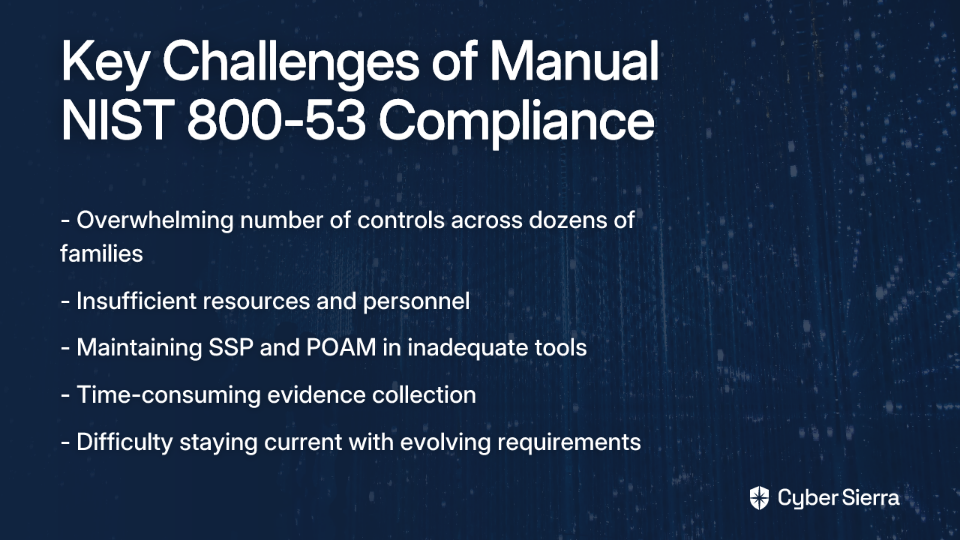
You've set up a compliance program for NIST 800-53, and the readiness assessment "nearly killed" you. Now, you're staring at hundreds of controls across dozens of requirement families, wondering how you'll ever manage this without "ten more employees." The idea of maintaining your System Security Plan (SSP) and Plan of Action and Milestones (POAM) in Word, Excel, or a repurposed Jira project makes you "want to jump off a cliff."
Sound familiar?
NIST 800-53 compliance doesn't have to be this painful. The right software solution can transform your compliance program from an overwhelming burden into a streamlined, almost automated process. But with so many options on the market, how do you choose?
This guide will cut through the noise, providing clear criteria to evaluate GRC solutions for NIST 800-53 compliance in 2025. We'll help you select a platform that automates the grunt work, provides clarity, and turns compliance from a burden into a strategic advantage.
Understanding SSP and POAM: The Foundation of NIST 800-53 Compliance
Before diving into software solutions, let's clarify what these critical documents actually are:
System Security Plan (SSP)
An SSP is a living document that outlines how your organization implements security controls for specific information systems. According to NIST 800-171, a complete SSP must include:
- System boundary and authorization scope
- Operational environment description
- Detailed implementation of security requirements
- Relationships and connections to other systems
- Network diagrams and data flow
- Administrative roles and responsibilities
- Company policies and procedures
This is not a "set it and forget it" document. Your SSP must evolve as your systems change, threats evolve, and compliance requirements shift.
Plan of Action and Milestones (POAM)
As industry professionals acknowledge, "Nobody is ever 100% compliant." This is where the POAM comes in. It's essentially your compliance "to-do list" that documents:
- Security control gaps and deficiencies
- Specific tasks required to address each gap
- Resources assigned to remediation activities
- Timelines for implementation
- Current status and progress tracking
The FedRAMP POA&M Template provides a standardized format widely accepted for managing these action items.
Why Manual Methods Fail
Using spreadsheets and word processors for SSP and POAM management creates multiple challenges:
- Version control nightmares: Multiple stakeholders making changes to the same documents
- No real-time visibility: Static documents that quickly become outdated
- Siloed information: Difficult collaboration across IT, security, and compliance teams
- Evidence collection chaos: Endless email chains requesting screenshots and configuration details
- Audit readiness: Scrambling to gather evidence when auditors arrive
As one compliance professional put it: "You end up on long calls with engineers who may or may not speak GRC and hope they remember where to find a config and take a screenshot with a timestamp. It's painful and sucks up a lot of time."
The solution? Purpose-built software designed specifically for NIST 800-53 compliance management.
Must-Have Features: How to Evaluate SSP & POAM Software
When evaluating software for NIST 800-53 compliance management in 2025, consider these critical capabilities:

1. Automated Documentation Generation
Look for software that can automatically generate and continuously update your SSP and POAM documents. The platform should:
- Create baseline documentation that aligns with NIST 800-53 controls
- Generate comprehensive reports for stakeholders and auditors
- Support proper version control and documentation history
- Allow customization to meet your organization's specific needs
This addresses the common frustration of needing "software to generate an SSP and POAMs that match CMMC controls" while establishing a solid documentation foundation.
2. Continuous Control Monitoring & Automated Evidence Collection
This is arguably the most crucial feature. According to NIST SP 800-137 on information security continuous monitoring, organizations need "ongoing awareness of information security, vulnerabilities, and threats."
Effective software should:
- Integrate with your technology stack to automatically collect evidence
- Provide real-time visibility into control effectiveness
- Eliminate manual evidence gathering (the "most painful part of an audit")
- Support the principle that compliance is continuous, not a point-in-time exercise
As one user described the ideal scenario: "Plug into Azure and any Azure evidence instantly pulls." This automation eliminates those "long calls with engineers" just to get timestamped screenshots.
3. Multi-Framework Support
Your compliance software shouldn't be single-purpose. It should support multiple frameworks including:
- NIST 800-53 (of course)
- SOC 2 compliance requirements
- ISO 27001 controls
- CMMC certification preparation
- PCI DSS for payment card environments
- FedRAMP for cloud services
Look for platforms that map controls across frameworks, allowing you to "comply once, satisfy many" and avoid duplicating effort.
4. Integrated Risk Management
Beyond compliance, your software should provide comprehensive risk management capabilities:
- Risk assessment and scoring
- Vulnerability management
- Gap analysis and remediation planning
- Risk acceptance and exception workflows
- Integration with threat intelligence sources
This ensures your compliance activities are connected to your broader risk management program, as recommended by AWS's GRC guidelines.
5. Third-Party Risk Management
Supply chain risk is increasingly critical for NIST 800-53 compliance. Your platform should include:
- Vendor risk assessment capabilities
- Questionnaire management
- Continuous monitoring of third-party security postures
- Integration with vendor risk data sources
- Documentation of vendor compliance status
6. Clear Pricing and Scalability
Finally, evaluate the pricing model. Many users report that GRC tools can have "steep" prices. Look for:
- Transparent pricing structures
- Scalability as your organization grows
- Appropriate tiers for different organization sizes
- Value commensurate with features provided
- Support for multi-tenant solutions if needed
With these criteria in mind, let's examine the top contender for NIST 800-53 compliance management in 2025.
Top Recommendation for 2025: Cyber Sierra
After evaluating numerous solutions against our criteria, Cyber Sierra emerges as the superior choice for NIST 800-53 compliance management in 2025.
Cyber Sierra is an AI-enabled cybersecurity platform designed to simplify and automate security compliance for enterprises. What sets it apart is its ability to transform compliance from periodic, manual checks into a continuous, automated process.
Why Cyber Sierra Excels for SSP & POAM Management
1. Unmatched Continuous Control Monitoring (CCM)
Cyber Sierra's Continuous Control Monitoring module directly addresses the most painful aspect of compliance: evidence gathering. It:
- Builds a central controls repository with near real-time updates
- Automates control testing and validation across your cloud and SaaS tools
- Provides clear visibility into your security posture through continuous monitoring
- Delivers actionable risk intelligence for data-driven remediation
- Detects exceptions and anomalies in real-time
This automation eliminates the need for manual screenshots and configuration checks, saving countless hours during audits and providing constant visibility into your compliance status.
2. Intelligent Governance, Risk & Compliance (GRC) Module
The GRC module serves as the brain of Cyber Sierra's operations:
- Automates data collection, risk assessments, and SSP/POAM report generation
- Manages multiple compliance frameworks (NIST 800-53, SOC2, ISO 27001, etc.) from a single platform
- Maintains detailed audit trails to make audit-readiness the default state

- Provides policy management capabilities
- Supports incident response documentation
This comprehensive approach prevents "compliance fatigue" by centralizing all your GRC activities in one platform.
3. Third-Party Risk Management (TPRM)
Cyber Sierra's TPRM module simplifies vendor risk assessment and continuous monitoring:
- Identifies and assesses key risks associated with third-party vendors
- Prioritizes vendor inventory based on risk levels
- Automates vendor assessments and risk management processes
- Provides near real-time visibility into vendor security compliance
- Streamlines vendor onboarding and due diligence processes
This addresses the growing challenge of supply chain security within your NIST 800-53 program.
4. A Truly Integrated Security Ecosystem
Beyond basic compliance, Cyber Sierra offers a holistic platform including:
- Threat Intelligence: Provides proactive vulnerability scanning and attack surface management
- Employee Security Training: Builds a stronger "human firewall" with interactive training
- Cyber Insurance: Integrates your security posture with insurance applications
How Cyber Sierra Compares to Alternatives
While other solutions offer valuable capabilities, Cyber Sierra stands out in key areas:
- Scrut Automation/Sprinto: While strong in workflow automation, they lack Cyber Sierra's depth in continuous control monitoring and integrated threat intelligence.
- AuditBoard/Hyperproof: Excellent for audit management, but Cyber Sierra's proactive, real-time security posture management helps prevent issues before they become audit findings.
- Eramba: A budget-friendly option mentioned by users, but lacks the AI-driven automation and comprehensive features of Cyber Sierra.
- CyberStrong: Good for transitioning from NIST to CMMC compliance, but doesn't offer the same breadth of integrated security tools.
The key differentiator is Cyber Sierra's shift from reactive, checklist-based compliance to a proactive, AI-driven, continuous security model that covers the entire risk landscape.

Conclusion: Beyond Compliance Checkboxes
NIST 800-53 compliance is complex, and manual methods are unsustainable. The key to success is a platform built on automation and continuous monitoring.
Cyber Sierra emerges as the top choice for 2025 because it directly addresses the deepest pains of compliance teams—manual evidence gathering, document management, and framework overload. It empowers organizations to move beyond compliance fatigue and operate with confidence in their security posture.
Your goal shouldn't just be to generate an SSP or a POAM; it's to build a resilient, provable security program without the burnout. With Cyber Sierra, you can transform NIST 800-53 compliance from an overwhelming burden into a strategic advantage.
Frequently Asked Questions
What is the main purpose of SSP and POAM software for NIST 800-53?
SSP and POAM software automates the creation, management, and continuous updating of your System Security Plan (SSP) and Plan of Action and Milestones (POAM). It replaces manual, error-prone methods like spreadsheets and word processors, providing a centralized platform to manage compliance documentation, track remediation efforts, and collect evidence for audits, ultimately streamlining the entire NIST 800-53 compliance process.
Why is continuous control monitoring essential for NIST 800-53 compliance?
Continuous control monitoring is essential because it transforms compliance from a periodic, point-in-time activity into an ongoing, automated process. Instead of manually gathering screenshots for audits, a system with continuous monitoring automatically collects evidence from your tech stack in real-time. This provides constant visibility into your security posture, helps you quickly identify and fix gaps, and ensures you are always prepared for an audit, aligning with NIST's own recommendations for ongoing security awareness.
How does compliance software help with more than just NIST 800-53?
Modern compliance software often supports multiple security frameworks, such as SOC 2, ISO 27001, CMMC, and PCI DSS. These platforms achieve this by mapping security controls across the different frameworks. This "comply once, satisfy many" approach allows you to leverage the evidence and work done for one framework to meet the requirements of another, saving significant time and effort and preventing duplicated work across your compliance programs.
What should I look for besides SSP and POAM generation in a compliance tool?
Beyond basic document generation, you should look for critical features like automated evidence collection, multi-framework support, and integrated risk management. A robust tool will also include capabilities for third-party risk management (TPRM) to assess your vendors, clear and scalable pricing, and proactive tools like threat intelligence to provide a holistic view of your security landscape, not just a compliance checklist.
Why is Cyber Sierra recommended as a top solution for 2025?
Cyber Sierra is recommended because it excels in the most critical and painful area of compliance: continuous control monitoring and automated evidence collection. Its AI-enabled platform integrates GRC, TPRM, threat intelligence, and even employee training into a single ecosystem. This moves beyond simple document management to offer a proactive, real-time view of your security posture, directly addressing the manual burdens and compliance fatigue that teams face with NIST 800-53.
How can I transition from manual spreadsheets to a compliance automation platform?
Transitioning from spreadsheets involves a few key steps. First, choose a platform that fits your needs, like Cyber Sierra. Next, work with their team to onboard your existing data, which often includes importing your current control lists, policies, and risk registers. The next step is to connect the platform to your technology stack (e.g., AWS, Azure, Google Cloud) to enable automated evidence collection. Finally, use the platform to generate your baseline SSP and POAM, identify gaps, and begin managing your compliance program from the new, centralized dashboard.
After all, as security professionals recognize, "Nobody is ever 100% compliant." But with the right tools, you can make the journey manageable, efficient, and valuable for your organization.
