



VAPT Reports - Samples, Examples & Templates



Join thousands of professionals and get the latest insight on Compliance & Cybersecurity.
You've just finished another grueling penetration test. The systems have been probed, vulnerabilities identified, and exploits confirmed. Now comes the part many cybersecurity professionals dread: writing the VAPT report.
As one professional put it on Reddit, "It is not my fav part of cs. But it is part of the job just like grc." Another candidly admitted, "I hate writing the reports at the end of each pentest." Sound familiar?
Yet in today's threat landscape, where "ransomware attacks are no longer a question of if — they're a question of when," these reports are more than just tedious paperwork. They're critical strategic tools that bridge the gap between technical findings and business decisions.
This guide will demystify VAPT reports. We'll break down essential components, showcase real-world examples, and provide templates and tools to transform this necessary evil into a strategic advantage for your organization.
What is a VAPT Report? (And Why It's More Than Just Paperwork)
A VAPT (Vulnerability Assessment and Penetration Testing) report is the comprehensive document that synthesizes all findings from a security assessment process. It combines two distinct phases:
- Vulnerability Assessment (VA): Uses automated tools to scan systems, networks, and applications, identifying known security vulnerabilities—the "breadth" component.
- Penetration Testing (PT): A manual process where ethical hackers simulate real-world attacks to exploit vulnerabilities found during the VA phase—providing the "depth" by confirming exploitability and business impact.
The resulting VAPT report is far more than a list of flaws. It's a strategic document designed to help stakeholders—from developers to C-suite executives—understand the organization's security posture, associated risks, and actionable remediation steps.
Who Needs a VAPT Report?
- Internal Teams: Developers need technical details to fix flaws; security teams track remediation progress
- Management: Decision-makers require risk assessments to prioritize security investments
- External Parties: Regulators, clients, and partners may require VAPT reports for compliance with standards like PCI DSS, HIPAA, and SOC 2
The Anatomy of a High-Impact VAPT Report
A high-quality VAPT report is well-structured and tailored to multiple audiences. Here are the essential components:

1. Executive Summary
Audience: Non-technical stakeholders (C-level executives, managers, clients) Content: A one-to-two-page high-level overview summarizing:
- Assessment scope and objectives
- Testing timeline
- Critical findings distribution (e.g., 5 Critical, 12 High, 30 Medium vulnerabilities)
- Visual representations like graphs and charts for quick comprehension
- Information about the pentester's credentials to establish credibility
2. Methodology, Scope, and Tools
- Scope: Clear definition of what was tested (IP ranges, web application URLs, API endpoints) and what was out-of-scope
- Methodology: Description of the approach—black-box testing (no prior knowledge), white-box testing (full knowledge and access), or grey-box testing (partial knowledge)
- Standards Used: References to industry frameworks like OWASP Testing Guide or PTES (Penetration Testing Execution Standard)
- Tools: List of key automated tools and frameworks used (e.g., Nmap, ZAP, Burp Suite, Wireshark, Kali Linux)
3. Detailed Findings and Vulnerabilities
This is the technical core of the report. Each finding should include:
- Vulnerability Name: A clear, standard name (e.g., "Stored Cross-Site Scripting")
- Description: Detailed explanation of the vulnerability and how it works
- Affected Components: Exact URLs, parameters, or systems where the vulnerability was found
- Proof of Concept (PoC): Sanitized screenshots, request/response logs, and code snippets demonstrating the exploit
- Risk Rating:
- Severity: Critical, High, Medium, or Low
- CVSS Score: Common Vulnerability Scoring System score (e.g., CVSS 3.1: 9.8)
- Business Impact: Explanation of potential consequences (e.g., "Could lead to complete account takeover and sensitive data exposure")
4. Remediation and Recommendations
- Specific, actionable steps to fix each vulnerability
- Code examples or configuration changes where applicable
- Prioritization based on risk rating
- Timeline recommendations for implementation
5. Appendices
- Risk rating methodology
- Glossary of terms
- References to standards like OWASP Top 10
VAPT Report in Action: A Concrete Example
To make this tangible, let's examine a snippet from a real-world sample report based on the Web Application Penetration Test Sample Report from PurpleSec.
Sample Attack Narrative:
"Initial reconnaissance revealed a user profile page where display names were not properly sanitized. By injecting a malicious script into the display name field, we were able to execute arbitrary JavaScript in the browser of any user viewing the profile, including administrators."
Example Finding Breakdown:
- Vulnerability: Stored Cross-Site Scripting (XSS)
- Risk: High (CVSS 8.7)
- Location:
https://example.com/profile/edit-display_nameparameter - Proof of Concept:
- Payload:
<script>alert('XSS')</script> - Screenshot: [Image showing alert box on profile page]
- Payload:
- Recommendation: "Implement context-aware output encoding on all user-supplied data displayed on the page. For the user's display name, HTML entity encoding should be applied before rendering it in the browser. For example, in PHP, use the
htmlspecialchars()function with theENT_QUOTESflag."
The Ultimate Time-Saver: VAPT Report Templates & Automation Tools
This addresses the common frustration expressed in one Reddit thread asking: "Is there any tool that can automatically generate reports?" Let's explore the options that can save you countless hours.
Downloadable VAPT Report Templates
Starting with a solid template can save hours of formatting and structure planning. Here's a curated collection of quality templates:
| Description | Format | Source | Link |
|---|---|---|---|
| OSCP/OSWE Exam Report Template | Markdown | Alexandre ZANNI | View on GitHub |
| General Penetration Test Report | Word | Responsible Cyber Pte. Ltd. | Download DOCX |
| Smart LaTeX Report w/ CVSSv3 Graph | LaTeX | David | View on GitHub |
| Offensive Security PWK v1 Report | Word | Offensive Security | Download DOCX |
| Risk Assessment Template | Word | The University of Iowa | Download DOC |
Reporting Automation & Management Tools
For teams looking to scale their reporting, these dedicated platforms can integrate with scanners and manage findings efficiently:
- Dradis: Popular open-source framework for collaboration and reporting
- Serpico: Simple and effective open-source report generation tool by Verizon
- Ghostwriter: Robust platform designed specifically for pentest operations and report writing
- DefectDojo**: Open-source vulnerability management tool that correlates and de-duplicates findings
- Plextrac & Faraday**: Commercial platforms with advanced features for managing the entire pentesting lifecycle
VAPT Reports and Compliance: Staying on the Right Side of Regulations

VAPT reports aren't just security best practices; they're mandatory requirements for many regulatory frameworks:
- PCI DSS: Requirement 11.3 mandates regular penetration testing for organizations handling cardholder data
- HIPAA: The Security Rule requires covered entities to conduct risk analysis, with VAPT being a standard methodology
- SOC 2: Penetration testing is a key control for meeting the Security (Common Criteria) principle
- ISO 27001 & GDPR: While not explicitly mandating "penetration testing," they require appropriate security measures that VAPT validates
The stakes are high. Non-compliance can lead to severe penalties, and data breaches remain a global concern. According to a Surfshark report, India ranked fifth globally for data breaches in 2023, underscoring the real-world risks that compliance frameworks aim to mitigate.
Conclusion: Transforming Reports from a Chore to a Strategic Asset
We've explored the what, why, and how of VAPT reports. A high-impact report goes beyond listing vulnerabilities—it becomes a strategic document for risk management and security prioritization.
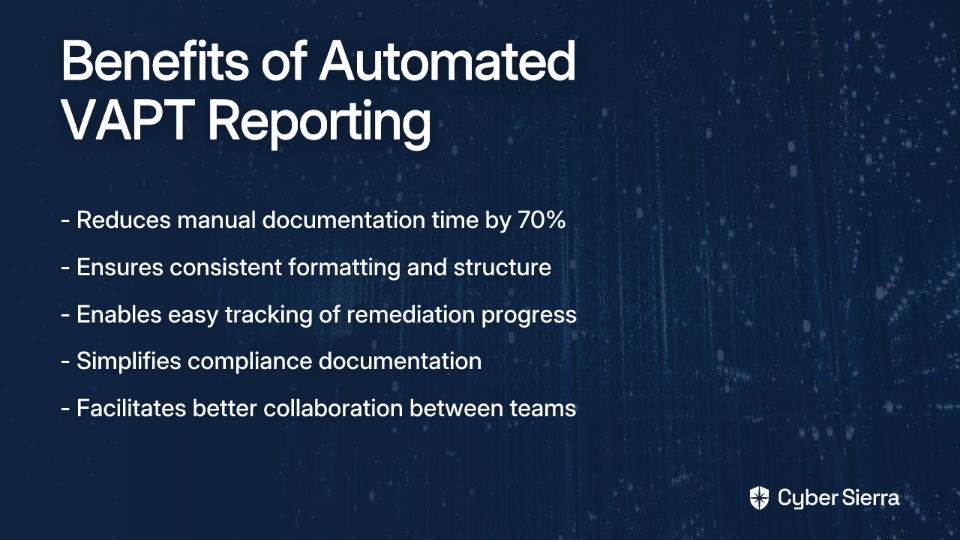
By leveraging the report structures, templates, and automation tools discussed, you can significantly reduce the time and frustration associated with report generation, freeing your valuable time for what truly matters: finding and fixing vulnerabilities.
A great VAPT report does more than tick a compliance box. It strengthens your organization's security posture, fosters a culture of secure development, and builds trust with stakeholders by demonstrating your proactive commitment to cybersecurity.
The next time you face that blank page after completing a penetration test, remember: you're not just writing a report—you're creating a roadmap to a more secure future for your organization.
Frequently Asked Questions
What is the main purpose of a VAPT report?
The main purpose of a VAPT report is to provide a clear, actionable summary of an organization's security weaknesses. It translates complex technical findings into a strategic document that helps stakeholders at all levels—from developers to executives—understand security risks and prioritize remediation efforts effectively.
How often should our organization conduct a VAPT?
As a best practice, organizations should conduct a VAPT at least once a year. However, more frequent testing is recommended for high-risk systems, after significant changes to infrastructure or applications, to meet specific compliance requirements (like PCI DSS), or if there has been a recent security incident.
What's the difference between a Vulnerability Assessment and a Penetration Test?
A Vulnerability Assessment (VA) is typically an automated process that scans systems to identify and list known potential vulnerabilities, providing broad coverage. A Penetration Test (PT) is a manual, goal-oriented process where an ethical hacker simulates a real-world attack to exploit those vulnerabilities, confirming their business impact and providing critical depth. A VAPT report combines both.
Who should receive the VAPT report?
The VAPT report should be distributed to different audiences based on its sections. The high-level Executive Summary is for non-technical stakeholders like C-suite executives and managers to understand overall risk. The detailed technical findings and remediation sections are for developers, system administrators, and the internal security team who are responsible for fixing the vulnerabilities.
What makes a VAPT report effective?
An effective VAPT report is clear, concise, and tailored to its audience. Key elements include a high-level executive summary for decision-makers, detailed technical findings with reproducible Proofs of Concept (PoCs) for developers, and specific, actionable recommendations for remediation, all prioritized by risk to guide resource allocation.
Why is a Proof of Concept (PoC) so important in a report?
A Proof of Concept (PoC) provides undeniable evidence that a discovered vulnerability is not just a theoretical flaw but is actively exploitable. By demonstrating the attack with screenshots or code snippets, a PoC helps eliminate debates about the risk's validity, shows developers the exact point of failure, and justifies the need for immediate remediation to management.
