



Detailed Comparison of SOC 1, SOC 2 & SOC 3 - And Which Do You Need?

Join thousands of professionals and get the latest insight on Compliance & Cybersecurity.
Are you confused about which SOC report your organization needs? You're not alone. Many professionals find themselves bewildered by the alphabet soup of compliance frameworks, especially when clients or partners start demanding "SOC certification" without specifying which type.
As one overwhelmed professional put it on Reddit: "Can somebody explain in simple words the difference between SOC 1 & 2 Reports and type 1 and 2?" This confusion is compounded when contractual obligations suddenly require compliance, leaving you with "no choice" but to dive into an unfamiliar audit process.
In this comprehensive guide, we'll demystify the world of SOC report types, explain their key differences, and help you determine which one your business actually needs.
What is a SOC Report? A High-Level Overview
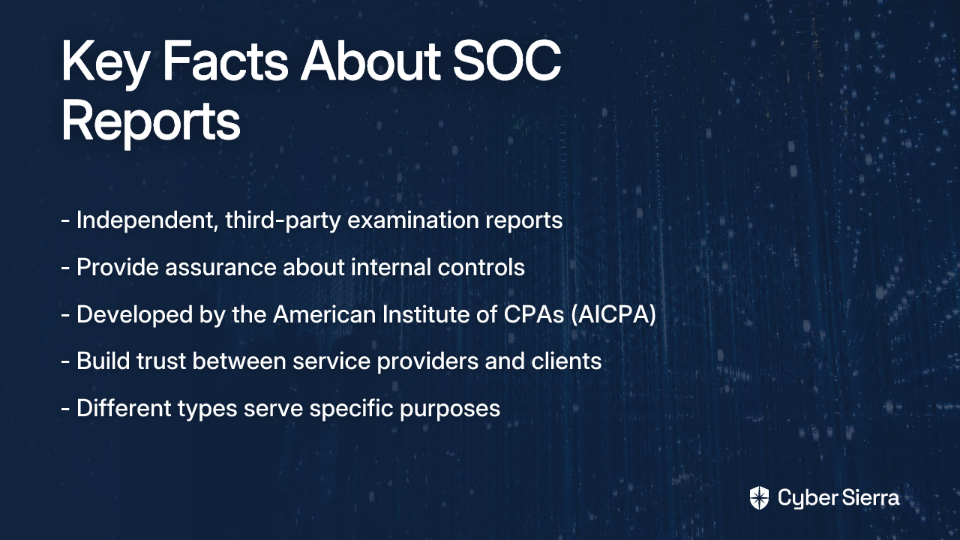
System and Organization Controls (SOC) reports are independent, third-party examination reports that provide assurance about a service organization's internal controls. Developed by the American Institute of Certified Public Accountants (AICPA), these reports help build trust between service providers and their clients.
Think of SOC reports as a verified stamp of approval that demonstrates your commitment to maintaining robust controls over your systems and data. However, not all SOC reports are created equal—each serves a specific purpose and audience.
Deep Dive: SOC 1 for Financial Controls
What is a SOC 1 Report?
A SOC 1 report focuses specifically on a service organization's controls that are relevant to a user entity's internal control over financial reporting (ICFR). As succinctly explained by one Reddit user: "SOC 1 covers internal controls over financial reporting, which is why external auditors request them for financial statement purposes."
The Core Focus: Internal Control over Financial Reporting
Unlike other SOC reports, SOC 1 is concerned with how your services might impact your clients' financial statements. If your company processes transactions, manages financial data, or otherwise affects how your clients report their finances, SOC 1 is designed to address those controls.
Understanding Control Objectives
A key distinction of SOC 1 is that it doesn't use a predefined set of criteria. Instead, your organization works with an auditor to define your own control objectives—overarching statements for each audit process area meant to mitigate specific risks.
For example, a typical control objective might be: "Controls provide reasonable assurance that logical and physical access to programs and data relevant to user entities' internal control over financial reporting is restricted to authorized users."
Who Needs a SOC 1 Report?
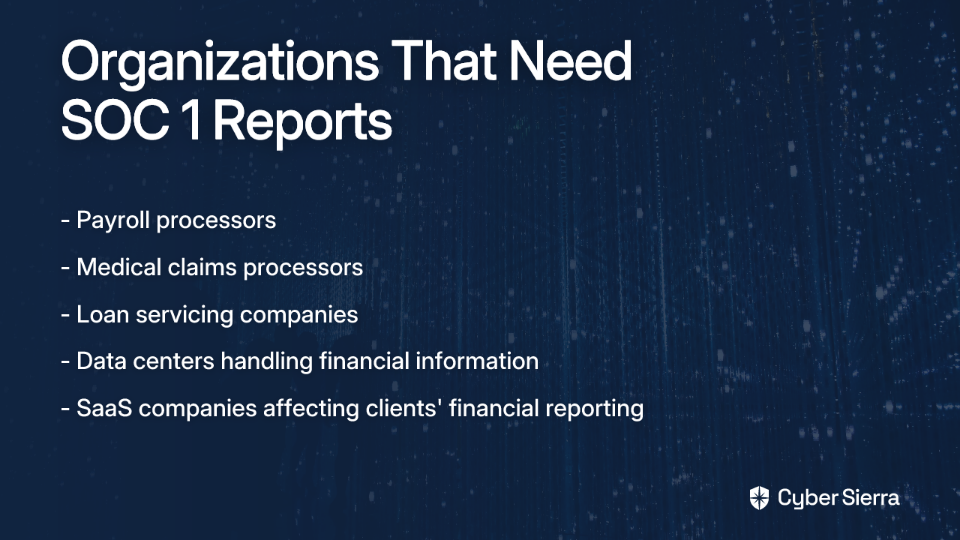
SOC 1 reports are essential for service organizations whose services can materially impact their clients' financial statements, including:
- Payroll processors
- Medical claims processors
- Loan servicing companies
- Data centers handling financial information
- SaaS companies whose services are part of their clients' financial reporting process
Deep Dive: SOC 2 for Security and Data Protection
What is a SOC 2 Report?
A SOC 2 report evaluates the effectiveness of an organization's security protocols based on the AICPA's framework. Its core purpose is to establish trust with customers by demonstrating that you can protect their data stored in the cloud.
The Core Focus: The Five Trust Services Criteria (TSC)
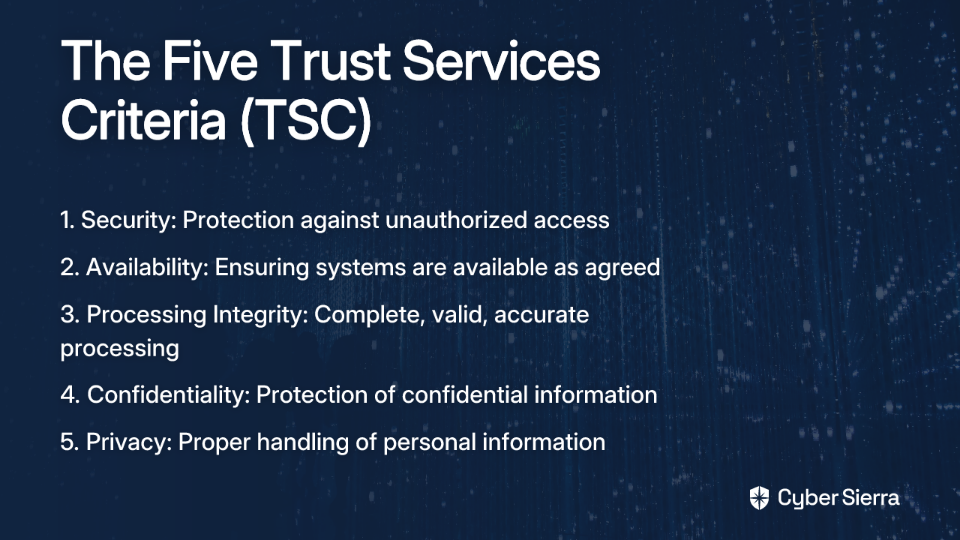
SOC 2 audits are performed against one or more of the five Trust Services Criteria (TSC). The Security criterion (also called Common Criteria) is mandatory, while the others are optional depending on your business needs:
- Security: Protecting information and systems against unauthorized access
- Availability: Ensuring systems are available as committed or agreed
- Processing Integrity: Ensuring system processing is complete, valid, accurate, timely, and authorized
- Confidentiality: Protecting information designated as confidential
- Privacy: Ensuring personal information is properly collected, used, retained, and disposed of
Beyond "Security Theater": The Real Value of SOC 2
Some skeptics view compliance frameworks as mere "security theater," focusing more on documentation than actual security. As one Reddit user pointedly asked: "What's actually important is what goes INSIDE the SOC 2 report, or what are your actual controls?"
This is a valid concern. The true value of SOC 2 isn't just the certificate but the robust security program it helps you build. A well-implemented SOC 2 program forces organizations to establish and maintain strong security practices that protect against data breaches and build customer trust.
Who Needs a SOC 2 Report?
SOC 2 reports are critical for:
- SaaS providers
- Cloud service providers
- Data centers
- Managed IT service providers
- Any organization that stores, processes, or transmits customer data
Deep Dive: SOC 3 for Public Assurance
What is a SOC 3 Report?
Think of SOC 3 as the "public-friendly" version of SOC 2. It provides the same assurance about a company's security controls but without the detailed descriptions of tests and results found in a SOC 2 report.
The Core Focus: A Public-Facing Summary of Security
SOC 3 reports are designed for marketing purposes and for users who need assurance but don't require the technical details. They contain a high-level summary of the auditor's opinion and can be freely shared with the public without requiring an NDA.
Key Differences: SOC 2 vs. SOC 3
| Feature | SOC 2 Report | SOC 3 Report |
|---|---|---|
| Use | Restricted-use | General-use (public) |
| Report Type | Can be Type I or Type II | Based on a Type II audit |
| Content | Includes detailed descriptions of controls, tests, and results | High-level summary without confidential information |
| Audience | Customers, partners, and auditors who have signed an NDA | Publicly available on the company's website |
Who Needs a SOC 3 Report?
SOC 3 reports are ideal for:
- Organizations that have completed a SOC 2 Type II audit and want to publicly demonstrate their security commitment
- Companies looking for a marketing tool to enhance brand reputation
- Businesses wanting to provide security assurance without sharing sensitive internal details
Key Distinctions: Type I vs. Type II Reports Explained
Another source of confusion is the difference between Type I and Type II reports. This applies to both SOC 1 and SOC 2 reports and refers to the scope of the audit rather than the content areas.

Type I: A Snapshot in Time
A Type I report assesses and reports on the design of controls at a specific point in time. It essentially answers the question: "Are your controls appropriately designed to meet the specified objectives or criteria?"
Type II: A Look Over Time
A Type II report goes deeper by assessing the operating effectiveness of those controls over a period of time, typically 3-12 months. It answers two questions: "Are your controls appropriately designed, AND do they work consistently over time?"
Why Type II Offers Greater Assurance
Type II reports provide a higher level of assurance because they test controls in action over time, not just their design on a single day. Most customers and stakeholders will require a Type II report for meaningful assurance, especially for mature business relationships.
At-a-Glance: SOC 1 vs. SOC 2 vs. SOC 3 Comparison Table
| Attribute | SOC 1 | SOC 2 | SOC 3 |
|---|---|---|---|
| Primary Focus | Internal Control over Financial Reporting (ICFR) | Security, Availability, Processing Integrity, Confidentiality, Privacy | Same as SOC 2, but a high-level summary |
| Criteria | Company-defined Control Objectives | AICPA's Trust Services Criteria (TSC) | AICPA's Trust Services Criteria (TSC) |
| Audience | User entity management & their financial auditors | Customers, partners, regulators (under NDA) | Public, prospective customers, marketing |
| Report Use | Restricted Use | Restricted Use | General Use / Public |
| Level of Detail | Highly detailed | Highly detailed | Summary level, no sensitive details |
| Report Types | Type I and Type II | Type I and Type II | Based on a Type II audit |
Which Report is Right for Your Business?
Choose SOC 1 if:
- Your services are part of your client's financial reporting chain
- Your clients are public companies that must comply with Sarbanes-Oxley (SOX)
- You are a payroll processor, loan servicer, or medical claims processor
- A client contract specifically requires it
Choose SOC 2 if:
- You store, process, or manage client data in the cloud
- You are a SaaS company, data center, or managed service provider
- Customers are demanding proof of your security posture to sign deals
- You want to differentiate your business with a competitive advantage in security
Choose SOC 3 if:
- You have already achieved SOC 2 Type II compliance
- You want a document to post on your website for marketing purposes
- You need to provide assurance to a broad audience without requiring NDAs
Navigating the Audit: Common Challenges and Best Practices
The SOC audit process can be challenging, especially for first-timers. As one Reddit user bluntly put it: "First time, un-prepared, should be excruciating." Another warned: "If they don't have their ducks in a row, they're in for a bad time."
Common Challenges:
- Documentation Burden: The feeling of "non-stop documentation, and proving every little thing"
- Lack of Formal Processes: Startups may struggle with requirements like formal board meeting minutes
- Cross-Department Collaboration: SOC 2 requires input from HR, engineering, legal, and leadership
Best Practices for Success:
- Conduct a Readiness Assessment: Perform a self-audit or hire a consultant to identify gaps before the official audit begins
- Find the Right Auditor: Choose a reputable CPA firm with deep experience in your industry
- Develop a Strong Security Program: Don't just check boxes—build a robust data security program
- Leverage Automation: Consider compliance automation tools to streamline evidence collection and monitoring

Conclusion: Making the Right Choice for Trust and Growth
In today's data-driven economy, demonstrating verifiable trust through SOC reports isn't just a compliance exercise—it's a business necessity. The choice between SOC 1, SOC 2, and SOC 3 isn't about which report is "better" but which aligns with your business model, services, and client expectations.
Remember that the ultimate goal isn't just obtaining a report but building a culture of security and trust that supports your business growth. When implemented thoughtfully, SOC compliance can transform from a perceived "security theater" into a genuine competitive advantage that opens doors to new business opportunities.
By understanding the nuances between SOC report types and preparing adequately, you can navigate the compliance landscape with confidence and use your SOC reports as powerful tools for building trust with clients and partners.
Frequently Asked Questions
What is the main difference between a SOC 1 and SOC 2 report?
The main difference is their focus: SOC 1 reports on controls relevant to a client's financial reporting, while SOC 2 reports on controls related to security, availability, and data privacy. Essentially, SOC 1 is for services that impact your client's financials (e.g., payroll processing), whereas SOC 2 is for services that handle client data (e.g., cloud hosting).
How do I choose between a Type I and Type II SOC report?
Choose a Type I report for a point-in-time snapshot of your controls' design, and a Type II report to prove your controls' operating effectiveness over a period (usually 3-12 months). While a Type I can be a good starting point, most customers require a Type II report as it provides much higher assurance that your security practices are consistently working.
Which SOC report does my SaaS company need?
Most SaaS companies need a SOC 2 report. Because SaaS providers store and process customer data, a SOC 2 report is the standard for demonstrating to customers that their data is protected according to criteria like Security, Availability, and Confidentiality. If your SaaS tool directly impacts client financial reporting, you may also need a SOC 1.
What is a SOC 3 report used for?
A SOC 3 report is a general-use, public-facing summary of a SOC 2 audit. It's primarily a marketing tool that can be freely shared on your website. It confirms you have achieved SOC 2 compliance without revealing sensitive details about your internal controls, making it ideal for providing assurance to a broad audience without an NDA.
What is the first step to getting a SOC report?
The best first step is to conduct a SOC readiness assessment. This pre-audit exercise helps you identify and fix gaps in your controls and documentation before the formal audit begins. A readiness assessment significantly increases your chances of a successful audit and can save you time and money.
How long does a SOC audit take and how much does it cost?
The timeline and cost can vary significantly. A Type I audit might take a few months from start to finish, while a Type II requires an observation period of 3-12 months plus the audit time. Costs can range from $15,000 to over $100,000 depending on the report's scope, your company's size and complexity, and the audit firm selected.
