8 Practical AI Use Cases for GRC That Actually Work


Join thousands of professionals and get the latest insight on Compliance & Cybersecurity.
The pressure is on to use AI in Governance, Risk, and Compliance. With vendors quietly slipping AI capabilities into their platforms and marketing teams trumpeting AI solutions at every turn, it's hard to separate genuine innovation from hype.
As one GRC professional noted, "There's plenty of AI hype floating around GRC today. Some of it is genuinely useful, some more marketing sparkle." This sentiment echoes throughout the industry, where practitioners are desperate for AI applications that deliver tangible value—not just flashy demos.
This article cuts through the noise to highlight eight proven, practical AI use cases that are already delivering measurable benefits in GRC. From automating tedious compliance documentation to enhancing risk forecasting, these applications address the real pain points GRC professionals face daily.

1. Dynamic and Automated Policy Creation
Many organizations struggle with policies that have "created a patchwork of randomness that is not super cohesive or organized and has confusing syntax." Sound familiar?
AI is transforming this chaotic policy landscape by:
- Generating consistent first drafts based on regulatory requirements
- Ensuring policies maintain cohesive language and structure
- Automatically updating policies when regulations change
Real-world implementation: One GRC team reported success "creating dynamic policies based on company information collected through a Tines form." This automation pulls relevant company data to generate tailored policies that remain consistent with existing documentation.
Tools like ChatGPT can produce solid policy frameworks with well-crafted prompts, while specialized platforms continuously scan regulatory databases to suggest policy updates aligned with evolving standards like GDPR or NIST frameworks.
2. Automating Vendor Security Questionnaires & RFPs
The endless stream of security questionnaires is a significant drain on resources. As one professional lamented, maintaining a response library is "horrible to maintain. Maybe you can make it work if you have an absolute army of proposal people, but I'm guessing you don't."
AI solutions are revolutionizing this process:
- Vanta's Questionnaire Automation accelerates security reviews by an average of 81%
- AI can automatically answer up to 80% of security questions using your existing knowledge base
- These AI-generated responses achieve a 95% acceptance rate from customers
The process works by building a central knowledge repository that learns from each completed questionnaire, improving accuracy over time. "Shout out to SafeBase!!!!!" noted one Reddit user, highlighting another popular tool in this space that's delivering real value.
3. Reviewing and Managing Third-Party App Risks
The proliferation of third-party apps—from enterprise SaaS to simple Chrome extensions—creates significant security challenges. Manual vetting is time-consuming and often superficial.
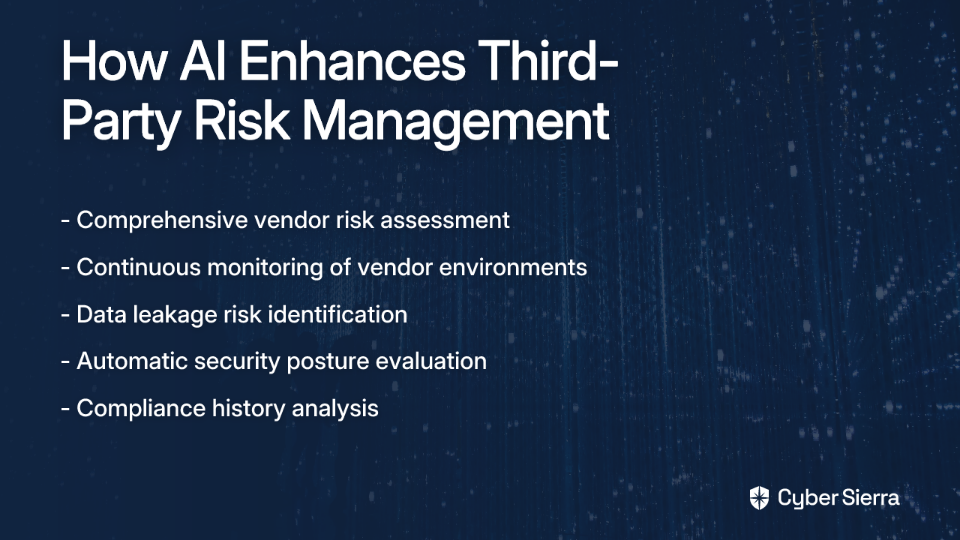
AI tools enhance third-party risk management by:
- Analyzing vendors' financial stability, cybersecurity posture, and compliance history
- Identifying potential data leakage risks in applications like Chrome extensions
- Continuously monitoring third-party environments for new vulnerabilities
Platforms like Black Kite leverage AI to assess and quantify vendor risk by analyzing various data points and providing comprehensive risk profiles, dramatically reducing the manual effort required for thorough assessments.
4. Formatting and Streamlining Compliance Data (POA&Ms)
Frameworks like FedRAMP require extensive documentation and meticulous formatting of security findings. One GRC professional shared a practical solution: "Using AI to write a ton of scripts to handle things like formatting large chunks of scan data for FedRAMP scans into a nice, clean POA&M."
This use case demonstrates how AI can:
- Automate the parsing of complex scan data into standardized formats
- Ensure consistency in vulnerability documentation across multiple systems
- Dramatically reduce the time spent on manual data entry and formatting
For organizations pursuing CMMC or other compliance frameworks, this automation of tedious formatting tasks frees up valuable time for analysis and remediation planning rather than administrative busy work.
5. Continuous Compliance Monitoring and Regulatory Mapping
"Businesses waste thousands of hours manually tracking ever-changing regulations (GDPR, HIPAA) and updating compliance documents," according to one frustrated compliance professional. AI provides a solution to this seemingly endless task.
Modern AI systems can:
- Continuously monitor regulatory changes across multiple jurisdictions
- Automatically map new requirements to your existing control framework
- Flag gaps and recommend necessary updates to maintain compliance
As one Reddit user observed, GRC vendors like "Vanta and Drata will scan your policy text and suggest ISO/CIS/NIST controls," effectively automating the mapping process. This capability is particularly valuable for organizations operating in highly regulated industries or across multiple jurisdictions.
6. Predictive Risk Assessment and Management
Traditional risk management tends to be reactive—addressing issues after they emerge. AI and Machine Learning (ML) enable a shift to proactive risk management.
Advanced AI systems can:
- Generate data-driven risk statements based on historical patterns
- Identify emerging risk hotspots before they become critical issues
- Prioritize risks based on potential impact and likelihood
One user mentioned how "IBM's OpenPages leans on Watson to forecast where new risk hotspots might emerge," showcasing how established GRC platforms are incorporating predictive capabilities. This approach allows organizations to allocate resources more effectively, addressing potential problems before they manifest.
7. Internal Controls Optimization and Gap Analysis
Identifying weaknesses in complex control frameworks like SOX or ISO standards traditionally requires significant manual effort. AI streamlines this process through automated gap analysis.
AI-powered control optimization:
- Analyzes control effectiveness across different business units
- Identifies redundancies and gaps in control frameworks
- Suggests improvements based on industry best practices
"AuditBoard's ML flags gaps across your SOX/ISO workflows," noted one practitioner, highlighting how machine learning is already addressing this challenge in the field. By automating control analysis, organizations can maintain stronger compliance postures with less effort.
8. Enhancing AML/KYC and Fraud Detection
Financial institutions struggle with high volumes of false positives in Anti-Money Laundering (AML) and Know Your Customer (KYC) processes. AI significantly improves detection accuracy while reducing false alerts.
AI enhances compliance processes by:
- Analyzing transaction patterns to identify truly suspicious activities
- Reducing false positives that drain investigator resources
- Automatically screening against sanctions lists and PEP databases
These capabilities are particularly valuable in financial services, where regulatory expectations for compliance are extraordinarily high, and the cost of missing actual fraud or money laundering incidents can be severe.
Critical Considerations: The Human-in-the-Loop Imperative
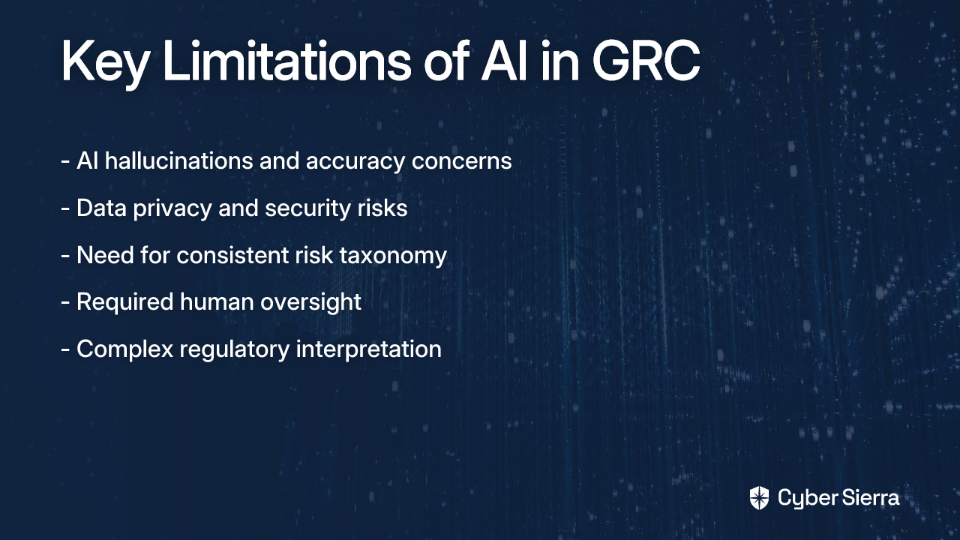
Despite these powerful applications, AI in GRC comes with important limitations that practitioners must recognize:
AI Hallucinations and Accuracy Concerns
LLMs can sometimes generate plausible-sounding but incorrect information. All AI-generated content—from policy drafts to risk statements—must be reviewed by human experts before implementation. As one user cautioned about frameworks like CMMC: "trying to cross-map it from other frameworks, like other GRCs do, can be tedious and erroneous."
Data Privacy and Security Risks
Organizations must establish clear policies about what GRC data can be used with external AI tools. As one practitioner warned, "GRCs should not be storing your data" in public AI systems. Feeding sensitive compliance information into unsecured models creates significant security and privacy risks.
Risk Taxonomy Consistency
For AI to be effective, organizations need a consistent risk taxonomy and structured data approach. Without standardized terminology and data formats, AI systems will struggle to deliver accurate insights across different business functions.
Conclusion: Making AI Work for Your GRC Program
The real promise of AI in GRC isn't about replacing human judgment—it's about augmenting it by handling repetitive, data-intensive tasks that consume too much valuable time.
The most successful implementations target specific pain points rather than attempting sweeping transformation. Start with high-effort, low-judgment tasks like automating vendor questionnaires, formatting POA&Ms, or monitoring regulatory changes.
By focusing AI implementation on these practical use cases with proven ROI, GRC teams can cut through the marketing hype and deliver genuine efficiency gains. The future of GRC isn't about replacing practitioners; it's about empowering them with smart tools that free up their time for the strategic thinking machines can't replicate.
The pressure to adopt AI in GRC is undeniable—but with these eight practical applications as your starting point, you can ensure your AI investments deliver real value rather than just "marketing sparkle."
Frequently Asked Questions
What is a practical first step for implementing AI in GRC?
A practical first step is to target high-effort, low-judgment tasks where AI can provide immediate value. Focus on automating repetitive processes like filling out vendor security questionnaires, formatting compliance data for reports like POA&Ms, or using AI to generate initial drafts of standard policies. This approach delivers a clear return on investment and builds momentum for more advanced AI applications.
How does AI help with continuous compliance monitoring?
AI helps with continuous compliance monitoring by automating the manual process of tracking regulatory changes. AI-powered platforms can continuously scan global regulations (like GDPR, HIPAA, etc.), automatically map new requirements to your organization's existing controls, and alert you to any gaps. This ensures your compliance framework remains up-to-date without requiring thousands of hours of manual work.
What are the biggest risks when using AI for GRC tasks?
The biggest risks include accuracy, data privacy, and data consistency. AI models, particularly LLMs, can "hallucinate" and produce incorrect information. Feeding sensitive GRC data into public AI tools creates significant security risks. Furthermore, without a consistent risk taxonomy across the organization, AI-driven insights can be unreliable and fragmented.
Will AI replace GRC professionals?
No, AI is not expected to replace GRC professionals. Instead, it is a tool designed to augment their capabilities. AI excels at handling repetitive, data-intensive tasks, which frees up GRC experts to focus on strategic activities that require human judgment, critical thinking, and nuanced decision-making—skills that machines cannot replicate.
Why is a "human-in-the-loop" approach crucial for GRC?
A "human-in-the-loop" approach is crucial because AI outputs require expert validation. GRC tasks have significant regulatory and security implications, and AI-generated content—whether a policy clause, a risk assessment, or a control mapping—must be reviewed by a human expert for accuracy, context, and applicability before it is implemented. This oversight mitigates the risk of AI errors and ensures responsible adoption.
How can AI improve the vendor security review process?
AI can dramatically improve the vendor security review process by automating the completion of security questionnaires. AI tools can build a knowledge base from your existing security documentation and past questionnaires to automatically answer a high percentage of incoming questions (often up to 80%). This reduces the manual workload on security teams by an average of 80%, accelerating sales cycles and freeing up resources.