



How to Report Cybersecurity Maturity to Your Board


Join thousands of professionals and get the latest insight on Compliance & Cybersecurity.
You've spent months building your cybersecurity program, implementing controls, and assessing your organization against frameworks. Now comes the challenging part: explaining your progress to the board in a way that resonates with business leaders who may lack technical expertise.
While 84% of board directors now recognize cyber risk as a business risk according to Gartner, only 29% of boards have significant cybersecurity expertise per Heidrick & Struggles research. This expertise gap creates a significant communication challenge for GRC professionals.
This article provides a step-by-step guide to creating clear, compelling, and visually appealing maturity reports that translate technical progress into business value the board can understand and act upon.
The Critical Distinction: Risk Reduction vs. Capability Maturity
One of the most common challenges GRC professionals face is getting leadership to understand the fundamental difference between risk reduction and capability maturity. These are related but distinct concepts that must be clearly separated in your board reporting.
Risk Reduction focuses on addressing specific, known threats and vulnerabilities. It's tactical and often reactive. Risk reduction answers the question: "What are the top dangers that could cost us money this quarter, and what are we doing to mitigate those specific threats?"
Examples include:
- Patching a critical vulnerability in your customer database
- Implementing stronger authentication for financial systems
- Updating your risk register with new audit findings
Capability Maturity, on the other hand, measures your organization's overall, institutionalized ability to manage cybersecurity. It's strategic and proactive. Maturity answers the question: "How strong are our systems, processes, and people to handle any threat—known or unknown—over the long term?"
A useful analogy: Risk reduction is like fixing a flat tire—it solves an immediate, critical problem. Capability maturity is like having a comprehensive vehicle maintenance program with skilled mechanics and run-flat tires—it prevents future breakdowns and ensures operational resilience.
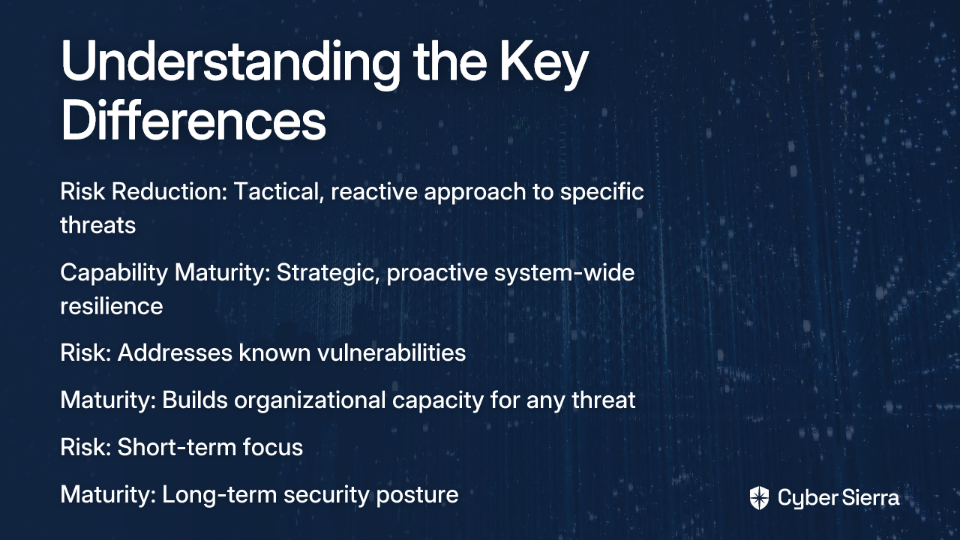
When presenting to the board, clearly label which metrics relate to risk reduction (specific threats mitigated) versus capability improvements (systematic enhancements to your security posture).
Choosing Your Framework: The Key to Objective Reporting
Many GRC professionals worry that maturity assessments feel subjective and prone to errors. The solution is to use standardized frameworks that provide objective criteria and a common vocabulary.
NIST Cybersecurity Framework (CSF)
The NIST CSF is an industry-standard framework that recently released Version 2.0 (February 2024). This latest version places greater emphasis on governance, making it even more relevant for board conversations. The framework consists of six core functions:
- Govern: The new function that establishes cybersecurity risk management strategy and policy
- Identify: Understand assets, risks, and vulnerabilities
- Protect: Implement safeguards to contain potential incidents
- Detect: Discover cybersecurity events quickly
- Respond: Take appropriate action when incidents occur
- Recover: Restore capabilities impaired by incidents
The NIST CSF uses maturity tiers that provide clear benchmarks:
- Tier 1 (Partial): Ad-hoc, reactive cybersecurity
- Tier 2 (Risk-Informed): Risk management practices are approved but not established as policy
- Tier 3 (Repeatable): Formal policies and procedures are in place and regularly updated
- Tier 4 (Adaptive): Continuous improvement based on lessons learned and predictive indicators
Cybersecurity Capability Maturity Model (C2M2)
For organizations seeking a free, accessible alternative to expensive consultants, the C2M2 model offers an excellent solution. Key features include:
- Free, interactive self-evaluation tool
- Can be completed in as little as one day
- Comprises 10 domains covering over 350 cybersecurity practices
- Uses Maturity Indicator Levels (MILs) from 1 (Initiated) to 3 (Managed)
The U.S. Department of Energy provides mappings between C2M2 and the NIST CSF, allowing organizations to leverage both frameworks.
Other frameworks to consider include ISO 27001, COBIT2019, and the CIS Controls, depending on your industry and regulatory requirements.
A 4-Step Process for Building Your Maturity Report
Now that you understand the difference between risk and maturity and have selected an appropriate framework, here's a practical process for creating your board report:
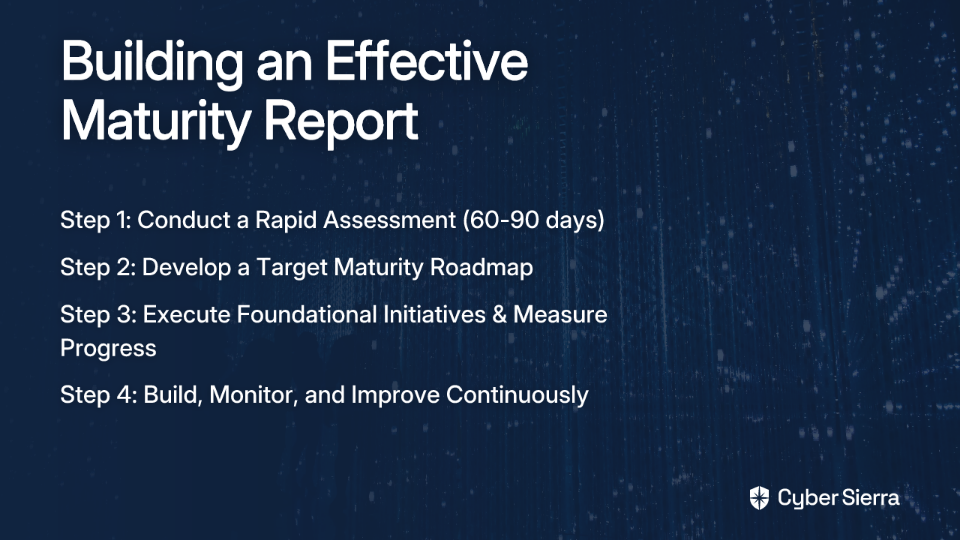
Step 1: Conduct a Rapid Assessment
Goal: Establish your baseline maturity level.
Method: Use your chosen framework (NIST CSF or C2M2) to conduct a comprehensive assessment through surveys, interviews, and technical data gathering.
Timeline: Aim to complete this within 60-90 days to show quick progress.
Key Performance Indicators (KPIs): Document your current maturity tier for each function or domain, supported by evidence.
Step 2: Develop a Target Maturity Roadmap
Goal: Define your desired future state based on business priorities.
Method: Align target maturity levels with specific business objectives and risk appetite. Not every function needs to reach Tier 4—prioritize based on your organization's critical assets and threat landscape.
Output: Create a visual roadmap with clear deliverables, timelines, and prioritized initiatives. Treat your maturity journey like a standalone project with defined milestones and Objectives and Key Results (OKRs).
Step 3: Execute Foundational Initiatives & Measure Progress
Goal: Make and demonstrate tangible progress.
Method: Implement quick wins and foundational projects. Track progress using Key Risk Indicators (KRIs) that show movement from one maturity tier to the next.
Example Reporting: "In Q3, we moved the 'Detect' function from Tier 1 (Partial) to Tier 2 (Risk-Informed) by implementing centralized logging. This increases our ability to spot threats by 40% and reduces our average detection time from 72 hours to 24 hours."
Step 4: Build, Monitor, and Improve Continuously
Goal: Make maturity a continuous process, not a one-time project.
Method: Develop dashboards for ongoing monitoring. Transition from static reporting to dynamic reporting that shows trends over time. Adapt your plan as threats and business priorities evolve.
Storytelling for the Boardroom: 5 Best Practices for Communication
Creating an effective report is as much about communication as it is about measurement. Here are five best practices for presenting maturity to your board:
1. Speak in Business Terms, Not Technical Jargon
The C-suite doesn't care about technical details—they care about business impact. Instead of saying, "We implemented EDR," say, "We invested in technology that stops ransomware attacks before they can encrypt our files, potentially saving us millions in recovery costs and lost revenue."
2. Visualize the Journey
Create aesthetically pleasing visuals that tell a clear story:
- Use a spider graph (radar chart) to show current vs. target maturity across all framework functions on a single slide
- Include a roadmap graphic showing key projects and expected maturity improvements over time
- Consider using "Pulse Buckets" to group related capabilities for easier tracking
3. Quantify Everything Possible
Connect investments to financial outcomes: "Our proposal to invest $250K to reach Tier 3 in 'Respond' capabilities is projected to reduce our incident recovery time by 50%, translating to an estimated savings of $1.2M per major incident based on industry data."
4. Keep it Concise with Focus on Outcomes
Your board presentation should be an executive summary focused on:
- Current maturity state vs. target
- Progress since last report
- Key achievements and challenges
- Business impacts of maturity improvements
- Resources needed for continued advancement
5. Be Transparent About Gaps
Avoid sugar-coating results, as this can backfire when security incidents occur. Present a realistic picture of both strengths and areas for improvement. Frame gaps not as failures but as opportunities for strategic investment.
Conclusion
Reporting on cybersecurity maturity is fundamentally a communication challenge. By clearly differentiating maturity from risk, using standardized frameworks like NIST CSF, and telling a visual, business-focused story, you can transform boardroom conversations from confusing technical updates into strategic discussions about business resilience.
When done effectively, your maturity reporting will build trust, secure investment, and position cybersecurity as a strategic enabler of your organization's success rather than just a cost center.
Remember that third-party assessments can provide valuable objectivity and credibility to your maturity reporting, especially when benchmarking against industry averages or when preparing for auditors. A crosswalk engine between different frameworks can also help streamline reporting for different stakeholders while maintaining consistency in your measurement approach.
By following these steps, you'll create cybersecurity maturity reports that resonate with your board and drive meaningful improvements in your organization's security posture.
Frequently Asked Questions
What is the difference between cybersecurity maturity and risk reduction?
Cybersecurity maturity measures your organization's long-term capability to manage any threat, while risk reduction focuses on fixing specific, immediate dangers. Think of maturity as a comprehensive vehicle maintenance program (proactive and strategic) and risk reduction as fixing a flat tire (reactive and tactical). A mature program is resilient against both known and unknown threats.
Why is it important to report on cybersecurity maturity to the board?
Reporting on cybersecurity maturity is crucial because it translates complex technical efforts into a strategic business conversation about resilience and risk management that the board can understand. It helps the board see cybersecurity not just as a cost center, but as a strategic enabler that protects business value, which in turn builds trust and helps secure necessary investment.
What is the best framework for measuring cybersecurity maturity?
There is no single "best" framework; the right choice depends on your industry and goals, but the NIST Cybersecurity Framework (CSF) and the Cybersecurity Capability Maturity Model (C2M2) are two highly respected and widely used options. The NIST CSF is an industry standard ideal for board-level talks, while C2M2 is a free, excellent alternative that allows for rapid self-assessment.
How can I explain cybersecurity maturity to a non-technical board?
To explain maturity to a non-technical board, use business-focused language, visual aids, and quantifiable outcomes. Avoid technical jargon. Instead of saying "we implemented EDR," say "we invested in technology to stop ransomware, potentially saving millions." Use visuals like spider graphs to show progress and connect every security investment to a financial outcome, such as reduced recovery costs.
Should our organization aim for the highest maturity level in all areas?
No, your organization should not necessarily aim for the highest maturity level in all areas. The goal is to set a target maturity level that aligns with your specific business priorities, risk appetite, and critical assets. For example, the systems protecting your most sensitive customer data may require a higher maturity level than less critical internal systems.
How do I start building a cybersecurity maturity report?
The first step in building a maturity report is to conduct a rapid assessment to establish your current baseline using a standardized framework like NIST CSF or C2M2. After establishing a baseline, you can develop a target roadmap, execute foundational initiatives to show progress, and finally, build a system for continuous monitoring and improvement.
