
5 Common Risk Register Mistakes (And How to Fix Them Fast)


Join thousands of professionals and get the latest insight on Compliance & Cybersecurity.
You've spent weeks collecting vulnerability scan data, meticulously documenting findings, and formatting your risk register to perfection. Yet when you present it to leadership, you're met with blank stares and questions like "So what does this mean for our business?" or worse, "How does this help us make decisions?"
If this scenario sounds familiar, you're not alone. Many CISOs and security professionals find themselves trapped in a cycle of creating risk registers that fail to deliver real value, becoming little more than "colorful scan reports" that gather digital dust.
Beyond the Compliance Checklist
The truth is, an effective risk register isn't just another compliance checkbox—it's a strategic decision-making tool that bridges technical vulnerabilities with business context. When done right, it empowers leadership to make informed risk-based decisions aligned with the organization's risk appetite and core mission.
Yet many organizations struggle with risk registers that fail to provide a comprehensive view of operational risks. According to discussions among GRC professionals, the disconnect between reported vulnerabilities and their actual business impact undermines the entire risk management process.
Let's examine the five most common risk register mistakes and how you can fix them quickly to transform your risk register from a liability into a strategic asset.

Mistake #1: Relying Solely on Vulnerability Scan Data
The Pitfall: Many security teams populate their risk registers exclusively with data from vulnerability scans and automated reports. This creates a narrow, technical view that lacks business context.
You end up with pages of CVE numbers and technical details that mean little to anyone outside the security team. Without proper context, leadership can't determine which vulnerabilities pose genuine threats to the organization's core mission/business function versus those that are theoretically concerning but practically irrelevant.
Why It's a Problem: This approach creates a disconnect between technical findings and their actual impact on the business, making it impossible for stakeholders to prioritize effectively. It also fosters an "illusion of control" where documenting risks is mistaken for managing them.
How to Fix It Fast:
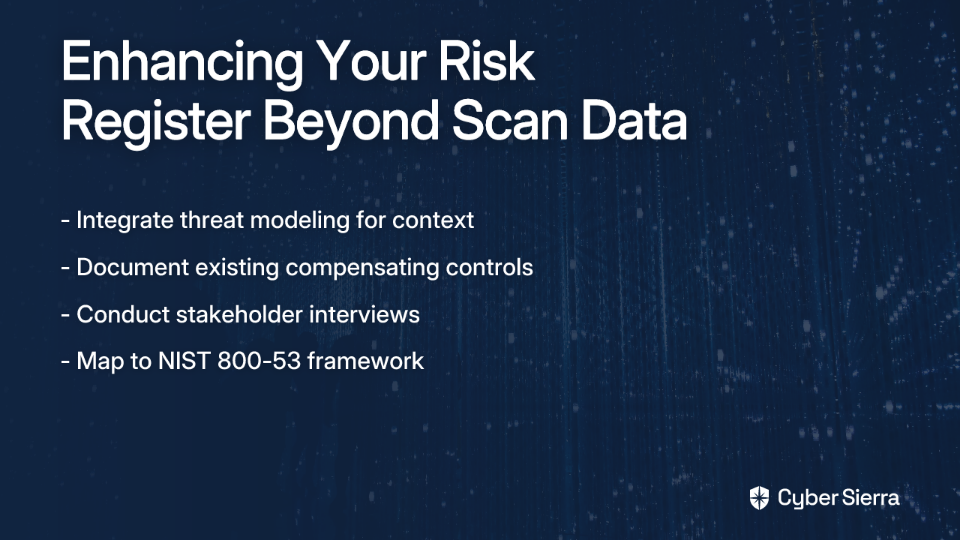
- Integrate Threat Modeling: Supplement vulnerability scan data with formal threat modeling to identify adversarial threats that automated scans might miss. This provides crucial context about how vulnerabilities might be exploited.
- Document Compensating Controls: For each vulnerability, list existing compensating controls that might reduce the actual risk, even if the vulnerability itself remains. For example, a server might have an unpatched vulnerability, but network segmentation and zero trust architecture significantly reduce the exploitation risk.
- Conduct Stakeholder Interviews: Schedule 30-minute interviews with key business unit leaders to understand how technical vulnerabilities might impact their operations. These conversations often reveal connections between technical issues and business processes that aren't obvious from scan data alone.
- Use the NIST 800-53 Framework: Map vulnerabilities to the NIST 800-53 control families to provide a standardized way of categorizing and communicating about risks across the organization.
Mistake #2: Vague Descriptions and Lack of Proper Risk Tiering
The Pitfall: Risks are often logged with ambiguous descriptions like "potential security breach" or "possible data loss" without specific details about the threat scenario, attack vector, or business impact. Even worse, these vaguely defined risks are thrown into a flat list without any prioritization or risk tiering.
This leads to a cluttered, confusing register where critical threats requiring immediate attention are lost among dozens or hundreds of lower-priority items.
Why It's a Problem: Without clear descriptions and proper risk tiering, teams misallocate resources, focusing on low-impact issues while high-priority threats go unaddressed. When everything is labeled a "high risk," nothing is truly treated as high risk.
How to Fix It Fast:
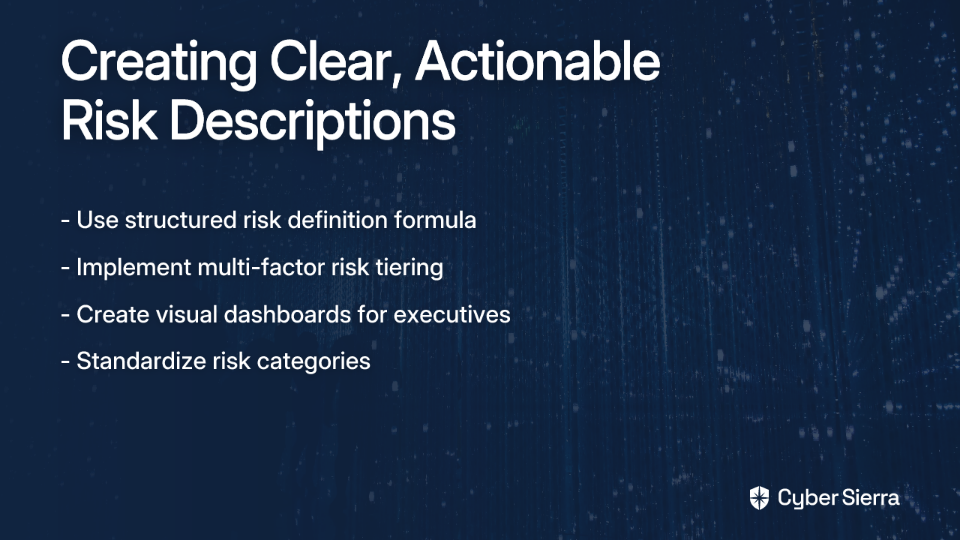
- Implement a Risk Definition Convention: Enforce a clear structure for writing risks using this formula: "There is a risk that [a specific event will happen] which will result in [a specific consequence to the business]." Instead of "Server vulnerability," write: "There is a risk that an unpatched vulnerability in our payment processing server could be exploited by an adversarial threat actor, which will result in unauthorized access to customer payment information and potential regulatory penalties."
- Create a Multi-Factor Risk Tiering System: Move beyond simple High/Medium/Low classifications. Develop a scoring system that considers:
- Potential impact on core mission/business function
- Likelihood of exploitation
- Existence of compensating controls
- Alignment with the organization's documented risk appetite
- Use Visual Abstraction: Create visual dashboards that allow executives to see high-level risk categories while maintaining the ability to drill down into specific technical details when needed. This abstraction helps communicate risk effectively to different audiences.
- Standardize Risk Categories: Group risks into standardized categories (e.g., operational, compliance, strategic, reputational) to facilitate better understanding and appropriate response planning.
Mistake #3: Poor Communication and Stakeholder Engagement
The Pitfall: The risk register exists in a silo, with inadequate sharing of information between the security team, IT operations, business units, and executive leadership. Risk assessment meetings become theoretical exercises divorced from business realities.
According to cybersecurity professionals, miscommunication and lack of leadership alignment are among the biggest hurdles in effective risk management.
Why It's a Problem: When stakeholders aren't engaged, they don't trust the process or understand how the risks affect them. The risk register becomes a technical document that fails to drive action or inform strategic decisions.
How to Fix It Fast:
- Establish a Risk Awareness Committee: Create a cross-functional team with representatives from security, IT, legal, finance, and key business units that meets monthly to review and update the risk register. This ensures diverse perspectives and shared ownership.
- Tailor Communication to Audience: Develop different views of the risk register for different stakeholders:
- Executive summary with business impacts and costs for leadership
- Detailed technical information for IT teams
- Compliance implications for legal and regulatory teams
- Connect Risks to Risk Owner's Interests: When communicating risks to stakeholders, explicitly link them to objectives they care about. For example, when discussing a security vulnerability with the marketing team, frame it in terms of potential impact on brand reputation or customer trust.
- Create a Feedback Loop: Implement a mechanism for stakeholders to provide input on risk assessments and treatment plans. This not only improves the quality of the register but also increases buy-in and accountability.
Mistake #4: The "Set It and Forget It" Register
The Pitfall: The risk register is created during an annual compliance exercise or at the beginning of a project, then rarely updated. It quickly becomes obsolete, failing to reflect the current risk environment or emerging threats.
As one security professional noted, "Most look at this as a point in time when it really needs continuous monitoring."
Why It's a Problem: An outdated register is worse than no register at all. It provides a false sense of security while new threats emerge, and the status of existing risks changes. Decisions are made based on outdated information, potentially increasing organizational exposure.
How to Fix It Fast:
- Schedule Routine Reviews: Make risk register review a standing agenda item in monthly security meetings. Assign specific team members to update sections relevant to their domains.
- Implement Continuous Monitoring: Move beyond periodic assessments to continuous risk monitoring. Leverage automation to update vulnerability status in real-time when possible.
- Use Modern GRC Tools: Replace static spreadsheets with dedicated GRC platforms that support real-time updates, automated workflows, and integration with security tools. Solutions like SimpleRisk, Jira with custom workflows, or Eramba can significantly improve the maintainability of your risk register.
- Conduct Quarterly Internal Self-Audits: Perform regular internal self-audits of your risk management process to identify gaps and ensure alignment with frameworks like NIST 800-53.
Mistake #5: Lack of Clear Ownership and Accountability
The Pitfall: Risks are identified and documented, but no one is assigned specific responsibility for monitoring them and driving the risk treatment plan. This leads to what security professionals cite as one of their biggest frustrations: "Inaction on recommendations post-risk assessment."
Why It's a Problem: A risk without an owner is a risk that will not be managed. It creates a culture of diffusion of responsibility, where everyone assumes someone else is handling the issue. This directly leads to unresolved vulnerabilities and increased organizational exposure.
How to Fix It Fast:
- Assign a Risk Owner for Every Entry: For each risk in your register, designate a specific individual as the "Risk Owner" who is responsible for monitoring the risk and implementing the treatment plan. This should be someone with the authority and resources to address the risk effectively.
- Define Clear Risk Treatment Options: For each risk, document the chosen treatment approach:
- Mitigate (implement controls to reduce the risk)
- Accept (formally acknowledge and accept the risk based on business justification)
- Transfer (shift the risk through insurance or third-party agreements)
- Avoid (eliminate the risk by changing processes or technologies)
- Establish Accountability Mechanisms: Implement regular check-ins where risk owners must report on the status of their assigned risks. Make risk ownership part of performance evaluations for relevant positions.
- Document Decisions: When a risk is accepted, ensure there's proper documentation of who approved the acceptance, the business justification, and the timeframe for review.
From Static List to Strategic Advantage
By addressing these five common mistakes, you can transform your risk register from a compliance burden into a powerful strategic tool. Remember that an effective risk register isn't just a document—it's a process and a communication framework that connects technical realities with business objectives.
The goal isn't just to document risks but to create a culture of risk awareness where everyone understands their role in identifying, communicating, and managing risks to the organization's mission-critical functions.
Start today by performing an internal self-audit of your current risk register. Pick one of these fixes to implement immediately—even small improvements can yield significant benefits in your organization's risk posture and decision-making capability.