



Scaling Detection as Code: Taming 10+ SIEM Platforms


Join thousands of professionals and get the latest insight on Compliance & Cybersecurity.
You've just been asked to manage security detections across a sprawling enterprise with multiple SIEM platforms. Your first thought? "This is going to be a nightmare."
Looking at your new reality—dozens of detection rules, each requiring translation and maintenance across Splunk, Microsoft Sentinel, Elastic, and a half-dozen other platforms—you can already envision the chaos: inconsistent detections, deployment failures, and the dreaded "messy merges" that will inevitably plague your main branch.
The spreadsheets alone might drive you insane. As one security professional lamented, "the sheer amount of spreadsheets I have to deal with on a daily basis... feels like it melts my brain." Sound familiar?
Why Detection as Code Is Your Salvation
Detection as Code (DaC) applies software engineering principles to security rule management. Instead of manually updating rules across platforms, you define them programmatically, manage them in version control, test them automatically, and deploy them through automated pipelines.
This approach helps tame the complexity that plagues modern security environments. As one industry observation notes, "Complexity is the enemy of security; yet the average organization works with 10 to 15 security vendors and 60 to 70 security tools."
DaC offers critical benefits for multi-platform environments:

The Multi-SIEM Reality: Why One-Size-Fits-None
Managing multiple SIEMs creates unique challenges that simple solutions can't address:
- Divergent Query Languages: A rule written for Splunk's SPL won't work in Microsoft Sentinel (KQL) without translation
- Inconsistent Data Models: Field names vary wildly across platforms (user vs. username vs. sAMAccountName)
- Deployment Fragmentation: Each SIEM has unique APIs and deployment requirements
- Endpoint Differences: Detection capabilities vary between platforms
This complexity increases exponentially as you add more platforms. A Fortune 500 retailer who attempted a single-database architecture for multiple tenants saw a 400% spike in support tickets and performance degradation when one client ran intensive queries—a cautionary tale for any shared security architecture.
Architecting for Scale: The "Repo-per-SIEM" Strategy
When working across multiple SIEMs, you'll inevitably face the architectural question that plagues many security teams: "Branch per SIEM vs. multiple repos?" as one security engineer put it.
After evaluating numerous approaches, the most effective architecture for scaling across 10+ platforms is the "repo-per-SIEM" strategy with a shared library:
The Recommended Structure:
- Central "Library" Repository: This is your single source of truth for detection logic, containing platform-agnostic rules written in a universal format like Sigma.
- Platform-Specific Repositories: Create dedicated repositories for each SIEM (e.g.,
detections-splunk,detections-sentinel).
This approach directly addresses the concern that "each SIEM platform definitely needs at least its own repo, but then managing each individual SIEM instance with its own set of requirements, use-cases, etc." can become unwieldy.
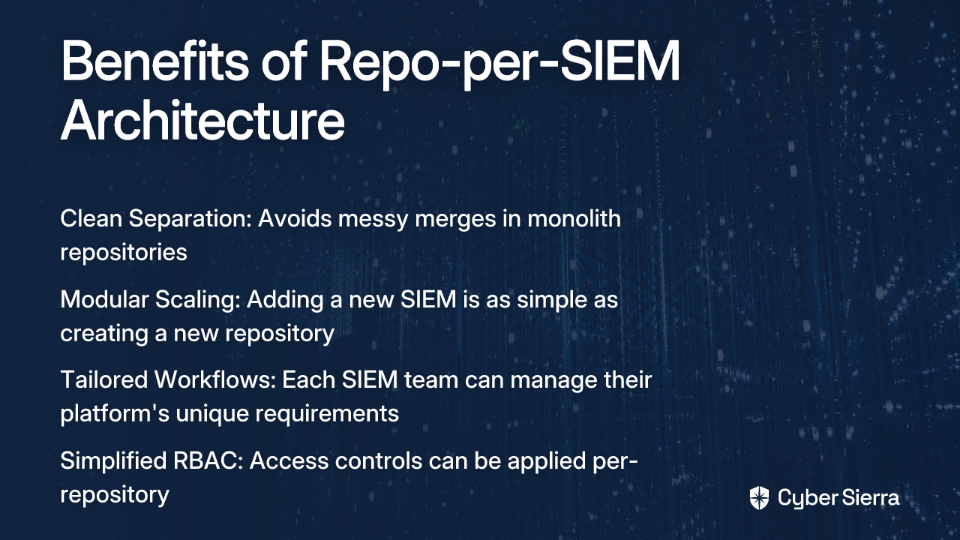
One security engineer endorsed this approach saying, "I would personally do a repo per SIEM, this will help keep things logically separated."
Building the Automation Engine: CI/CD Workflow
The heart of any Detection as Code implementation is the CI/CD pipeline that automates testing and deployment. Here's how to build one that scales:
1. Developer Workflow
- An engineer creates a detection in a feature branch within the central library
- Detection is written in a generic format (like Sigma)
- PR request is submitted for review
2. Automated Testing
When the PR is created, the CI/CD pipeline springs into action:
- Syntax Validation: Ensures the detection follows proper format
- Unit Tests: Verifies the rule correctly identifies known-good and known-bad patterns
- Integration Tests: Checks for conflicts with existing rules
3. Cross-Platform Deployment
After approval and merging to the main branch:
- Central pipeline validates the merge
- Triggers downstream pipelines in each SIEM-specific repository
- Each SIEM pipeline:
- Pulls the generic rule
- Translates it to the platform's native query language
- Applies platform-specific templates
- Manages secrets securely
- Deploys to the appropriate environment

Practical Implementation Tips
Use Submodules to Share Common Logic
Git submodules allow you to include the central library in each SIEM-specific repository while maintaining separation:
# Adding the central library as a submodule
git submodule add https://github.com/your-org/detection-library.git lib
This approach keeps generic content centralized while allowing platform-specific customizations.
Embrace Test-Driven Development
Before writing any detection rule, create a test case first:
- Generate or find a log sample representing the malicious activity
- Write a test that validates your rule will catch this activity
- Develop the detection rule until it passes the test
This ensures your detections are actually effective before deployment.
Standardize Metadata
Develop a consistent schema for rule metadata across all platforms:
metadata:
  name: "Suspicious PowerShell Command Line"
  description: "Detects suspicious PowerShell commands"
  severity: "high"
  mitre_attack:
    - "T1059.001"
  author: "Security Team"
  date_created: "2023-10-15"
This enables cross-platform reporting and management.
Proving Value and Gaining Buy-In
Many security teams struggle with "getting funds for security tools, and getting people's buy-in for implementing the processes needed." To overcome this hurdle, focus on demonstrating tangible value:
Start Small with a Proof of Concept
As one practitioner advised, if you're "starting out and want to build a POC to prove value," select one SIEM and a handful of high-value rules to automate. This shows immediate benefits without requiring a complete infrastructure overhaul.
Track Metrics That Matter
Measure and report on:
- Time Saved: Compare manual vs. automated deployment time
- Error Reduction: Track deployment failures before/after automation
- Detection Coverage: Map all rules to MITRE ATT&CK to visualize gaps
- Alert Quality: Monitor false positive rates across platforms
Common Pitfalls to Avoid
- Over-Engineering: Start simple and iteratively improve
- Neglecting Testing: Without automated tests, you'll lose confidence in deployments
- Ignoring Platform Differences: Each SIEM has unique quirks that generic approaches may miss
- Failing to Document: Clear documentation is essential for team adoption
Conclusion
Scaling Detection as Code across 10+ SIEM platforms is challenging but achievable with the right architecture and automation. The repo-per-SIEM approach with a central library provides the flexibility needed to handle platform-specific requirements while maintaining consistency in your detection logic.
For security engineers with "unconventional backgrounds" or those "panicking" about new automation responsibilities, take heart. Detection as Code provides a structured framework that makes managing complex security environments more approachable and reliable.
By implementing proper CI/CD pipelines, embracing test-driven development, and focusing on proving value through metrics, you can transform a chaotic, multi-platform security environment into a well-orchestrated detection program that scales with your organization's needs.
Remember, as your detection program grows, complexity will inevitably increase. The key is developing systems that manage this complexity rather than being overwhelmed by it.
Frequently Asked Questions
What is Detection as Code (DaC)?
Detection as Code (DaC) is the practice of managing security detection rules using principles from software development, such as version control, automated testing, and CI/CD pipelines. Instead of manually creating and updating rules in each security platform's UI, you define them as code in a central repository. This allows for consistent, high-quality detections that can be automatically deployed across multiple systems, significantly reducing manual effort and errors.
Why is managing security rules across multiple SIEMs so challenging?
Managing security rules across multiple SIEMs is challenging due to fundamental differences between the platforms, including divergent query languages (e.g., SPL vs. KQL), inconsistent data models and field names, and unique deployment processes for each system. These inconsistencies mean a rule written for one platform cannot be simply copied to another. It requires manual translation and testing, which becomes exponentially more complex and error-prone as the number of platforms and rules grows.
What is the best repository structure for multi-SIEM Detection as Code?
The most effective and scalable structure is the "repo-per-SIEM" strategy, which uses a central "library" repository for platform-agnostic logic and separate, dedicated repositories for each specific SIEM platform (e.g., Splunk, Sentinel). The central library acts as a single source of truth for all detection logic, often using a universal format like Sigma. Each platform-specific repository then pulls from this library, translating and tailoring the rules for its unique environment. This modular approach avoids complex branching strategies, simplifies access control, and makes it easy to add or remove platforms.
How does a CI/CD pipeline improve Detection as Code?
A CI/CD (Continuous Integration/Continuous Deployment) pipeline automates the entire lifecycle of a detection rule, from validation and testing to deployment across multiple platforms. When a new rule is proposed, the pipeline automatically runs syntax checks, unit tests, and integration tests to ensure its quality and prevent conflicts. Once approved, the pipeline manages the translation of the generic rule into platform-specific formats and deploys it, ensuring that security detections are rolled out quickly, consistently, and reliably.
What is a good first step to implement Detection as Code?
The best way to start is with a small, focused Proof of Concept (POC). Instead of attempting a full-scale overhaul, select one SIEM platform and a few high-value detection rules to automate. By successfully automating this small set, you can demonstrate tangible value—such as time saved and reduced errors—to gain buy-in and funding for a broader implementation.
How can I measure the value of a Detection as Code program?
You can measure the value of a DaC program by tracking key metrics that demonstrate improvements in efficiency, quality, and security coverage. Focus on metrics that resonate with leadership, such as a reduction in the time required to deploy new detections, a decrease in deployment errors and rollbacks, an increase in detection coverage mapped to frameworks like MITRE ATT&CK, and an improvement in alert quality measured by a lower false positive rate.
