



Dangers of AI in the Enterprise Landscape


Join thousands of professionals and get the latest insight on Compliance & Cybersecurity.
You've enthusiastically adopted AI systems across your enterprise to boost productivity, automate routine tasks, and gain competitive advantages. But when you open the news and see another organization falling victim to a sophisticated AI-enabled attack or facing massive reputational damage from an AI mishap, a sinking feeling hits your stomach. Have you fully grasped the dangers lurking beneath the surface of these powerful technologies?
The modern enterprise exists in a precarious balance between AI's transformative promise and its perilous potential. While many discussions focus on existential threats or science fiction scenarios, the immediate dangers of AI in enterprise settings are far more concrete and pressing.
Today's business leaders are rightfully concerned about eroding trust in what's real, sophisticated scams using deepfake technology, and the amplification of existing biases. These aren't hypothetical future threats—they're already materializing across industries, creating unprecedented security risks for enterprises unprepared for AI's darker implications.
This article explores the most critical dangers of AI in the enterprise landscape and provides a structured framework for navigating these treacherous waters safely.

The Trust and Truth Crisis: Misinformation, Scams, and Hallucinations
The enterprise landscape increasingly resembles a digital battlefield where truth itself is under siege. AI has dramatically lowered the barriers to creating convincing false information, presenting three immediate dangers to organizations:
Automated Disinformation and Market Manipulation
AI enables bad actors to generate and distribute false information at unprecedented scale and speed. This goes beyond political manipulation to direct business impacts. Forbes reports instances where fabricated but realistic-looking AI-generated images caused temporary stock market fluctuations—a preview of how market manipulation tactics are evolving.
More concerning is the rise of automated defamation, where AI systems generate false and damaging claims about executives or companies with such volume and apparent authenticity that reputational damage occurs before fact-checking can catch up.
The Surge in AI-Powered Scams and Social Engineering
The fear that "AI can be used for scams, like using deepfake technology to clone voices" has become reality. According to McKinsey research, there's been a staggering 1200% surge in phishing attacks since the rise of generative AI in late 2022.
Today's scammers use AI to:
- Craft hyper-personalized phishing emails that bypass traditional security filters
- Generate convincing fake websites indistinguishable from legitimate corporate sites
- Clone executive voices for fraudulent authorization calls
- Create deepfake video for impersonation in virtual meetings
The sophistication of these attacks has increased while the technical barriers and costs have plummeted, creating a perfect storm of security risk for enterprises.
The Unreliability of AI "Hallucinations"
Even well-intentioned AI deployments present a danger through "hallucinations"—instances where AI systems confidently provide completely fabricated information. In enterprise contexts, this creates substantial risks:
- Customer support chatbots providing incorrect product information or dangerous advice
- Internal knowledge systems generating false but convincing documentation
- Decision-support tools presenting fabricated data as factual insights
As one Redditor noted, "AI misinterpreting commands could lead to unexpected and harmful outcomes." When these hallucinations occur in high-stakes business environments, the consequences can be severe, from compliance violations to customer harm.
The Operational Minefield: Internal Biases, Shadow IT, and Skill Erosion
While external threats command attention, equally dangerous risks emerge from within the organization's own AI implementations and adoption patterns.
Pervasive and Amplified Algorithm Bias
The concern that "AI can amplify biases already present in data" represents a profound danger to enterprises. AI systems trained on historical data inevitably replicate and often magnify existing biases, creating significant legal and reputational risks.
TechTarget research documents cases of algorithm bias manifesting in:
- Hiring systems that disadvantage certain demographic groups
- Loan approval algorithms that perpetuate historical discrimination patterns
- Customer service routing that provides inferior service to specific communities
- Marketing systems that reinforce harmful stereotypes
For enterprises, these biases create tangible dangers beyond ethical concerns—they expose organizations to discrimination lawsuits, regulatory penalties, and lasting brand damage.
The "Shadow IT" Epidemic and The Great Data Heist
Perhaps the most alarming operational danger is the uncontrolled proliferation of AI tools throughout organizations. According to TechTarget, in some companies, as many as 78% of employees use unauthorized AI tools, creating a massive shadow IT problem.
Employees routinely paste proprietary data, confidential information, and sensitive materials into public AI systems without understanding the privacy implications. This creates multiple dangers:
- Intellectual property leakage into public AI training datasets
- Potential violations of data protection regulations
- Exposure of competitive intelligence and strategic plans
- Creation of backdoors into secure corporate systems
Forbes describes this phenomenon as "The Great Data Heist," where AI's use of copyrighted or private material for training constitutes a form of intellectual property theft—except in this case, employees are unwittingly the accomplices.
Lack of Trust and the "Black Box" Problem
A KPMG report cited by TechTarget reveals that 61% of respondents are either ambivalent or unwilling to trust AI. This distrust stems largely from the opacity of AI decision-making—the "black box" problem.
Without Explainable AI (XAI) capabilities, enterprises face dangers including:
- Inability to audit or verify AI-based decisions
- Difficulties defending AI-driven processes in regulatory reviews
- Challenges in diagnosing and correcting AI errors
- Resistance to adoption from both employees and customers
The Erosion of Critical Human Skills
Beyond the immediate concern that "AI will cost jobs," lies a subtler but more pervasive danger: the gradual erosion of key human skills as enterprises become increasingly dependent on AI systems.
When organizations over-rely on AI for tasks that previously required human judgment, critical thinking, and specialized knowledge, they risk creating dangerous capability gaps. If AI systems fail or face novel situations they weren't trained for, the enterprise may lack the human expertise to intervene effectively.
The Cybersecurity Battlefield: AI as a Double-Edged Sword
In no area is the danger of AI in enterprise more acute than cybersecurity, where AI functions simultaneously as both the most significant threat and the most essential defense.
AI as the Attacker's Force Multiplier
McKinsey's analysis details how AI has become a force multiplier for attackers. Criminal organizations and nation-states now use AI to:
- Automate the creation of highly convincing phishing campaigns
- Generate novel malicious code that evades traditional detection
- Discover and exploit previously unknown vulnerabilities
- Optimize attack timing and victim selection
These AI-enhanced capabilities have dramatically reduced "breakout times"—the period between initial access and lateral movement within networks—often to less than an hour, giving defenders almost no time to respond.
Attacks on AI Systems
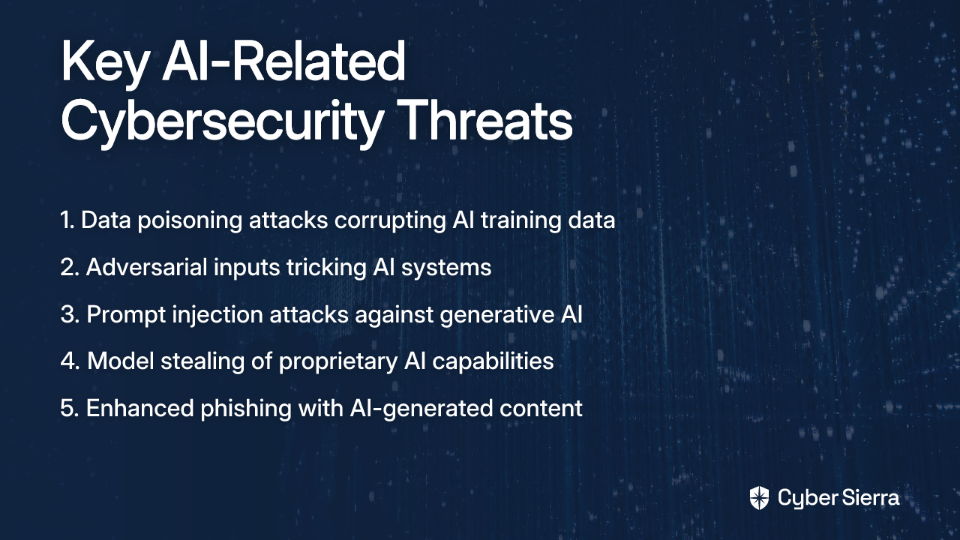
The Department of Homeland Security guidelines highlight another emerging danger: attacks targeting the AI systems themselves. These include:
- Data poisoning attacks that corrupt training data
- Adversarial inputs designed to trick AI systems into making specific mistakes
- Prompt injection attacks against generative AI interfaces
- Model stealing to replicate proprietary AI capabilities
As enterprises build Retrieval Augmented Generation (RAG) systems that connect AI to internal knowledge bases, these attacks present particularly severe dangers, potentially exposing sensitive information or corrupting decision processes.
AI as an Essential Defense Mechanism
Despite these risks, AI has become indispensable for cybersecurity defense. Modern security architectures like Zero Trust increasingly depend on AI to:
- Analyze vast datasets in real-time to detect anomalies
- Reduce mean time to respond to threats
- Automate routine security tasks
- Identify novel attack patterns before they cause damage
This creates a cybersecurity arms race where the danger of AI in enterprise contexts is matched only by the danger of failing to deploy AI defensively.
A Path Forward: Implementing a Framework for Responsible AI Adoption
To navigate these complex dangers, enterprises need more than ad-hoc policies—they need a comprehensive, structured approach to AI risk management.
The National Institute of Standards and Technology (NIST) AI Risk Management Framework (AI RMF), released on January 26, 2023, provides exactly such a framework. This voluntary but authoritative framework helps organizations incorporate trustworthiness considerations throughout the AI lifecycle.
The framework is built around four core functions:
- Govern: Establish a strong culture of AI risk management with clear policies, defined roles and responsibilities, and C-suite involvement.
- Map: Identify all AI systems in use across the enterprise, understand their context, and create comprehensive risk profiles for each deployment.
- Measure: Develop quantitative and qualitative methods to analyze AI risks, including testing for bias, performance issues, and security vulnerabilities.
- Manage: Prioritize identified risks, allocate resources for mitigation, and implement ongoing monitoring processes to ensure safety and security.
NIST provides supporting resources including the AI RMF Playbook with practical implementation strategies and a specific Generative AI Profile addressing the unique risks of models like ChatGPT and other generative systems.
Conclusion
The dangers of AI in the enterprise landscape are real, immediate, and multifaceted—from the erosion of truth and trust through disinformation, to the operational risks of bias and shadow IT, to the evolving cybersecurity battlefield where AI serves as both weapon and shield.
However, these dangers need not derail the transformative potential of AI. By adopting structured governance frameworks like the NIST AI RMF, enterprises can manage security risks of AI effectively, build trustworthy systems, and transform AI from a potential liability into a reliable strategic asset.
The path forward isn't to avoid AI adoption but to embrace it with clear-eyed awareness of its dangers and a commitment to responsible, thoughtful implementation.
Frequently Asked Questions
What are the main dangers of AI for an enterprise?
The main dangers of AI for an enterprise include the spread of misinformation and sophisticated scams, the amplification of algorithmic bias, uncontrolled data leakage through "Shadow IT," and new cybersecurity threats from AI-powered attacks. These risks can lead to financial loss, reputational damage, and legal penalties if not properly managed.
How can AI-powered scams target my business?
AI-powered scams can target your business through highly realistic and personalized attacks. Scammers use AI to generate convincing phishing emails that evade security filters, create deepfake voice clones of executives to authorize fraudulent transactions, and build fake websites or video impersonations for social engineering schemes.
What is an AI hallucination and why is it dangerous?
An AI hallucination is when an AI model confidently generates false or completely fabricated information. This is dangerous in an enterprise setting because it can lead to customer support bots giving harmful advice, internal systems creating incorrect documentation, or decision-making tools relying on fabricated data, resulting in poor business outcomes and potential liability.
Why is "Shadow IT" a significant AI risk?
"Shadow IT" is a significant AI risk because it involves employees using unauthorized AI tools, often by pasting sensitive company data into public platforms. This can lead to the unintentional leakage of intellectual property, confidential information, and strategic plans, creating severe data security and privacy vulnerabilities for the organization.
How does AI amplify bias in business?
AI amplifies bias by learning from historical data that contains existing human biases. If an AI model is trained on biased hiring or loan data, for example, it will not only replicate but often magnify those discriminatory patterns at scale, exposing the enterprise to legal challenges, brand damage, and unfair outcomes in hiring, marketing, and customer service.
What is the NIST AI Risk Management Framework?
The NIST AI Risk Management Framework (AI RMF) is a voluntary guide designed to help organizations manage the risks associated with artificial intelligence. It provides a structured approach with four core functions—Govern, Map, Measure, and Manage—to help enterprises build trustworthy and responsible AI systems throughout their entire lifecycle.
