



PII vs PHI vs PCI - What's the difference?



Join thousands of professionals and get the latest insight on Compliance & Cybersecurity.
You've been tasked with managing sensitive data at your organization, when suddenly you encounter a flurry of acronyms: PII, PHI, PCI. Everyone seems to expect you to understand the distinctions, but the subtle differences between these terms can be confusing even for experienced professionals.
When these terms get mixed up, the consequences can be severe. As one security professional put it, "a data breach of any of these can be catastrophic to an organization." Yet many companies don't prioritize proper data classification "UNTIL shit hits the fan"—and by then, it's usually too late.
This guide will demystify these critical data protection categories, clarify the regulations that govern them, and provide practical steps to safeguard this information within your organization.

What is Personally Identifiable Information (PII)?
Personally Identifiable Information (PII) is the broadest category of sensitive data. It encompasses any information that can be used to identify a specific individual, either directly or when combined with other data.
Types of PII
PII can be divided into two main categories:
- Direct Identifiers: Information that can immediately identify an individual:
- Full name
- Social Security Number (SSN)
- Driver's license number
- Passport number
- Email address
- Physical address
- Phone number
- Biometric data (fingerprints, retina scans)
- Quasi-Identifiers (or Linkable Information): Data points that may not identify someone on their own but could be combined with other information to identify an individual:
- Date of birth
- Race or gender
- Zip code
- Job title and employer
- Education information
- Mother's maiden name

Sensitive vs. Non-sensitive PII
Not all PII carries the same level of risk:
- Sensitive PII: Information that, if disclosed, could result in substantial harm, embarrassment, or inconvenience to an individual. This includes medical records, financial information, and SSNs. This data must be encrypted both when stored (data at rest) and when transmitted (data in flight).
- Non-sensitive PII: Information that can be transmitted in an unencrypted format and is generally available from public sources, like a work phone number or zip code.
Regulatory Landscape
PII protection varies by jurisdiction. Key regulations include:
- The European Union's General Data Protection Regulation (GDPR)
- The California Consumer Privacy Act (CCPA)
- Various state-level privacy laws in the US
These regulations grant individuals certain rights over their personal data, including what some call "the right to be forgotten"—the ability to request deletion of personal information.
What is Protected Health Information (PHI)?
Protected Health Information (PHI) is a specific subset of PII that relates to an individual's health status, healthcare provision, or payment for healthcare services.
The Relationship Between PHI and PII
As noted by experts at Nightfall.ai, all PHI is PII, but not all PII is PHI. What transforms health information into PHI is its connection to an identifiable individual and its relationship to healthcare.
HIPAA: The Guardian of Health Data
In the United States, PHI is federally protected by the Health Insurance Portability and Accountability Act (HIPAA). The HIPAA Privacy Rule establishes national standards to protect individuals' medical records and other identifiable health information.
What Constitutes PHI?
According to regulations, HIPAA identifies 18 specific identifiers that can turn health information into PHI. Common examples include:
- Patient names and medical record numbers
- Dates of service (admission, discharge, treatment)
- Diagnostic information and test results
- Billing information from doctors or hospitals
- Conversations between patients and healthcare providers
- Insurance information related to healthcare
- Prescription information
The Variable Compliance Landscape
Unfortunately, as one IT professional observed, "Every hospital is different in their priorities, with some taking considerations to avoid HIPAA consequences and others simply not caring UNTIL shit hits the fan." This inconsistency creates significant risks for healthcare organizations and their patients.
What is Payment Card Industry (PCI) Data?
Payment Card Industry (PCI) data refers specifically to cardholder information used in payment card transactions. This is distinct from general financial information, creating what one professional described as "a subtle distinction between PCI and PII."
PCI DSS: The Industry Standard
PCI data is protected by the Payment Card Industry Data Security Standard (PCI DSS), an information security standard developed by major credit card companies including Visa, Mastercard, American Express, Discover, and JCB.
Unlike HIPAA, which is a federal law, PCI DSS is an industry standard. However, compliance is effectively mandatory for any business that processes credit card payments.
What Constitutes PCI Data?
PCI data includes:
- Primary Account Number (PAN) or credit card number
- Cardholder name
- Expiration date
- Service code
- Sensitive authentication data:
- Full magnetic stripe data
- CAV2/CVC2/CVV2/CID (the security codes on cards)
- PINs and PIN blocks
The 12 Core Requirements
The PCI DSS framework is built around 12 requirements organized into six control objectives:
- Build and maintain a secure network
- Protect cardholder data
- Maintain a vulnerability management program
- Implement strong access control measures
- Regularly monitor and test networks
- Maintain an information security policy
PII vs PCI vs PHI: The Key Differences at a Glance
| Category | Personally Identifiable Information (PII) | Protected Health Information (PHI) | Payment Card Industry (PCI) Data |
|---|---|---|---|
| Scope | Broadest category; any data that identifies an individual | Health-related data that can identify an individual | Payment card data used in transactions |
| Regulation | Varies by jurisdiction (GDPR, CCPA, etc.) | HIPAA in the United States | PCI DSS (global industry standard) |
| Examples | Name, SSN, email, date of birth, driver's license | Medical records, health insurance ID, lab results | Credit card number, CVV, expiration date |
| Relationship | The parent category | A subset of PII | May overlap with PII but is distinct |
Why It Matters: The High Stakes of Non-Compliance
The consequences of mishandling these data types extend far beyond mere regulatory inconvenience:
Legal and Financial Penalties
- HIPAA violations can result in fines ranging from $100 to $50,000 per violation (with an annual maximum of $1.5 million)
- PCI DSS non-compliance can lead to fines from $5,000 to $100,000 per month, increased transaction fees, and even loss of card processing privileges
- Data privacy lawsuits can result in significant settlements
Reputational Damage
Consumer trust is fragile and hard to rebuild. As one frustrated user described trying to get a telecom provider to delete their SSN: "I might as well have shoveled against the tide." This kind of experience damages brand loyalty and customer confidence.
Operational Disruption
Following a breach, organizations must divert significant resources to investigation, remediation, and future prevention—taking focus away from core business functions.
A Blueprint for Data Protection
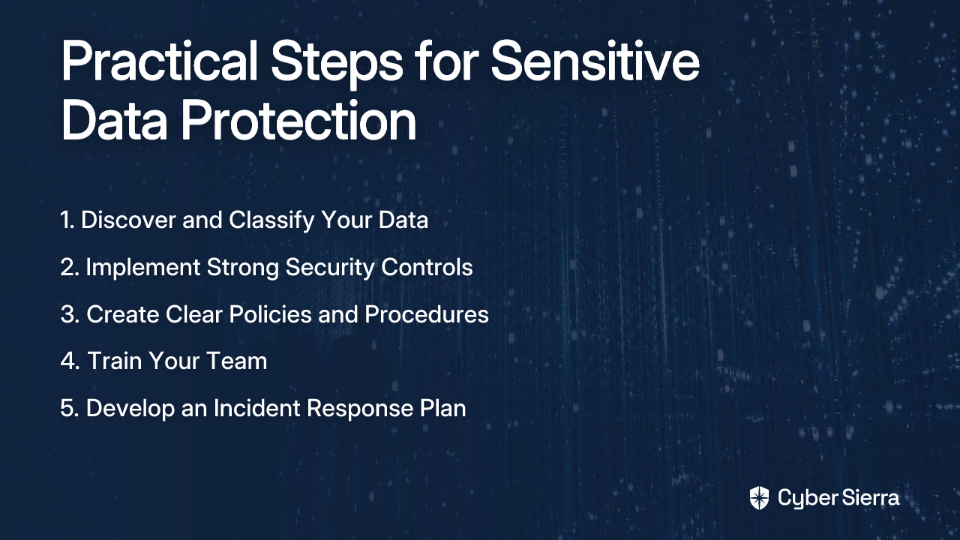
Many security professionals inherit "a bit of a mess" with "tons of shadow IT" and struggle because they "just don't know where it all lives." Here's a practical approach to gain control:
1. Discover and Classify Your Data
You can't protect what you don't know you have. Implement tools and processes to scan systems for sensitive data:
- For unstructured data scanning, consider tools like BigID
- For Data Loss Prevention (DLP) and controlling data movement, look at Netskope
- For comprehensive monitoring (though more expensive), Varonis is an option
- For budget-conscious organizations, explore open-source options like PII Tools or built-in capabilities in Microsoft Defender
2. Implement Strong Security Controls
- Use encryption for sensitive data both at rest and in transit
- Apply the principle of least privilege for access controls
- Implement multi-factor authentication for accessing sensitive systems
- Maintain a vulnerability management program with regular patching
3. Create Clear Policies and Procedures
Document how different data types should be handled, stored, and transmitted throughout your organization.
4. Train Your Team
Address the problem of "bad habits" and "people that just don't know any better" through regular security awareness training.
5. Develop an Incident Response Plan
When incidents do occur—like when "two idiot users get their laptops stolen out of their cars in the same week"—you need a clear plan for containment, investigation, notification, and recovery.
Conclusion
Understanding the distinctions between PII, PHI, and PCI isn't just about compliance checkboxes—it's fundamental to modern data governance and security strategy. Each category carries its own regulatory requirements and security considerations.
By implementing a comprehensive approach to discovering, classifying, and protecting sensitive data, you can avoid the all-too-common scenario where organizations don't care "UNTIL shit hits the fan." In today's data-driven world, proactive protection of sensitive information isn't optional—it's essential for survival and trust.
Remember: The time to understand the difference between PII vs PCI vs PHI is before you face a breach, not after.

Frequently Asked Questions (FAQ)
What is the main difference between PII and PHI?
The main difference is that Protected Health Information (PHI) is a specific type of Personally Identifiable Information (PII) that is directly related to an individual's health, healthcare services, or payment for healthcare. Essentially, all PHI is considered PII, but not all PII is PHI. For example, your name is PII, but it only becomes PHI when linked to your medical history or a doctor's visit.
Is PCI DSS a law?
No, the Payment Card Industry Data Security Standard (PCI DSS) is not a federal law. It is an information security standard created and enforced by major credit card companies. While not a law like HIPAA, compliance is effectively mandatory for any organization that accepts or processes credit card payments, as non-compliance can lead to severe fines and loss of payment processing privileges.
How are PII, PHI, and PCI data regulated?
Each data type is governed by different regulations. PII is regulated by broad privacy laws like Europe's GDPR and California's CCPA. PHI is specifically protected by the Health Insurance Portability and Accountability Act (HIPAA) in the United States. PCI data is governed globally by the PCI DSS industry standard.
What is the first step to protecting sensitive data in an organization?
The first and most critical step is data discovery and classification. You cannot protect sensitive information if you do not know where it is located within your systems. Begin by using tools and processes to scan your entire digital environment to find where PII, PHI, and PCI data reside. This foundational step informs all subsequent security measures.
Can information like a zip code be considered sensitive PII?
By itself, a zip code is typically considered non-sensitive PII. However, it can become part of a sensitive data set when combined with other quasi-identifiers (like date of birth and gender) to identify a specific individual. The context is key; the more data points you link together, the more sensitive the combined information becomes.
Why is the distinction between PII, PHI, and PCI so important?
The distinction is crucial because each category is governed by different rules, requires different security controls, and carries different penalties for non-compliance. Misclassifying data can lead to significant security gaps and legal violations. For instance, treating PHI with the same controls as generic PII would likely violate HIPAA and result in massive fines.
