



Beyond the Checkbox: The Case for Continuous Risk Assessment


Join thousands of professionals and get the latest insight on Compliance & Cybersecurity.
You've just completed your annual risk assessment. The documentation is meticulously filed, the compliance checkboxes are ticked, and leadership has signed off on the report. Everyone breathes a sigh of relief – until six months later when a zero-day vulnerability emerges, a key vendor suffers a breach, or your organization adopts a new technology that wasn't even on the radar during your last assessment.
Sound familiar? You're not alone.
"Many companies only conduct one-time assessments when an incident occurs or when compliance requirements are met," according to cybersecurity professionals. This reactive approach leaves organizations vulnerable in our rapidly evolving threat landscape, creating "delayed risk identification and difficulty in adjusting risk control measures as the environment changes."
Why Traditional Risk Assessments Fail
Traditional point-in-time risk assessments have become the corporate equivalent of checking a box – a perfunctory exercise done primarily for compliance with NIST 800-53, ISO 27001, or other frameworks rather than for actual security improvement.
This "checkbox exercise" mentality creates several critical problems:
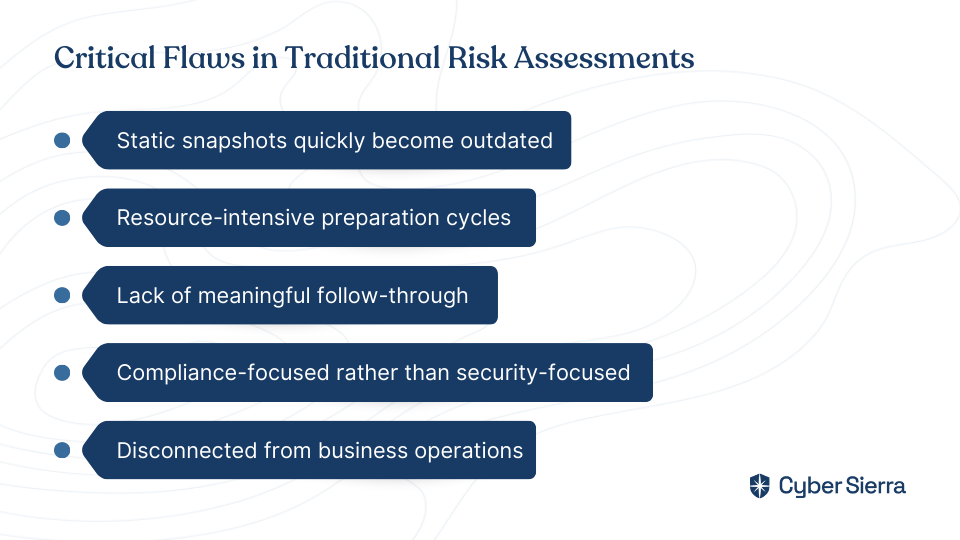
1. Rapidly Outdated Information
Risk is not a static entity. A risk assessment conducted in January may be woefully inadequate by March due to:
- Emerging vulnerabilities in your technology stack
- Changes in your business processes or environment
- New regulatory requirements
- Shifts in the threat landscape
According to Wolters Kluwer, "Using historical data to anticipate future risk events is becoming increasingly difficult. Rapidly changing environments demand real-time insight into emerging risks."
2. Resource-Intensive Scrambles
Annual risk assessments often trigger frantic preparation periods, pulling teams away from other critical tasks. This high-pressure environment creates conditions where:
- Documentation gets hastily updated just before review
- Teams play "CYA games" rather than honestly assess vulnerabilities
- The focus shifts to passing the assessment rather than improving security
3. Lack of Actionable Follow-Through
Perhaps most concerning is what happens after the assessment. As one security professional laments, "My biggest issue is action after risk assessment or rather inaction after risk assessment. 'Acceptance' is traditionally what I deal with the most when the bare minimum would easily mitigate the problem."
This inaction renders even the most thorough assessment meaningless.
The Continuous Risk Assessment Alternative
Continuous risk assessment (CRA) represents a fundamental shift in approach – from risk management as an event to risk management as an ongoing process integrated into daily operations.
What is Continuous Risk Assessment?
Continuous risk assessment is an ongoing, iterative process that:
- Consistently monitors the organization's risk landscape
- Dynamically updates risk evaluations as conditions change
- Enables proactive rather than reactive risk management
- Integrates risk awareness into everyday operations
Unlike traditional assessments that produce static reports, CRA creates a living risk profile that evolves with your organization and the threat landscape.
A Practical Framework for Implementation
Transforming from periodic to continuous risk assessment requires a structured approach. Here's a practical framework:
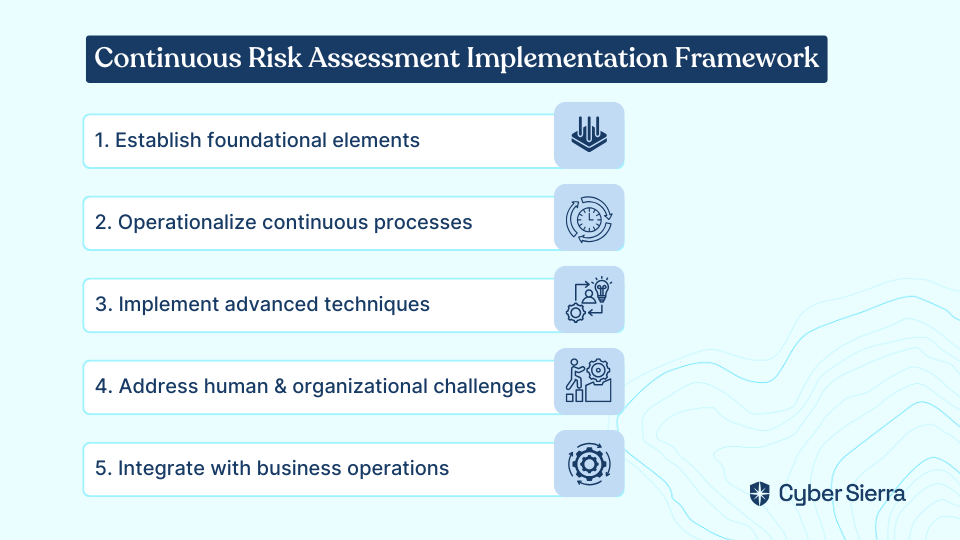
1. Foundational Elements
Start by establishing these essential components:
Situation Evaluation: Implement continuous monitoring tools (network monitoring, intrusion detection systems) to analyze operational conditions in real-time rather than snapshots.
Comprehensive Asset Inventory: Create and maintain a detailed, automated catalog of all assets (hardware, software, data), their location, and business roles. You can't protect what you don't know exists.
Regular Vulnerability Assessment: Conduct automated scanning and penetration testing on a scheduled basis to identify security gaps before they can be exploited.
Risk Prioritization Matrix: Establish a clear risk matrix to prioritize threats based on likelihood and impact, ensuring resources are allocated to the most critical issues first.
Impact Analysis Framework: Analyze potential financial, reputational, and regulatory consequences of breaches to inform mitigation strategies.
Role Definition: Use a Responsibility Assignment Matrix (RACI) to clearly delineate who is Responsible, Accountable, Consulted, and Informed for each task. This helps avoid situations where someone is "voluntold to be the project manager."
2. Operationalizing Continuous Assessment
With foundational elements in place, implement these operational processes:
Automated Data Collection: Deploy tools that continuously gather risk-relevant data from across your organization.
Dynamic Risk Scoring: Implement systems that automatically update risk scores based on new data, changing conditions, or emerging threats.
Regular Cadence of Reviews: Schedule brief, focused risk reviews at regular intervals (weekly, monthly, quarterly) instead of comprehensive annual reviews.
Integration with Change Management: Ensure any significant organizational, technological, or process change triggers an automatic risk evaluation.
3. Advanced Techniques for Mature Organizations
For organizations with mature risk management practices, consider implementing:
The Bow-Tie Model: This dynamic risk analysis approach creates visual representations of risk pathways, showing events that could cause an incident (the left side of the bow tie) and consequences that could follow (the right side).
According to research published in Science Direct, the dynamic Bow-Tie model updates risk probabilities in real-time by using:
- Physical reliability models that incorporate real-time monitored parameters
- Bayesian updating that applies new incident or near-miss data to refine probability estimates
Threat Intelligence Integration: Incorporate external threat intelligence feeds to provide early warning about emerging risks relevant to your industry or technology stack.
Overcoming the Human Challenges
While the technical aspects of continuous risk assessment are critical, the human element often presents the greatest challenges. As one security professional bluntly states, "People & alignment are by far the biggest hurdles. Without leadership buy-in & cross-team collaboration, risk assessments often become checkbox exercises rather than meaningful processes."
Here's how to address these challenges:
Securing Leadership Alignment
Leadership support is "the root cause for almost all cases" of risk assessment failure, according to cybersecurity practitioners. To gain and maintain this crucial support:
- Translate Risk into Business Impact: Frame risk discussions in terms of business objectives, customer trust, and financial implications rather than technical vulnerabilities.
- Provide Digestible Insights: Create executive dashboards that present risk data in a clear, actionable format that non-technical leaders can understand and act upon.
- Demonstrate ROI: Show how continuous risk assessment leads to more efficient resource allocation, fewer security incidents, and reduced recovery costs.
Fostering Cross-Team Collaboration
Continuous risk assessment requires input and action from across the organization:
- Establish Clear Roles and Responsibilities: Use the RACI matrix mentioned earlier to ensure everyone understands their part in the process.
- Create Cross-Functional Risk Committees: Bring together representatives from IT, security, legal, operations, and business units to ensure comprehensive risk evaluation.
- Develop Common Language: Address the communication challenge of "getting people to understand what we are actually doing, by using their own words, or by teaching them ours."
Combating Apathy and Checkbox Mentality
To move beyond what one professional calls "senior management apathy and incompetence" and another describes as "Auditors and management only interested in ticking boxes":
- Make Risk Tangible: Use scenarios and simulations to demonstrate the real-world impact of identified risks.
- Celebrate Risk Management Wins: Recognize and reward proactive risk identification and mitigation.
- Implement Accountability Mechanisms: Establish clear ownership of risks and track follow-through on mitigation actions.
From Compliance to Resilience
Continuous risk assessment represents a fundamental shift from viewing security as a compliance requirement to embracing it as a business enabler. By adopting dynamic update mechanisms and implementing robust continuous monitoring processes, organizations can:
- React swiftly to emerging threats
- Allocate security resources more effectively
- Foster genuine cross-team collaboration
- Transform risk management from a periodic burden to an ongoing advantage
As threats evolve at an unprecedented pace, organizations can no longer afford the dangerous illusion of security that point-in-time assessments provide. Moving beyond the checkbox to continuous risk assessment isn't just a best practice—it's becoming an operational necessity.
The question is no longer whether your organization should implement continuous risk assessment, but how quickly you can make the transition. In a world where yesterday's risk assessment is already outdated, continuous monitoring and dynamic risk management may be your only sustainable path forward.
For organizations ready to take this journey, the benefits are substantial – not just in security posture, but in operational efficiency, leadership confidence, and organizational resilience.
Frequently Asked Questions
What is continuous risk assessment?
Continuous risk assessment (CRA) is an ongoing, iterative process that consistently monitors and dynamically updates an organization's risk profile. Unlike traditional assessments that create a static snapshot in time, CRA integrates risk management into daily operations, allowing for proactive responses to changing threats and business conditions.
Why are traditional, point-in-time risk assessments failing?
Traditional risk assessments are failing because they become outdated very quickly in today's rapidly changing threat landscape. They are often treated as a periodic, resource-intensive "checkbox exercise" for compliance, which can lead to delayed risk identification, a false sense of security, and a lack of meaningful, actionable follow-through to improve security posture.
How can an organization begin implementing continuous risk assessment?
To start implementing continuous risk assessment, an organization should first establish foundational elements like a comprehensive asset inventory, automated vulnerability scanning, and a clear risk prioritization matrix. The next step is to operationalize the process through automated data collection, dynamic risk scoring, and integrating risk evaluation into the change management process.
What is the biggest challenge in adopting continuous risk assessment?
The biggest challenge is typically the human element, not the technology. Securing genuine leadership buy-in and fostering cross-team collaboration are the most significant hurdles. Without alignment from leadership and cooperation across departments, even the best CRA tools and processes can fail to be effective, devolving into another checkbox exercise.
How does continuous risk assessment benefit a business beyond compliance?
Beyond meeting compliance requirements, continuous risk assessment transforms security into a business enabler, leading to greater organizational resilience. It allows for more effective allocation of security resources, faster reaction to emerging threats, and provides leadership with real-time, actionable insights, ultimately reducing recovery costs and protecting business objectives.
What is the role of leadership in a continuous risk assessment model?
Leadership's role is critical and foundational to the success of continuous risk assessment. They must provide genuine buy-in by championing the process, translating technical risk into business impact, and holding teams accountable. Effective leaders ensure CRA is not just a compliance task but a strategic initiative integrated into the organization's goals.
