



What Are the 5 Titles in HIPAA?



Join thousands of professionals and get the latest insight on Compliance & Cybersecurity.
You've been tasked with developing healthcare software and suddenly someone mentions "HIPAA compliance." Your stomach drops as you imagine being "involved in a legal nightmare" with "serious legal liabilities." You're not alone – even developers with decades of experience admit they would "stay way the hell away from this."
The Health Insurance Portability and Accountability Act (HIPAA) of 1996 can seem like an impenetrable fortress of regulations. However, understanding its structure – specifically its five titles – provides crucial context that can help demystify this complex legislation.
Let's break down what many developers consider a regulatory minefield into manageable components, starting with some fundamental concepts before diving into the 5 HIPAA titles that form the backbone of healthcare data protection in the United States.
HIPAA 101: Core Concepts and Why They Matter
Before exploring the five titles, it's important to understand some key HIPAA concepts:
Protected Health Information (PHI) refers to individually identifiable health information that is transmitted or maintained in any form (electronic, paper, or oral).
Electronic Protected Health Information (e-PHI) is any PHI created, stored, transmitted, or received electronically.
Covered Entities are those required to comply with HIPAA, including:
- Healthcare providers who transmit health information electronically
- Health plans (insurers, company health plans, government programs)
- Healthcare clearinghouses that process nonstandard health information
Business Associates are individuals or organizations performing functions for covered entities that involve using or disclosing PHI. As a developer, if you're building healthcare software, you'll likely fall into this category.
HIPAA compliance goes beyond basic data protection. As one developer noted, "It's much more than just protecting it. For example, it's also about logging and auditing." This means implementing systems that track who accesses data, when, and why – adding layers of complexity to any healthcare software project.

Now, let's examine the 5 titles that comprise HIPAA:
Title I: Health Care Access, Portability, and Renewability
This title represents the "Portability" part of HIPAA and focuses on protecting health insurance coverage for workers and their families.
Key provisions include:
- Ensuring continuous health insurance coverage when workers change or lose jobs
- Limiting denial of coverage for pre-existing conditions
- Prohibiting discrimination based on health status
- Guaranteeing renewability of insurance policies
While Title I mainly affects insurance companies and employers, it's important for developers to understand that HIPAA wasn't originally created just for data privacy – it was designed to solve multiple healthcare challenges, with insurance portability being the first priority.
Title II: The Developer's Focus - Administrative Simplification
Title II is the section most relevant to software developers and contains what many consider the heart of HIPAA regulations. It establishes national standards for electronic healthcare transactions and protects the security and privacy of health information.
The Administrative Simplification provisions can be broken down into five key rules:
1. The Privacy Rule
This rule governs the use and disclosure of PHI, regardless of format (paper, oral, or electronic). It establishes:
- When patient authorization is required to share health information
- Patient rights to access their health information
- Requirements for privacy notices and policies
- Standards for minimum necessary use of PHI
The Privacy Rule applies to all forms of health information, not just electronic records, making it broader in scope than some of the other rules.
2. The Security Rule
While the Privacy Rule covers all PHI, the Security Rule focuses specifically on e-PHI and outlines three categories of safeguards:
Administrative Safeguards: Policies and procedures including risk analysis, workforce security, and contingency planning
Physical Safeguards: Measures to protect physical access to e-PHI, including facility access controls, workstation security, and device and media controls
Technical Safeguards: Technology-based protections including access controls, audit controls, integrity controls, and transmission security (encryption)
This rule directly addresses developer concerns about "logging and auditing," as it requires implementing technical solutions that maintain audit trails and ensure data integrity.

3. The Transactions and Code Sets Rule
This rule standardizes the electronic exchange of healthcare data by mandating the use of standard formats and code sets for all electronic health transactions. This standardization improves efficiency and reduces administrative costs across the healthcare system.
4. The Unique Identifiers Rule
This rule creates standard national identification numbers for healthcare providers, health plans, employers, and patients to streamline electronic transactions. The most commonly used identifier is the Employer Identification Number (EIN).
5. The Enforcement and Breach Notification Rules
These rules establish procedures for:
- Investigating HIPAA complaints
- Penalties for HIPAA violations
- Requirements for notifying individuals following a breach of unsecured PHI
The HHS Office for Civil Rights (OCR) enforces HIPAA rules, with potential penalties ranging from $100 to $50,000 per violation (with an annual maximum of $1.5 million), depending on the level of negligence.
Title III: Tax-Related Health Provisions
Title III focuses on tax matters related to healthcare, which may seem irrelevant to software developers but provides important context for understanding HIPAA's broad scope.
Key provisions include:
- Standardizing regulations for pre-tax medical spending accounts (Medical Savings Accounts or MSAs)
- Providing tax deductions for medical insurance and healthcare expenses
- Extending MSAs to employees of small businesses and self-employed individuals
While Title III has little direct impact on software development, it's part of what makes HIPAA a comprehensive healthcare reform law rather than just a privacy regulation.
Title IV: Application and Enforcement of Group Health Plan Requirements
Title IV builds on Title I by establishing more specific requirements for group health plans. It focuses on:
- Further detailing the protections for individuals with pre-existing conditions
- Setting standards for how group health plans must operate
- Prohibiting discrimination based on health status
- Providing important updates and clarifications to COBRA (Consolidated Omnibus Budget Reconciliation Act) continuation coverage requirements
Like Title III, Title IV primarily affects insurance companies and employers rather than software developers, but it demonstrates HIPAA's comprehensive approach to healthcare reform.
Title V: Revenue Offsets
Title V is perhaps the least discussed title but was necessary to fund HIPAA's various provisions. It includes:
- Regulations for tax deductions related to company-owned life insurance policies
- Provisions regarding the tax treatment of individuals who renounce U.S. citizenship to avoid taxes
- Requirements to publish names of those who expatriate for tax purposes
This title has minimal relevance for healthcare software development but completes our understanding of the 5 HIPAA titles.
Navigating HIPAA with Confidence
Now that you understand the 5 HIPAA titles, you can see that while the law is comprehensive, your focus as a developer will primarily be on Title II's Administrative Simplification provisions, particularly the Privacy and Security Rules.
The complexity is real, but with the right approach, you can navigate HIPAA compliance successfully. Here are actionable steps based on advice from experienced developers:
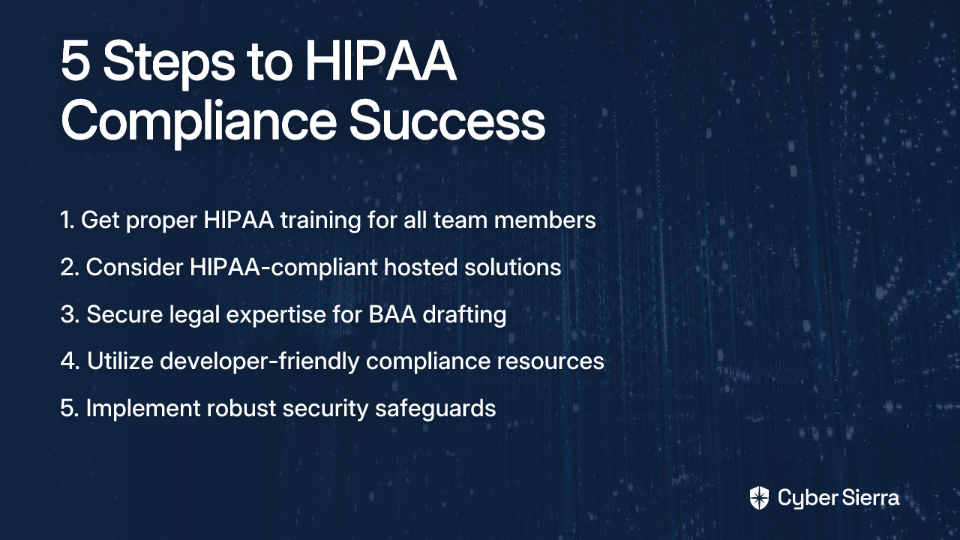
1. Get Trained
"First of all make sure that you and all developers working on this software undergo some HIPAA training." This is non-negotiable. While training can be expensive, it's an essential investment before working with protected health information.
2. Consider Hosted Solutions
"If I had to work with HIPAA data, I'd probably look into a hosted service that manages the data and provides a platform with an API." Services like Twilio offer HIPAA-compliant solutions that handle much of the compliance burden.
3. Secure Legal Expertise
"You will need a high level of encryption and get a HIPAA legal expert to draft a template BAA." Business Associate Agreements (BAAs) are legally binding contracts that define responsibilities for protecting PHI. Don't try to draft these yourself.
4. Utilize Developer-Friendly Resources
The HIPAA Compliance Developers Guide on GitHub provides practical guidance specifically for developers. Additionally, the OWASP Top 10 offers security best practices that form a foundation for HIPAA compliance.
5. Focus on the Security Rule Safeguards
Implement robust administrative, physical, and technical safeguards as required by the Security Rule, with particular attention to encryption, access controls, and audit logging.
Conclusion
While HIPAA's 5 titles may initially seem overwhelming, understanding this structure helps demystify the legislation. For developers, the focus remains primarily on Title II, particularly the Privacy and Security Rules.
Yes, the stakes are high, and the regulations are complex, but with proper training, resources, and professional guidance, you can successfully navigate HIPAA compliance without falling into a "legal nightmare." Rather than "staying way the hell away" from healthcare software, you can approach it with the knowledge needed to build compliant, effective solutions that protect both patients and your career.
By understanding the 5 HIPAA titles and focusing your compliance efforts where they matter most, you transform what many see as an insurmountable obstacle into a manageable challenge – one that opens doors to meaningful work in the healthcare technology space.

Frequently Asked Questions (FAQ)
What are the 5 titles of HIPAA?
The 5 titles of HIPAA are: Title I: Health Care Access, Portability, and Renewability; Title II: Administrative Simplification; Title III: Tax-Related Health Provisions; Title IV: Application and Enforcement of Group Health Plan Requirements; and Title V: Revenue Offsets. Each title addresses a different aspect of healthcare reform, from insurance portability to data privacy and security.
Which HIPAA title is most important for software developers?
Title II, the Administrative Simplification provisions, is the most important part of HIPAA for software developers. This title sets the national standards for protecting the privacy and security of health information, especially electronically. It contains the crucial Privacy Rule and Security Rule, which directly govern how developers must handle Protected Health Information (PHI) and electronic Protected Health Information (e-PHI).
What is the difference between the HIPAA Privacy Rule and Security Rule?
The main difference is their scope: the Privacy Rule applies to all Protected Health Information (PHI) in any form (paper, oral, electronic), while the Security Rule specifically covers electronic Protected Health Information (e-PHI). The Privacy Rule governs how PHI can be used and disclosed, while the Security Rule dictates the administrative, physical, and technical safeguards required to protect e-PHI.
How can developers ensure their software is HIPAA compliant?
Developers can ensure compliance by first undergoing HIPAA training, focusing on the Security Rule's safeguards (access controls, encryption, audit logs), securing legal expertise to draft a Business Associate Agreement (BAA), and considering the use of HIPAA-compliant hosted platforms. Following security best practices, like the OWASP Top 10, also provides a strong foundation for building secure and compliant healthcare software.
What are the consequences of a HIPAA violation?
The consequences of a HIPAA violation can be severe, including significant financial penalties and damage to your reputation. Fines are determined by the level of negligence and can range from $100 to $50,000 per violation, with an annual maximum of $1.5 million. The HHS Office for Civil Rights (OCR) is responsible for enforcing these rules and investigating complaints.
Do I need a Business Associate Agreement (BAA) to develop healthcare software?
Yes, if you are a developer or an organization creating software that involves using or disclosing Protected Health Information (PHI) on behalf of a covered entity (like a hospital or insurer), you are considered a Business Associate. A Business Associate Agreement (BAA) is a legally required contract that outlines your responsibilities for protecting PHI and is essential for HIPAA compliance.
