



Top Cybersecurity Concerns with Using the Cloud


Join thousands of professionals and get the latest insight on Compliance & Cybersecurity.
You've migrated your organization's infrastructure to the cloud, attracted by promises of scalability, flexibility, and cost savings. But when you check your security reports, you're shocked to see a flood of alerts pointing to potential vulnerabilities—from misconfigured storage buckets to questionable access attempts from unfamiliar locations. These cloud problems weren't what you signed up for.
The uncomfortable truth is that while cloud adoption continues to surge, so do security challenges and costs. According to SentinelOne, approximately 45% of security incidents originate from cloud environments, and the average cost of a data breach reached a staggering $4.88 million in 2024, with at least 80% of data breaches linked to cloud data.
Many organizations find themselves reconsidering on-premise solutions as cloud costs climb and security concerns multiply. As one IT professional noted on Reddit, "Companies are struggling with the cost of cloud services and seeking to move back to on-prem solutions."
Understanding these risks is the first step to mitigating them. This article breaks down the top cloud security threats identified by the Cloud Security Alliance and provides a comprehensive guide to building a robust defense—starting with a critical concept that underpins all cloud security efforts: the Shared Responsibility Model.
The Misunderstood Foundation: The Shared Responsibility Model
The Shared Responsibility Model dictates the division of security obligations between the Cloud Service Provider (CSP) and the customer. Misunderstanding this division is perhaps the most fundamental risk in cloud computing.
In simple terms, the CSP is responsible for the security of the cloud, while the customer is responsible for security in the cloud. But these responsibilities shift depending on the service type:
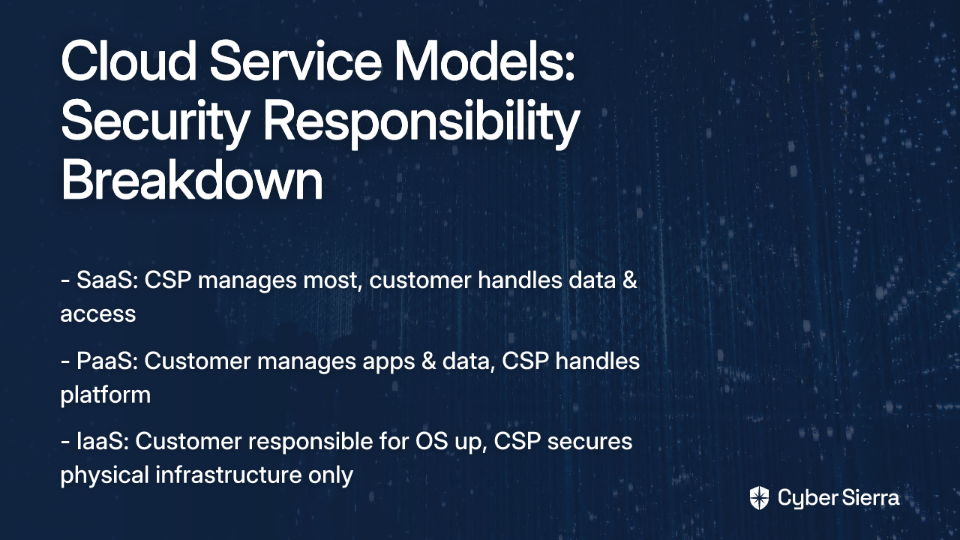
- SaaS (Software as a Service): The CSP manages most of the stack, including applications and infrastructure. The customer is primarily responsible for data and user access.
- PaaS (Platform as a Service): The customer manages applications and data, while the CSP manages the underlying platform and infrastructure.
- IaaS (Infrastructure as a Service): The customer has the most responsibility, managing everything from the operating system up, including applications, data, and middleware. The CSP secures only the physical infrastructure.
Failing to grasp these distinctions creates security gaps. As one security professional observed, "Poor management decisions affecting cloud security due to ignorance" are a major vulnerability source. When organizations treat the cloud "just like another data center," they miss the unique security considerations of cloud environments.
The Top Cloud Security Threats in 2024
According to the Cloud Security Alliance's (CSA) 2024 Top Threats report, several critical vulnerabilities dominate the current cloud security landscape:

1. Misconfiguration and Inadequate Change Control
Misconfiguration of cloud services remains the leading cause of cloud vulnerabilities and cloud problems. This happens when organizations struggle with proper cloud architecture, treating cloud resources like traditional on-premises systems rather than embracing cloud-native security approaches.
SentinelOne reports that about 15% of data breaches are the direct result of incorrectly configured cloud settings. These misconfigurations can create significant technical debt as organizations attempt to patch security gaps while maintaining operations.
Common examples include:
- Publicly accessible storage buckets
- Default credentials left unchanged
- Excessive permissions
- Disabled encryption
2. Identity and Access Management (IAM) Failures
Weak or poorly managed IAM roles and permissions expose sensitive data and applications to unauthorized access. This vulnerability is particularly challenging in a multi-cloud environment where different IAM systems must be coordinated.
The stakes are high—there was a 16-fold increase in account-based threats in 2023, highlighting the critical danger of account hijacking. As one security professional noted, there's "increased exploitation of cloud misconfigurations and IAM permissions" across industries.
3. Insecure Interfaces and APIs
As cloud services become more interconnected, API security has become a primary concern. APIs lacking sufficient security controls can be exploited to manipulate services or gain unauthorized access.
The scale of this problem is massive, with 92% of organizations reporting API-related security incidents in the last year. These vulnerabilities often stem from inadequate authentication, insufficient input validation, or improper error handling.
4. Insecure Software Development & Supply Chain Attacks
Vulnerabilities are introduced not just through in-house code but through the entire software supply chain, including third-party libraries and CI/CD pipelines. This directly addresses rising concerns about "supply chain attacks targeting CI/CD pipelines."
Organizations using Infrastructure as Code (IaC) to manage cloud resources must be particularly vigilant, as misconfigurations in templates can be rapidly propagated across environments, expanding the attack surface.
5. Limited Cloud Visibility and Observability
The dynamic and ephemeral nature of cloud environments makes them difficult to monitor. This lack of visibility complicates threat detection and incident response, leaving many security teams feeling "overwhelmed by the complexity of cybersecurity threats."
Without proper monitoring tools, organizations may not detect unauthorized access or data exfiltration until it's too late, significantly increasing the potential impact of breaches.
A Proactive Defense: Actionable Best Practices for Cloud Security
While the cloud security landscape presents significant challenges, implementing a multi-layered defense strategy can substantially reduce your risk exposure and solve many cloud problems.

Fortify Your Foundation with Strategy and Architecture
Adopt a Zero Trust Model: This strategic approach assumes no user or device is automatically trusted, regardless of their location or network connection. It relies on continuous verification and the principle of least-privilege access to protect against both internal and external threats.
As CrowdStrike explains, Zero Trust requires that you "never trust, always verify" every access request before granting access to resources.
Implement Robust Monitoring and Consolidate Tools: Use tools like a Cloud Security Posture Management (CSPM) to continuously monitor for misconfigurations. For greater efficiency, consolidate disparate solutions into a Cloud-Native Application Protection Platform (CNAPP), which integrates CSPM, Cloud Workload Protection (CWPP), and Cloud Infrastructure Entitlement Management (CIEM).
Lock Down Data and Access
Encrypt Everything: This is non-negotiable for strong data protection:
- Encryption in Transit: Use IPsec VPN tunnels or TLS/SSL to secure data as it travels between users and the cloud.
- Encryption at Rest: Implement disk-level or file-level encryption to protect data stored in the cloud, ensuring that even if storage is compromised, the data remains protected.
Enforce Strict Access Controls: Go beyond basic passwords:
- Micro-segmentation: Limit network access so users and devices can only reach the resources they absolutely need.
- Just Enough Access (JEA): Ensure accounts have only the minimum permissions necessary to perform their tasks, reducing the blast radius of a compromise.
Use a CASB: Implement an API-based Cloud Access Security Broker (CASB) to act as a policy enforcement point between users and cloud services, monitoring for threats and risky third-party app behavior.
The Human Element: Training and Awareness
Invest in Continuous Training: As one security professional emphasized on Reddit, "Training that gives examples of what to do, what not to do, and the consequences... is paramount."
Regular training helps teams understand cloud-specific threats and the unique security posture required in cloud environments. According to CrowdStrike, a strong cybersecurity training program is one of the most effective defenses against cloud breaches.
Specific recommendations include:
- Implement robust cloud architecture principles and regular security audits to identify and fix misconfigurations
- Adopt best practices for CI/CD security, including dependency scanning and monitoring deployments
- Establish strict security protocols when integrating AI technologies into cloud environments
- Invest in training and certification programs for IT staff to enhance skills in cloud security
Conclusion
Securing the cloud is a continuous process, not a one-time setup. The biggest threats—misconfigurations, IAM failures, and insecure APIs—can be mitigated through a proactive strategy combining a Zero Trust architecture, robust technical controls like encryption and monitoring, and a strong investment in employee training.
As technology evolves with the integration of AI into cloud services, maintaining a vigilant and adaptive security posture is essential for navigating the future of cloud computing securely. By understanding and addressing these top cybersecurity concerns, organizations can enjoy the benefits of cloud computing while minimizing the inherent risks.

Organizations that take these cloud security challenges seriously will be better positioned to prevent breaches, protect sensitive data, and maintain compliance—turning potential cloud problems into manageable risks.
Frequently Asked Questions
What is the most common cause of cloud security breaches?
The most common cause of cloud security breaches is the misconfiguration of cloud services. These errors, such as leaving storage buckets publicly accessible or using default credentials, often happen when organizations lack a deep understanding of cloud-native architecture and can lead to significant data exposure and technical debt.
How does the Shared Responsibility Model work in cloud security?
The Shared Responsibility Model divides security duties between the cloud provider and the customer. The provider is responsible for the security of the cloud (the physical infrastructure), while the customer is responsible for security in the cloud. These customer responsibilities vary by service type, from managing only data and access in SaaS to managing the operating system, applications, and data in IaaS.
What is a Zero Trust model and why is it important for cloud security?
A Zero Trust model is a security strategy that assumes no user or device is trustworthy by default, requiring continuous verification for every access request. It is crucial for cloud security because it protects against both internal and external threats by enforcing the principle of least-privilege access, significantly reducing the attack surface in complex, distributed cloud environments.
How can organizations improve their cloud Identity and Access Management (IAM)?
Organizations can improve their cloud IAM by enforcing strict, granular access controls. Key practices include implementing the principle of Just Enough Access (JEA) to ensure users have only the minimum permissions necessary, using micro-segmentation to limit network access, and regularly auditing IAM roles and permissions to remove excessive or unnecessary privileges.
Why is API security critical in a cloud environment?
API security is critical because APIs are the connective tissue between modern cloud services, and insecure APIs have become a primary target for attackers. Vulnerabilities in APIs, such as inadequate authentication or poor input validation, can be exploited to gain unauthorized access, manipulate services, or exfiltrate sensitive data from interconnected systems.
What are the first steps to secure a new cloud environment?
The first steps to securing a new cloud environment involve establishing a strong security foundation. This includes fully understanding the Shared Responsibility Model for your chosen cloud services, implementing a Cloud Security Posture Management (CSPM) tool to continuously monitor for misconfigurations, and enforcing a strict Identity and Access Management (IAM) policy based on the principle of least privilege from day one.
