



To Pay or Not to Pay? The Modern Ransomware Dilemma


Join thousands of professionals and get the latest insight on Compliance & Cybersecurity.
Your servers are unexpectedly encrypted. A message on the screen demands cryptocurrency payment. Your backups? They're compromised too. This is the reality of a modern ransomware attack—a moment of urgency and fear where every decision feels fraught with personal and professional liability.
Law enforcement and cybersecurity experts typically advise a hard "never pay" stance. Yet business leaders facing potential collapse often find themselves contemplating the unthinkable: paying the ransom. This ethical dilemma isn't just theoretical—it's a crisis scenario playing out with increasing frequency across organizations of all sizes.
This article won't give you a simple "yes" or "no." Instead, we'll explore the nuances of this complex decision, providing a framework based on expert insights, real-world data, and a clear understanding of the risks involved. Because in today's threat landscape, flexibility and open-mindedness have become necessary survival skills.
The Unrelenting Rise of Ransomware
Ransomware is malicious software that encrypts files or locks computers, demanding payment for restoration. With two main variants—Locker ransomware (which locks users out of systems) and Crypto ransomware (which encrypts files)—these attacks have evolved from nuisance to existential threat.
The statistics are sobering:

- Ransomware attacks increased by 95% in 2023 compared to 2022
- Cybercriminals successfully encrypted data in 75% of cyberattacks in 2023
- 94% of ransomware attacks now involve data exfiltration (the "double extortion" tactic)
- The average cost of a ransomware incident has reached $4.88 million in 2024
The Case Against Paying: Why Experts Say "Don't"
The arguments against payment are compelling:
It Fuels the Criminal Ecosystem: Each payment validates the attackers' business model and finances future, more sophisticated attacks.
Higher Overall Costs: Organizations that paid ransoms faced average recovery costs of $750,000—twice the $375,000 spent by companies that used backups instead.
Recovery Is Not Guaranteed: Only 13% of those who paid recovered all their data, according to a Ponemon Institute report. Even Cybereason's more optimistic findings show only 42% of organizations achieved full data restoration after payment.
You Become a Repeat Target: A staggering 80% of organizations that paid a ransom were attacked again, often with higher demands.
Legal and Compliance Risks: Payments could violate regulations from the U.S. Department of the Treasury's Office of Foreign Assets Control (OFAC) if the recipient is a sanctioned entity. Additionally, several U.S. states have passed laws prohibiting public sector organizations from using taxpayer funds for ransom payments.
Some organizations have stood firm. MGM Resorts International absorbed an estimated $100 million loss rather than pay attackers. The Port of Seattle similarly refused to meet ransom demands, demonstrating that recovery without payment is possible, albeit costly and difficult.
A Pragmatic Reality: When Paying Becomes a Viable Option
Despite the strong case against payment, many cybersecurity experts acknowledge that rigid policies aren't always realistic. Ethan Tancredi of Huntress Labs, while generally against payment, "acknowledges unique situations may justify them to save businesses."
Consider these scenarios where payment might be the lesser evil:
Business Survival: When the cost of downtime, revenue loss, and reputational damage far exceeds the ransom demand.
No Viable Backups: When backup systems have been compromised or are non-existent—a common issue when backup systems aren't properly segmented from the main network.
Data Exfiltration Threat: To prevent the public release of highly sensitive customer, employee, or proprietary data.
Faster Recovery: In some cases, paying may be the quickest path back to operational status, even if not the cheapest.
High-profile organizations have made the difficult decision to pay, including Change Healthcare (reportedly $22 million to BlackCat) and Caesars Entertainment ($15 million after negotiating down from $30 million).
The Decision-Making Framework: Navigating the Crisis
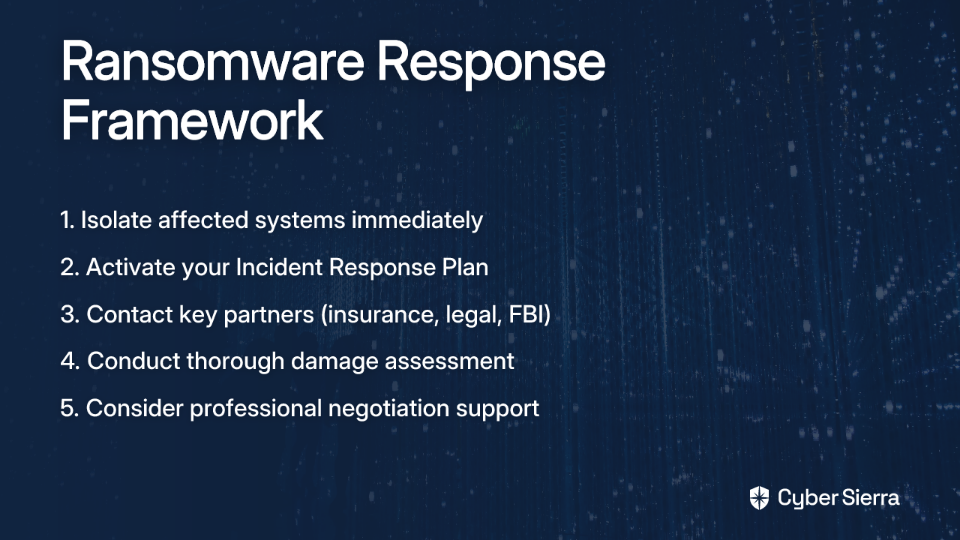
If your organization faces a ransomware attack, follow this framework to make an informed decision:
Step 1: Isolate and Assess
Do not touch anything immediately. As one victim warned, "if you mess up the data in any way, the chances of recovering it are very, very slim." Take affected systems offline to prevent lateral movement of the malware.
Step 2: Activate the Incident Response Plan (IRP)
Engage your pre-defined team, with the Incident Commander coordinating efforts across technical, legal, and executive stakeholders. Your IRP should include clear protocols for potential ransom situations.
Step 3: Contact Key Partners Immediately
- Cyber Insurance Carrier: Make this one of your first calls. They will guide you through the process and have pre-approved vendors for forensics and legal counsel.
- Legal Counsel: To navigate regulatory obligations and potential OFAC risks.
- Law Enforcement: Contact agencies like the FBI, which can provide resources and help track attackers.
Step 4: Conduct a Triage
- Evaluate Backups: Are they viable? Are they immutable backups? Are they properly segmented from the main network (not joined to the domain)?
- Identify the Threat Actor & Strain: Your Remediation Team should work to identify the group, their tactics, and whether they typically provide working decryptors.
- Determine Data Exfiltration: Assess if data was stolen using EDR logs and other monitoring tools.
Step 5: Consider Professional Negotiators
Cyber insurance policies often provide access to third-party negotiators who can verify the attacker's claims, negotiate the ransom down, and manage the payment process if that route is chosen.
The Cyber Insurance Safety Net: Savior or Source of Frustration?
Many organizations struggle with "convincing executives about the inadequacy of general business insurance" for cyber events and face "uncertainty about the reasons for denial of cyber insurance claims."
A comprehensive cyber insurance policy typically covers:
- Ransom payments and negotiation services
- Business interruption and lost revenue
- Forensics costs to investigate the breach
- Data recovery and system restoration costs
- Public relations support to manage reputation
However, be aware of common exclusions that could result in claim denials:
- Negligence: Claims can be denied if the organization failed to implement required security controls like MFA, regular patching, or proper vendor management.
- Pre-existing Vulnerabilities: Known issues that weren't remediated before the attack.
- Acts of War/Nation-State Attacks: A growing area of contention in cyber policies.
- Insider Attacks: Often excluded from standard coverage.
Prevention as the Ultimate Strategy
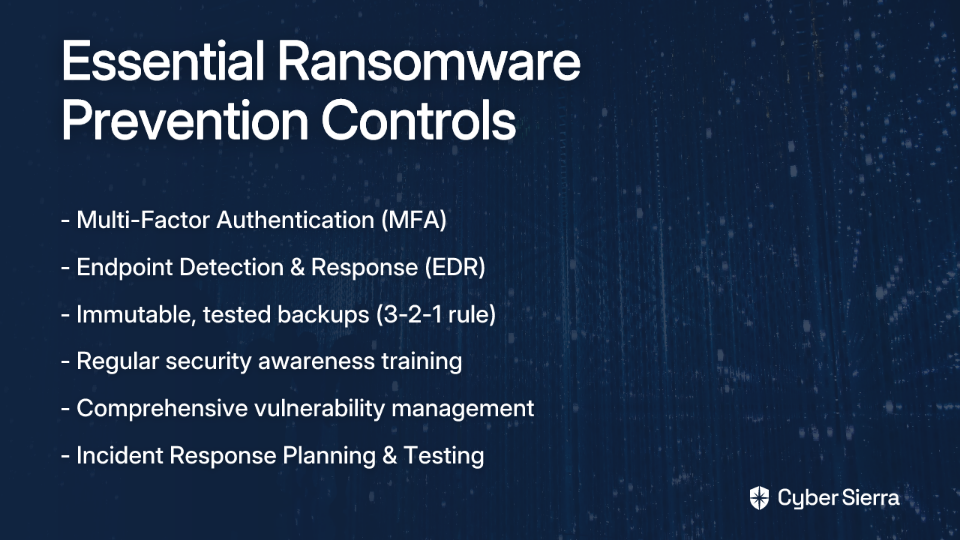
The best way to avoid the ransomware dilemma is to prevent an attack in the first place:
Implement Layered Defenses
- Multi-Factor Authentication (MFA): Essential for preventing unauthorized access via RDP and other remote services.
- Endpoint Detection and Response (EDR): Deploy solutions to protect against data exfiltration and malware execution.
- Regular, Tested Backups: Follow the 3-2-1 backup rule (3 copies, 2 different media, 1 offsite). Use immutable backups or air-gapped systems (e.g., Veeam backups on a separate SAN with San snapshots).
- Phishing-Resistant Training: Since "most security breaches are a result of human mistakes," regular training is essential.
- Asset Management & Vulnerability Management: Keep all software updated and maintain strong documentation of third-party servers.
Be Prepared for the Worst
- Develop and Rehearse Your IRP and DRP: Conduct regular tabletop exercises and ransomware readiness assessments to identify weaknesses before an attack.
- C-suite Engagement: Ensure leadership understands ransomware risks and supports proactive security hygiene.
- Psychological Aftercare: Acknowledge the human toll. Excessive work hours lead to burnout. Ensure psychological support for your team after an incident.
Conclusion: A Calculated Decision, Not a Moral Failure
The decision to pay a ransom is one of the most difficult choices a business can face. It's not simply a moral judgment but a complex risk management calculation with significant financial, operational, and legal consequences.
While the goal is to never be in this position, the modern threat landscape demands preparation. A robust, well-rehearsed IRP, strong preventative controls, and a clear understanding of your cyber insurance policy will determine your organization's resilience—whether you ultimately choose to pay or not.
Remember the wisdom shared by security professionals who have faced this dilemma: "Never say you will never pay ransom." In the end, your response must be guided by a clear-eyed assessment of your specific situation, with business continuity as the North Star of your decision-making process.
By taking steps now to improve your security posture—from implementing MFA and EDR to ensuring proper backup testing and comprehensive incident response planning—you can significantly reduce both the likelihood of an attack and the pressure to pay if one occurs.
The best time to prepare for a ransomware attack was yesterday. The second best time is today.
Frequently Asked Questions
What is the first thing you should do after a ransomware attack?
The first thing you should do is isolate the affected systems to prevent the ransomware from spreading further across your network. Do not touch or attempt to reboot the encrypted machines. Immediately take them offline by disconnecting network cables, then activate your Incident Response Plan (IRP) to contact your cyber insurance provider, legal counsel, and law enforcement.
Why do experts advise against paying a ransom?
Experts advise against paying a ransom primarily because it funds criminal enterprises, does not guarantee data recovery, and often leads to higher overall costs and repeat attacks. Paying validates the attackers' business model, financing more sophisticated future crimes. Furthermore, there's no guarantee the decryptor will work, and a staggering 80% of companies that pay are targeted again.
Is it illegal to pay a ransomware demand?
Paying a ransom is not inherently illegal in most jurisdictions, but it can be if the payment goes to a sanctioned entity. The U.S. Department of the Treasury's Office of Foreign Assets Control (OFAC) prohibits transactions with individuals or groups on its sanctions list. Paying a ransom to a sanctioned group could result in significant fines, which is why involving legal counsel early is critical.
What is double extortion in a ransomware attack?
Double extortion is a tactic where cybercriminals not only encrypt your data but also steal a copy of it before encryption. The attackers then threaten to publish the stolen sensitive data online if the ransom is not paid. This adds immense pressure, as organizations face not only downtime but also a potential data breach, regulatory fines, and severe reputational damage.
Will paying the ransom guarantee I get my data back?
No, paying the ransom does not guarantee you will get all your data back. Research shows that even when a ransom is paid, full data recovery is rare. Attackers may provide faulty decryptors, demand more money, or disappear after payment. Even with a working decryptor, the process can be slow and data may be corrupted beyond use.
How can you best prepare for a potential ransomware attack?
The best preparation involves a combination of robust technical defenses and a well-rehearsed incident response plan. Key technical controls include implementing multi-factor authentication (MFA), using an Endpoint Detection and Response (EDR) solution, and maintaining regular, tested, and isolated backups. Equally important is developing and practicing your Incident Response Plan (IRP) through tabletop exercises to ensure your team can act decisively during a crisis.
