



Safe AI: How Enterprises Can Safely Deploy AI


Join thousands of professionals and get the latest insight on Compliance & Cybersecurity.
You've heard the buzz about enterprise AI adoption—it's not just a trend, it's a revolution. With 36% of IT service management professionals already using corporate AI capabilities and an astonishing 66% using free tools like ChatGPT at work, the AI wave is impossible to ignore. But beneath this enthusiasm lurks a troubling reality: as one IT professional bluntly put it, "none of these tools are secure."
Perhaps you've experienced the anxiety yourself. You want to leverage AI's transformative potential, but concerns about data privacy keep you awake at night. What if, as many fear, your vendor is "happily sending whatever data you give them to OpenAI for analysis"? What if your confidential data "could be read by humans at OpenAI, used for AI training purposes, or even show up in a chat conversation with another user"?
The stakes couldn't be higher. For enterprises handling sensitive information, these aren't abstract concerns—they're existential threats to customer trust and regulatory compliance. And standard certifications offer little comfort; as one cybersecurity expert noted, "SOC2 is table stakes, but doesn't really cover model behavior."
Yet despite these legitimate concerns, enterprises can't afford to sit on the sidelines of the AI revolution. The competitive advantages are too significant to ignore. What's needed is not fear-based paralysis, but a structured, proactive approach to deploying AI safely.
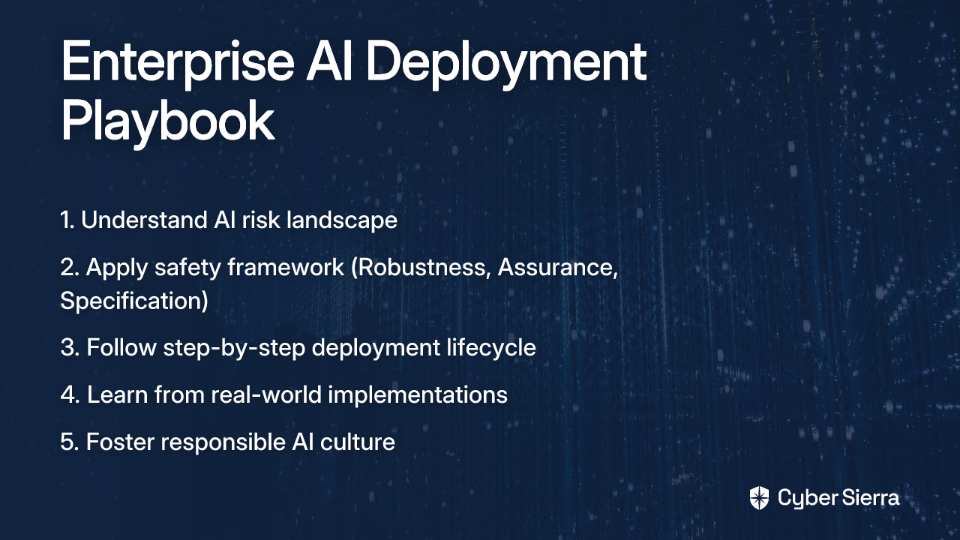
This article provides exactly that: a comprehensive playbook for enterprises to deploy AI with confidence, moving beyond vendor promises to establish true, verifiable security and responsibility. We'll explore:
- The full landscape of enterprise AI risks
- A foundational framework for AI safety
- A practical, step-by-step deployment lifecycle
- Real-world examples of safe AI implementation
The Landscape of Enterprise AI Risks: Beyond the Hype
Before building a safety strategy, it's crucial to understand the full spectrum of risks enterprises face when deploying AI. These fall into three main categories:
Data, Security, and Compliance Challenges
Data Confidentiality and Privacy concerns top the list for most organizations. The risk that sensitive information could be exposed is real—as one legal professional warned, "you have ZERO promise that those records are kept confidential." This becomes especially problematic for organizations subject to regulations like GDPR and HIPAA, where "They are not HIPAA compliant, even if they say they are" is a common sentiment.
Equally important is the challenge of Data Quality. Poor data quality inevitably leads to inaccurate AI models. Incomplete datasets, inconsistent formats, and biased information are common sources of AI failure, undermining the very value these systems are meant to provide.
Technical & Model-Specific Vulnerabilities
AI systems, particularly Large Language Models (LLMs), present unique security challenges. Unlike traditional software, "the data channel and command channel for LLM are the same, so prompt injection can't be treated like you treat SQL injection." This fundamental architectural difference requires new security approaches.
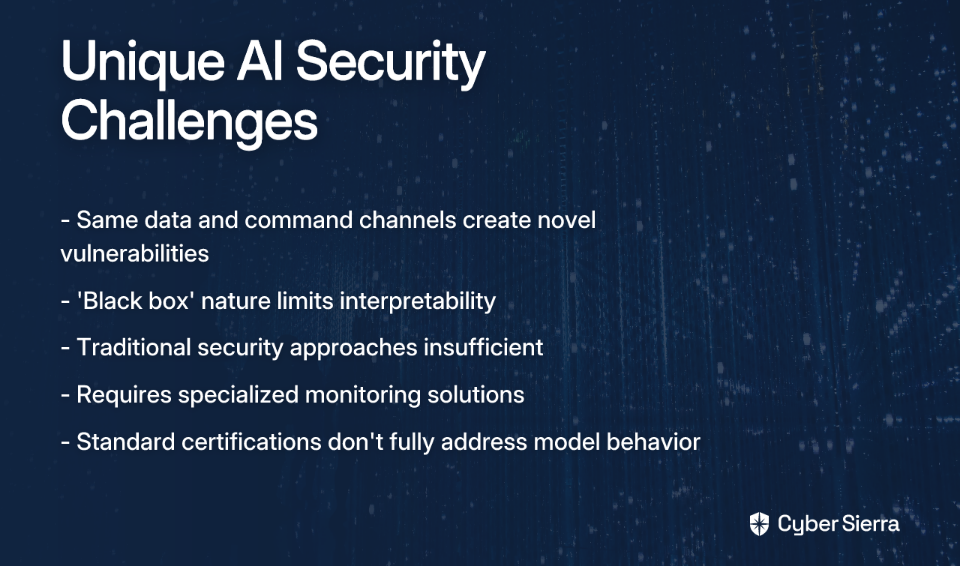
The "Black Box" problem adds another layer of complexity. Modern AI models, especially deep learning systems, can be difficult to interpret, making it challenging to understand why they make specific decisions. This lack of interpretability undermines trust and creates potential liability issues, particularly in regulated industries.
Organizational and Ethical Challenges
AI Bias represents a significant ethical risk. Biased training data can lead to discriminatory outcomes, potentially exposing organizations to legal liability and reputational damage. This requires fairness-aware algorithms and diverse training data.
Concerns about Impact on the Workforce are also prevalent. However, contrary to popular fears about job displacement, an OECD study of nearly 100 case studies found that job reorganization is more prevalent than job replacement. AI often improves job quality by reducing tedium and increasing worker engagement and physical safety.
Finally, many organizations operate in a Governance Vacuum, lacking the frameworks needed to ensure responsible AI use. Effective governance requires input from AI ethicists, legal experts, and affected communities—a multidisciplinary approach many enterprises have yet to implement.
A Foundational Framework for AI Safety: Robustness, Assurance, and Specification
To address these complex challenges, enterprises need more than a simple checklist—they need a comprehensive framework. The Georgetown Center for Security and Emerging Technology (CSET) offers a powerful structure organized around three core pillars.
At its heart, AI safety research aims to identify the causes of unintended behaviors in machine learning systems and develop tools for safe operation. Unlike traditional software engineering, modern ML systems lack inherent safety guarantees, making this research critical for enterprise adoption.
Pillar 1: Robustness
Robustness ensures systems operate safely and reliably, especially when facing unfamiliar conditions or malicious inputs. This pillar focuses on building models that don't fail unexpectedly when encountering new scenarios or deliberate attacks.
For enterprises, robustness means implementing:
- Adversarial testing to identify potential vulnerabilities
- Formal verification of model properties where possible
- Enhanced monitoring for unusual inputs or behaviors
Robustness is particularly important for mission-critical AI applications where failure could have severe consequences. Without it, your AI systems remain vulnerable to unexpected edge cases and deliberate manipulation.
Pillar 2: Assurance
Assurance ensures that systems are analyzable and understandable by human operators. This addresses the "black box" problem that undermines trust in AI systems.
Key assurance techniques include:
- Interpretability: Using tools like SHAP (SHapley Additive exPlanations) and LIME (Local Interpretable Model-agnostic Explanations) to understand how models make decisions
- Explainability: Creating systems that can articulate their reasoning in human-understandable terms
- Transparency in training data and methodology
For regulated industries like finance and healthcare, assurance isn't just good practice—it's increasingly becoming a regulatory requirement.
Pillar 3: Specification
Specification focuses on aligning a system's behavior with the designer's true intentions, not just its literal programming. This addresses the risk of an AI achieving a goal in an unintended, harmful way.
Specification challenges include:
- Ensuring AI systems understand implied constraints
- Preventing reward hacking (optimizing for metrics in ways that violate the spirit of the goal)
- Balancing multiple, sometimes competing objectives
This pillar is crucial for ensuring AI systems act as true partners in achieving business objectives rather than following instructions in technically correct but practically harmful ways.

The Enterprise Playbook: A Step-by-Step Guide to Safe AI Deployment
With our framework established, let's translate these principles into practical steps through a comprehensive AI deployment lifecycle.
Step 1: Robust Development and Validation
Data quality is paramount for safe AI deployment. Ensure your training data is representative to avoid biased predictions, implement automated data profiling, and conduct regular data audits to identify and address quality issues.
Implement a multi-stage testing approach that goes beyond basic accuracy checks:
- Unit Testing: Verify individual components function correctly
- Integration Testing: Ensure different components work together seamlessly
- Performance Testing: Validate model behavior under various load conditions
- A/B Testing: Compare model performance against existing solutions with real users
One critical practice often overlooked is establishing clear performance thresholds before deployment. Define in advance what constitutes acceptable performance and what triggers a rollback.
Step 2: Secure Packaging with Containerization and Versioning
Containerization is essential for consistent, secure deployment of AI models. Use lightweight base images to reduce size and attack surface, and implement multi-stage builds to separate the build environment from the runtime environment.
Implement strict versioning for all components:
- The model itself
- Training and validation data
- Code and dependencies
- Configuration parameters
This comprehensive versioning ensures full reproducibility and traceability—critical capabilities when troubleshooting issues or addressing security concerns.
Step 3: Designing Scalable and Secure Infrastructure
Cloud-native architectures offer significant advantages for AI deployment, including elastic scaling and reduced operational overhead. These architectures have proven their value in real-world scenarios—one retail company handled a 10x traffic increase during a sales event using cloud-native design without service degradation.
Kubernetes has emerged as the industry standard for containerized application orchestration, offering:
- Automated scaling based on demand
- Self-healing capabilities that replace failed containers
- Support for safe deployment strategies like rolling updates and canary deployments
When designing your infrastructure, incorporate security by design:
- Implement network segmentation to limit the blast radius of potential breaches
- Use the principle of least privilege for all service accounts
- Enable encryption for data at rest and in transit
Step 4: Implementing Robust Monitoring and Observability
Effective AI monitoring goes beyond traditional IT metrics to include:
- Model Performance Metrics: Track accuracy, precision, recall, and other domain-specific metrics
- Inference Latency & Resource Utilization: Monitor response times and system resource consumption
- Data Drift: Detect when input data changes significantly from the training data
- Concept Drift: Identify when the underlying relationships the model learned have changed
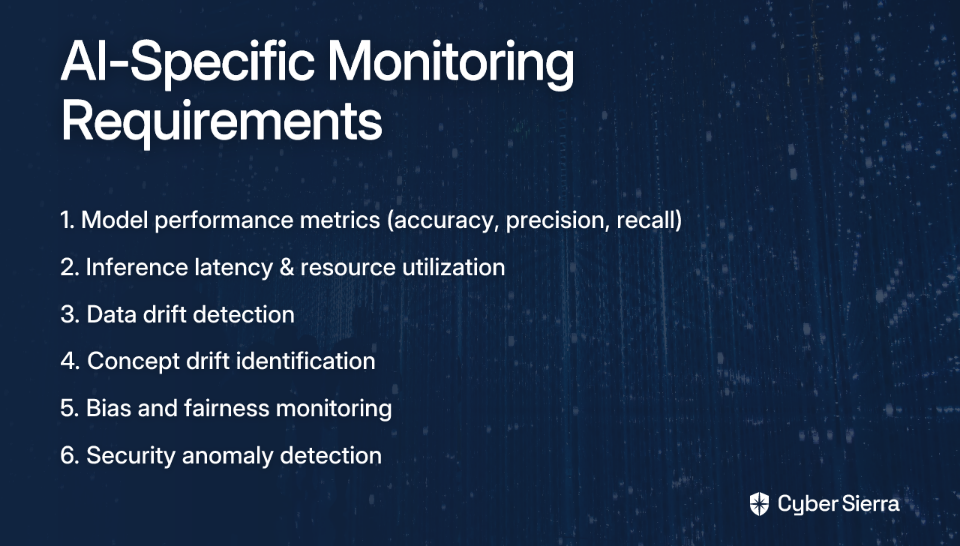
For your monitoring stack, tools like Prometheus for metrics collection and Grafana for visualization and alerting have become industry standards, offering robust capabilities for AI-specific monitoring needs.
Step 5: Governance, Continuous Learning, and Ethical Safeguards
Establish automated retraining pipelines for data collection, preprocessing, model retraining, evaluation, and deployment to keep models current and performing optimally.
Implement bias detection and mitigation through regular audits, fairness constraints in model training, and promoting diverse representation in development teams.
Deploy comprehensive data privacy and security controls, including:
- Data encryption at rest and in transit
- Granular access controls limiting data visibility
- Regular security audits to ensure ongoing compliance with regulations like GDPR and HIPAA
One particularly valuable practice, suggested by enterprise users themselves: "Create clear customer data usage policies that allow customers an opt-in choice for their data to be used in AI learning processes, ensuring transparency and trust." This simple step can significantly enhance customer confidence in your AI initiatives.
Learning from the Leaders: Real-World Examples of Safe AI Implementation
Theory becomes more tangible when viewed through the lens of successful real-world implementations. These case studies demonstrate how the principles we've discussed translate into practice.
Finance: JPMorgan Chase's COiN Platform
Application: JPMorgan deployed an AI platform using Document Parsing and Anomaly Detection to analyze complex legal documents and financial agreements.
Safety Approach: The system incorporates multiple validation checks, human-in-the-loop oversight for critical decisions, and strict data access controls to meet financial compliance requirements.
Impact: This approach slashed document review time from 360,000 hours to mere seconds while significantly reducing losses from fraud, all without compromising data security.
Healthcare: IBM Watson & Memorial Sloan Kettering
Application: Their collaboration employs Natural Language Processing (NLP) and Machine Learning to interpret clinical notes and patient data for cancer diagnosis and treatment recommendations.
Safety Approach: The system was designed with robust data de-identification protocols, strict access controls, and continuous validation against established medical guidelines to ensure HIPAA compliance and clinical safety.
Impact: This implementation reduced cancer diagnosis time from weeks to hours while increasing accuracy, demonstrating how safe AI can transform even highly regulated industries.
Manufacturing: Siemens' Smart Factories
Application: Siemens leverages Predictive Maintenance AI systems to foresee equipment failures before they happen across its manufacturing facilities.
Safety Approach: Their implementation includes isolated networks for industrial systems, extensive adversarial testing to ensure reliability, and model interpretability features that allow engineers to understand and validate AI recommendations.
Impact: This approach achieved a 50% reduction in unplanned downtime and a 20% increase in production efficiency while maintaining strict safety standards for critical industrial systems.
Retail: Amazon's Recommendation Engine
Application: Amazon uses Collaborative Filtering and Deep Learning to personalize customer experiences across its vast product catalog.
Safety Approach: Their system incorporates strict data anonymization, granular privacy controls, and continuous monitoring for bias or problematic recommendations.
Impact: This implementation generates an estimated 35% of revenue from personalized recommendations while maintaining customer trust through responsible data practices.

Conclusion: Fostering a Culture of Responsible AI Innovation
Safe AI deployment is not a one-time checklist but a continuous, disciplined process. It requires a holistic commitment to the principles of robustness, assurance, and specification, implemented through a rigorous ML Ops lifecycle.
Success demands more than just technical excellence; it requires fostering "a culture of innovation and openness to change" balanced with a deep commitment to ethical considerations and responsible use. This cultural shift is often the most challenging aspect of safe AI deployment, but also the most important for long-term success.
For organizations just beginning their AI journey, here's perhaps the most valuable advice: Start with small, pilot projects to test AI applications and build expertise before attempting full-scale deployment. These controlled experiments allow you to develop the technical capabilities and governance structures needed for larger initiatives while limiting potential risks.
Enterprises that master this disciplined approach to safe AI deployment will not only avoid the pitfalls that concern so many—data breaches, compliance violations, and ethical missteps—but will also build profound customer trust and unlock a sustainable competitive advantage in the age of AI.
The path to safe AI isn't about limiting innovation; it's about enabling innovation that lasts—creating systems that deliver value while earning the trust of customers, employees, and regulators alike. By embracing the frameworks and practices outlined in this guide, your organization can confidently navigate the AI revolution, harnessing its transformative potential while maintaining the highest standards of security, ethics, and responsibility.
Frequently Asked Questions (FAQ)
What are the biggest risks of deploying AI in an enterprise?
The biggest risks of deploying AI in an enterprise setting fall into three main categories: data confidentiality, security vulnerabilities, and ethical challenges like AI bias. Sensitive company or customer data can be inadvertently exposed, violating regulations like GDPR or HIPAA. AI systems, especially LLMs, also present unique security challenges like prompt injection that differ from traditional software vulnerabilities. Finally, if an AI is trained on biased data, it can produce discriminatory outcomes, leading to legal liability and reputational harm.
How can I ensure my company's data remains private when using AI tools?
You can ensure data privacy by implementing a multi-layered strategy that includes strong data governance, technical controls, and transparent policies. This involves encrypting data both at rest and in transit, using data de-identification or anonymization techniques, and enforcing strict access controls. It's also crucial to choose AI vendors with clear data handling policies or, as the article suggests, create your own policy that gives customers an explicit opt-in choice for how their data is used.
What is a foundational framework for safe AI deployment?
A strong foundational framework for safe AI deployment is built on the three core pillars of Robustness, Assurance, and Specification. Robustness ensures the AI operates reliably, even with unexpected inputs. Assurance makes the AI's decision-making process understandable to human operators, addressing the "black box" problem. Specification ensures the AI's actions align with the true intent behind its goals, preventing it from taking harmful or unintended shortcuts to achieve a programmed objective.
How do I get started with safe AI deployment in my organization?
The best way to start is with small, controlled pilot projects that test specific AI applications in a low-risk environment. This approach allows your organization to build internal expertise, develop the necessary technical skills, and establish governance structures before attempting a full-scale, mission-critical deployment. Starting small helps demonstrate value incrementally, builds confidence, and allows you to learn and adapt your safety practices with limited exposure.
Why is monitoring AI models so important after deployment?
Monitoring is crucial because AI models can degrade in performance over time as the real-world data they encounter changes. This phenomenon, known as "data drift" or "concept drift," can make a once-accurate model unreliable or biased. Continuous monitoring tracks key performance metrics, fairness, and data consistency, alerting you to potential issues so you can retrain or update the model to ensure it remains effective, accurate, and aligned with business goals.
What is the "black box" problem in AI and how can it be addressed?
The "black box" problem refers to the difficulty of understanding how or why complex AI models, like deep learning systems, arrive at a specific decision or prediction. This lack of transparency can undermine trust and make it difficult to troubleshoot errors or biases. It can be addressed through the pillar of Assurance, which uses interpretability techniques and tools (like LIME and SHAP) to explain model behavior, making the AI's reasoning understandable to human experts.
