



AWS Security Specialty Certification Guide for Cloud Engineers

Join thousands of professionals and get the latest insight on Compliance & Cybersecurity.
You've been working with AWS for a while now, and you're looking to take your career to the next level. But as you browse through job listings, it's clear that cloud security expertise is no longer optional—it's essential. You feel overwhelmed by the sheer volume of security concepts to master, and the thought of transitioning from your general IT role to a specialized security position seems daunting.
If this resonates with you, you're not alone. As one professional put it, "The knowledge required to pass any of these exams is so diverse and granular..." making it easy to feel lost before you even begin.
The good news? The AWS Certified Security - Specialty certification is your pathway to becoming the cloud security expert organizations desperately need—and this guide will provide you with a clear, actionable roadmap to get there.
Why the AWS Security Specialty Certification Matters Now More Than Ever
Cloud adoption is accelerating at an unprecedented rate, creating an urgent demand for security professionals who can navigate the complex AWS ecosystem. According to AWS, job listings requiring this certification increased by an impressive 73% between October 2021 and September 2022 alone.
More importantly, this certification isn't just another credential to add to your LinkedIn profile. It's recognized as one of the highest-paying technical certifications in the US and ranks among the top 10 most popular cybersecurity certifications globally.
As one Reddit user aptly described, "Cloud security is the 'newest' domain to information security, and thus in need of security professionals." Organizations are struggling with proper cloud architecture, leading to misconfigurations that can have serious security implications.
By earning this certification, you'll be positioned to fill this critical gap and command premium compensation in the process.
Deconstructing the AWS Certified Security - Specialty (SCS-C02) Exam
Before diving into preparation strategies, let's understand exactly what you're up against.
Exam Overview
- Purpose: This certification validates your ability to effectively use AWS security services to secure the AWS platform.
- Target Audience: Professionals with at least 5 years of IT security experience and 2 years of hands-on experience securing AWS workloads.
- Format: 65 questions (50 scored, 15 unscored) in multiple-choice or multiple-response format.
- Duration: 170 minutes (approximately 2.5 minutes per question).
- Passing Score: 750 out of 1000.
- Cost: $300 USD (Pro tip: After earning your first AWS certification, you receive a 50% discount voucher for your next exam).
While there are no mandatory prerequisites, having the AWS Certified Solutions Architect - Associate certification provides a solid foundation for tackling this more specialized exam.
The Six Domains: Your Technical Blueprint for Success
One of the biggest challenges when preparing for this exam is the vast range of topics covered. Let's break down the six domains that form the core of the exam, along with their relative weightings:
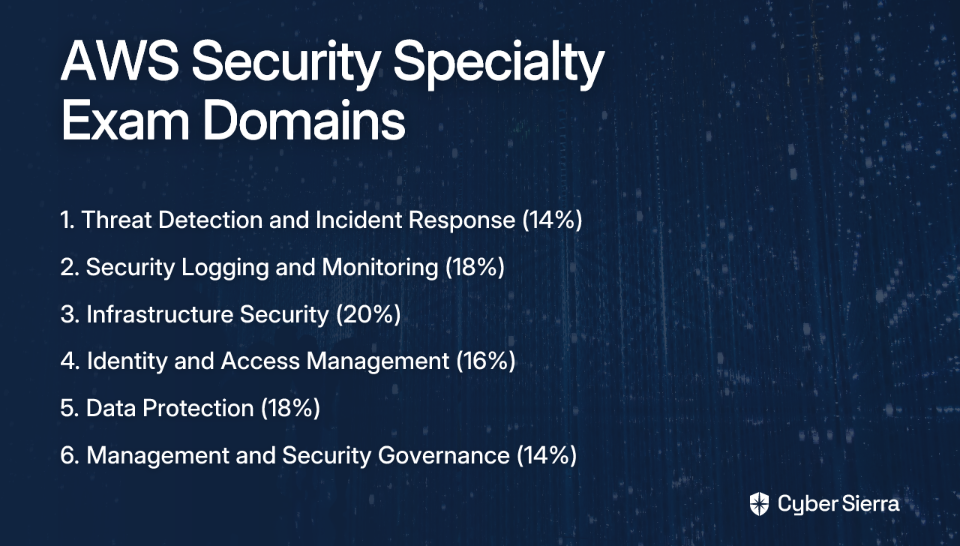
Domain 1: Threat Detection and Incident Response (14%)
This domain focuses on your ability to identify and respond to security incidents in AWS environments.
Key Services: AWS GuardDuty, Amazon Inspector, AWS Security Hub, AWS Config, CloudTrail, and CloudWatch Events.
Core Concepts: Setting up automated responses to security events, investigating potential compromises, and configuring threat detection services for proactive security.
Domain 2: Security Logging and Monitoring (18%)
This domain tests your ability to implement comprehensive logging solutions and monitor AWS environments for security issues.
Key Services: AWS CloudTrail, Amazon CloudWatch, VPC Flow Logs, and S3 Access Logs.
Core Concepts: Setting up centralized logging, troubleshooting logging configurations, and analyzing logs for security anomalies. The AWS Logging and Monitoring Guide is an essential resource for this section.
Domain 3: Infrastructure Security (20%)
As the most heavily weighted domain, this area examines your ability to secure AWS infrastructure components.
Key Services: VPC (Security Groups, NACLs, Endpoints), AWS WAF, AWS Shield, AWS Systems Manager (for Patch Management), and AWS Network Firewall.
Core Concepts: Designing secure network architectures, implementing edge security, and automating infrastructure security tasks using IaC (Infrastructure as Code) principles.
Domain 4: Identity and Access Management (16%)
This domain assesses your understanding of AWS IAM and related services for controlling access to AWS resources.
Key Services: AWS IAM (Users, Groups, Roles, Policies, MFA), AWS Organizations (Service Control Policies - SCPs), AWS SSO, and Amazon Cognito.
Core Concepts: Mastering IAM policy evaluation logic, understanding the differences between IAM Users and Roles, and applying Zero Trust principles and least privilege access.
Domain 5: Data Protection (18%)
This domain tests your knowledge of encrypting data and managing encryption keys in AWS.
Key Services: AWS KMS (Key Management Service), AWS Certificate Manager, Amazon S3 encryption, Amazon RDS encryption, and Amazon Macie.
Core Concepts: Implementing key rotation strategies, understanding the difference between a key policy and grants, and encrypting data both at rest and in transit.
Domain 6: Management and Security Governance (14%)
This domain focuses on managing security across AWS accounts and ensuring compliance with regulatory requirements.
Key Services: AWS Organizations, AWS Config, AWS Artifact, and AWS Security Hub.
Core Concepts: Understanding the AWS Shared Responsibility Model, managing security across multiple accounts, and aligning with compliance frameworks.
A Practical 4-Week Study Plan: From Preparation to Certification
Many candidates struggle with exam preparation due to "limited practical experience with AWS," as one Reddit user mentioned. The following structured study plan addresses this challenge by combining theoretical knowledge with hands-on practice:

Week 1: Foundations and Familiarization
- Set a Deadline: Book your exam now for 4 weeks from today. This creates urgency and commitment.
- Review Official Materials: Download the official exam guide and familiarize yourself with the exam domains.
- Take the Free AWS Training: Enroll in the free Exam Readiness course to get a high-level overview of the exam.
Weeks 2-3: Deep Dive and Hands-On Practice
- Domain-by-Domain Study: Systematically work through each domain, focusing on the AWS documentation and service FAQs.
- Apply What You Learn: This is critical for addressing the "limited practical experience" pain point. Use AWS Free Tier or AWS Builder Labs to implement what you're learning. Create a small project for each domain to reinforce concepts.
- Avoid Brain Dumps: Focus on understanding rather than memorization. As one successful candidate advised, "brain dumps can be confusing and outdated."
Week 4: Assess, Refine, and Review
- Take Practice Exams: Use the AWS Official Practice Exam and third-party practice tests from reputable providers like TutorialsDojo.
- Perform Gap Analysis: For each question you get wrong, understand why the correct answer is right. This targeted approach helps close knowledge gaps efficiently.
- Rest: The day before the exam, do only a light review and prioritize rest for optimal performance.
Exam Day Strategy: Passing with Confidence
With the exam costing $300, you want to make sure you pass on the first attempt. Here are proven strategies:
Time Management
- You have approximately 2.5 minutes per question. Use it wisely.
- If a question is taking too long, flag it for review and move on. Return to it later if time permits.
Question Approach
- Read Carefully: Pay special attention to keywords like "most secure," "cost-effective," or "automated" that can guide you to the correct answer.
- Eliminate Wrong Answers: Often, you can immediately eliminate two obviously incorrect options, improving your odds on the remaining choices.
- Trust Your Preparation: Answer the questions you're confident about first to build momentum.
Launch Your Career as an AWS Security Specialist
As cloud adoption continues to accelerate, organizations are facing an increasingly complex security landscape. The AWS Certified Security - Specialty certification demonstrates that you have the expertise to navigate these challenges effectively.
Remember that this certification isn't just about technical knowledge—it's about applying that knowledge to real-world scenarios. By following the structured approach outlined in this guide, you'll not only pass the exam but also develop practical skills that make you invaluable in the job market.
The journey may seem daunting, especially if you're transitioning from a general IT role, but the reward is substantial: entry into one of the fastest-growing and highest-paying fields in technology.

Frequently Asked Questions
What is the AWS Certified Security - Specialty exam?
The AWS Certified Security - Specialty (SCS-C02) exam is a professional-level certification that validates your expertise in securing AWS environments using AWS security services. It is designed for individuals with hands-on experience in AWS and a strong background in IT security, covering topics from incident response and logging to infrastructure security and data protection.
Why should I get the AWS Security Specialty certification?
You should get the AWS Security Specialty certification to validate your cloud security skills, meet the high demand for security professionals, and command a higher salary. The certification is recognized as one of the top-paying IT certifications and addresses a critical skills gap in the industry, making you a highly valuable candidate for advanced security roles.
Who is the ideal candidate for the AWS Security Specialty certification?
The ideal candidate is an IT security professional with at least two years of hands-on experience securing AWS workloads and a minimum of five years of general IT security experience. While there are no strict prerequisites, a strong foundation in AWS services, often demonstrated by holding the AWS Certified Solutions Architect - Associate certification, is highly recommended for success.
How difficult is the AWS Certified Security - Specialty exam?
The AWS Certified Security - Specialty exam is considered challenging due to its breadth and depth, requiring both theoretical knowledge and practical, hands-on experience with AWS security services. The difficulty lies in the scenario-based questions that test your ability to apply concepts across multiple domains. Success typically requires a structured study plan and significant hands-on practice to bridge the gap between theory and real-world application.
What are the most important topics to study for the SCS-C02 exam?
The most important topics are concentrated in the heavily weighted domains: Infrastructure Security (20%), Security Logging and Monitoring (18%), and Data Protection (18%). You should focus heavily on services like VPC (Security Groups, NACLs), AWS WAF, AWS Shield, CloudTrail, CloudWatch, and AWS KMS. Mastering IAM policy evaluation logic is also critical, as it is a foundational element across all domains.
How long does it take to prepare for the AWS Security Specialty exam?
Preparation time can vary, but a dedicated study plan of 4 to 8 weeks is common for individuals with prior AWS experience. This timeframe allows for a systematic review of all six domains, hands-on practice labs to reinforce concepts, and multiple practice exams to identify and close knowledge gaps. Your personal timeline will depend on your existing familiarity with AWS and daily study commitment.
Ready to take the first step? Visit the AWS Certification page today to download the exam guide and schedule your exam. Your future as a cloud security expert awaits.
