



How to Structure Your Risk Register Without Losing Control Visibility


Join thousands of professionals and get the latest insight on Compliance & Cybersecurity.
You've inherited a risk register that's bursting at the seams—filled with control deficiencies, vulnerabilities, and general bugbears rather than actual risks. Every time you open it, you're hit with an overwhelming mix of "weak passwords," unpatched servers, and vague concerns that don't quite fit together. The mess is undeniable, yet you're hesitant to clean it up for fear of losing visibility into those legitimate control concerns.
If this sounds familiar, you're not alone. Risk registers are essential GRC tools, but they frequently become dumping grounds for every security concern in the organization, regardless of whether it's truly a risk.
The good news? You can transform this chaos into clarity without sacrificing visibility into your control environment. This article provides a practical framework for restructuring your risk register while enhancing—not reducing—your oversight of the factors that contribute to risk.
The Root of the Problem: Confusing Risks with Their Ingredients
The primary reason risk registers become unmanageable is a fundamental confusion about what belongs in them. Many organizations struggle to differentiate between three key concepts:
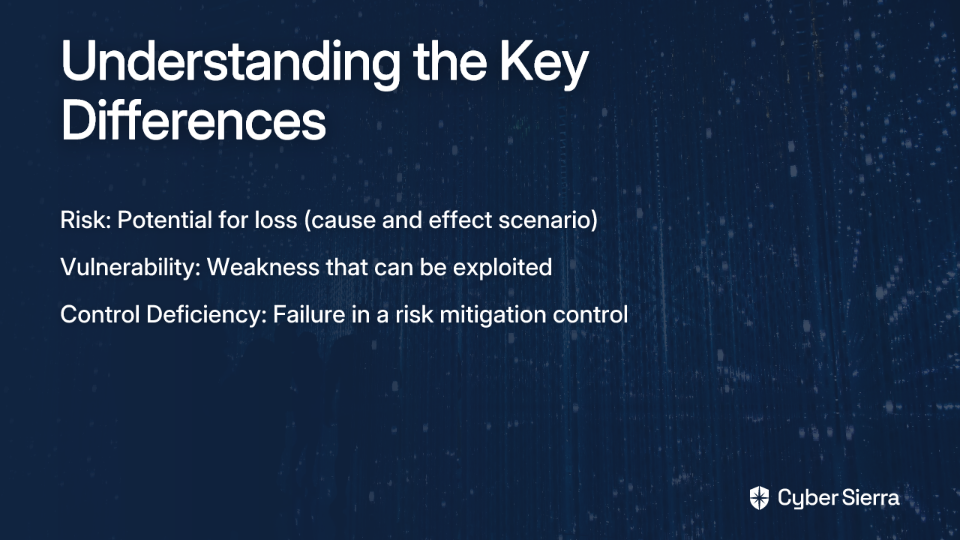
- Risk: The potential for loss when a threat exploits a vulnerability. A proper risk statement describes a scenario with a cause and effect (e.g., "Unauthorized access to sensitive data due to inadequate authentication controls").
- Vulnerability: A weakness in an asset or control that can be exploited by a threat actor (e.g., an unpatched server or misconfigured firewall).
- Control Deficiency: A weakness or failure in the design or operation of a control meant to mitigate risk (e.g., "poorly configured password policy" or "multiple reports of poor passwords in use").
As one security professional noted, control deficiencies "simply increase risk, but are not risks themselves." Yet these items frequently dominate risk registers, creating a cluttered document that's difficult to prioritize and ineffective for decision-making.
When your register contains a mix of all three elements without clear distinction, you end up with a tool that's:
- Too detailed for executive decision-making
- Too cluttered for effective prioritization
- Too confusing for clear ownership and accountability
- Too overwhelming to maintain consistently
Part 1: Building a Clean and Strategic Risk Register
The first step toward clarity is building (or rebuilding) a "pure" risk register focused solely on actual risks. This becomes your strategic view of what could go wrong and how you're addressing it.
Essential Components of an Effective Risk Register
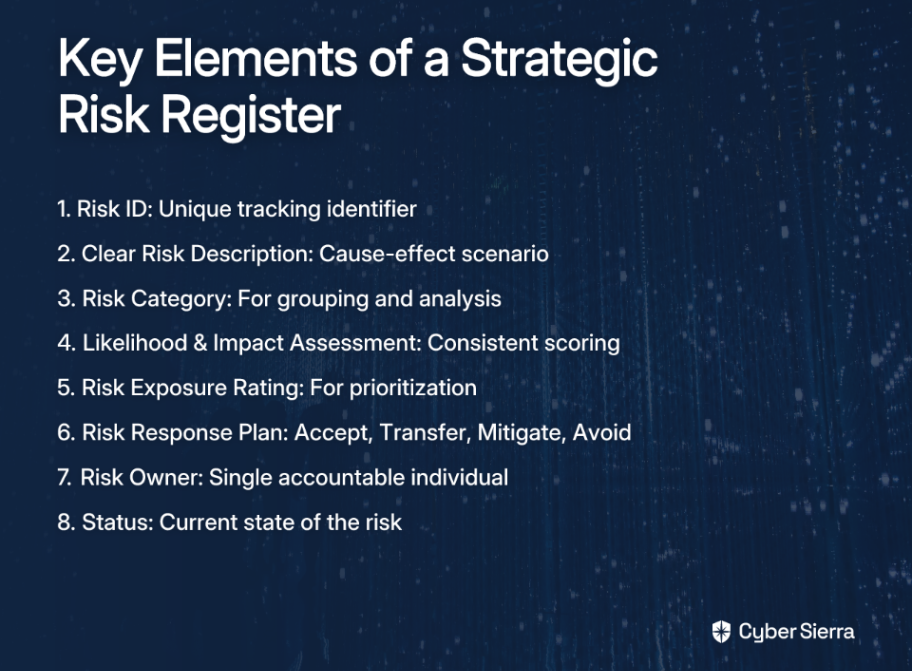
According to best practices from organizations like Hyperproof and LogicManager, every entry in your risk register should include:
- Risk ID: A unique identifier for tracking purposes.
- Risk Description: A clear, concise scenario explaining the potential event. This should follow a cause-effect format (e.g., "Due to [cause], there is a risk that [event] may occur, resulting in [consequence]").
- Risk Category: Group similar risks for analysis (e.g., Technical, External, Organizational, Project Management).
- Likelihood & Impact Assessment: Use a consistent scoring system (e.g., 1-5 scale) to quantify both the probability of occurrence and the potential business impact.
- Risk Exposure Rating: A calculated score (typically Likelihood × Impact) to help with prioritization.
- Risk Response Plan: The defined strategy (Accept, Transfer, Mitigate, Avoid, or Escalate).
- Risk Owner: The single individual accountable for managing the risk.
- Status: The current state of the risk (e.g., 'Open', 'In Progress', 'Closed').
Step-by-Step Process for Populating the Register
- Identify the Risk: Use techniques like brainstorming, SWOT analysis, and stakeholder interviews to identify potential risks.
- Assess the Risk: Evaluate likelihood and impact based on your organization's risk assessment methodology. Context is critical here—as one security professional pointed out, "Having a poorly configured password is going to be a lower risk if it's on an account only accessible internally vs an externally accessible account."
- Categorize the Risk: Implement a risk breakdown structure for a hierarchical view of your risk landscape.
- Develop a Risk Response: Outline actionable steps, timelines, and resources needed to address the risk.
- Assign Ownership: Ensure clear accountability by designating a specific individual as the risk owner.
- Monitor and Review: Remember that the risk register is a living document requiring regular updates as risks evolve and controls mature.
Part 2: The Solution - A Hub-and-Spoke Model for Total Visibility
Now for the critical question: How do you maintain visibility into vulnerabilities and control deficiencies without cluttering your risk register?
The answer is a hub-and-spoke model where your risk register serves as the strategic "hub," linked to tactical "spokes" that provide detailed operational information.
Spoke 1: The Vulnerability Management Log
Instead of tracking individual vulnerabilities as risks, maintain a separate vulnerability management database. As one practitioner noted, "We don't track individual vulnerabilities as risks in the risk register."
This vulnerability log should track:
- Vulnerability ID
- Description
- Affected assets
- CVSS scoring
- Remediation status
- Assigned teams/individuals
Connecting to the Hub: The aggregation of vulnerabilities informs strategic risks in your register. For example, a high number of critical, unpatched vulnerabilities on internet-facing servers creates a risk of "External compromise of critical systems due to delayed patch management." The vulnerability log provides the tactical evidence and feeds into the inherent risk assessment in the main register.
Spoke 2: The Control Deficiency & Issues Log
This is the proper home for items like "weak passwords" or other audit findings. It tracks deviations from your established control framework, including:
- Issue ID
- Description
- Related control
- Root cause analysis
- Remediation plan
- Owner
- Due date
Connecting to the Hub: The industry recommendation is valuable here: "Would suggest you think about pulling out thematic/repeating issues - if you have multiple reports of poor passwords in use, this is clearly a systemic issue that should be dealt with." These systemic patterns become risks in the main register: "Increased likelihood of unauthorized access due to systemic password control failures."
By implementing this structure, you maintain complete visibility while creating a clearer, more strategic risk register. The hub-and-spoke model allows you to:
- Keep your risk register focused on true risks
- Maintain detailed tracking of vulnerabilities and control deficiencies
- Establish clear relationships between operational issues and strategic risks
- Provide appropriate levels of detail for different audiences

Maintaining Control: Advanced Practices and Tools
Standardize Your Methodology
A common pain point in the GRC community is that "How risk are recorded, assessed, managed is probably the one thing that varies the most from a GRC group to another." To combat this inconsistency:
- Document a clear, standardized process for risk assessment
- Establish common scales for likelihood and impact
- Create templates for risk descriptions to ensure consistency
- Define thresholds for when vulnerabilities or control deficiencies should escalate to risk register entries
Effective Reporting and Communication
It's important to differentiate between a risk register (the detailed log) and a risk report (a summary for stakeholders), as explained by LogicManager. Your reporting should:
- Provide different levels of detail for different audiences
- Incorporate visual aids or dashboards to summarize risk data
- Highlight trends and patterns in your vulnerability and control deficiency logs
- Demonstrate the connections between operational issues and strategic risks
Move Beyond Spreadsheets
While spreadsheets are a common starting point, they have significant limitations for managing complex risk data. Consider purpose-built GRC software that can provide:
- Better data integrity
- Automated workflows
- Relationship mapping between risks, controls, and vulnerabilities
- Real-time reporting and dashboards
- Role-based access for different stakeholders
Conclusion: From a Cluttered Log to a Strategic GRC Tool
A well-structured risk register, supported by separate but linked logs for vulnerabilities and control deficiencies, is the key to clarity without sacrificing control visibility. This approach transforms your risk register from a tactical dumping ground into a powerful strategic asset.
The benefits are substantial:
- Proactive risk management: Clear visibility into what matters most
- Improved decision-making: Focused information at the appropriate level of detail
- Enhanced communication: Consistent language and structure across the organization
- Clear accountability: Proper ownership at both the strategic and tactical levels
By implementing this structured approach, you'll not only clean up your risk register but also enhance your overall risk management capabilities. You'll maintain complete visibility into your control environment while providing leadership with the strategic view they need to make informed decisions.
Remember that effective risk management isn't about tracking every possible issue—it's about understanding the relationships between vulnerabilities, control deficiencies, and the risks they create. With the right structure in place, your risk register becomes the cornerstone of a mature, effective GRC program that drives value for your organization.

Frequently Asked Questions
What is the difference between a risk, a vulnerability, and a control deficiency?
A risk is the potential for loss, a vulnerability is a weakness that can be exploited, and a control deficiency is a flaw in a safeguard designed to mitigate risk. Essentially, vulnerabilities and control deficiencies are the ingredients of risk. An unpatched server is a vulnerability, and a poorly configured password policy is a control deficiency. The risk is the potential event that could happen because of them, such as "unauthorized access to sensitive data."
Why shouldn't I track all vulnerabilities in my risk register?
Tracking every vulnerability in a risk register makes it cluttered, tactical, and difficult for leadership to use for strategic decision-making. A register filled with individual vulnerabilities becomes an overwhelming operational log rather than a strategic tool, making it hard to prioritize the most significant threats. It's better to track vulnerabilities in a dedicated log and use their aggregate impact to inform true, strategic risks.
How do I know when a control issue becomes a risk?
A control issue or vulnerability becomes a risk worthy of the register when it is systemic or creates a significant potential for business impact. For example, a single weak password is a control deficiency. However, widespread, repeated instances of weak passwords become a systemic failure that should be captured as a strategic risk, such as "Increased likelihood of account compromise due to systemic password control failures."
What is the hub-and-spoke model for risk management?
The hub-and-spoke model is a structure where a strategic risk register (the hub) is linked to detailed operational logs for vulnerabilities and control deficiencies (the spokes). This model keeps the main risk register clean and focused on high-level risks for executives, while the spokes provide the detailed, tactical evidence and tracking needed by operational teams.
How often should a risk register be reviewed?
A risk register should be formally reviewed at least quarterly or semi-annually, with more frequent updates for high-priority or rapidly changing risks. The register is a living document, not a static one. Regular reviews ensure that risk assessments remain accurate, response plans are on track, and new risks are identified promptly.
What is the first step to clean up a cluttered risk register?
The first step is to create separate logs for vulnerabilities and control deficiencies, then migrate non-risk items out of your main register and into these new logs. Begin by establishing a clear definition of what constitutes a "risk." Then, go through your existing register item by item and re-categorize each one. This initial triage is crucial for transforming the register into a strategic tool.
For additional resources, consider exploring NIST's guide on integrating cybersecurity and enterprise risk management and Hyperproof's risk register template as practical starting points.
