



How to Streamline Security Questionnaires with AI Automation


Join thousands of professionals and get the latest insight on Compliance & Cybersecurity.
You've just received your tenth security questionnaire this month. Two hundred questions, many redundant, all requiring detailed responses. Your heart sinks as you forward it to your already overworked security team, knowing this will bottleneck deals and drain valuable resources.
Sound familiar? You're not alone.
Security questionnaires represent what many professionals call the "peak of Security Theater" – a necessary evil that consumes time, creates cross-departmental chaos, and generates genuine frustration across organizations of all sizes.
The Anatomy of Questionnaire Burnout: Why the Manual Process is Broken
The traditional approach to handling security questionnaires is fundamentally flawed:

Resource Drain: Organizations often find themselves "assigning headcount" specifically to manage the questionnaire influx. As companies grow, entire teams form just to handle this administrative overhead – a seemingly "crazy thing to assign headcount to," yet increasingly necessary.
Cross-Departmental Chaos: Responding accurately requires a "collaborative effort" across multiple departments. Questions bounce between GRC teams, Sales Engineers, Product teams, and even Legal departments, creating coordination nightmares and bottlenecks.
Repetitive & Inefficient: Without proper systems, teams answer the same questions repeatedly. The lack of a "centralized knowledge library" forces manual lookups and rewrites for every new questionnaire, multiplying the inefficiency.
Despite these frustrations, security questionnaires serve critical business functions:
- Vendor Due Diligence: Evaluating the security practices of prospective vendors before onboarding them
- Building Trust: Demonstrating your own secure practices to close deals with potential clients
- Compliance: Proving adherence to frameworks like SOC 2, ISO 27001, NIST CSF, HIPAA, and GDPR
The question isn't whether security questionnaires are necessary – they absolutely are. The question is: how can we transform this tedious necessity into a streamlined, efficient process?
The AI Revolution in GRC: How Automation Changes the Game
Artificial intelligence is fundamentally transforming how organizations handle security questionnaires. Here's how:
Creating a Centralized, Living Knowledge Base
AI platforms don't simply store static answers – they create dynamic knowledge repositories by ingesting and learning from:
- Existing security documentation and policies
- Previously completed questionnaires
- Compliance framework documentation
- Company wikis and knowledge bases
This directly addresses the pain point expressed by many security professionals who recognize the need to "create a knowledge library" but struggle to maintain it as answers evolve.
Achieving Near-Instant, Accurate Responses
The most tangible benefit is speed and accuracy. Modern AI solutions can generate instant, contextually accurate answers with high confidence:
- Conveyor's platform reports over 95% accuracy on first attempts and a 91% reduction in time spent on questionnaires. The average response time per question drops from 4 minutes to just 22 seconds.
- Safebase's AI has processed over 1,000,000 questions, saving an estimated 28,000 hours of manual work—equivalent to 13 years of full-time effort.
Automating Evidence Collection and Control Mapping
Advanced AI solutions go beyond text answers to enable continuous monitoring of security controls:
- AI can automatically collect and map evidence (logs, system configurations, asset inventories) to specific controls required by frameworks like SOC 2 or ISO 27001
- This creates a continuously updated evidence library, ensuring answers are not just fast but also accurate and audit-ready
- Control mapping allows for consistent responses across different questionnaire formats and frameworks
Enhancing Collaboration and Streamlining Workflows
AI tools centralize the entire process, allowing teams to:
- Assign specific questions to subject matter experts when human review is needed
- Track statuses and deadlines in real-time
- Auto-complete questionnaires directly in third-party portals through browser extensions
- Integrate with tools like Slack and Salesforce to maintain workflow continuity
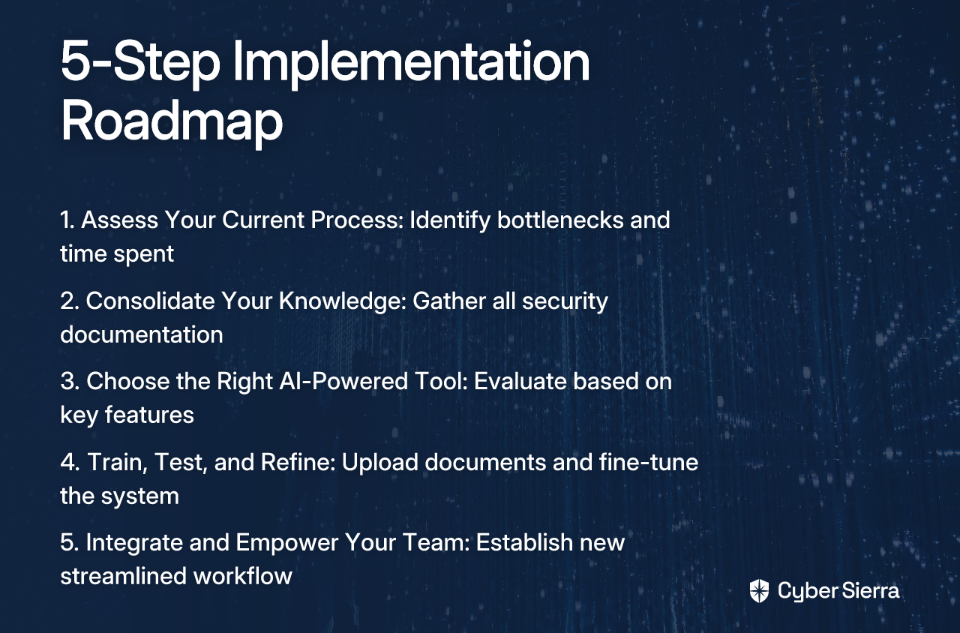
A Practical Guide: Implementing AI for Questionnaire Automation in 5 Steps
Ready to transform your questionnaire process? Here's how to get started:
Step 1: Assess Your Current Process
Map your existing workflow. Identify who's involved, where the bottlenecks occur, and how much time is being spent. Understand the specific pain points before applying a solution.
Step 2: Consolidate Your Knowledge
Gather all existing security documentation:
- Past questionnaires and responses
- Security policies and procedures
- Architecture diagrams
- Compliance reports (SOC 2, ISO 27001, etc.)
This collection will form the initial knowledge base for your AI engine.
Step 3: Choose the Right AI-Powered Tool
Evaluate solutions based on key features:
- AI Quality: Does it generate accurate, context-aware answers?
- Knowledge Management: How easily can it ingest and learn from your documents?
- Workflow & Collaboration: Does it support assignments, tracking, and approvals?
- Integrations: Does it work with your existing tools (CRM, TPRM portals)?
- Reporting & Analytics: Can you track time saved and calculate ROI?
Step 4: Train, Test, and Refine
Upload your documents and let the AI build its knowledge base. Run several test questionnaires through the system and review the AI-generated answers, providing feedback to improve accuracy. This training period is crucial for fine-tuning the system to your specific needs.
Step 5: Integrate and Empower Your Team
Roll out the tool to relevant teams (GRC, Sales Engineering, etc.). Provide training and establish a new, streamlined workflow where AI handles the first pass, and humans review and approve only when necessary.
Beyond Questionnaires: The Broader Impact of an AI-Enabled GRC Platform
While questionnaire automation delivers immediate relief, the real value comes from integrating this capability into a comprehensive security and compliance program.
Proactive Third-Party Risk Management (TPRM)
Answering questionnaires is just one side of the coin; managing your own vendors' risk is equally important.
An integrated platform like Cyber Sierra's TPRM module uses AI automation not just to respond to inquiries but to manage vendor risk proactively by:
- Automating vendor assessments and streamlining onboarding
- Providing near real-time, 24/7 visibility into vendor security posture
- Prioritizing vendors by risk level to focus resources where they matter most
Continuous Control Monitoring (CCM)
The knowledge base powering your questionnaire responses should reflect your actual security posture, not just documented policies.
Cyber Sierra's CCM module delivers ongoing, automated visibility into your security controls by:
- Centralizing your control repository with near real-time updates
- Automating control testing and validation
- Detecting exceptions and anomalies in real-time
This ensures that your questionnaire responses are always backed by verifiable evidence of your security practices.
Streamlined Audits and Unified Compliance
When your questionnaire responses, control monitoring, and evidence collection are unified, audit preparation becomes dramatically simpler.
Cyber Sierra's GRC module automates data collection and reporting for multiple frameworks (SOC2, ISO 27001, GDPR, HIPAA, PCI DSS), ensuring you're always audit-ready and can demonstrate compliance with minimal effort.
Conclusion: From Security Theater to Strategic Advantage
Security questionnaires don't have to be the dreaded "Security Theater" that professionals lament. With AI automation, you can transform this process from a resource-draining necessity into a streamlined, efficient function that accelerates sales cycles and strengthens trust.
By implementing AI-powered automation, you can:
- Slash response times by over 90%
- Free your security team to focus on strategic initiatives
- Ensure consistent, accurate responses across all questionnaires
- Build a continuously updated knowledge base that improves over time
- Integrate questionnaire responses with your broader security program
The ultimate goal is to leverage technology to handle the repetitive work, freeing up skilled security professionals to focus on what matters most: strategic risk management and building a stronger security posture.
Security questionnaires will always be part of doing business. But with the right AI automation, they no longer need to be the bane of your security team's existence.

Frequently Asked Questions
What is security questionnaire automation?
Security questionnaire automation is the use of Artificial Intelligence (AI) to automatically generate accurate answers to security and compliance questionnaires. It works by creating a centralized knowledge base from your existing security documents, policies, and past questionnaires. When a new questionnaire arrives, the AI instantly finds and populates the best answers, dramatically reducing the manual effort required from your security and GRC teams.
How does AI improve the security questionnaire process?
AI improves the security questionnaire process primarily by increasing speed, accuracy, and consistency while significantly reducing manual work. Instead of teams manually searching for answers and writing them from scratch, AI can generate responses in seconds. It centralizes all your security knowledge, ensuring answers are consistent and up-to-date. This frees up your security experts to focus on strategic tasks rather than repetitive administrative work.
How accurate are AI-generated answers?
Modern AI platforms for questionnaire automation are highly accurate, often achieving over 95% accuracy on the first pass. The accuracy comes from the AI's ability to learn from your specific company documentation, including past questionnaires, security policies, and compliance reports. The system can be trained and refined over time; users can review and correct answers, which helps the AI learn and improve its confidence for future responses.
What is a centralized knowledge base and why is it important?
A centralized knowledge base is a single, searchable repository that stores all your company's security information and previously answered questionnaire responses. It is critically important because it eliminates the need to reinvent the wheel for every new questionnaire. Without it, teams waste countless hours searching for the same information in different documents or asking colleagues for answers they've provided before.
What are the first steps to implementing AI for questionnaire automation?
The first steps are to assess your current process and consolidate all your existing security documentation into one place. Before choosing a tool, you need to understand your current bottlenecks. After that, gather past questionnaires, security policies, compliance reports, and any other relevant documents. This collection will serve as the initial training data for the AI engine.
Does AI automation replace the need for human oversight?
No, AI automation does not replace human oversight; it enhances it by handling the repetitive, time-consuming tasks. The best practice is to use AI as a powerful first-pass tool. It generates the initial draft of answers, which subject matter experts can then quickly review, edit, and approve. This collaborative workflow ensures accuracy and accountability while still saving the vast majority of manual effort.
