



How to Actually Implement PCI DSS v4.0.1 Requirements 6.4.3 and 11.6.1



Join thousands of professionals and get the latest insight on Compliance & Cybersecurity.
You've been handed the task of implementing PCI DSS v4.0.1's new requirements. After spending hours trying to decipher the documentation, you're met with vague guidelines that leave you wondering what "integrity verification" actually means and how you're supposed to implement it with limited resources before the 2025 deadline.
Sound familiar?
You're not alone. As one security professional put it, "The guidelines are well intentioned, but poorly defined" and "compliance isn't protection, but it damn well should NOT be this vague either."
This article cuts through the confusion surrounding Requirements 6.4.3 and 11.6.1. Instead of theoretical advice, we're providing a practical, actionable implementation guide that transforms these requirements from compliance burdens into real security advantages.
Understanding the Threat Landscape
Before diving into implementation, let's understand why these requirements exist.
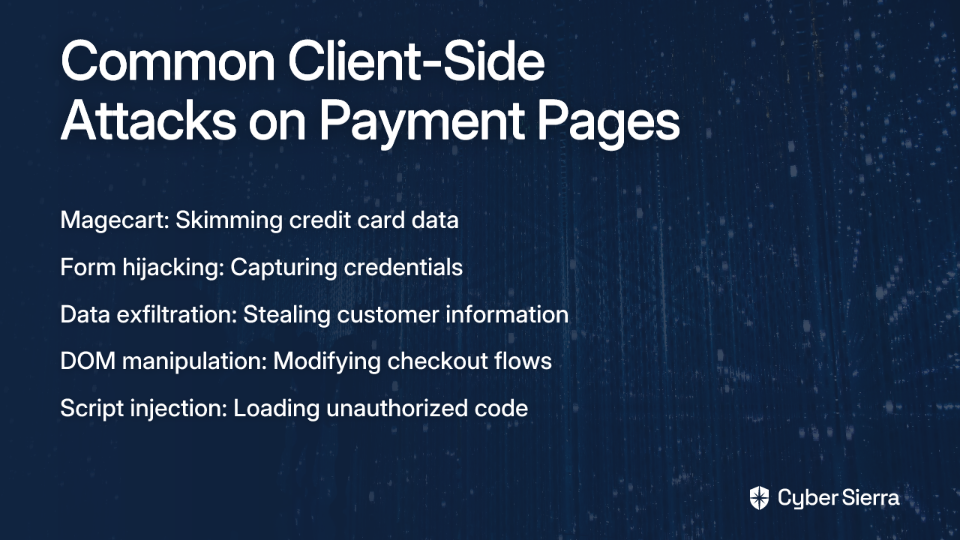
Since 2018, there's been a significant rise in client-side attacks like Magecart and digital skimming. These attacks target scripts running in your customers' browsers, injecting malicious code that harvests payment information directly from form fields - completely bypassing server-side security measures.
The PCI Security Standards Council responded with Requirements 6.4.3 and 11.6.1, which mandate better management and monitoring of scripts on payment pages.
The deadline is approaching fast: While 13 requirements became mandatory in April 2024, Requirements 6.4.3 and 11.6.1 must be implemented by April 1, 2025.
Requirement 6.4.3: Breaking It Down
Let's start with the official language:
"For payment pages that are loaded in the customer's browser, a method is in place to confirm that each script is authorized, has integrity, and has a documented inventory of all scripts with written justification as to why each is necessary."
This requirement has three core pillars:
1. Build and Maintain a Dynamic Script Inventory
The Problem: Manual inventories become outdated almost immediately due to dynamic DOM manipulations and third-party script dependencies.
The Solution: Implement an automated solution that continuously tracks all scripts executing on your payment pages.
Implementation Steps:
- Deploy a client-side monitoring solution capable of discovering all first-party and third-party scripts
- Ensure your solution captures scripts loaded through dynamic techniques (not just static script tags)
- Document the source domains and functions of each script
- Update this inventory automatically as changes occur
Many organizations try to maintain spreadsheets of scripts manually. As one Reddit user noted, a company "decided to try meeting these manually & it is currently costing them $100k + benefits for the FTE they had to onboard." This isn't sustainable or effective.
2. Authorize and Justify Every Script
The Problem: "Script sprawl" from marketing, analytics, and support tools introduces unnecessary risk to payment pages.
The Solution: Create a formal process for authorizing scripts and documenting their business justification.
Implementation Steps:
- For each script in your inventory, document:
- Who authorized it
- When it was authorized
- Why it's necessary for the payment page
- What data it accesses
- Create a review process for new script requests
- Regularly audit and remove unnecessary scripts
- Maintain this documentation for your QSA (Qualified Security Assessor)
This process forces organizations to confront the reality of script sprawl. You'll likely discover scripts from abandoned campaigns, duplicate analytics tools, and third-party services that no longer provide value but still introduce risk.
3. Implement and Monitor Script Integrity
The Problem: Even authorized scripts can be compromised or tampered with.
The Solution: Continuously verify script integrity to detect unauthorized modifications.
Implementation Steps:
- Implement SRI (Subresource Integrity) checks for static scripts where possible
- For scripts that can't use SRI, employ behavior-based monitoring solutions
- Set up alerting for script modifications and updates
- Document your integrity verification methods
While SRI is a powerful native browser feature, it can be challenging to implement at scale, especially with third-party scripts that frequently update. Modern automated tools can analyze script behavior patterns to detect suspicious changes even when file hashes change legitimately.
Requirement 11.6.1: Real-Time Detection and Alerting
Now for the second requirement:
"A change- and tamper-detection mechanism is deployed as follows: To alert for unauthorized modification to the HTTP headers and the contents of payment pages as received by the consumer browser. The mechanism is configured to evaluate the received HTTP header and payment page."
While the requirement states this check must run at least weekly, weekly checks are woefully inadequate. As one security professional bluntly put it, "If your solution crawls the page weekly and calls it protection, you are part of the problem."
1. Implement Automated Monitoring
The Problem: Infrequent checks leave wide windows of vulnerability.
The Solution: Deploy continuous monitoring rather than periodic scans.
Implementation Steps:
- Implement a Content Security Policy (CSP) in report-only mode to detect script violations
- Deploy client-side monitoring that captures real user sessions
- Ensure your solution checks both HTTP headers and DOM modifications
- Configure monitoring for all payment pages and testing environments
A robust CSP can significantly enhance your security posture, though as one Reddit user noted, "Managing CSP is a headache and will rapidly age anyone who touches it." This is why automated solutions are crucial.
2. Configure Real-Time Anomaly Alerts
The Problem: Alert fatigue from non-critical notifications results in missed security incidents.
The Solution: Implement intelligent alerting that provides context and prioritization.
Implementation Steps:
- Configure alerts for:
- New script detection
- Script modifications
- HTTP header changes
- Data exfiltration attempts
- Send alerts through multiple channels (email, Slack, SIEM)
- Include context with each alert (affected pages, script details, etc.)
- Implement alert severities to prioritize response
3. Provide Actionable Insights for Remediation
The Problem: An alert without context is useless for remediation.
The Solution: Ensure your monitoring system provides detailed information for incident response.
Implementation Steps:
- Capture logs showing when and how changes occurred
- Document the behavior of suspicious scripts
- Maintain an audit trail for investigation
- Create playbooks for common incident types
When unauthorized script changes are detected, your team needs to quickly understand what happened, assess the impact, and take corrective action. Without detailed context, this becomes nearly impossible.
A Unified Strategy: Plan, Analyze, Implement, Improve
To successfully implement these requirements, adopt a strategic lifecycle approach:
1. Plan
Develop a comprehensive strategy outlining how you will:
- Define your payment page scope
- Assign roles and responsibilities
- Select appropriate tools and technologies
- Create documentation templates
- Establish review processes
2. Analyze
Conduct a gap analysis to:
- Assess current script usage
- Identify vulnerabilities
- Document existing controls
- Understand compliance shortfalls
- Prioritize remediation efforts
3. Implement
Execute your plan using automated tools:
- Deploy script inventory solutions
- Implement integrity checks
- Configure real-time monitoring
- Set up alerting mechanisms
- Document everything for your QSA
4. Improve
Continuously enhance your script management practices:
- Review and refine alerts
- Update script inventories
- Improve authorization processes
- Refine monitoring capabilities
- Incorporate lessons from incidents
Common Pitfalls and Pro Tips
Common Pitfalls
- Lack of Documentation: Failing to maintain detailed records of script justifications will lead to audit failures
- Ignoring Initial Findings: Many organizations are shocked at how many unauthorized scripts are running on their payment pages
- Inconsistent Practices: Different development teams using different standards creates security gaps
- Superficial Compliance: As one Reddit user noted, "Sampling 10% of sessions and calling it real-time monitoring is honestly terrifying"
Pro Tips
- Automate Where Possible: The scale and complexity of modern websites make manual approaches impractical
- Integrate Security into the SDLC: Build script controls into your development process rather than treating it as a separate compliance exercise
- Foster a Culture of Security: Train developers on secure coding practices and the importance of script management
- Consider Runtime Protection: Beyond monitoring, implement runtime protection to actively block suspicious script behavior
Conclusion: From Compliance Burden to Security Advantage
Successfully implementing PCI DSS Requirements 6.4.3 and 11.6.1 requires moving beyond periodic, manual checks to a continuous, automated approach focused on inventory, authorization, integrity, and real-time detection.
By embracing automation and integrating these practices into your development lifecycle, you transform these challenging requirements from compliance burdens into powerful security advantages. This is how you achieve actual protection against injection attacks and sophisticated digital skimming, ensuring you meet the 2025 deadline not just with a checkmark, but with confidence in your security posture.
Remember, as one security professional aptly put it, "The quality of your threat intel and detection capabilities will make all the difference." Invest in robust solutions now, and you'll not only achieve compliance but genuinely enhance your security against the growing threat of client-side attacks.

FAQs
What is the deadline for PCI DSS requirements 6.4.3 and 11.6.1?
The deadline for implementing PCI DSS v4.0.1 requirements 6.4.3 and 11.6.1 is April 1, 2025. While many other PCI v4.0 requirements became mandatory in 2024, these specific rules related to client-side security were given a later deadline to allow organizations time to adopt new technologies and processes.
What is the main purpose of PCI DSS requirement 6.4.3?
The main purpose of requirement 6.4.3 is to manage all scripts running on payment pages by maintaining an inventory, ensuring each script is authorized and necessary, and verifying its integrity. This involves three key actions: continuously inventorying every script, formally documenting the business justification for each one, and implementing mechanisms like Subresource Integrity (SRI) or behavior monitoring to ensure scripts are not tampered with.
How does requirement 11.6.1 differ from 6.4.3?
Requirement 6.4.3 focuses on the management of scripts (inventory, authorization, integrity), while requirement 11.6.1 focuses on the real-time detection of unauthorized changes to payment pages and HTTP headers as they are rendered in the user's browser. Think of 6.4.3 as proactive governance—knowing what should be there. In contrast, 11.6.1 is reactive detection—alerting you immediately when something unexpected appears or changes, such as a script modification or a malicious HTTP header.
Why are automated tools necessary for PCI DSS script management?
Automated tools are necessary because modern websites use dynamic and third-party scripts that make manual tracking via spreadsheets infeasible, quickly outdated, and prone to error. Manual methods cannot keep up with scripts that load other scripts or change dynamically. Automated solutions provide continuous, real-time monitoring of all scripts, detect unauthorized changes instantly, and offer a reliable system of record for audits, which is more effective and cost-efficient than hiring full-time staff for manual tracking.
What are client-side attacks like Magecart?
Client-side attacks, such as Magecart or digital skimming, are attacks that inject malicious code into scripts running in a customer's web browser to steal sensitive information, like payment card data, directly from online forms. These attacks bypass traditional server-side security because the malicious activity happens entirely on the user's device (the "client-side"). The new PCI DSS requirements are specifically designed to help organizations detect and prevent these kinds of attacks on their payment pages.
How can I start implementing these PCI DSS requirements?
The first step is to conduct a gap analysis to get a complete, automated inventory of all scripts currently running on your payment pages. You cannot authorize or protect what you don't know exists. Use an automated tool to discover all first-party and third-party scripts. This initial analysis will reveal your current compliance posture, identify unauthorized scripts, and provide the foundation for building your authorization process and monitoring strategy.
For more information on PCI DSS v4.0.1 requirements, visit the PCI Security Standards Council documentation library.
