



HIPAA Compliance in ABA Clinics: Parent Observation Guidelines


Join thousands of professionals and get the latest insight on Compliance & Cybersecurity.
You've entrusted your child to an ABA clinic for therapy, eager to see their progress firsthand. But when you ask to observe a session, the staff hesitates, citing "HIPAA regulations." Frustration builds as you think, "Do they expect people to leave their kids at a place they can't see?" Meanwhile, the clinic director worries about "incidental exposure of PHI" if parents observe sessions where multiple children receive treatment.
This tension between parental rights and privacy obligations creates unnecessary friction in what should be a collaborative therapeutic relationship. The problem isn't that clinics want to hide their practices—it's that they lack clear, standardized guidelines for balancing observation with legal compliance.
This guide provides ABA clinics with a comprehensive framework for developing HIPAA-compliant parent observation policies that honor a parent's right to be involved while protecting the confidentiality and dignity of every client.
A Primer on HIPAA in the ABA Context
Before diving into specific guidelines, let's clarify what HIPAA actually requires of ABA providers.
The Health Insurance Portability and Accountability Act of 1996 (HIPAA) was enacted by President Bill Clinton on August 21, 1996, to protect the confidentiality and security of patient health information. Though initially designed for traditional healthcare settings, its rules apply fully to behavioral health providers, including ABA clinics.
Key Terminology for ABA Providers:
- Covered Entities (CEs): ABA clinics fall under this category as healthcare providers who transmit health information electronically.
- Business Associates (BAs): These are entities that handle Protected Health Information (PHI) on behalf of your clinic, such as billing services, electronic health record vendors, or cloud service providers.
- Protected Health Information (PHI): This includes any identifiable health information. In ABA therapy, PHI encompasses:
- Session notes and behavior data
- Treatment plans and protocols
- Diagnoses and assessment results
- Client names or initials when connected to their status as a client
- Videos or photos of therapy sessions
The Core HIPAA Rules to Know:
- The Privacy Rule: This governs how PHI is used and disclosed. It's central to the parent observation dilemma, as it dictates who can access what information and under what circumstances.
- The Security Rule: This focuses on safeguarding electronic PHI (ePHI) through administrative, physical, and technical safeguards. With the rise of telehealth and digital record-keeping in ABA, compliance with this rule is increasingly important.
- The Breach Notification Rule: This details the steps required if a PHI breach occurs, including notifying affected individuals. Understanding this rule helps clinics appreciate the seriousness of potential privacy violations.
Parental Rights vs. Client Privacy: Navigating the Gray Areas
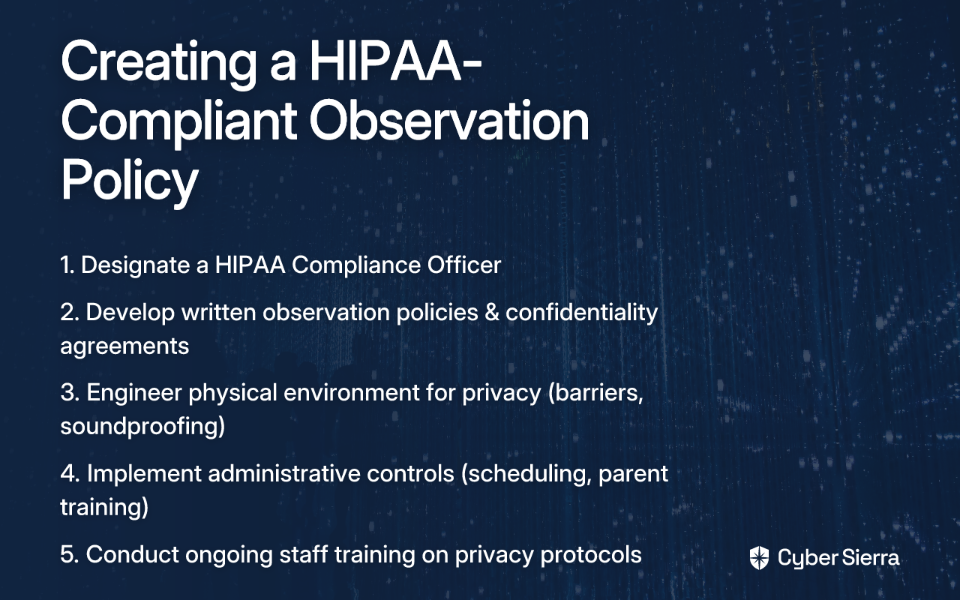
The fundamental tension in parent observation stems from two competing principles: a parent's right to access their child's healthcare information and a provider's obligation to protect all clients' privacy.
The General Rule: Parents as "Personal Representatives"
Under the HIPAA Privacy Rule, parents are generally considered their minor child's "personal representatives" and have the right to access their child's medical records. According to the Department of Health and Human Services, this means parents can exercise privacy rights on behalf of their children, including the right to view treatment.
Crucial Exceptions to Parental Access:
However, there are specific situations where a parent may not be treated as a personal representative:
- When the minor consents to care, and state law does not require parental consent
- When the minor obtains care at the direction of a court
- When the parent agrees to a confidential relationship between the provider and the minor
Additionally, a provider may deny a parent access if there is a reasonable belief of domestic violence, abuse, or neglect. This is a critical legal protection for vulnerable children.
The Challenge of the Multi-Client Setting: Incidental Exposure
ABA clinics face a unique challenge because therapy often occurs in settings where multiple children receive treatment simultaneously. This creates the potential for "incidental exposure"—an unavoidable disclosure of PHI that occurs as a byproduct of an otherwise permissible activity.
For example, a parent observing their child in a group therapy room might:
- See another child experiencing a behavioral episode
- Hear another child's name called
- Overhear a therapist discussing another child's targets
Parents often ask, "Why isn't it a violation for the clients to see other clients' sessions?" The answer lies in understanding that while incidental exposure is sometimes permissible, clinics must take "reasonable safeguards" to limit it. The absence of such safeguards is what creates HIPAA compliance risks.
Common Pitfalls: How Parent Observations Can Lead to HIPAA Violations
Even well-intentioned observation policies can inadvertently create compliance issues. Here are the most common pitfalls:
Overheard Conversations
Staff discussing one client's progress in a waiting room or hallway where another client's parents are present creates unauthorized disclosure. As one provider noted, "We do our best to use initials when talking about the kids when parents are in the building," but even this precaution may be insufficient if the context makes the child's identity obvious.
Improper Document Handling
Leaving session notes, data sheets, or treatment plans with visible PHI on a desk in an area accessible to observing parents is a direct violation. Electronic records displayed on unattended screens pose similar risks.
Lack of Physical/Auditory Separation
Without proper soundproofing or visual barriers, parents being able to see or hear into other treatment rooms from their observation point constitutes a breach. This is why many clinics emphasize "a setting away from other children" for observations.
Unsecured Digital PHI
A therapist using a laptop with another client's data visible on the screen during an observation session can expose sensitive information. With the increasing use of tablets and electronic data collection in ABA settings, this risk has grown substantially.
Failure to Obtain Specific Consent
Many clinics mistakenly assume that a general consent-to-treat form covers observation in a multi-client setting. As one provider put it, "I think a consent form just needs to be signed based on my center," but HIPAA requires more specific authorization for sharing PHI beyond the minimum necessary for treatment.
A Step-by-Step Guide to Creating a Compliant Parent Observation Policy
Now that we understand the challenges, let's build a framework for a HIPAA-compliant observation policy:
Step 1: Designate a HIPAA Compliance Officer
This individual is responsible for developing, implementing, and overseeing all HIPAA policies, including parent observation. Even small practices should assign this role to ensure accountability and consistent application of privacy standards.
Step 2: Develop a Written Observation Policy & Confidentiality Agreement
This is non-negotiable. The policy should be clear, concise, and provided to all families upon intake. The confidentiality agreement, signed by parents before any observation, should include:
- Acknowledgement that they may be incidentally exposed to the PHI of other children
- A binding agreement not to disclose any information (visual or auditory) about any other child
- Clear rules of conduct during observation (e.g., designated viewing areas, no cell phones/recording, scheduled times only)
Step 3: Engineer the Physical Environment for Privacy
Implement "reasonable safeguards" to protect privacy:
- Physical Separation: Use dedicated observation rooms with one-way mirrors, as described by providers using "DTI rooms" for observation
- Soundproofing: Ensure conversations from one treatment room cannot be easily heard in another or in the observation area
- Visual Barriers: Use privacy screens or position furniture to limit sightlines into other therapy areas. As one clinic described, "We put up the wall/door for drop off so parents won't see/watch another client engaging in behaviors... for their dignity and privacy."
Step 4: Implement Administrative Controls
- Scheduled Observations: Require parents to schedule observation times in advance to prevent drop-ins during sensitive activities
- Structured Parent Training: Frame this as the primary method for observation. As one provider recommended, "Have parents come in for parent training and meetings." This creates a controlled environment where the focus is on teaching the parent skills related to their child's program.
Step 5: Conduct Rigorous and Ongoing Staff Training
Training should be annual at a minimum and should cover:
- The clinic's specific observation policy
- How to professionally enforce the rules with parents
- Protocols for managing conversations and client data when parents are present (the "minimum necessary rule")
- How to respond if they witness a breach by a parent or another staff member
Leveraging Technology for Secure Observations
Modern tools can support compliant observation policies:
- Use HIPAA-compliant software for practice management and data collection
- Implement secure communication channels rather than texting PHI or using unsecured email
- Consider telehealth platforms with observation capabilities that limit what parents can see to only their child's session
Fostering Trust Through Compliant Transparency
A strong HIPAA observation policy isn't meant to exclude parents but to create a safe and respectful environment for everyone. By implementing written policies, signed confidentiality agreements, structured observation environments, and comprehensive staff training, ABA clinics can balance a parent's desire for transparency with their legal obligation to protect all clients' privacy.
Remember: the goal isn't just legal compliance—it's building a foundation of trust that supports effective therapy. When parents understand that privacy protocols protect their child too, they're more likely to respect and appreciate your clinic's professionalism.
Take time to audit your current procedures, consult with legal counsel specializing in healthcare law, and proactively communicate your policies to families. The investment in proper HIPAA compliance will pay dividends in parental satisfaction, staff confidence, and protection from potentially costly violations.
Frequently Asked Questions
Why can't I watch my child's ABA therapy session anytime I want?
Parents generally have a right to observe their child's therapy, but ABA clinics must balance this with their legal duty under HIPAA to protect the privacy of all clients. Unscheduled or unrestricted observations in a multi-client setting can lead to the "incidental exposure" of other children's Protected Health Information (PHI), creating a HIPAA compliance risk. To manage this, clinics implement structured, scheduled observation policies that respect both parental involvement and the confidentiality of every child.
How can ABA clinics allow parent observation without violating HIPAA?
Clinics can facilitate HIPAA-compliant observations by implementing a multi-faceted strategy. This includes requiring parents to sign a confidentiality agreement, engineering the physical environment with dedicated observation rooms or visual barriers, scheduling observations in advance, and providing comprehensive staff training. These "reasonable safeguards" minimize the risk of exposing the PHI of other clients while honoring a parent's right to be involved.
What is "incidental exposure" of PHI in an ABA setting?
Incidental exposure is the unavoidable disclosure of Protected Health Information (PHI) that occurs as a byproduct of a permissible activity, like a parent observing their child's session. For example, a parent might see another child's behavioral episode or overhear a therapist discussing another client. While HIPAA permits some incidental exposure, clinics are required to have "reasonable safeguards" in place to limit these occurrences as much as possible.
Can a parent be legally denied access to observe their child's therapy?
Yes, under specific circumstances, a provider may deny a parent access. While parents are typically considered a child's "personal representative" under HIPAA, access can be restricted if there is a reasonable belief of domestic violence, abuse, or neglect by that parent. Additionally, access may be limited in specific legal situations, such as when a minor consents to their own care as permitted by state law or when care is court-ordered.
What should be included in a parent confidentiality agreement for observations?
A strong confidentiality agreement is a critical component of a compliant observation policy. It should include an acknowledgment from the parent that they may be incidentally exposed to the PHI of other children, a legally binding agreement not to disclose any information (visual or auditory) about any other child they see or hear, and a clear outline of the rules of conduct during observation (e.g., designated viewing areas, no recording devices, no cell phone use).
