



How to Make Employees Actually Care About Cybersecurity Training


Join thousands of professionals and get the latest insight on Compliance & Cybersecurity.
You've invested in the latest cybersecurity training program. You've mandated completion for every employee. The compliance numbers look great on paper. But when another phishing email slips through your email filter, employees still click suspicious links without hesitation, potentially exposing your organization to devastating cyber attacks.
Sound familiar?
"They're worthless... it doesn't give you any useful knowledge that wouldn't be either blatantly obvious or some absolutely useless trivia," laments one frustrated employee about mandatory training sessions. Another admits they "just half-ass it enough to get a 70% on the assessment."
The hard truth? Most cybersecurity training programs fail because they focus on checking compliance boxes rather than creating genuine engagement. This matters enormously because 74% of all data breaches involve a human element, according to Verizon's 2024 Data Breach Investigations Report.
It's time to move beyond the "bullshit training" (as employees often describe it) and create security awareness programs that employees actually care about.
Why Your Annual "Checkbox" Training is Failing
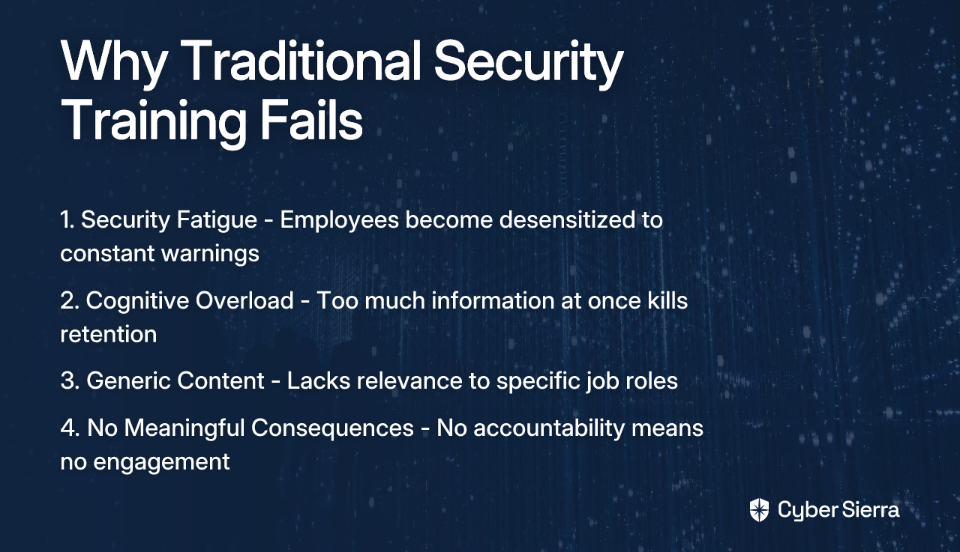
Traditional cybersecurity training programs fail for several fundamental reasons:
1. Security Fatigue Leads to Disengagement
Employees become overwhelmed by constant warnings and alerts about security threats, leading to "security fatigue" – a well-documented phenomenon where people become desensitized to security concerns. When your team receives multiple spoofed emails daily alongside legitimate communications from outsourced HR functions, distinguishing between them becomes exhausting.
2. Cognitive Overload Kills Retention
Long, information-dense training sessions compete with actual work demands. This cognitive overload means employees retain very little information. When cybersecurity concepts aren't presented in digestible formats, the brain simply can't process and store the information effectively.
3. Generic Content Lacks Relevance
"They're all so braindead obviously fake that it's astonishing anyone actually falls for it," says one employee about phishing simulations. Yet others find them "annoyingly difficult to catch" with "spoofed internal email addresses." This disconnect highlights how one-size-fits-all approaches fail to address varying skill levels and job responsibilities.
4. No Meaningful Consequences
"The fake emails to catch people who aren't careful don't have any consequences..." This sentiment appears repeatedly in employee feedback. Without accountability, the training becomes a meaningless exercise in compliance rather than risk reduction.
The Paradigm Shift: From Compliance to Culture
Effective cybersecurity training isn't about forcing compliance—it's about fostering a culture of shared responsibility and vigilance. This requires a fundamental shift in how organizations approach security awareness.
When leadership treats "security threats like something that just won't happen to us," employees naturally adopt the same attitude. Conversely, when leaders model vigilance and make security a visible priority, it signals to everyone that cybersecurity matters.
Here are four actionable strategies to transform your security training from a dreaded requirement into a source of genuine engagement:
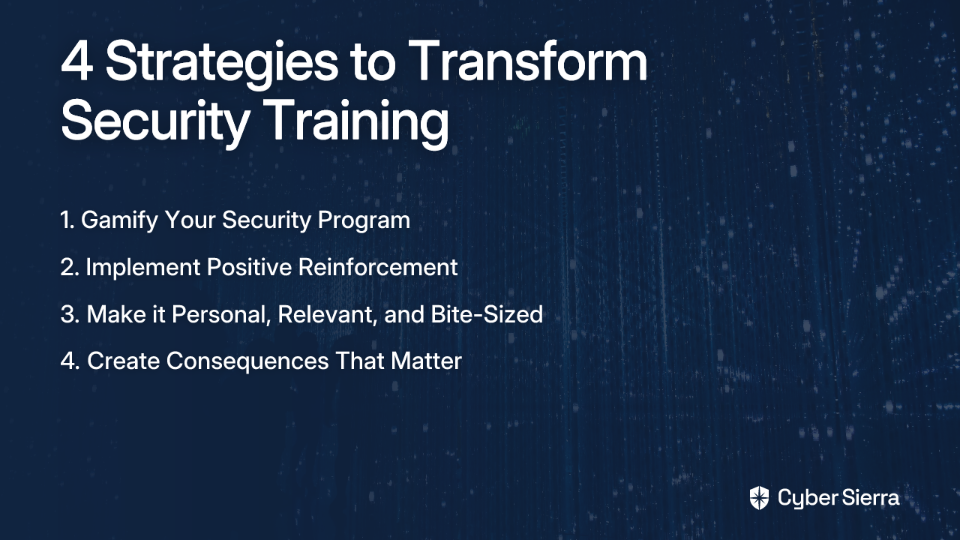
Strategy 1: Gamify Your Security Program
Gamification isn't about playing games—it's about using game mechanics like points, badges, leaderboards, and challenges to influence behavior. The science is compelling: gamification can boost engagement by up to 60%, with 90% of employees reporting higher productivity with gamified training.
AES Corporation, a Fortune 500 company, saw employee participation in security training jump from a dismal 10% to over 70% after implementing gamification. Organizations using gamified phishing simulations have seen a 6× improvement in reporting accuracy.
How to implement it:
- Create a points system for security-positive behaviors (reporting phishing attempts, completing micro-training modules)
- Develop leaderboards to foster friendly competition between departments
- Offer achievement badges for mastering specific security skills
- Design progressive challenges that increase in difficulty as employees build competence
This approach taps into intrinsic motivation, making security feel like a challenge to master rather than a burden to bear.
Strategy 2: Implement Positive Reinforcement and Rewards
Instead of punishing employees who fail phishing tests, create a program that rewards those who successfully identify and report threats. As one cybersecurity professional suggests, "Give them a reward for reporting phishing emails."
Effective reward ideas:
- Gift cards for reporting suspicious emails (especially those that bypass your email filter)
- Public recognition in company meetings for security champions
- Extra time off for teams with the best security performance
- Tangible rewards like company swag or meal vouchers
The SANS Institute notes that positive reinforcement is far more effective than fear-based messaging for creating lasting behavior change. When employees feel rewarded and recognized for security vigilance, they shift from reluctant compliance to active participation.
Strategy 3: Make it Personal, Relevant, and Bite-Sized
Generic training fails because different roles face different security threats. An accountant needs different training than an IT administrator or marketing professional.
Implementation tactics:
- Role-based scenarios: Create realistic phishing simulations tailored to specific job functions. Finance teams should receive fake invoices, while HR might get resume submissions containing malware.
- Microlearning: Replace hour-long sessions with 3-5 minute modules focused on specific skills. This combats the "Ebbinghaus Forgetting Curve" by reinforcing key concepts over time.
- Real-world examples: Share anonymized stories of actual security incidents from your organization or industry. As one employee noted, "if they had examples of how it went wrong in the past everyone or mostly everyone paid attention."
The Ponemon Institute found that role-relevant training significantly enhances engagement and retention. When training addresses the actual risks employees face in their daily work, they're far more likely to pay attention.
Strategy 4: Create Consequences That Matter
"The fake emails to catch people who aren't careful don't have any consequences..." This sentiment appears repeatedly in employee feedback. Without accountability, even the best training program will fail.
A tiered approach to consequences:
- First failure: Assign a short, interactive micro-module specifically related to the security threat they missed.
- Second failure: Schedule a one-on-one session with their manager or security team member to review best practices. This "makes managers manage" the security behaviors of their teams.
- Persistent failures: Implement temporary restrictions on system access or include security performance in formal performance reviews.
The goal isn't to punish but to communicate the seriousness of security risks and provide targeted support to change behavior. Without consequences, training becomes an empty exercise that employees can safely ignore.

Case Studies: From Apathy to Vigilance
IGT's Dramatic Transformation
International Game Technology (IGT) faced high phishing failure rates and low engagement with their traditional security training. After switching to a gamified, behavior-based approach:
- Phishing failure rates plummeted from 30% to 4-6%
- Employee engagement surged to over 56%
- Security became part of the company culture rather than an IT problem
Princeton University's Creative Approach
Princeton University faced resistance to mandatory cybersecurity training. Their solution? Make security fun and engaging through events like "Cyber Wheel of Fortune" and "Web Cookie Cornhole" to teach important concepts in a memorable way.
Results included:
- Significant increase in password manager adoption (1,100 new accounts in one year)
- Marked improvement in security behaviors noted in internal audits
- Cultural shift toward accepting the importance of security awareness
A key lesson from their success was "Less is More"—focusing on concise, relevant content rather than overwhelming employees with information.
Your Employees Are Your Best Defense
Stop treating employees like the weakest link and start empowering them to be your greatest security asset. By implementing these four strategies—gamification, positive reinforcement, personalized content, and meaningful consequences—you can transform your security culture from one of apathy to one of vigilance.
Remember:
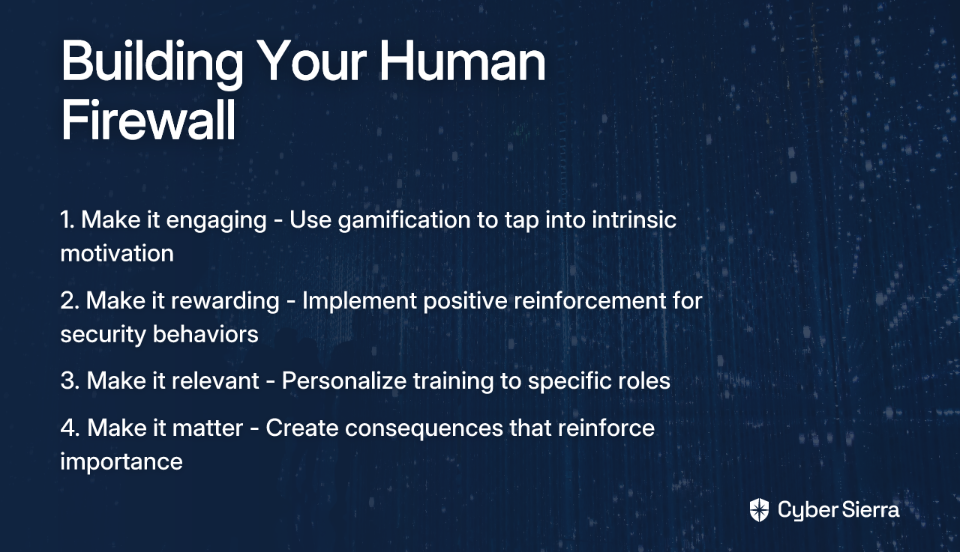
- Make it engaging: Use gamification to tap into intrinsic motivation
- Make it rewarding: Implement positive reinforcement for security-positive behaviors
- Make it relevant: Personalize training to specific roles and use microlearning
- Make it matter: Create consequences that reinforce the importance of security
The best defense against the ever-evolving landscape of cyber attacks isn't just technology—it's a workforce that genuinely cares about protecting your organization. When employees feel empowered rather than burdened by security responsibilities, they become active participants in your defense strategy rather than its greatest vulnerability.
As threats from phishing, malware, and other attack vectors continue to grow more sophisticated, the organizations that succeed in building a culture of security awareness will be the ones that remain resilient in the face of these challenges.
Frequently Asked Questions
Why does most cybersecurity training fail?
Most cybersecurity training fails because it prioritizes compliance over genuine employee engagement, leading to issues like security fatigue, cognitive overload, and a lack of personal relevance. Traditional annual training is often seen as a "checkbox" exercise that overwhelms employees with generic information they quickly forget. Without content tailored to their roles or meaningful consequences for inaction, employees disengage and see the training as a pointless requirement.
How can we make cybersecurity training more engaging for employees?
You can make cybersecurity training more engaging by using strategies like gamification, positive reinforcement, and personalized, bite-sized content. Instead of long annual sessions, use game mechanics like points and leaderboards to foster friendly competition. Reward employees for positive security behaviors, such as reporting phishing emails, rather than just punishing failures. Finally, deliver training in short microlearning modules with scenarios that are directly relevant to an employee's specific job.
What is the most important first step to improve a security awareness program?
The most important first step is to shift your organization's mindset from a compliance-focused approach to building a positive security culture. This cultural shift begins with leadership visibly prioritizing security as a shared responsibility. Instead of asking, "Are we compliant?" start asking, "Are our people engaged and empowered to defend against threats?" This change in perspective is the foundation for implementing more effective training strategies.
Should we punish employees who fail phishing tests?
No, positive reinforcement is far more effective for long-term behavior change than punishment. Punishing employees can create a culture of fear, discouraging them from reporting real incidents. A better approach is a tiered system of consequences focused on education. For a first failure, assign a relevant micro-training module. For repeat issues, a one-on-one coaching session can provide targeted support. The goal is to educate, not to shame.
How do you measure the success of a security awareness program?
You can measure success by tracking key behavior-based metrics over time, rather than just course completion rates. Look for improvements in metrics like lower phishing simulation click-through rates, a higher number of suspicious emails reported by employees, and a shorter time-to-report for potential threats. Success isn't just about who finished the training; it's about seeing a measurable reduction in risky behaviors across the organization.
Note: This article is based on research from various sources including the Verizon Data Breach Investigations Report, NIST studies on security fatigue, and case studies from Princeton University and IGT.
