



The Hidden Cost of Kubernetes Knowledge Debt in Your DevOps Team



Join thousands of professionals and get the latest insight on Compliance & Cybersecurity.
You've invested heavily in Kubernetes to achieve the promised land of cloud agnosticism. Your infrastructure now spans multiple environments - maybe even across AWS, GCP, and Azure. But there's a growing problem lurking beneath the surface that keeps you up at night: "I'm the only person on my team that seems to understand how it works. As a result I'm expected to do everything."
This sentiment, shared by countless DevOps engineers across Reddit and other forums, highlights not the traditional vendor lock-in that companies fear, but something potentially more insidious - knowledge lock-in.
The Lock-In You Didn't See Coming
When organizations adopt Kubernetes, they often focus on avoiding vendor lock-in. The appeal is obvious - a containerized infrastructure that can theoretically run anywhere gives you leverage against cloud providers. But as one engineer candidly puts it: "The lock-in for Kubernetes isn't a vendor lock-in but a knowledge one. If you're running that for everything then you need the resources who know it, and migrating to another provider isn't as simple as people make it seem."
This knowledge lock-in creates a dangerous dependency. Your operations, disaster recovery (DR) plans, and ability to innovate all hinge on the expertise of a small subset of your team - sometimes even a single person. As another practitioner bluntly states: "You have to have at least 2 [Kubernetes experts] or you can never really take a day off."
Decoding Kubernetes Knowledge Debt
Technical debt is a familiar concept to most engineering teams - it encompasses any workflow, process, code, or hardware that detracts from team objectives. But Kubernetes knowledge debt is a specialized form where your operational stability dangerously depends on a small pool of experts.
The consequences of this debt manifest in three critical ways:
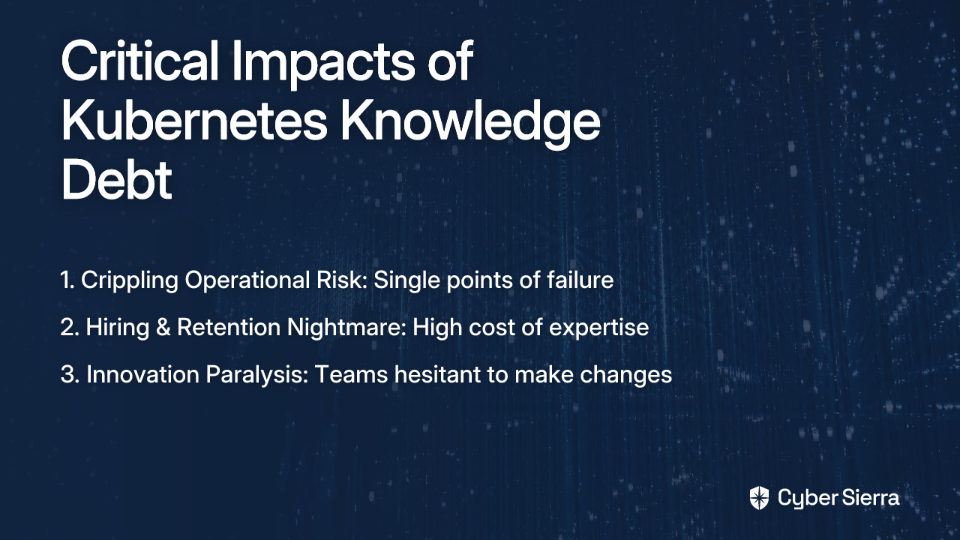
1. Crippling Operational Risk
When Kubernetes knowledge is siloed, a single expert's absence can halt progress or delay critical incident response. Imagine your production EKS cluster experiencing issues during a major product launch, but your only Kubernetes expert is on vacation. The rest of the team might understand the application layer but lack the expertise to diagnose infrastructure problems.
This is the "single person on-call responsible for SRE for the whole company" nightmare scenario that keeps both managers and engineers awake at night.
2. The Hiring and Retention Nightmare
Finding qualified Kubernetes engineers is becoming increasingly difficult and expensive. According to recent salary data, Kubernetes engineers in the US earn between $100,000 and $200,000, with an average of $140,000-$160,000. A DevOps Kubernetes engineer earns around $146,000 on average, while top experts can demand over $200,000.
This creates immense pressure on both sides of the hiring equation. Job seekers feel "If you don't know Kubernetes... you are, almost certainly, completely fucked on your next job search." Meanwhile, companies struggle to compete for the limited talent pool, often paying premium rates for contractors or consultants to fill critical gaps.
3. Innovation Paralysis
Perhaps most concerning is how knowledge debt stifles innovation. When your Kubernetes experts are constantly firefighting, they can't focus on strategic initiatives. The rest of the team, lacking confidence in the infrastructure, becomes hesitant to propose changes or improvements that might affect the cluster.
The result? Your organization's velocity slows precisely when you need it most - when trying to leverage the agility Kubernetes was supposed to provide in the first place.
Calculating the True Cost of Kubernetes Expertise
The Total Cost of Ownership (TCO) for Kubernetes goes far beyond what appears on your cloud bill. To make informed decisions about your infrastructure strategy, you need to understand both the direct and indirect costs.
Direct Costs: What Shows Up on Your Bill
These are the expenses most organizations track:
- Compute: Virtual machines running your nodes, whether EC2 instances in AWS or similar services in other clouds
- Storage: Persistent volumes, container images, and backup systems
- Networking: Load balancers, CDN services, and data transfer costs
- Managed Kubernetes Services: Fees for EKS, AKS, or similar managed offerings
Indirect Costs: The Iceberg Below the Surface
These hidden costs often dwarf the direct expenses:
- Platform Engineering Time: The six-figure salaries of engineers building and maintaining your Kubernetes platform. As one practitioner notes, "The moment your product requires more than a bare bones webapp, you suddenly have six months worth of technical debt for your $180k-ish ops/infrastructure engineer to retrofit."
- Efficiency Loss: The average Kubernetes cluster runs at only 30-50% utilization. This waste is a direct result of the complexity in properly configuring resource limits and requests.
- Tooling Overhead: Costs for monitoring, logging, and CI/CD pipeline tools specifically needed for Kubernetes.
- Knowledge Acquisition: Training, certification, and time spent learning instead of building.
A Framework for Calculating Your Knowledge Debt
To quantify your organization's knowledge debt, consider this framework:
- Cost of Expertise (Annual):
(Number of K8s Engineers * Average Salary [$146,000]) + Annual Training Budget + Annual Recruiting & Retention Costs - Cost of Inefficiency (Annual):
(Total Annual Cloud Spend * (1 - Average Cluster Utilization [e.g., 40%]))For example, a $500k annual spend with 40% utilization means $300k is potentially wasted due to resource inefficiency. - Cost of Risk (Qualitative): Assess the business impact if a key engineer leaves. What projects would be delayed? What is the estimated cost of that delay? What happens to your DR capabilities?
- DB Costs and Hidden Expenses: Don't forget that database services often come with their own complexity when running in Kubernetes, potentially adding unexpected costs through improper configuration or management.
Strategies to Mitigate Knowledge Debt and Build Internal Competency
Building a sustainable Kubernetes practice requires deliberate effort to distribute knowledge and reduce dependency on key individuals. Here are practical strategies:
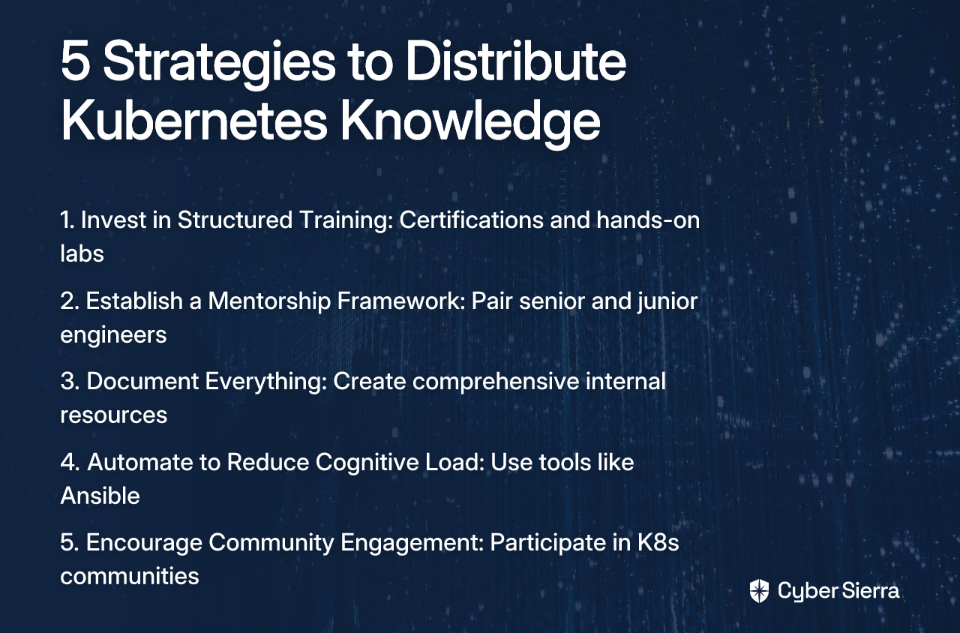
1. Invest in Structured Training
Don't leave learning to chance. Develop a continuous education program focusing on:
- Official Kubernetes certification paths (CKA, CKAD)
- Hands-on labs and sandbox environments
- Regular knowledge-sharing sessions
This helps turn a "total k8s noob" into a competent team member over time, reducing your vulnerability to expert departure.
2. Establish a Mentorship Framework
Pair senior and junior engineers to actively share knowledge. This directly mitigates the "single point of failure" risk and helps distribute on-call responsibility. Make knowledge transfer an explicit part of performance goals for senior team members.
3. Document Everything
Create comprehensive internal documentation for:
- Cluster setup and configuration
- CI/CD pipelines using Helm or GitOps approaches
- Incident response playbooks
- Architecture decisions and their rationales
Documentation makes knowledge accessible to everyone, not just the experts, and serves as a crucial resource during incidents when experts might be unavailable.
4. Automate to Reduce Cognitive Load
Use tools like Ansible and Terraform to automate complex deployment and management tasks. Automation reduces the need for deep, specialized knowledge for routine operations, making the platform more accessible to the broader team.
5. Encourage Community Engagement
Support your team's participation in Kubernetes and DevOps communities to keep skills relevant and network with other professionals. This external perspective often brings fresh ideas and approaches that can improve your internal practices.
DIY Kubernetes vs. Cloud-Native PaaS: A Financial Crossroads
When evaluating your infrastructure strategy, it's crucial to understand that Kubernetes itself is not a PaaS; it's a platform for building platforms. This distinction helps frame the choice between building an internal platform on raw Kubernetes and using a managed PaaS.
Comparison: DIY K8s vs. PaaS
| Factor | DIY Kubernetes | Managed PaaS |
|---|---|---|
| Pros | Ultimate flexibility, cloud agnostic, easier for existing containerized apps | Decouples app dev from ops, simplified compliance, built-in services (databases, etc.) |
| Cons | High complexity, high FTE cost, compliance challenges | Higher upfront subscription cost, less flexibility, potential for vendor lock-in |
When to Choose Which Path
Go with a PaaS if:
- Your team is small and lacks deep Kubernetes expertise
- Speed to market is your top priority
- Your applications don't require extreme customization
The subscription cost of a PaaS is often less than the salary of one senior Kubernetes engineer, making it financially viable for many organizations.
Build on Kubernetes if:
- You have a dedicated platform team (or the budget to build one)
- You require extreme customization for your specific use cases
- You operate at a scale where managing your own infrastructure makes financial sense
- Your strategy demands being truly cloud agnostic across AWS, GCP, and Azure
A Word of Caution on Managed Services
Even managed Kubernetes services like AKS or EKS aren't a silver bullet. As users note, "Cloud Based K8S service always has some hidden settings, which may cause inconvenience when u deploy your own services." A thorough evaluation is necessary to avoid unexpected complications.
Making a Conscious Choice
Kubernetes knowledge debt is a significant, often unmeasured cost that manifests as operational risk, high turnover, and wasted cloud spend. The goal isn't to fear Kubernetes but to approach it with a clear-eyed strategy.
Kubernetes is undoubtedly powerful, capable of supporting everything "from the most bare bones, hello-world webapp, up to an enterprise scale suite" of applications. However, this power comes with complexity that must be managed deliberately.
For many organizations, the most sustainable path forward includes:
- Honest assessment of your team's current Kubernetes expertise
- Clear quantification of the knowledge debt using the framework provided
- Strategic decision-making about whether to invest in building internal competency or leveraging a PaaS
- Commitment to knowledge distribution if you choose the Kubernetes path
Remember that the true cost of your infrastructure includes not just the IaaS or SaaS components billed by your cloud provider, but also the human expertise required to operate effectively. By addressing knowledge debt proactively, you can harness the power of Kubernetes without falling victim to its hidden costs.
Whether you choose open source solutions, managed services, or cloud-native PaaS offerings, the key is making this decision with full awareness of both the visible and invisible costs involved. In the end, your technology should enable your business objectives, not hold them hostage due to knowledge lock-in.
Frequently Asked Questions
What is Kubernetes knowledge lock-in?
Kubernetes knowledge lock-in is a form of operational risk where an organization becomes dangerously dependent on a small number of in-house experts who understand its complex Kubernetes infrastructure. Unlike traditional vendor lock-in, this dependency isn't on a specific cloud provider but on key personnel. This can lead to significant problems, including operational bottlenecks, delays in incident response, and an inability to innovate because the experts are constantly firefighting.
How does Kubernetes knowledge debt impact a business?
Kubernetes knowledge debt impacts a business by increasing operational risk, creating significant hiring and retention challenges, and slowing down innovation. Operationally, it creates a single point of failure, making incident response and daily tasks dependent on a few individuals. Financially, the high demand for scarce Kubernetes talent drives up salaries and recruiting costs. Strategically, when experts are consumed with maintenance, they have no time for value-added projects, and other team members may be hesitant to propose changes, leading to innovation paralysis.
How do you calculate the true cost of running Kubernetes?
The true cost of running Kubernetes involves calculating both direct costs (compute, storage, networking) and significant indirect costs, such as platform engineering salaries, cloud resource inefficiency, and tooling overhead. To get a full picture, you should quantify three main areas:
- Cost of Expertise: The sum of engineer salaries, training budgets, and recruiting costs.
- Cost of Inefficiency: The monetary value of underutilized cloud resources (clusters often run at only 30-50% utilization).
- Cost of Risk: The potential business impact and financial loss if a key Kubernetes expert were to leave unexpectedly.
What are the most effective strategies to reduce dependency on Kubernetes experts?
The most effective strategies involve democratizing knowledge and automating complex tasks. This includes implementing structured training programs, establishing a mentorship framework, creating comprehensive documentation, and using automation tools. A continuous education program can upskill the entire team, while pairing senior engineers with junior team members facilitates direct knowledge transfer. Detailed documentation makes critical information accessible to everyone, and automation reduces the cognitive load for routine operations.
When does it make more sense to use a PaaS instead of building on Kubernetes?
You should consider a Platform-as-a-Service (PaaS) over a do-it-yourself (DIY) Kubernetes setup if your team lacks deep Kubernetes expertise, your primary goal is speed to market, or your applications do not require highly customized infrastructure. A PaaS abstracts away infrastructure complexity, allowing developers to focus on applications. While it may have a higher upfront subscription cost, this is often less than the salary of a single senior Kubernetes engineer, making it a financially sound choice for many teams.
