The CA System Is Broken: Here's What Security Teams Need to Know


Join thousands of professionals and get the latest insight on Compliance & Cybersecurity.
You're entrusting your organization's entire digital security to a system that was designed in the 1990s and has failed catastrophically multiple times since then. The Certificate Authority (CA) model—the foundation of HTTPS and internet trust—is fundamentally broken, yet security teams continue to operate as if this weren't the case.
As one security professional bluntly put it: "The CA system is structurally broken, and always has been... CAs only get paid when they issue certs, not when they don't issue certs." This perverse incentive structure is just the beginning of the problem.
This article will dissect why the CA model is structurally flawed, showcase its historical failures, and outline the strategic shift required for security teams to build resilience in a zero-trust world. The days of passively trusting CAs are over—it's time for active verification and management.
The Illusion of Trust: Deconstructing the Centralized CA Model
The Certificate Authority system serves as the trusted third party responsible for issuing digital certificates that authenticate the ownership of public keys—a critical function for secure HTTPS communications. On the surface, this seems reasonable: we need some authority to verify identity.
But the model's fatal flaw lies in its centralized nature. Any of the hundreds of CAs trusted by major browsers can issue a certificate for any domain. This creates an enormous attack surface with multiple points of failure that can compromise the entire system.
As another security professional observed, "The notion of paying other people to say you're you... is ridiculous." This sentiment highlights the absurdity of the current model, where your online identity depends on third parties with questionable incentives and security practices.
The inherent vulnerabilities of this system include:
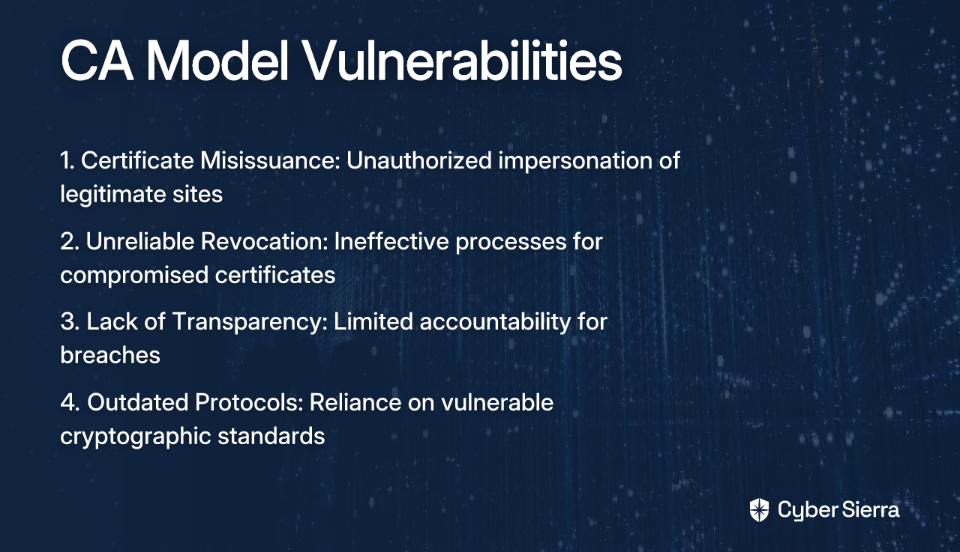
The implications are severe: when a CA fails, the entire trust model collapses. And history shows that CAs fail with alarming regularity.
A Litany of Failures: A History of CA Compromises
These aren't theoretical risks. The history of the web is littered with high-profile CA failures that prove the system's untrustworthiness:
- DigiNotar (2011): Suffered a complete compromise, leading to the issuance of over 500 rogue certificates, including fraudulent wildcard certificates for Google domains. This breach was so severe it led to the complete collapse of the company. The attackers, reportedly connected to the Iranian government, were able to conduct man-in-the-middle attacks against Gmail users in Iran.
- Comodo (2011): An attacker compromised a reseller's account and issued multiple rogue certificates for high-value domains like
login.yahoo.com,mail.google.com, andlogin.skype.com. - TurkTrust (2011): Accidentally issued two intermediate CA certificates instead of end-entity certificates, which could have been used to forge certificates for any site.
- WoSign & StartCom (2015-2016): Engaged in numerous deceptive practices, including back-dating certificates to avoid new security requirements and using inadequate validation methods, leading to major browsers distrusting them entirely.
- Symantec (2015-2017): Found to have improperly issued over 100 certificates for domains without authorization, including Google-owned domains. A lengthy investigation uncovered systemic issues, ultimately forcing Google and Mozilla to distrust all Symantec-issued certificates.
The root causes of these failures include poor security practices, misconfigurations, trusting third-party resellers without proper checks, and fundamental failures to comply with industry regulations. Yet the system persists, largely unchanged.
The Problem at Home: Stagnation in Enterprise CAs
The problem isn't limited to public CAs. Many organizations run their own internal PKI using tools that are outdated and architecturally flawed.
Microsoft Active Directory Certificate Services (AD CS) exemplifies this issue. Despite being a cornerstone of Windows enterprise environments since Windows NT 4.0, AD CS has seen virtually no significant updates for years—even in Windows Server 2022. It lacks support for modern cryptographic algorithms like EdDSA (crucial for IoT devices), has no clear roadmap for post-quantum cryptography, and suffers from several architectural limitations:
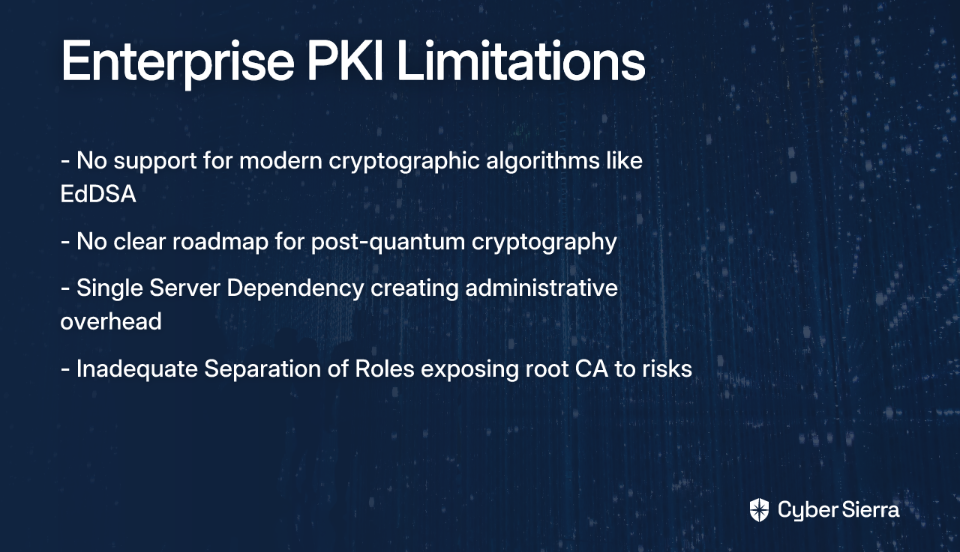
The Microsoft Teams global outage in 2020, caused by a single forgotten certificate renewal, demonstrates the real-world impact of poor certificate management. As digital certificate usage explodes with machine identities, IoT devices, and DevOps automation, these limitations become increasingly problematic.
Navigating the Broken System: Strategic Imperatives for Security Teams
Given that we're stuck with this flawed system for the foreseeable future, security teams need a strategic approach that acknowledges the inherent untrustworthiness of CAs while building in resilience. This requires a fundamental shift from passive trust to active verification and management.
Pillar 1: Proactive Monitoring & Validation
Many security professionals lament that "Certificate Transparency logs are voluntary on the part of the bad actors" and often just provide "confirmation of the breach after-the-fact." While this criticism has merit, CT logs remain a critical data source that security teams must leverage.
Implement Certificate Transparency (CT) Monitoring:
- CT creates public, append-only logs of all issued certificates, providing a mechanism for monitoring and auditing CAs.
- Security teams must actively monitor these logs for certificates issued for their domains that they did not request.
- Tools like SSLmate's Cert Spotter can automate this critical function.
Strengthen Domain Control Validation:
- Shift away from email-based validation, which can be compromised if an attacker controls MX records.
- Use DNS validation (via
TXTorCNAMErecords) which provides a stronger link to control over the domain itself. - Implement CAA (Certification Authority Authorization) Records to specify which CAs are permitted to issue certificates for your domains—a simple but powerful control to prevent misissuance.
Explore Alternatives:
- Consider emerging technologies like DANE (DNS-based Authentication of Named Entities) which binds certificates to domain names using DNSSEC, reducing reliance on the CA system.

Pillar 2: Embrace Certificate Lifecycle Management (CLM)
As certificate numbers skyrocket, manual management becomes impossible, leading to operational failures and security gaps. Gartner estimates that dedicated CLM solutions can reduce certificate-related outages by 90% and manual processing time by 50%.
Core Functions of a CLM Solution:
- Discovery: A unified interface to visualize all certificates across your environment, identifying rogue certs and compliance issues.
- Automation: Automate the entire certificate lifecycle—requests, renewals, provisioning, and revocation.
- Governance: Enforce security policies and compliance rules through customizable workflows and role-based access.
- Alerting: Provide timely notifications for expiring certificates that cannot be automated.
Leading vendors in this space include DigiCert (CertCentral), Entrust (Certificate Hub), and Venafi (TLS Protect).
From Passive Trust to Active Resilience
The foundational trust model of the CA system is flawed and has proven unreliable time and again. Passively trusting CAs is an abdication of security responsibility.
Security teams must evolve from a mindset of passive trust to one of active resilience. This requires a strategic commitment to continuous verification through CT log monitoring and strong validation controls, coupled with automated management via robust Certificate Lifecycle Management.
In today's threat landscape, trust is not a given; it must be continuously verified and managed. By adopting these strategies, security teams can build a more resilient and defensible infrastructure, even on a foundation they cannot fully trust.
Frequently Asked Questions
What is the Certificate Authority (CA) model and why is it considered broken?
The Certificate Authority (CA) model is a system where trusted third-party organizations issue digital certificates to verify the identity of websites and secure online communication. However, the model is considered fundamentally broken because its centralized nature creates a massive attack surface; a compromise of any single CA can be used to issue fraudulent certificates for any website, undermining the entire system's trust.
How can a compromised Certificate Authority affect my organization?
A compromised CA can directly affect your organization by issuing fraudulent certificates for your domains to malicious actors. This enables sophisticated man-in-the-middle attacks, allowing attackers to impersonate your websites, intercept sensitive user data (like login credentials and financial information), and launch highly convincing phishing campaigns, leading to severe security breaches and reputational damage.
What is Certificate Transparency (CT) and how does it help?
Certificate Transparency (CT) is a system that creates public, append-only logs of all digital certificates issued by Certificate Authorities. It helps improve security by allowing domain owners and security teams to monitor these logs for any unauthorized or fraudulent certificates issued for their domains, providing a critical early warning system for potential attacks.
What is Certificate Lifecycle Management (CLM) and why is it important?
Certificate Lifecycle Management (CLM) is the practice of automating and managing the entire lifespan of digital certificates, from request and issuance to deployment, renewal, and revocation. It is critically important because as the number of certificates in an organization explodes (due to IoT, cloud, and DevOps), manual management becomes impractical, leading to outages from expired certificates and security gaps from unmanaged ones.
What are the first steps my security team should take to mitigate CA risks?
The first steps your security team should take are to implement Certificate Transparency (CT) monitoring to detect unauthorized certificates and to enforce Certification Authority Authorization (CAA) records in your DNS. A CAA record specifies which CAs are permitted to issue certificates for your domains, providing a simple yet powerful preventative control against misissuance.
Are internal CAs like Microsoft AD CS a safer alternative to public CAs?
No, internal CAs are not necessarily a safer alternative and often present their own significant risks. Many internal PKI solutions, such as Microsoft Active Directory Certificate Services (AD CS), are outdated, lack support for modern cryptography, have architectural limitations, and are often poorly managed. This can create a large internal attack surface and lead to critical failures, as seen in major service outages.