



KnowBe4 vs Proofpoint vs Infosec IQ: Real User Experiences


Join thousands of professionals and get the latest insight on Compliance & Cybersecurity.
You've been tasked with choosing a security awareness training (SAT) platform for your organization, and after hours of research, you're frustrated. The marketing materials all sound the same, each vendor claims to be the best, and it's nearly impossible to distinguish meaningful differences between KnowBe4, Proofpoint, and Infosec IQ. You're not alone in this struggle.
"Most platforms are basically the same," laments one cybersecurity professional on Reddit. "Most of the time, companies want to tick a box for insurance purposes," adds another, highlighting the compliance-driven approach that often sacrifices actual security improvements for the sake of documentation.
This article cuts through the marketing noise to provide a detailed comparison based on real user experiences. We'll examine how each platform performs in the areas that matter most: phishing simulation effectiveness, LMS integration, user engagement, and reporting capabilities that don't require translation for C-level executives.
Cutting Through the Noise: Why Most Security Awareness Training Feels the Same
The security awareness training industry has a problem: most solutions appear interchangeable because they focus on similar threats and compliance requirements. This creates the illusion that selecting any platform will yield similar results. However, significant differences exist beneath the surface—differences that directly impact your program's success.
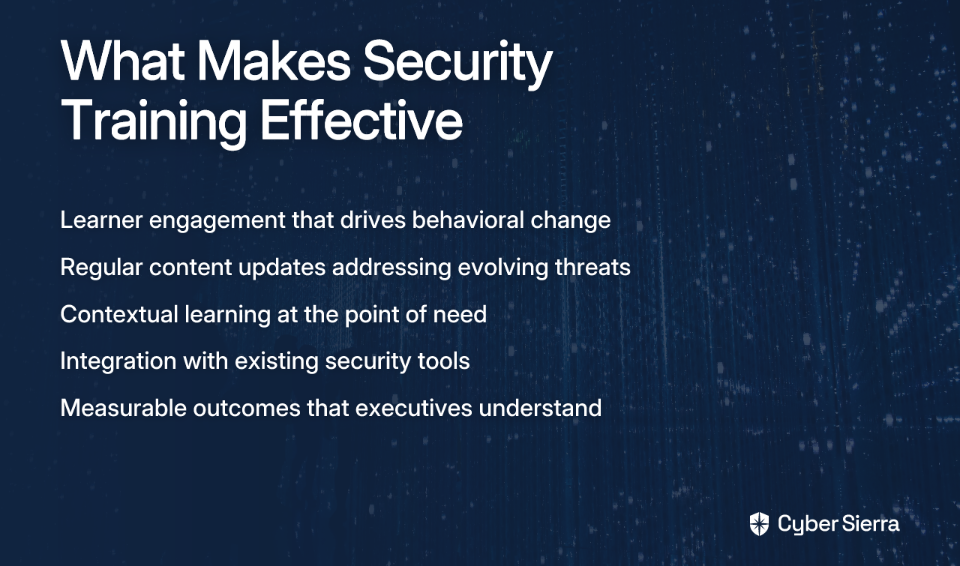
"Engagement of the learners trumps all," emphasizes one security leader with experience across multiple platforms. When users find training irrelevant or boring, even the most comprehensive curriculum will fail to create meaningful behavioral change. The challenge isn't just delivering information about email scams, social engineering, and cloud security—it's making that information stick.
Another critical factor is content freshness. As one professional notes, "a good content refresh cycle" is essential for addressing evolving threats. Without regular updates, your training quickly becomes outdated as attackers develop new techniques to bypass security measures like MFA (Multi-Factor Authentication) and exploit vulnerabilities in BYOD (Bring Your Own Device) environments.
The Science of Forgetting: Why Your Annual Training Isn't Working
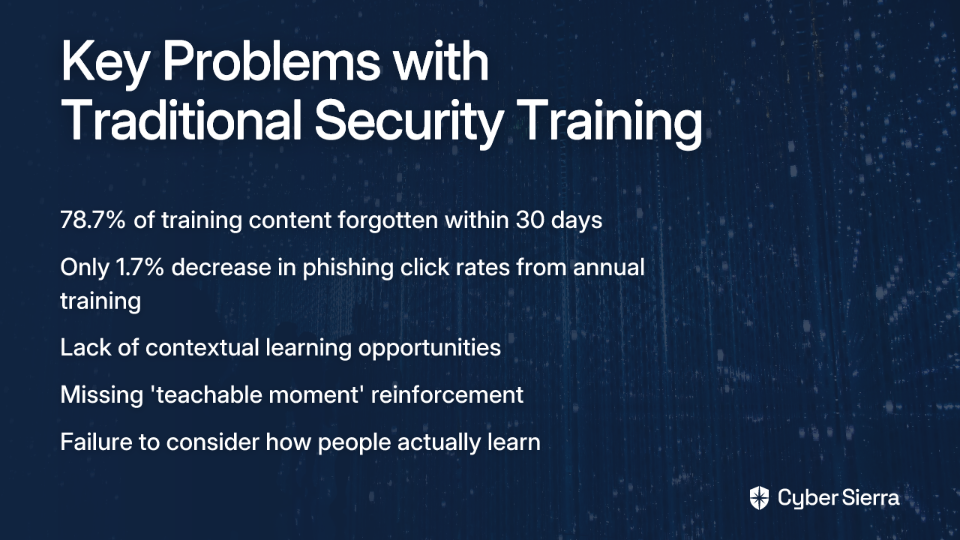
The uncomfortable truth about security awareness training? Annual cybersecurity training typically results in only a 1.7% decrease in click rates on phishing attempts, according to research from Ho et al. (2025).
This minimal improvement stems from a fundamental cognitive limitation: people forget approximately 78.7% of what they learn within just 30 days without reinforcement. This explains why many cybersecurity professionals complain that current platforms fail to consider "how people learn."
The solution isn't just more training—it's better training delivered at the right time. Studies show that contextual interactive exercises provided as "teachable moments" (especially within 24 hours of a phishing simulation failure) can reduce future phishing failures by 19%. This significant improvement highlights the importance of timing and relevance in security education.
Deep Dive: KnowBe4 Security Awareness Training
Overview and Market Position
KnowBe4 stands as the market leader, serving nearly 70,000 organizations worldwide with a 4.6-star rating from over 2,300 reviewers on Gartner Peer Insights. Their comprehensive approach covers everything from Core Cyber Hygiene to specialized training on ransomware and CEO fraud.
User-Reported Strengths
KnowBe4's greatest asset is its vast content library. Users consistently praise the platform for offering diverse training materials that address virtually every security scenario imaginable. This variety helps combat content fatigue and keeps security messaging fresh.
The platform also excels at simulated phishing campaigns with an extensive template library that allows security teams to create highly customized and realistic phishing scenarios. These templates can mimic current threats, making the training immediately relevant to users' daily experiences.
KnowBe4's strong brand recognition and large user community provide additional value through shared knowledge and best practices. For organizations without dedicated security training experts, this community support can be invaluable.
Potential Considerations
The platform's comprehensive nature comes with a trade-off: some users report feeling overwhelmed by the sheer volume of options. Small security teams may struggle to fully leverage KnowBe4's capabilities without dedicated resources.
Content quality can be inconsistent across the library. As one user notes, "Are some of these not business-focused? Yes." This requires security teams to carefully review materials before deploying them to ensure they align with organizational culture and needs.
Deep Dive: Proofpoint Security Awareness Training
Overview and Focus on Teachable Moments
Proofpoint takes a science-driven approach to security awareness training, earning a 4.6-star rating from 785 reviewers on Gartner Peer Insights. The platform is particularly strong for organizations already using Proofpoint's email filter and security gateway products, offering seamless integration between threat detection and user education.
What distinguishes Proofpoint is its emphasis on learning science and "teachable moments." The company has invested significantly in research about how people learn and retain security information, moving beyond simply tracking who clicked on phishing links to focus on meaningful behavioral change.
User-Reported Strengths
Proofpoint's remediation approach stands out as particularly effective. Their methodology employs contextual interactive designs (like Phish Hooks) that have been shown to reduce phishing failures by 19%. This directly addresses a common pain point expressed by security professionals: "If someone falls for a simulated phish... then what?"
The answer, according to Proofpoint users, is immediate, contextual training that helps users understand exactly what they missed and how to identify similar threats in the future. This approach is backed by research showing that timing feedback within 24 hours of a phishing test significantly improves retention and future performance.
Users also appreciate Proofpoint's integrated approach to email security and training. When the same vendor handles both your email filter and security awareness training, you gain valuable insights into how real-world threats correlate with training scenarios, allowing for more targeted education.
Potential Considerations
Proofpoint's platform may feel less flexible for organizations not already committed to their security ecosystem. The full benefits of their approach are most apparent when using multiple Proofpoint products together.
Some users report that Proofpoint's pricing structure can be challenging for smaller organizations with limited security budgets. The science-backed approach delivers results but comes at a premium price point.
Deep Dive: Infosec IQ Security Awareness & Phishing Training
Overview and Emphasis on Integration
Infosec IQ positions itself as a highly flexible platform focused on automation and integration. With a 4.6-star rating from 482 Gartner reviewers, it has earned a reputation for technical excellence, with over 90% of customers reporting that the training helped cultivate a strong cybersecurity culture.
The platform emphasizes seamless integration with existing technology stacks, making it particularly appealing for organizations with established learning management systems or identity management solutions.
User-Reported Strengths
Infosec IQ's automation capabilities receive consistent praise from users. Their "Adaptive Campaigns" automatically enroll users in remedial training based on their actions during phishing simulations, reducing administrative overhead while ensuring that education is targeted to those who need it most.
The platform's integration options are exceptionally robust. Infosec IQ connects with identity management solutions like Microsoft Entra ID, JumpCloud, and Okta for automated user provisioning. For organizations with existing learning platforms, Infosec IQ provides SCORMaaS files, allowing over 300 training videos to be easily imported into LMS platforms like Workday and Blackboard.
Advanced reporting capabilities address another key pain point. The Infosec IQ API allows security teams to aggregate performance statistics and learner data into external dashboards or HR platforms, creating what one user described as "good reporting what you don't have to translate for C-level" executives.
The platform also includes practical incident response tools like the PhishNotify button for Outlook and Gmail, which streamlines the reporting of real phishing threats. This creates a direct connection between training and actual security operations, reinforcing the importance of user vigilance.
Potential Considerations
Despite its technical strengths, Infosec IQ has less market visibility than KnowBe4, which may be a concern for organizations seeking a widely recognized training provider.
Organizations without dedicated IT or security teams may not fully leverage Infosec IQ's extensive API and integration capabilities. The platform delivers the most value when technical teams can customize it to fit specific organizational needs.
The Ultimate Comparison: Decision Matrix
| Feature | KnowBe4 | Proofpoint | Infosec IQ |
|---|---|---|---|
| User Engagement & Gamification | Extensive library, varied formats, strong gamification elements | Focus on interactive "teachable moments" post-simulation | Customizable campaigns with diverse content library |
| Phishing Simulation & Remediation | Massive template library, robust campaign management | Research-backed remediation with contextual training proven to reduce failures by 19% | "Adaptive Campaigns" automatically enroll users who fail tests into follow-up training |
| LMS Integration & Technical Stack | SCORM compliant | Integrates deeply with Proofpoint's own security stack | Excellent flexibility with SCORMaaS files for any LMS, plus robust API and IdP integrations |
| Reporting & Analytics | Detailed dashboards for campaign and user tracking | Strong metrics tied to risk reduction and learning objectives | Highly customizable via API for C-level dashboards |
| Content Library & Freshness | Largest library in the industry | High-quality, research-driven content | Over 300 security awareness videos, customizable with company branding |
| Gartner User Rating (reviews) | 4.6 (2373) | 4.6 (785) | 4.6 (482) |
Which Platform is Right for Your Organization?
For Small to Medium Businesses (SMBs)
Recommendation: KnowBe4 or Infosec IQ
Small to medium businesses often face unique challenges: limited security personnel, budget constraints, and the need for solutions that work effectively without extensive customization.
KnowBe4's tiered pricing model can be accessible for smaller organizations, and its comprehensive out-of-the-box experience means you can deploy effective training with minimal configuration. The platform's extensive content library provides immediate value without requiring significant customization.
Alternatively, Infosec IQ offers strong automation capabilities that can save time for small IT teams. Its adaptive campaigns automatically assign remedial training to users who fail phishing tests, reducing the administrative burden on security teams while still providing targeted education.
For Enterprises with Mature Security Programs
Recommendation: Infosec IQ or Proofpoint
Large enterprises with established security programs have different requirements. They typically need platforms that integrate with complex technology ecosystems and provide granular data for security analytics.
Infosec IQ shines in this environment due to its API and deep integration capabilities. Security teams can pipe training data into central analytics platforms, correlate security awareness metrics with other security telemetry, and create custom workflows that align with established security processes.
Proofpoint is particularly compelling for enterprises already invested in the Proofpoint security ecosystem. The seamless integration between email security and awareness training creates a unified approach to combating phishing and social engineering attacks.
For Highly Regulated Industries (Compliance Focus)
Recommendation: All three platforms are strong contenders
Organizations in regulated industries need comprehensive documentation, detailed reporting, and training that addresses specific compliance requirements for dark web monitoring, email security, and data protection.
KnowBe4 offers extensive compliance-specific modules that cover virtually every regulatory framework. Its detailed reporting provides the documentation needed for audits and compliance verification.
Infosec IQ's API allows for custom compliance reporting that can be tailored to specific regulatory requirements. This flexibility is valuable for organizations that need to demonstrate compliance in unique ways.
Proofpoint provides clear metrics on risk reduction, which is crucial for demonstrating the effectiveness of security controls to auditors and regulators. Their science-backed approach offers compelling evidence that the organization is taking meaningful steps to reduce human security risk.
Final Verdict: Moving Beyond the Platform to Build a Security Culture
After examining real user experiences with KnowBe4, Proofpoint, and Infosec IQ, a few key points emerge:
- KnowBe4 leads the market with an unparalleled content library and vast phishing template selection, making it ideal for organizations that value comprehensive coverage and community support.
- Proofpoint takes a science-driven approach with proven methodology for effective remediation and teachable moments, particularly valuable for organizations focused on measurable risk reduction.
- Infosec IQ excels at integration and automation, offering powerful API access and flexible LMS integration that streamlines security awareness operations within complex technology environments.
However, the most important insight from real users is that no platform alone will transform your security culture. The most successful programs combine a great platform with proactive security leadership.
As one security professional noted, "the security team hosts quarterly all-hands updates to the org" to reinforce training concepts and discuss current threats. These personal touchpoints, combined with simulated phishing campaigns and targeted education, create a comprehensive approach to security awareness.
When evaluating these platforms, look beyond features to consider how each solution will integrate with your broader security culture initiatives. The goal isn't just to avoid phishing clicks—it's to build a vigilant workforce that serves as your first line of defense against social engineering, scams, and other human-targeted attacks.
Use this guide to ask informed questions during vendor demos, focusing on the aspects that matter most to your specific organizational needs. Choose a partner, not just a product, in your journey toward a stronger security posture and robust Core Cyber Hygiene for all employees.
Frequently Asked Questions
What is the most important factor when choosing a security awareness training platform?
The most important factor is user engagement. A platform's ability to deliver relevant, fresh, and engaging content is more critical than any single feature, as this directly impacts behavioral change and the development of a strong security culture. Without engagement, even the most comprehensive training will be forgotten.
Why is annual security training not enough to stop phishing?
Annual security training is not enough because people forget most of what they learn within 30 days without reinforcement. Research shows that annual training only results in a marginal decrease in phishing click rates. More effective programs use continuous learning and "teachable moments," such as immediate feedback after a failed simulation, which can reduce future failures by up to 19%.
How do I choose the best SAT platform for a small business (SMB)?
For a small business, the best SAT platform is one that is easy to deploy and manage without extensive resources. KnowBe4 is a strong choice due to its comprehensive out-of-the-box experience and large content library. Infosec IQ is also a great option for SMBs, as its automation features can reduce the administrative burden on small IT teams.
What makes a phishing simulation effective?
An effective phishing simulation goes beyond simply testing users; it provides immediate, contextual remediation. Platforms like Proofpoint emphasize "teachable moments" right after a user clicks a simulated phishing link, explaining what they missed. This timely feedback is proven to be significantly more effective at changing user behavior than delayed or generic training.
How can I integrate security awareness training with my existing Learning Management System (LMS)?
You can integrate security awareness training by choosing a platform with strong technical compatibility, such as SCORM compliance. Infosec IQ excels in this area by providing SCORMaaS files for over 300 training videos, allowing for easy import into established LMS platforms like Workday or Blackboard, alongside robust API and identity provider integrations.
Can a security awareness platform alone build a strong security culture?
No, a security awareness platform alone cannot build a strong security culture. While a platform is a critical tool, it must be combined with proactive security leadership and consistent communication, such as regular security updates and discussions. The goal is to create a vigilant workforce where technology and human engagement work together to build a resilient first line of defense.
