



How to Choose the Right Risk Assessment Framework for Your Organization

Join thousands of professionals and get the latest insight on Compliance & Cybersecurity.
Are you struggling to understand which risk assessment framework fits your organization's needs best? The complexity of options like NIST, ISO, and FAIR can leave teams feeling overwhelmed and unsure where to start, especially when resources seem geared toward large enterprises rather than smaller organizations.
Selecting an appropriate risk assessment framework is a fundamental strategic decision that shapes your entire governance, risk, and compliance program. It's not just about checking a compliance box—it's about establishing a structured approach to identifying, assessing, and mitigating the risks that could impact your business objectives.
This guide will demystify risk assessment frameworks, helping you understand the fundamentals, compare popular options, and select the best-fit framework for your organization's unique needs. No more drowning in technical jargon or conflicting advice—just practical guidance to make an informed decision.
The Groundwork: Understanding Risk Assessment Methodologies Before You Choose
Before diving into specific frameworks, it's essential to understand the underlying methodologies that drive them. This foundational knowledge will simplify your decision-making process and help you avoid common pitfalls.
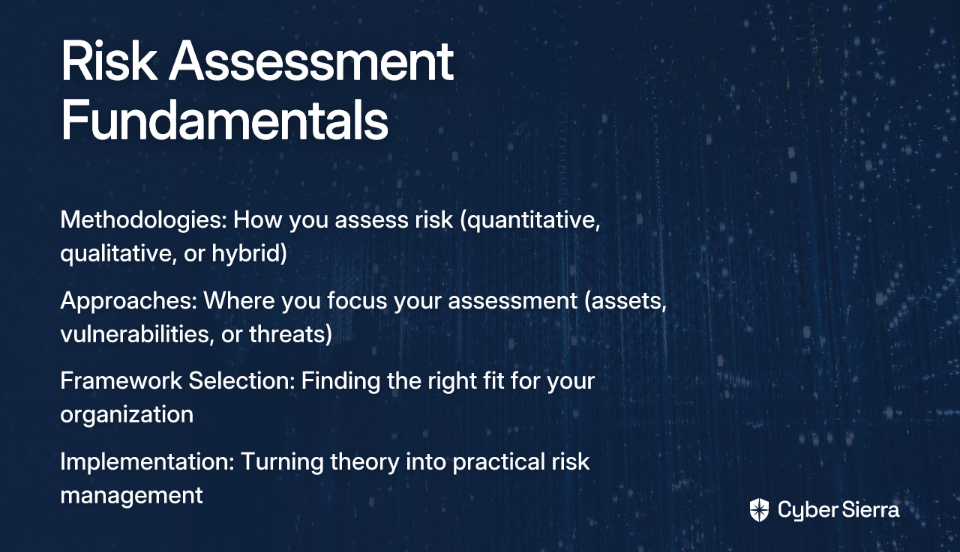
Risk Assessment Methodologies: The "How"
There are three primary approaches to assessing risk:
- Quantitative Risk Assessment
- Uses measurable, numerical data, often expressed in monetary terms
- Provides objective results that can be easily compared and prioritized
- Example: A telecommunications firm analyzes potential financial losses from a data breach by examining industry averages and calculating the likelihood of incidents
- Qualitative Risk Assessment
- Relies on subjective judgments and descriptive scales (high, medium, low)
- More accessible when hard data isn't available
- Example: A small business gathers expert opinions to evaluate cybersecurity risks, focusing on critical threats first
- Semi-Quantitative Risk Assessment
- A hybrid model combining numerical scales with subjective assessments
- Useful when complete data is unavailable but more precision than qualitative assessment is desired
- Example: Using a 1-5 scale for both likelihood and impact, then multiplying them for a risk score
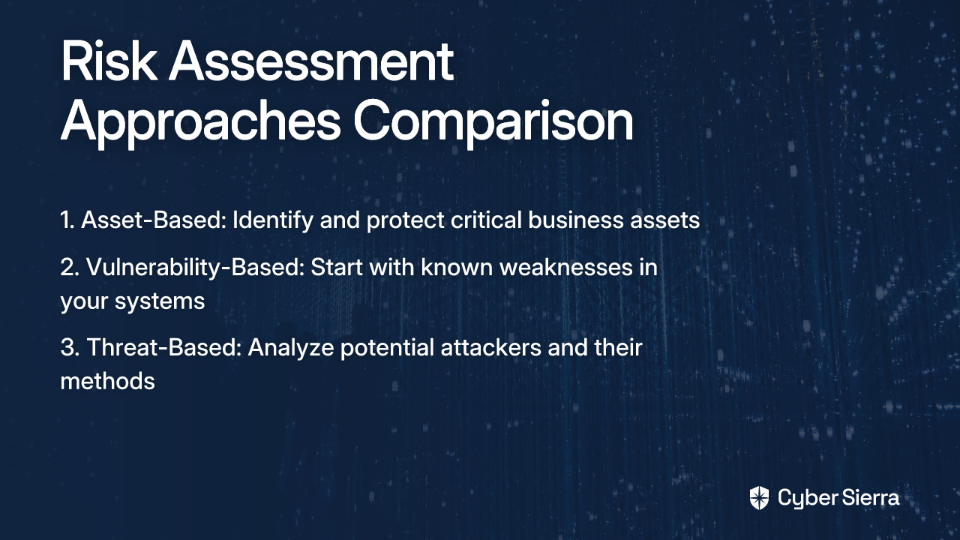
Risk Assessment Approaches: The "Focus"
Different frameworks emphasize different starting points for assessment:
- Asset-Based Approach
- Focuses on identifying and protecting critical assets
- Process typically involves:
- Asset identification and classification
- Threat identification
- Vulnerability identification
- Risk determination
- Vulnerability-Based Approach
- Identifies risks by starting with known weaknesses
- Example: An outdated server OS leads to vulnerability assessments focused on specific cyber threats
- Threat-Based Approach
- Considers the methods and intent of threat actors to proactively address risks
- Example: A financial institution assesses phishing tactics that cybercriminals may use to target sensitive information
Understanding these fundamental approaches will help you evaluate which frameworks align with your organization's risk management philosophy and capabilities.
Key Factors in Your Decision-Making Process
When evaluating risk assessment frameworks, consider these critical factors to find the best fit:
1. Organizational Goals, Size, and Maturity
Your organization's size, industry, and risk management maturity level significantly influence which framework will work best:
- Small to Mid-sized Organizations: Consider frameworks with simpler implementation paths like OCTAVE-S, which is specifically designed for smaller teams with limited resources
- Large Enterprises: More comprehensive frameworks like NIST RMF or ISO 31000 may be appropriate
- Risk Management Maturity: If you're just starting, begin with qualitative assessments before moving to more complex quantitative approaches
2. Industry and Regulatory Compliance Requirements
Different industries face specific regulatory demands:
- Healthcare: Organizations must consider HIPAA compliance requirements
- Federal Contractors: The NIST Risk Management Framework (RMF) is designed to meet the requirements of the Federal Information Security Modernization Act (FISMA)
- Financial Services: May need to address requirements from regulations like SOX, GLBA, or PCI DSS
Your framework selection should help you meet these compliance obligations while also providing practical risk management benefits.
3. Resource Availability
Be realistic about your available resources:
- Data Requirements: Quantitative frameworks like FAIR require reliable data to calculate financial impact
- Expertise: Do you have team members with experience in specific frameworks?
- Tools: Some frameworks work better with specialized software or assessment tools
If you lack hard data but have access to internal experts, a qualitative approach may be more feasible.
4. Stakeholder Communication Needs
Consider how you will communicate findings to different audiences:
- Executive Leadership: The FAIR framework's emphasis on financial terms makes it highly effective for communicating with non-technical business leaders
- Technical Teams: More detailed frameworks like NIST provide comprehensive guidance for implementation teams
- Regulators: Industry-specific frameworks may provide reporting formats that regulators expect
A Comparative Guide to Popular Risk Assessment Frameworks
Now let's examine the most common frameworks to understand their unique characteristics and best use cases.
NIST Risk Management Framework (RMF)
What it is: A comprehensive seven-step process that integrates security and privacy into the system development life cycle.
Who it's for: U.S. federal agencies, their contractors, and private sector organizations seeking a robust, structured security standard.
Key Features:
- Detailed, prescriptive approach with seven clearly defined steps:
- Prepare: Establish risk management roles and responsibilities
- Categorize: Classify information systems and data based on impact
- Select: Choose appropriate controls from NIST SP 800-53
- Implement: Deploy security controls and document how they're implemented
- Assess: Determine if controls are working properly
- Authorize: Senior officials make risk-based decision to authorize the system
- Monitor: Continuously track control effectiveness and risks
Primary Focus: Compliance with federal standards while ensuring comprehensive risk management.
ISO 31000:2018 / ISO 27005
What it is: ISO 31000 provides international principles and guidelines for risk management, while ISO 27005 is specific to information security risk management.
Who it's for: Organizations of any size or sector, especially those operating internationally or seeking to align with the ISO 27001 standard for an Information Security Management System (ISMS).
Key Features:
- Focuses on embedding risk management into governance, strategy, and planning
- Encourages a proactive approach to turn challenges into strategic advantages
- Provides a common language for risk management across different departments
Important Note: ISO 31000 provides guidelines and is not a certifiable standard itself, though it supports compliance with ISO 27001, which is certifiable.
FAIR (Factor Analysis of Information Risk)
What it is: A quantitative model for understanding, measuring, and analyzing information risk in financial terms.
Who it's for: Organizations that need to prioritize risks based on financial impact and communicate effectively with business executives.
Key Features:
- Provides a model for measuring cyber and operational risk
- Helps justify security investments in financial language management understands
- Focuses on probable frequency and magnitude of future loss
COBIT (Control Objectives for Information and Related Technology)
What it is: A framework focused on IT governance and management.
Who it's for: Enterprises looking to align their IT processes and resources with business objectives.
Key Features:
- Offers a flexible, holistic approach to enterprise IT governance
- Helps bridge the gap between technical issues and business risks
- Focuses on control objectives and management guidelines
OCTAVE (Operationally Critical Threat, Asset, and Vulnerability Evaluation)
What it is: A risk-based strategic assessment and planning technique for cybersecurity.
Who it's for: Organizations that want a self-directed approach. It has multiple variations for different needs.
Key Features:
- OCTAVE-S: Designed for smaller organizations with limited resources
- OCTAVE Allegro: A more comprehensive approach for larger organizations
- Emphasizes operational risk and security practices
A Practical Roadmap to Implementation
Once you've selected a framework, follow these steps to implement it effectively:
Step 1: Establish a Cross-Functional Risk Management Team
Include stakeholders from across your organization:
- IT and security professionals
- Business unit representatives
- Executive sponsors
- Compliance and legal team members
This diverse team ensures a holistic view of risk and broader organizational buy-in.
Step 2: Define the Scope and Context
Clearly document what is being assessed:
- Specific applications or systems
- Business units or processes
- The entire enterprise
- External dependencies and third-party relationships
This step prevents scope creep and ensures focused assessment efforts.
Step 3: Conduct the Risk Assessment
Follow a structured process:
- Categorize and inventory IT assets: Include hardware, software, data, and processes
- Identify threats: Consider both natural disasters and cyber threats
- Identify vulnerabilities: Use security testing, penetration test results, and anecdotal evidence
- Prioritize risks: Evaluate existing controls, then determine the likelihood and impact of potential breaches
Use a uniform numerical scale (e.g., 1-10) and clearly define what each number represents to reduce ambiguity.
Step 4: Communicate Findings and Develop a Mitigation Plan
Translate technical findings into business impact:
- Create executive summaries with visualizations
- Prioritize risks based on their potential impact
- Develop specific, actionable mitigation strategies
- Establish clear ownership and deadlines for remediation
Step 5: Implement Continuous Monitoring and Review
Risk assessment is not a one-time project:
- Regularly review and update your risk register
- Monitor the effectiveness of implemented controls
- Reassess when significant changes occur in your environment
- Keep abreast of emerging threats and vulnerabilities
Conclusion
The goal isn't to find the single "best" framework, but rather the "best fit" for your specific organizational context. Consider your organization's size, industry requirements, available resources, and communication needs when making your selection.
Remember that a framework is a tool to build a proactive risk management culture, not just a one-off compliance exercise. The right framework will help you identify, prioritize, and address risks in a systematic way that aligns with your business objectives and strengthens your security posture.
By taking a thoughtful approach to selecting and implementing a risk assessment framework, you'll build a more resilient organization that can navigate the complex landscape of information security risks with confidence.
Frequently Asked Questions
What is the most important factor when choosing a risk assessment framework?
The most important factor is finding the "best fit" for your organization’s unique context. There is no single "best" framework for everyone. Your decision should be guided by your organization's size, industry, regulatory requirements, and risk management maturity. For example, a federal contractor will lean toward NIST, while a company focused on communicating risk in financial terms might choose FAIR.
Which risk assessment framework is best for small businesses?
For small businesses, frameworks like OCTAVE-S are often recommended because they are specifically designed for teams with limited resources. A qualitative approach, which relies on expert judgment rather than extensive data, is also a practical starting point. The goal for a small business is to choose a framework that is simple to implement and maintain while still providing meaningful insights.
How often should an organization conduct a risk assessment?
A risk assessment should not be a one-time event but a continuous process. While a comprehensive assessment is often conducted annually, it should be reviewed and updated whenever significant changes occur, such as the introduction of new technology, changes in business processes, or the emergence of new threats. Continuous monitoring is key to maintaining an effective risk management program.
What is the difference between a qualitative and quantitative risk assessment?
The key difference is how risk is measured. A qualitative risk assessment uses descriptive, subjective scales (e.g., high, medium, low) to evaluate the likelihood and impact of a risk. In contrast, a quantitative risk assessment uses measurable, objective numerical data, often expressed in monetary terms, to calculate a precise value for risk.
Can an organization use multiple risk frameworks?
Yes, many organizations adopt a hybrid approach by combining elements from different frameworks. For instance, an organization might use ISO 31000 for its overall risk management governance structure while using the quantitative FAIR model to analyze specific high-impact cyber risks and communicate their financial implications to the board.
How does a risk assessment framework help with regulatory compliance?
A risk assessment framework provides a structured, repeatable, and defensible process for identifying and managing risks. This helps organizations demonstrate due diligence to auditors and regulators. Many regulations, like HIPAA, PCI DSS, and FISMA, require formal risk assessments. Using an established framework like NIST RMF or ISO 27005 helps ensure that all necessary components of risk management are covered, simplifying compliance efforts.
