



Top Vendor Risk Monitoring Solutions for Privacy Managers (DPOs) in 2025

Join thousands of professionals and get the latest insight on Compliance & Cybersecurity.
In an interconnected digital ecosystem, the stakes for Data Protection Officers have never been higher. Consider this alarming reality: 62% of data breaches can be traced back to third-party vendors. With the average cost of a data breach now reaching $4.45 million, DPOs face mounting pressure to secure their vendor ecosystem.
If you're a privacy leader, you likely understand the frustration. Traditional due diligence questionnaires often feel like mere formalities, and there's that nagging doubt that "you can't trust the third party didn't just lie" on their self-assessments. You're tasked with managing a diverse vendor landscape that includes everything from enterprise solutions to "mom and pop setups that cannot obtain certification," making standardized approaches nearly impossible.
This article cuts through the noise by outlining essential features DPOs need in vendor risk monitoring solutions, reviewing the top platforms for 2025, and providing actionable best practices to build a resilient third-party risk management (TPRM) program.
The High Stakes of Vendor Risk for Privacy Leaders in 2025
Vendor risk monitoring has evolved from periodic assessments to a continuous process of detecting and responding to changes in the security and compliance posture of third- and fourth-party vendors. This shift is crucial because the interconnectedness of modern business means a single vendor weakness can cascade into widespread operational disruption and data breaches.
The move toward proactive, AI-driven approaches isn't just a technical upgrade—it's a strategic necessity. Organizations implementing continuous monitoring solutions have seen a 75% reduction in the probability of a breach via third parties and a 70% reduction in vendor onboarding time, according to Bitsight.
For DPOs specifically, vendor risk isn't merely a security concern but a core compliance requirement. Under frameworks like GDPR, HIPAA, and CCPA, privacy leaders are expected to maintain demonstrable oversight of their data processors and sub-processors. Regulatory authorities increasingly expect evidence of due diligence and ongoing monitoring—not just point-in-time assessments. Failure to provide this evidence can result in significant fines, reputational damage, and personal liability for the DPO.
The DPO's Checklist: Essential Features of a Modern Vendor Risk Monitoring Solution
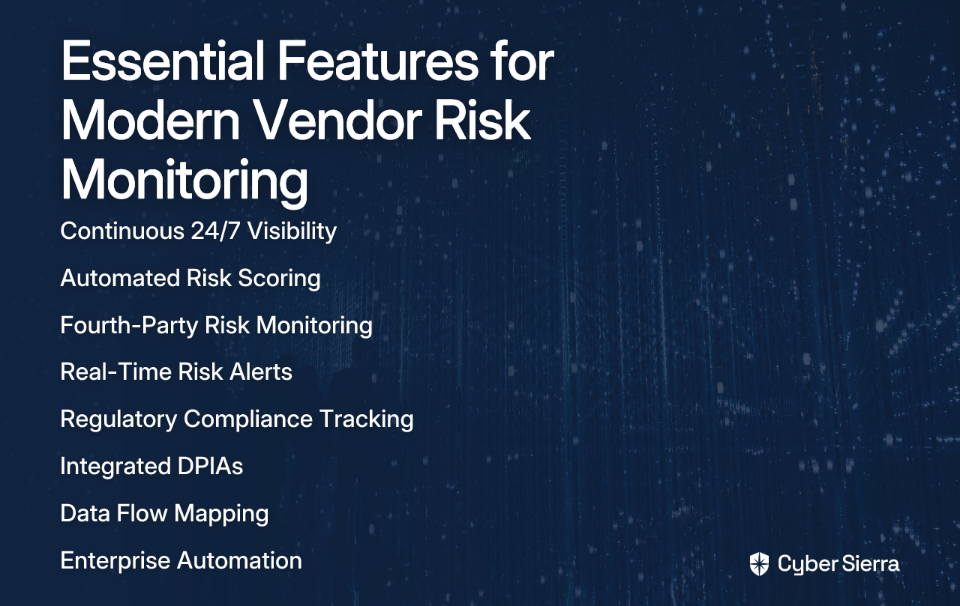
When evaluating vendor risk monitoring platforms, privacy leaders should prioritize these key capabilities:
Core Monitoring & Assessment Capabilities:
- Continuous Monitoring: Look for solutions offering near real-time, 24/7 visibility into vendor security posture, moving beyond static questionnaires to dynamic assessment.
- Automated Risk Scoring: The platform should rank vendors based on their security posture and dynamically update scores as changes are detected, allowing for prioritization of remediation efforts.
- Fourth-Party Vendor Risk Monitoring: Critical visibility into the risks posed by your vendors' vendors—a common blind spot in traditional vendor management approaches.
- Real-time Risk Alerts: Immediate notifications when security ratings change, data breaches occur, or critical vulnerabilities are disclosed in relation to a vendor.
Privacy-Centric Functionality:
- Automated Regulatory Compliance Monitoring: The platform must track vendor compliance against specific privacy laws like GDPR and CCPA, with built-in controls for each regulation.
- Risk Assessments and DPIAs: Look for built-in tools to conduct and manage Data Protection Impact Assessments for high-risk vendors, as required by GDPR Article 35.
- Data Mapping and Inventory: Features that provide visibility into where vendor data flows and is stored, essential for maintaining compliance with cross-border transfer restrictions.
- Consent and Preference Management: Tools to help ensure vendors are correctly managing user consent in alignment with your privacy program requirements.
Workflow and Integration:
- Enterprise-Grade Automation: The solution should automate vendor assessments, questionnaire workflows, and remediation tracking to reduce manual effort and human error.
- Centralized "Single Source of Truth": A unified repository for all vendor contracts, risk data, assessment evidence, and communications eliminates knowledge silos.
- Integration with Internal Systems: Look for robust APIs to connect with your existing GRC, SIEM, and ticketing platforms for seamless workflows.
A Review of the Top Vendor Risk Monitoring Solutions for 2025
1. CyberSierra
Description: CyberSierra offers an AI-enabled cybersecurity platform that integrates TPRM with a comprehensive suite of GRC, Continuous Control Monitoring (CCM), and Threat Intelligence tools.
Key Features for DPOs: The platform provides near real-time, 24/7 visibility into vendor security compliance and automates assessments. CyberSierra's GRC module simplifies managing multiple compliance frameworks (SOC2, ISO 27001, GDPR, HIPAA) in one place, while its TPRM module helps prioritize vendor inventories based on risk levels.
Why It Stands Out: CyberSierra's strength lies in its automation capabilities and unified platform approach. This eliminates siloed tools and provides a single source of truth, helping DPOs move from periodic checks to proactive, continuous risk management.
Best For: Organizations looking for an all-in-one, automated platform to manage GRC, vendor risk, and continuous compliance without the fatigue of manual processes.
2. UpGuard
Description: UpGuard focuses on providing daily security scores and attack surface monitoring with detailed risk assessments.
Key Features for DPOs: The platform offers strong fourth-party risk monitoring and automated AI assessments that can identify potential compliance issues before they become problems.
Best For: Larger companies needing highly scalable, detailed security rating solutions. Learn more at UpGuard TPRM.
3. SecurityScorecard
Description: SecurityScorecard is known for its easy-to-understand A-F security ratings system that makes risk communication intuitive.
Key Features for DPOs: The platform excels at tracking compliance frameworks and offers advanced visualization for executive reporting, making it easier to communicate complex risk concepts to leadership.
Best For: Large enterprises that need to communicate vendor risk effectively to non-technical stakeholders and the board. More details at SecurityScorecard Overview.
4. Bitsight
Description: A leader in security ratings with a focus on financial quantification of risk and business impact analysis.
Key Features for DPOs: Bitsight translates cyber risk into financial impact, which is powerful for securing budget and executive buy-in. It offers AI-driven insights and continuous monitoring capabilities.
Best For: Organizations in finance and insurance that need advanced reporting and risk quantification to meet strict regulatory requirements. Learn more at Bitsight Overview.
5. OneTrust
Description: OneTrust is a platform with deep roots in privacy management and comprehensive GRC capabilities.
Key Features for DPOs: The platform offers streamlined vendor onboarding and extensive support for major privacy frameworks. Its entire platform is built around privacy-first principles, making it particularly suitable for DPOs.
Best For: Privacy-focused organizations that need a tool deeply integrated with broader privacy management functions. More information available at OneTrust Overview.
Best Practices for an Effective Vendor Risk Management Program
Implementing the right tool is only part of the solution. Based on insights from privacy and security professionals, here are key best practices to enhance your vendor risk management program:
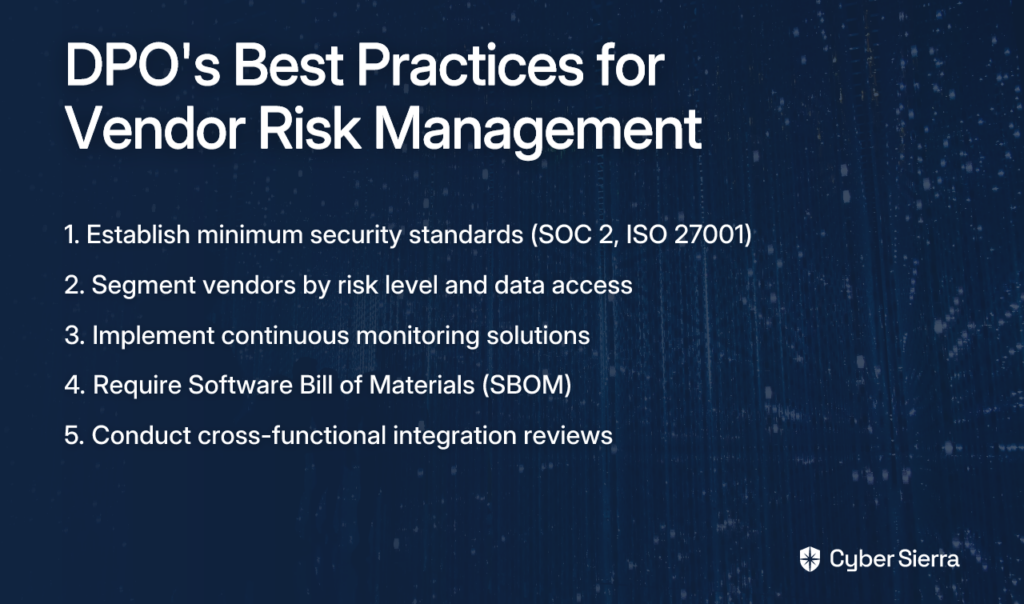
1. Establish Minimum Security Standards
Don't start from scratch with every vendor. As one security professional noted, "...leaning on a minimum certification standard can help." Mandate baseline certifications like SOC 2 Type II or ISO 27001:2022 for vendors handling critical or sensitive data.
Consider creating tiered requirements based on data sensitivity and access levels. For critical vendors processing sensitive personal data, a full suite of certifications and continuous monitoring may be necessary, while less critical vendors might need only basic verification.
2. Assess and Segment Vendors by Risk
Not all vendors pose the same level of risk. Maintain an updated inventory and categorize vendors based on data access and criticality to your operations. For smaller vendors where compliance costs may be prohibitive, you may need to "...accept the risk associated with smaller providers" but document this decision and implement compensating internal controls.
The key is to apply proportional due diligence—focusing most resources on high-risk vendors while maintaining appropriate oversight of the entire vendor ecosystem.
3. Implement Continuous Monitoring to "Trust but Verify"
Shift from relying solely on vendor self-attestations to objective, real-time data. This addresses the common concern that a vendor might have just "lied" on their questionnaire. Continuous monitoring solutions provide validation between formal assessments and can quickly alert you to emerging risks.
As one Reddit user pointed out, "you can't trust the third party didn't just lie." Continuous monitoring serves as an objective verification layer that supplements traditional assessments.
4. Demand Transparency with a Software Bill of Materials (SBOM)
Take the advice to "ask for an SBOM and prefer vendors who can provide them." A Software Bill of Materials gives you critical visibility into the components of vendor software, allowing you to quickly identify exposure when a new vulnerability (like Log4j) is announced.
This transparency enables you to "have an inventory and visibility so when the next celebrity vulnerability is announced, you don't spend weeks looking for what apps are impacted," as one security professional advised.
5. Involve Stakeholders and Review Integrations
Before onboarding any vendor, ensure there is a "...gate check to at a minimum do a review of the integration." Involve legal, IT, privacy, and business stakeholders to weigh in on the risks of the integration itself.
This cross-functional approach ensures that all perspectives are considered, and appropriate controls are implemented before sensitive data starts flowing to a new vendor.
Conclusion
The era of "check-the-box" vendor risk management is over. For DPOs in 2025, the standard of care requires a move towards automated, continuous monitoring to keep pace with an expanding threat landscape and complex regulatory demands.
Choosing the right solution is about aligning technology with a robust TPRM program. The goal is to gain a real-time, evidence-based view of your supply chain's security and compliance posture.
Platforms like CyberSierra are purpose-built for this new reality, offering an AI-powered, unified solution that simplifies everything from vendor onboarding to continuous monitoring and GRC. By automating manual tasks, DPOs can focus on strategic risk mitigation and building a more resilient organization.
As privacy regulations continue to evolve and third-party risks grow more complex, the right vendor risk monitoring solution won't just be a compliance tool—it will be a strategic advantage that protects your organization, your customers' data, and ultimately, your reputation in an increasingly privacy-conscious world.
Frequently Asked Questions
What is vendor risk monitoring?
Vendor risk monitoring is the continuous process of detecting, assessing, and mitigating security and compliance risks associated with third-party vendors. It moves beyond traditional, point-in-time questionnaires to provide real-time visibility into a vendor's security posture, helping to prevent data breaches that originate in the supply chain.
Why is vendor risk monitoring crucial for Data Protection Officers (DPOs)?
Vendor risk monitoring is crucial for DPOs because it is a core compliance requirement under regulations like GDPR, HIPAA, and CCPA. DPOs are responsible for ensuring third-party data processors protect personal data adequately. Effective monitoring provides demonstrable evidence of due diligence, helps prevent costly data breaches (62% of which trace back to vendors), and reduces the personal liability of the DPO.
What are the most important features in a vendor risk monitoring tool?
An effective vendor risk monitoring tool should offer continuous, 24/7 monitoring of a vendor's security posture, automated risk scoring, and visibility into fourth-party risks (your vendors' vendors). For privacy leaders, essential features also include automated tracking of regulatory compliance (e.g., GDPR), built-in tools for Data Protection Impact Assessments (DPIAs), and data flow mapping capabilities.
How do you implement a continuous vendor monitoring program?
To implement a continuous monitoring program, you must shift from relying solely on vendor self-assessments to using a platform that provides objective, real-time data. This involves integrating a solution that automates security ratings, tracks compliance changes, and sends immediate alerts on emerging risks. This "trust but verify" approach validates vendor claims and provides an up-to-date view of risk exposure between formal assessments.
What is a Software Bill of Materials (SBOM) and why does it matter for vendor risk?
A Software Bill of Materials (SBOM) is a detailed inventory of all software components and dependencies within an application. It is critical for vendor risk management because it provides transparency into your software supply chain. When a new vulnerability is discovered, an SBOM allows your organization to quickly identify which vendors are affected, drastically reducing the time and effort needed to respond to the threat.
How can you manage risk for small vendors who cannot afford certifications?
Managing risk for smaller vendors without certifications like SOC 2 requires a risk-based approach. First, segment vendors based on the criticality of the data they access. For lower-risk vendors, you may formally accept the risk while documenting the decision and implementing compensating internal controls. For higher-risk vendors, you can use continuous monitoring tools to gain objective insights into their security posture, even in the absence of formal certification.
