



How to Justify Your GRC Automation Budget with Measurable ROI



Join thousands of professionals and get the latest insight on Compliance & Cybersecurity.
You've been tasked with upgrading your organization's Governance, Risk, and Compliance (GRC) processes. You know automation is the answer, but every time you mention the budget needed, you're met with skepticism: "Can't we just keep doing things manually?" "Is this really worth the investment?" "How do we know this won't fail like other IT projects?"
If this sounds familiar, you're not alone. GRC professionals across industries face the challenge of justifying automation investments to budget-conscious executives who view compliance as a cost center rather than a value driver.
"Most GRC automation improvement stops when the cost benefit no longer makes sense," notes one cybersecurity professional in an online discussion. Others express frustration with "incomplete automation leading to reliance on manual processes" and the "high cost and requirements for clean data" needed for effective implementation.
But here's the reality: GRC automation isn't just another expense—it's a strategic investment with measurable, substantial returns. With the global GRC market valued at $32.2 billion in 2021 and projected to grow at a CAGR of 14.5% through 2030, forward-thinking organizations are already reaping the benefits of modernized compliance programs.
This article provides a practical, data-driven framework to help you build a compelling business case for GRC automation by demonstrating clear ROI, operational efficiencies, and strategic value.
Quantifying the Pain: The Hidden Costs of Manual GRC
Before you can demonstrate the return on investment, you must first establish what your current manual processes are actually costing your organization—both in direct expenses and hidden opportunity costs.
The Time Sink of Manual GRC
Traditional GRC processes consume an astounding 2,400+ hours annually for a typical mid-sized organization. That's more than one full-time employee dedicated solely to administrative compliance tasks.
Consider these eye-opening statistics:
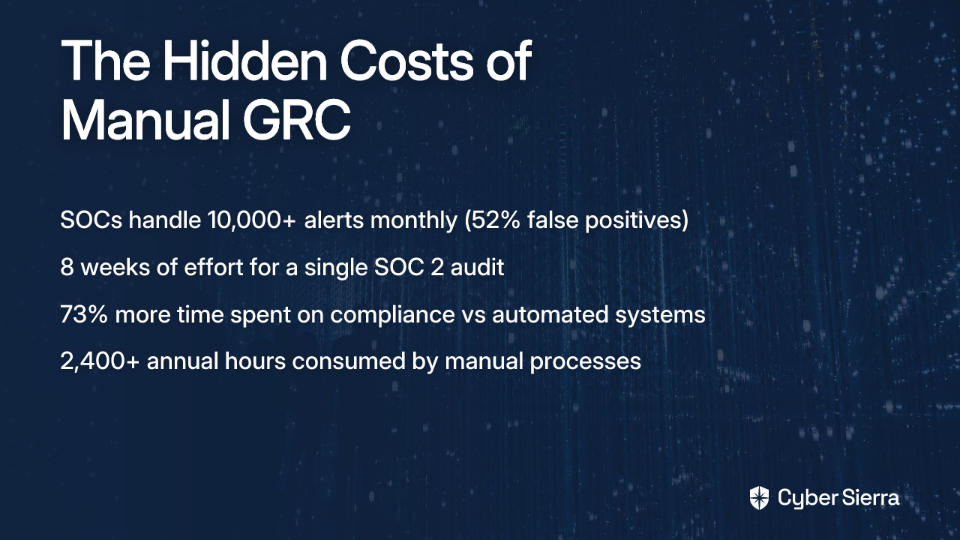
- Security Operations Centers (SOCs) handle approximately 10,000 alerts monthly, with a staggering 52% being false positives that waste valuable analyst time
- Manual evidence collection for a single SOC 2 audit takes an average of 8 weeks of dedicated effort
- Organizations with manual processes spend 73% more time on compliance activities than those with automated systems
Conducting Your Own Process Audit
To build a compelling business case, start by quantifying your current baseline costs:
- Identify Manual Tasks: List all recurring GRC activities (evidence collection, policy updates, vendor questionnaires, access reviews, etc.)
- Measure Time & Personnel: Document hours spent per task and the roles/salaries of those involved
- Calculate Labor Costs: Multiply hours by blended hourly rates
- Factor in Error Rates & Risk: Quantify the cost of non-compliance, including past fines or remediation costs
For example, if your organization spends 20 hours weekly on manual evidence gathering across three team members with an average hourly rate of $50, that's $52,000 annually on just one GRC activity—before accounting for the opportunity cost of what those team members could be doing instead.
The Core of Your Business Case: Calculating the Hard ROI
With your baseline established, it's time to build the financial case for automation. According to research by Axis Intelligence, GRC automation platforms deliver an average 340% ROI within the first year of implementation. Let's break down where these returns come from:
Pillar 1: Direct Cost Savings (Average: $1.8M/year)
GRC automation dramatically reduces labor costs by eliminating repetitive, manual tasks:
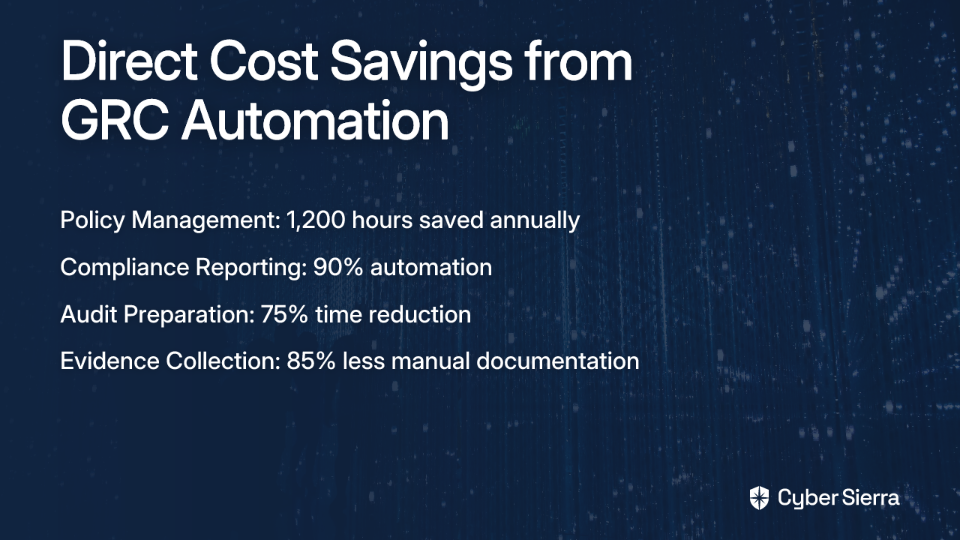
- Automated Policy Management: Saves an estimated 1,200 hours annually
- Compliance Reporting: Can be automated by up to 90%
- Audit Preparation: Cut from an average of 8 weeks down to just 2 weeks
- Evidence Collection: Automation eliminates 85% of manual documentation tasks
For a mid-sized company with 5-10 compliance frameworks to manage, these efficiency gains translate to approximately $1.8 million in annual labor cost savings.
Pillar 2: Operational Efficiency Gains (Average: $850K/year)
Beyond direct cost savings, GRC automation creates operational efficiencies that multiply throughout the organization:
- Real-time Risk Monitoring: Proactively prevents up to 95% of compliance violations before they occur
- Automated Workflows: Reduce approval cycles for policies, risk assessments, and vendor onboarding by 60%
- Decision-Making Velocity: Data-driven dashboards enable faster, more informed risk decisions
When compliance becomes streamlined, the entire organization benefits from reduced friction and faster processes.
Pillar 3: Compliance Cost Avoidance (Average: $2.1M/year)
Perhaps the most significant financial benefit comes from avoiding the costs associated with compliance failures:
- Reduced Audit Scope: Continuous compliance monitoring can reduce external audit costs by up to 40%
- Penalty Avoidance: Automated controls dramatically reduce the risk of non-compliance fines
- Remediation Reduction: Proactive monitoring means fewer findings requiring costly fixes
According to the Cybersierra GRC Benefits Blog, organizations with mature GRC automation experience 65% fewer compliance incidents than those relying on manual processes.
Beyond the Balance Sheet: Strategic and Revenue-Generating Benefits
While cost savings provide a compelling financial case, the strategic benefits of GRC automation often deliver even greater long-term value.
Accelerating Business Velocity
In today's fast-moving markets, speed is a competitive advantage. GRC automation can:
- Accelerate Time-to-Market: Automated compliance clearance leads to 35% faster product launches
- Improve Innovation Cycles: When compliance becomes an enabler rather than a roadblock, innovation thrives
- Reduce Time-to-Decision: Real-time risk data allows for faster, more confident decision-making
Strengthening Trust and Brand Reputation
Trust is a valuable currency in business relationships:
- Enhanced Customer Confidence: Transparent reporting and strong compliance posture can lead to a 67% improvement in customer trust
- Stakeholder Relationships: Robust GRC frameworks reassure investors, partners, and customers
- Competitive Differentiation: Demonstrable compliance excellence creates market advantage, particularly in regulated industries
Enabling New Revenue Opportunities
Perhaps most compelling for executive stakeholders, GRC automation can directly impact top-line growth:
- Market Expansion: Achieving certifications like ISO 27001 or SOC 2 can unlock new enterprise markets, potentially creating $3.2M in new annual revenue
- Reduced Sales Friction: Automated evidence sharing and compliance reporting can accelerate enterprise sales cycles by up to 40%
Your Step-by-Step Guide to Building the Budget Proposal
Now that you understand the value proposition, here's how to build a compelling budget proposal that addresses both financial and strategic considerations:
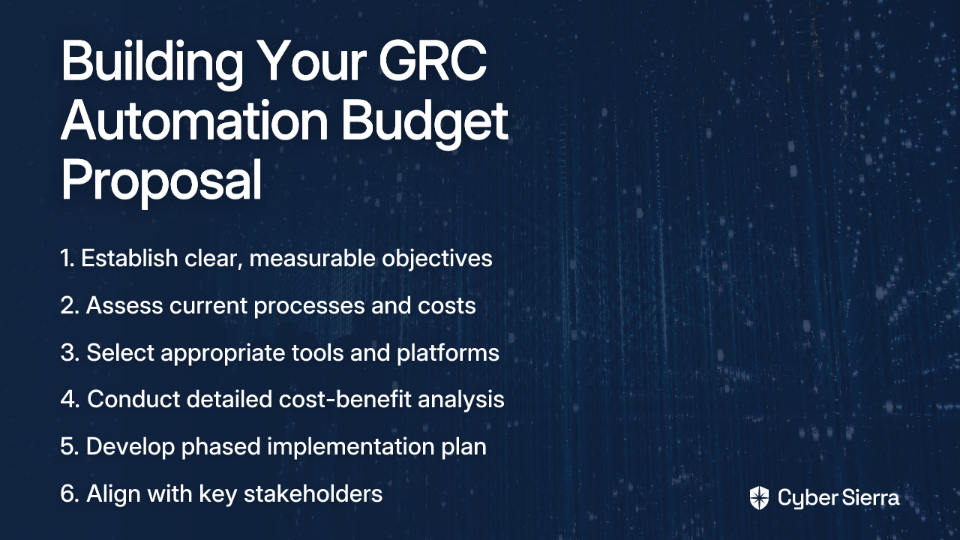
1. Establish Clear Objectives
Define what you want to achieve with GRC automation. Is it streamlining SOC 2 compliance, improving risk visibility, or reducing audit costs? Cybersierra's GRC Automation Blog recommends starting with specific, measurable objectives tied to business outcomes.
2. Assess Current Processes & Costs
Use the process audit framework outlined earlier to establish your baseline. Identify the biggest bottlenecks and inefficiencies in your current GRC processes.
3. Select Appropriate Tools
Choose a platform that aligns with your objectives and integrates key functionalities. A unified solution like Cyber Sierra integrates Governance, Risk & Compliance (GRC), Continuous Control Monitoring (CCM), and Third-Party Risk Management (TPRM) into a single platform, reducing technology debt and providing a single source of truth.
4. Conduct a Detailed Cost-Benefit Analysis
- Costs: Factor in the total cost of ownership (TCO), including software license fees, implementation costs, and training
- Benefits: Use the hard numbers and strategic benefits from our earlier sections to build your ROI calculation
- Calculate Break-Even Point: When will the investment begin generating positive returns?
5. Develop a Phased Implementation Plan
Propose a 90-day phased deployment to mitigate integration risks and demonstrate early wins. Start with a high-impact area like automated evidence collection for an upcoming audit.
6. Align with Stakeholders
Secure buy-in from key executives (CFO, CEO) and department heads (IT, Legal) by aligning the GRC proposal with their business goals and addressing their specific pain points.
Addressing the Skeptics: Overcoming Common Objections
Be prepared to address these common concerns when presenting your proposal:
"Automation is unreliable. We still need humans in the loop."
Response: Automation isn't about removing humans—it's about empowering them. GRC automation handles repetitive, low-value tasks, freeing experts to focus on high-level analysis and strategic risk management. Modern platforms provide real-time dashboards and comprehensive audit trails, actually increasing visibility compared to manual spreadsheet-based processes.
"These implementations are too complex and risky."
Response: This is a valid concern. In fact, 60% of failed implementations stem from integration complexity. That's why we propose a phased deployment, starting with specific, high-impact modules to demonstrate value quickly before expanding.
"The cost is too high. We can't afford it right now."
Response: Consider the cost of inaction. Without automation, we face escalating compliance costs, increased risk of fines, and slower business operations. The annual cost savings ($2.4M for mid-market) and ROI (340%) demonstrate that the investment pays for itself quickly. Modern platforms use a SaaS subscription model, which means lower upfront costs and predictable operational expenses.
Secure Your Budget and Transform Your GRC Program
Justifying your GRC automation budget isn't about "automation for automation's sake"—it's about presenting a clear, data-driven case that links the investment to significant cost savings, operational efficiencies, and strategic business growth.
The numbers speak for themselves: a potential 340% ROI, a 73% reduction in compliance costs, and an average annual savings of $2.4 million for mid-market companies.
By using the frameworks and data in this article, you can move from a reactive, manual GRC posture to a proactive, automated, and value-driven program. In today's complex regulatory landscape, GRC automation isn't just a nice-to-have—it's a competitive necessity that pays for itself many times over.
FAQ
What is GRC automation?
GRC automation is the use of technology to streamline and integrate an organization's governance, risk management, and compliance processes. It replaces manual, repetitive tasks like evidence collection, policy updates, and compliance reporting with automated workflows. This not only improves efficiency but also provides real-time visibility into an organization's risk and compliance posture, enabling more strategic decision-making.
Why is investing in GRC automation important?
Investing in GRC automation is important because it transforms compliance from a costly manual effort into a strategic, value-driving function. It significantly reduces the risk of costly fines and data breaches, accelerates business operations like product launches and sales cycles, and strengthens trust with customers and partners. In a complex regulatory environment, manual processes are no longer sufficient to keep pace, making automation a competitive necessity.
How does GRC automation deliver a positive ROI?
GRC automation delivers a positive ROI, often within the first year, by cutting direct labor costs, improving operational efficiency, and avoiding the high costs of non-compliance. Studies show it can deliver an average ROI of 340% by reducing thousands of hours of manual work (direct savings), speeding up internal processes like audits and approvals (efficiency gains), and preventing penalties and remediation costs through continuous monitoring (cost avoidance).
What are the main challenges of implementing GRC automation?
The main challenges of implementing GRC automation are often related to integration complexity with existing systems, securing budget approval, and managing organizational change. Many projects falter due to poor integration or a lack of clean data. To overcome this, it's crucial to choose a unified platform that reduces technology debt and to propose a phased implementation plan. This approach demonstrates value quickly with early wins, making it easier to secure stakeholder buy-in.
How can we ensure a successful GRC automation implementation?
To ensure a successful implementation, start with clear objectives, conduct a thorough cost-benefit analysis, and adopt a phased deployment strategy. Begin by identifying a specific, high-impact area to automate, such as evidence collection for a SOC 2 audit. This allows you to demonstrate tangible results quickly. It's also vital to select a tool that aligns with your goals and to secure buy-in from key stakeholders by aligning the project with their business objectives.
What is the first step to building a business case for GRC automation?
The first step is to quantify the hidden costs of your current manual GRC processes. Before you can show the value of automation, you must establish a baseline. Document all manual compliance tasks, measure the hours and personnel involved, and calculate the associated labor costs. This data-driven approach provides a clear financial justification for the investment by highlighting the true cost of inaction.
