



How Generative AI is Changing Audit Evidence Collection


Join thousands of professionals and get the latest insight on Compliance & Cybersecurity.
You've set up a Google Ads campaign to drive targeted traffic to your website or online store. But when you check your analytics, you're shocked to see a flood of visitors from countries like India, Pakistan, and Bangladesh - places you never intended to target.
"Compliance is blocking our enterprise deals." If you're in the tech or SaaS world, this phrase likely sends shivers down your spine. It's the dreaded bottleneck that prevents growth-stage companies from closing crucial deals that could transform their trajectory. Since the public release of tools like ChatGPT in late 2022, Generative AI (GenAI) has rapidly evolved from a theoretical concept to a practical tool being enthusiastically adopted in finance and auditing.
According to the CAQ Audit Partner Pulse Survey, 1 in 3 audit partners now see companies in their industry already deploying or planning to deploy AI in financial reporting processes. This adoption is driven by a simple truth: traditional compliance processes are crushing organizations under their weight.
The Crushing Weight of Traditional Evidence Collection
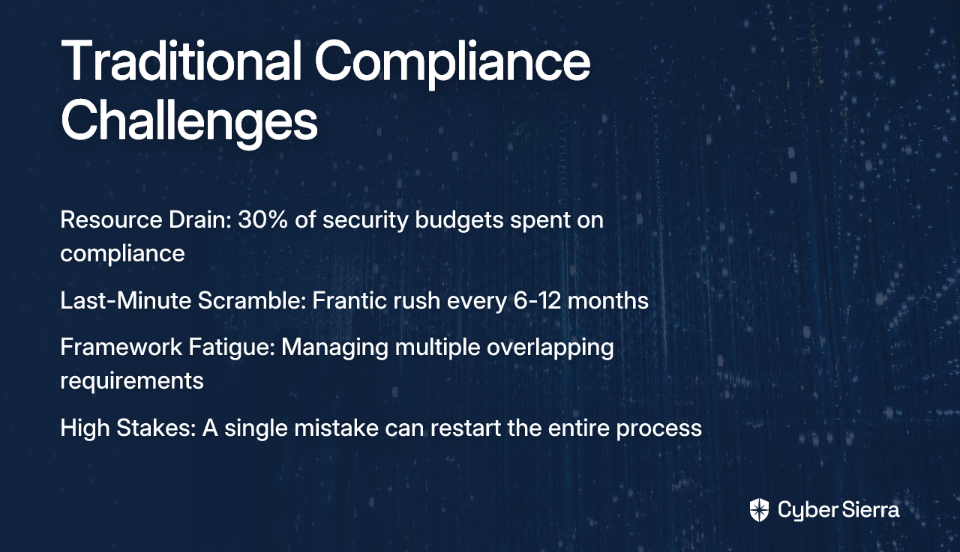
Before diving into how AI is transforming audit evidence collection, let's acknowledge the painful reality of traditional compliance processes that many organizations still endure:
Resource Drain: Organizations often spend upwards of 30% of their security budgets on compliance-related activities alone. This significant financial burden diverts resources from other critical security initiatives.
The "Last-Minute Scramble": The periodic nature of audit preparation creates a frantic rush every 6-12 months. Teams scramble to gather screenshots, logs, and documents from disparate systems, often pulling all-nighters to meet auditor deadlines.
Framework Fatigue & "Regulatory Agility Gaps": Managing multiple, overlapping frameworks (SOC 2, ISO 27001, GDPR, HIPAA, PCI DSS) leads to duplicated efforts and an inability to keep pace with new regulations. Each framework has its own nuanced requirements, creating a compliance maze that's difficult to navigate.
The High Stakes of Failure: The anxiety of the "3-month observation period" is real, especially knowing that a single mistake could mean "having to restart" the entire process, wasting months of effort and delaying deals. For startups and growth-stage companies, this can mean the difference between securing crucial funding or running out of runway.
As one founder lamented on Reddit, "SOC 2-ready in days [is] always needed," highlighting the urgent pressure companies face to accelerate compliance processes that traditionally take months.
Generative AI as the Ultimate Assistant: Automating the Grunt Work
Generative AI is revolutionizing audit evidence collection by automating the most labor-intensive and repetitive tasks:
Automated Document Review & Summarization: GenAI can rapidly review enormous volumes of documents like contracts, financial statements, and policy documents, summarizing key clauses and identifying relevant information. This allows auditors to focus on critical analysis instead of manual reading.
Drafting Policies and Reports: GenAI excels at generating first drafts of necessary documentation, from internal security policies to sections of an audit report. It can effectively produce the "verbose corporate maculature" that is necessary for compliance, which can then be refined by a human expert.
24/7 Evidence Collection: With AI-driven platforms, "evidence collection happens automatically while they sleep," as one compliance solution provider noted. The process is no longer a manual, point-in-time task but a continuous, background operation.
Quantifiable Impact: Automation isn't just a convenience; it delivers massive efficiency gains. Companies using these tools report 70-80% reductions in time spent gathering compliance evidence. This translates to significant cost savings and allows security teams to focus on more strategic initiatives.
Beyond Automation: Achieving Continuous, Intelligent Compliance
The true power of GenAI in audit evidence collection goes beyond simple task automation to enable a strategic advantage through continuous compliance:
Continuous Control Monitoring (CCM): Instead of periodic checks, AI enables ongoing, real-time monitoring of security controls. Platforms integrate with existing systems (cloud providers like AWS, HR software) to constantly pull data, monitor settings, and automatically update evidence. This creates a "single source of truth" for compliance status.
Platforms like Cyber Sierra's Continuous Control Monitoring (CCM) module embody this principle by providing a central controls repository with near real-time updates, offering clear visibility into security posture and delivering actionable risk intelligence. This makes an organization perpetually audit-ready rather than scrambling before audits.
Enhanced Risk Assessment & Anomaly Detection: AI can analyze vast datasets of financial transactions and system logs to identify anomalies and unusual patterns that might indicate risk or fraud. This helps auditors focus their efforts where they matter most, improving the overall quality of the audit process.
Cross-Framework Control Mapping: One of the most powerful applications of AI is its ability to intelligently identify overlapping requirements across multiple compliance frameworks. For example, access control requirements exist in both SOC 2 and ISO 27001, but with slight variations. AI can map these controls, allowing organizations to "test once, comply many" and eliminate redundant work.
The Human-in-the-Loop: Navigating the Perils of AI Hallucinations
Despite its transformative potential, GenAI comes with significant risks that must be managed, particularly in the high-stakes world of compliance. The biggest concern? AI "hallucinations" – instances where AI generates plausible but false information.
One compliance automation user shared a cautionary tale: "AI confidently stated we had encryption at rest enabled on a database that didn't even exist." In an audit context, this type of error could be catastrophic, potentially invalidating the entire compliance process and forcing organizations to restart their observation period.
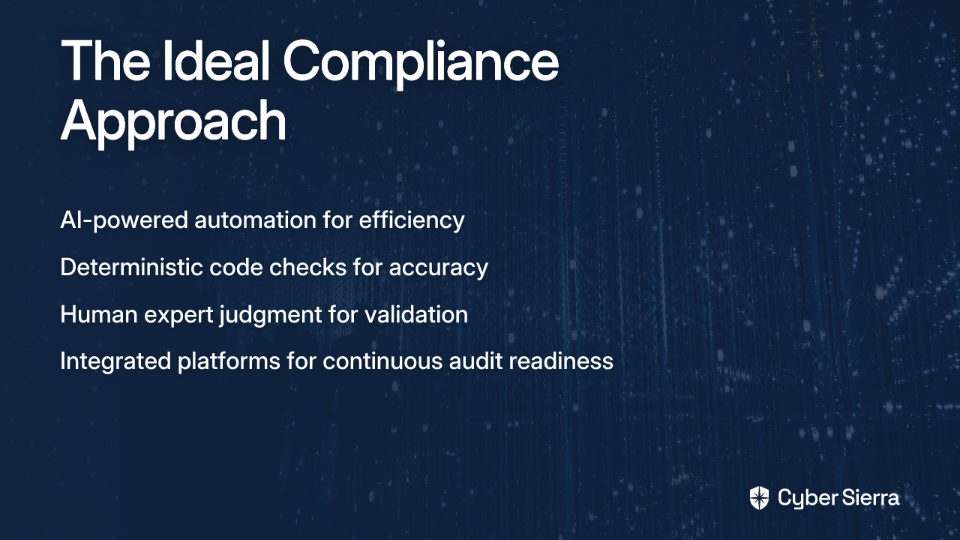
The solution is not to abandon AI, but to implement a hybrid approach:
The Hybrid Solution: GenAI + Deterministic Checks: The best practice is "not to have AI interpret anything critical." Instead, rely on deterministic code checks to verify if Multi-Factor Authentication is actually enabled or if specific AWS configurations are correct. These are hard facts that shouldn't be left to probabilistic AI interpretation.
Define the roles clearly:
- Use GenAI for tasks requiring language understanding (summarizing reports, drafting policies)
- Use deterministic, code-based automation to verify technical evidence (checking configurations, logs, user access)
- Keep the human expert as the ultimate arbiter who reviews and validates AI outputs
This balanced approach leverages the strengths of each component while mitigating the risks. It's also important to consider data privacy when feeding sensitive information into AI models and to implement measures to mitigate bias in AI outputs.
The Future of Audit is Strategic, Not Administrative
As we look toward the future, it's clear that the role of compliance professionals is evolving from paper-pushers to strategic advisors. The trend toward AI adoption in compliance is accelerating: the percentage of firms using GenAI has grown from 8% to 21% in just the last year, while those with no plans to adopt have fallen from 49% to 25%, according to Thomson Reuters.
The ultimate goal of this transformation is predictive compliance management, where AI helps organizations anticipate and prepare for regulatory changes before they happen. This proactive approach allows businesses to maintain continuous compliance rather than reactively scrambling to catch up with new requirements.
Generative AI is not a silver bullet for compliance challenges, but it is a powerful force multiplier. The most effective path forward combines:
- The efficiency of AI-powered automation
- The accuracy of deterministic code checks
- The invaluable judgment of human experts
By leveraging integrated platforms that provide this balanced approach, organizations can transform compliance from a source of stress and a deal blocker into a demonstrable strategic advantage that builds trust and accelerates growth. For businesses looking to streamline this journey, exploring a unified GRC platform like Cyber Sierra can be the first step toward continuous audit readiness.
In the end, the goal isn't just to collect evidence more efficiently – it's to fundamentally change how organizations approach compliance, moving from a periodic, painful process to a continuous state of readiness that supports rather than hinders business growth.
Frequently Asked Questions
How does Generative AI streamline audit evidence collection?
Generative AI streamlines audit evidence collection by automating repetitive tasks like reviewing documents, drafting policies, and summarizing information. It can rapidly process vast amounts of text from contracts and policy documents, generate first drafts of required reports, and work 24/7 to gather evidence. This significantly reduces the manual "grunt work," freeing up compliance teams to focus on more strategic analysis and validation.
What are the biggest risks of using AI in compliance audits?
The biggest risk of using AI in compliance audits is the potential for "hallucinations," where the AI generates plausible but factually incorrect information. For example, an AI might incorrectly state that a security control is enabled when it is not. To mitigate this, a hybrid approach is essential, using deterministic code-based checks for verifying technical evidence while reserving GenAI for language-based tasks, all under the supervision of a human expert.
What is Continuous Control Monitoring (CCM)?
Continuous Control Monitoring (CCM) is an automated process that continuously checks and validates a company's security controls in real-time, rather than only during a specific audit period. AI-powered platforms enable CCM by integrating with various systems (like cloud providers and HR software) to constantly pull data and verify that controls are operating correctly. This ensures an organization is always audit-ready and has a "single source of truth" for its compliance posture.
Can AI help with managing multiple compliance frameworks at once?
Yes, AI is highly effective at managing multiple compliance frameworks like SOC 2, ISO 27001, and GDPR simultaneously through a process called cross-framework control mapping. AI can identify and map overlapping requirements between different standards. This allows organizations to "test once, comply many," eliminating redundant work and streamlining the management of their overall compliance program.
Will AI replace the role of human compliance professionals?
No, AI is not expected to replace human compliance professionals but rather to augment their capabilities and evolve their role. AI automates the administrative and repetitive tasks, shifting the human expert's focus from manual evidence gathering to more strategic responsibilities. This includes validating AI outputs, interpreting complex regulatory nuances, making critical judgments, and advising the business on risk and strategy.

This article is brought to you by Cyber Sierra, providing an AI-enabled cybersecurity platform designed to simplify and automate security compliance for enterprises. Learn more about our Continuous Control Monitoring and Governance, Risk & Compliance solutions.
