Top CCM Platforms for Multi-Cloud Environments in 2025


Join thousands of professionals and get the latest insight on Compliance & Cybersecurity.
You've meticulously built your cloud infrastructure across AWS, Azure, and Google Cloud to leverage the best each provider has to offer. But now you're drowning in disparate dashboards, juggling different security configurations, and losing sleep over whether something critical might slip through the cracks. Every time an auditor requests evidence, your team spends weeks manually gathering screenshots and logs from multiple environments.
With 89% of enterprises now operating multi-cloud strategies, you're not alone in this struggle. The promise of cloud flexibility has created a new challenge: maintaining consistent security controls and compliance across increasingly complex environments.
The Multi-Cloud Security Challenge
The core problem is painfully simple yet difficult to solve: how do you maintain visibility and control when your infrastructure, applications, and data are scattered across multiple cloud providers? This fragmentation creates significant blind spots in security posture and makes proving compliance a herculean task.
As one CISO recently shared on Reddit: "Each cloud provider has different IAM policies and configurations. Ensuring a unified access control strategy is challenging but critical to preventing unauthorized access."
This is where Continuous Control Monitoring (CCM) platforms have become essential for modern enterprises navigating the multi-cloud maze.
What is Continuous Control Monitoring (CCM) in a Multi-Cloud Context?
CCM is "a proactive approach that utilizes technology for ongoing, automated oversight of an organization's controls to ensure their effectiveness in mitigating risks and maintaining compliance with regulations and security policies," according to Cybersierra's comprehensive guide.
But there's often confusion about what "continuous" actually means. Many Reddit discussions reveal frustration with tools marketed as continuous but relying on scheduled checks instead of real-time monitoring. One user asked: "Would the scheduled tools I described above still be considered CCM tools?"
The reality is that while not all CCM tools offer true, event-driven real-time monitoring, the term "continuous" refers to the shift from manual, point-in-time audits to frequent, automated checks (hourly or daily). This automated cadence provides near real-time insights that represent a massive improvement over traditional quarterly or annual assessments.
For multi-cloud environments specifically, a robust CCM platform provides:
- Unified visibility across all environments through a "single pane of glass"
- Standardized security practices despite different native cloud controls
- Automated evidence collection for compliance frameworks like NIST, ISO 27001, PCI DSS, and GDPR
- Consistent identity and access management oversight across providers
The Road to 2025: Key Trends Shaping Multi-Cloud Management
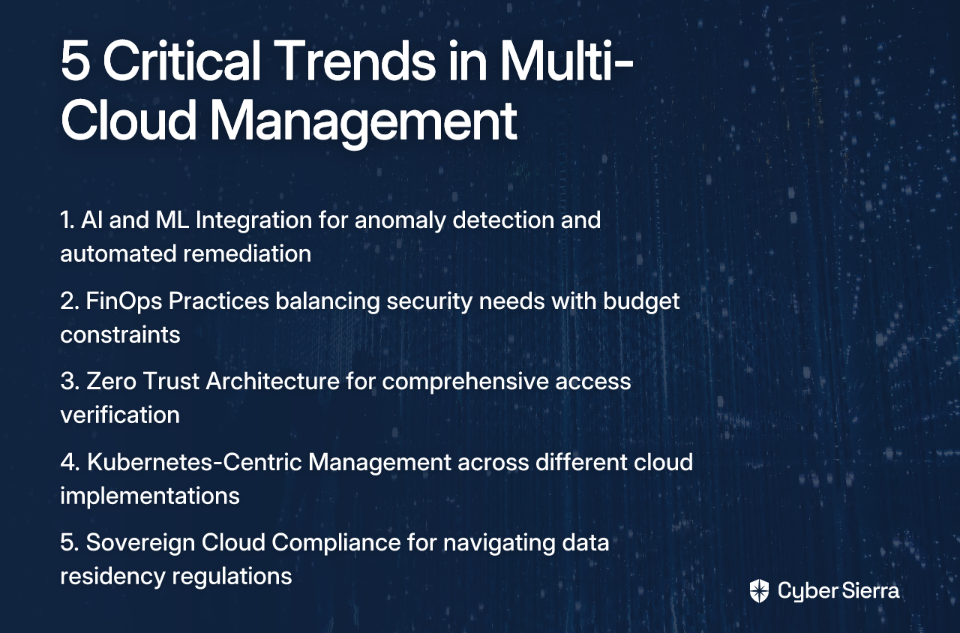
As we look toward 2025, several critical trends are reshaping what organizations should demand from their CCM platforms:
- AI and ML Integration: Advanced platforms now leverage artificial intelligence to detect anomalies, predict potential compliance issues, and automate remediation tasks that previously required human intervention.
- FinOps Practices: With cloud costs constantly increasing, leading platforms integrate financial governance into security controls, helping organizations balance security needs with budget constraints.
- Zero Trust Architecture: As perimeter-based security becomes obsolete in multi-cloud environments, CCM platforms are adopting zero trust principles, verifying every access request regardless of origin.
- Kubernetes-Centric Management: With containerization becoming standard, platforms must provide dedicated controls for Kubernetes security across different cloud implementations.
- Sovereign Cloud Compliance: As data residency regulations tighten globally, platforms need to help organizations navigate complex compliance requirements for data stored in different geographic regions.
Essential Features for a Multi-Cloud CCM Platform
Before examining specific platforms, let's establish what features are non-negotiable when evaluating CCM solutions for multi-cloud environments:
1. Unified Dashboard and Monitoring
A true multi-cloud CCM platform must provide a consolidated view of all security controls, assets, and risks across every cloud provider. This eliminates the need to switch between multiple tools and ensures nothing falls through the cracks.
2. Automated Control Testing & Provisioning
The platform should support Infrastructure-as-Code (IaC) tools like Terraform and provide policy-driven orchestration to ensure configurations are secure from deployment. This "shift-left" approach catches misconfigurations before they become vulnerabilities.
3. Comprehensive Compliance Management
The ability to map controls to multiple frameworks (NIST, ISO 27001, PCI DSS, GDPR, HIPAA) and generate audit-ready reports is essential for multi-cloud environments where compliance complexity multiplies with each additional provider.
4. Actionable Risk Intelligence
As one security professional noted on Reddit: "Tools like Wiz or Orca look slick, but if no one has time to tune them you'll end up with alert fatigue." The platform must prioritize vulnerabilities and misconfigurations based on business context, not just technical severity.
5. Broad API and Integration Support
Seamless integration with your existing DevOps toolchain, including CI/CD pipelines, SIEM solutions, and IAM systems ensures the CCM platform enhances rather than disrupts your workflows.
Top CCM Platforms for Multi-Cloud in 2025
Based on current trajectory and capabilities, here are the standout platforms for managing security and compliance across multi-cloud environments in 2025:
Wiz
Focus: Cloud Security Posture Management (CSPM) with a comprehensive risk-based approach
Key Features for Multi-Cloud:
- Agentless scanning across AWS, Azure, GCP, and OCI
- Graph-based risk assessment that identifies attack paths
- Infrastructure-as-Code scanning integrated with CI/CD pipelines
- Automated compliance reporting for major frameworks
Ideal Use Case: Organizations seeking deep visibility into their security posture with prioritized, context-aware remediation across multiple cloud providers.
CloudZero
Focus: Cloud Cost Intelligence and FinOps with security integration
Key Features for Multi-Cloud:
- Granular cost allocation across all major cloud providers
- Anomaly detection that flags both security and cost outliers
- Unit economics analysis connecting cloud spend to business outcomes
- Security posture monitoring tied to cost optimization
Ideal Use Case: Engineering and finance teams looking to optimize cloud spending while maintaining security standards across their multi-cloud infrastructure.
Spacelift
Focus: Infrastructure-as-Code (IaC) Orchestration and Security Governance
Key Features for Multi-Cloud:
- Centralized provisioning for Terraform, CloudFormation, Pulumi, etc.
- GitOps integration for version control and collaboration
- Policy as Code using Open Policy Agent to enforce security standards
- Drift detection to identify unauthorized changes
Ideal Use Case: DevOps-focused organizations that need to standardize and secure their infrastructure deployment process across multiple clouds while maintaining developer autonomy.
VMware Aria (formerly vRealize Suite) / CloudHealth
Focus: Comprehensive Multi-Cloud Management with deep operational insights
Key Features for Multi-Cloud:
- Performance management across hybrid and multi-cloud environments
- Centralized log analytics and security monitoring
- FinOps-focused cost visibility and optimization
- Infrastructure automation with security guardrails
Ideal Use Case: Large enterprises, especially those with a significant VMware footprint, needing a robust, all-in-one platform for managing complex hybrid and multi-cloud operations.
Cybersierra
Focus: Unified Governance, Risk, Compliance (GRC) and Continuous Control Monitoring
Key Features for Multi-Cloud:
- Central controls repository that builds a single source of truth across cloud environments
- Multi-framework compliance management (NIST, ISO 27001, PCI DSS, GDPR)
- Automated evidence collection that significantly reduces manual audit work
- Actionable risk intelligence prioritized by business impact
Ideal Use Case: For CISOs, Compliance Managers, and IT leaders who need to streamline GRC processes, achieve continuous compliance across their entire cloud estate, and demonstrate a proactive security posture to auditors and stakeholders.
How to Select the Right CCM Platform for Your Organization
With numerous options available, here's a structured approach to selecting the platform that best fits your multi-cloud needs:
- Define Your Primary Objective: Are you primarily solving for compliance automation, cost optimization, or infrastructure security? This clarity will narrow your options significantly.
- Assess Integration and Compatibility: Ensure the platform seamlessly connects with your cloud providers, CI/CD pipelines, and other security tools to avoid creating new data silos.
- Prioritize Usability and Actionable Insights: A tool is only effective if it's used. Look for a clean interface and features that reduce noise and prevent alert fatigue. As one Reddit user advised: "upwind's solid for your size... it just works without needing a whole security team to manage it."
- Evaluate Scalability and Vendor Support: The solution must be able to grow with your organization's cloud footprint. Check for robust customer support and training resources.
- Conduct a Cost-Benefit Analysis: Look beyond the sticker price. Evaluate the total cost of ownership against the potential savings from reduced manual labor, avoided regulatory fines, and faster audit cycles.
Frequently Asked Questions
What is Continuous Control Monitoring (CCM) for multi-cloud environments?
Continuous Control Monitoring (CCM) for multi-cloud is an automated approach that provides ongoing oversight of security controls across all your cloud providers, such as AWS, Azure, and Google Cloud, from a single platform. Unlike traditional, manual audits that happen periodically, CCM uses technology to frequently test controls, ensuring they are consistently effective at mitigating risks and maintaining compliance. This gives organizations a unified, near real-time view of their security posture across their entire, fragmented cloud estate.
Why is a CCM platform essential for multi-cloud security?
A CCM platform is essential for multi-cloud security because it solves the critical challenge of fragmentation by unifying visibility, standardizing security policies, and automating compliance evidence collection across disparate cloud environments. Without a centralized platform, teams struggle with security blind spots, inconsistent configurations between providers like AWS and Azure, and an overwhelming manual workload for audits. CCM provides a "single pane of glass" to manage these complexities, reducing risk and ensuring consistent security.
How does a CCM platform simplify multi-cloud compliance and audits?
A CCM platform simplifies compliance and audits by automatically collecting and mapping evidence from all cloud environments to multiple regulatory frameworks like NIST, ISO 27001, and PCI DSS. Instead of spending weeks manually gathering screenshots and logs from different cloud dashboards, a CCM tool provides audit-ready reports on demand. This continuous evidence collection significantly reduces manual labor, shortens audit cycles, and provides proactive assurance that your organization meets its compliance obligations.
What is the difference between CCM and CSPM?
The primary difference is that Cloud Security Posture Management (CSPM) focuses on identifying and remediating misconfigurations within cloud infrastructure, while Continuous Control Monitoring (CCM) has a broader scope that includes verifying the operational effectiveness of security controls for governance, risk, and compliance (GRC) purposes. A CSPM tool is excellent for tactical, technical security checks. A CCM platform integrates this posture data into a larger GRC context, mapping technical findings to business risks and compliance requirements. Many modern platforms blend these capabilities, but CCM's core strength is its focus on continuous compliance and audit readiness.
What are the key features to look for in a multi-cloud CCM tool?
The most important features for a multi-cloud CCM tool are a unified dashboard, automated control testing, comprehensive compliance management for frameworks like ISO 27001 and GDPR, and broad integration support with your existing tools. A strong platform must eliminate the need to juggle multiple dashboards. It should also provide actionable risk intelligence to prevent alert fatigue and support "shift-left" security by integrating with Infrastructure-as-Code (IaC) tools. This ensures security is built-in, not bolted on.
From Reactive Audits to Proactive Assurance
The shift to multi-cloud is now the norm, with over 90% of enterprises expected to use multiple cloud platforms by 2026, according to Gartner research. This new reality demands a strategic approach to security and compliance.
Manual, point-in-time audits simply can't keep pace with the complexity and velocity of modern cloud environments. Continuous Control Monitoring is the strategic imperative for gaining visibility, maintaining compliance, and building a resilient security posture in a distributed world.
The future of cloud security is continuous, automated, and integrated. Platforms like Cybersierra are at the forefront of this shift, offering AI-enabled solutions to unify CCM, GRC, and threat intelligence. To see how continuous monitoring can transform your multi-cloud security and simplify your next audit, book a demo with Cybersierra.
By embracing modern CCM platforms, you can finally turn the multi-cloud challenge into a strategic advantage, ensuring consistent security across all your environments while dramatically reducing the manual effort of compliance.