



Top Vendor Risk Management Tools for 2025


Join thousands of professionals and get the latest insight on Compliance & Cybersecurity.
You've set up a robust security program for your organization, meticulously implementing controls and passing audits with flying colors. But when you open your inbox to find news of yet another massive data breach caused by a third-party vendor, that sinking feeling sets in again. Despite your best efforts, your security is only as strong as your weakest vendor.
This scenario has become all too common, with a staggering 61% of U.S. companies experiencing data breaches caused by third-party providers. And with the average data breach now costing approximately $4.9 million, the stakes couldn't be higher.
If you're struggling with overly complex questionnaires leading to analysis paralysis, the constant battle to get accurate vendor data, or the nagging doubt about whether your vendors' self-attested controls are actually working, you're not alone. As one security professional on Reddit put it, the "difficulty in verifying vendor controls and processes" remains a major source of risk.
The truth is that traditional, point-in-time vendor assessments are no longer sufficient in today's rapidly evolving threat landscape. The future of Third-Party Risk Management (TPRM) in 2025 and beyond is about continuous, evidence-based validation. Let's explore the essential features of modern vendor risk management tools and review the top contenders that can truly secure your supply chain.
The Evolution of TPRM: From Static Audits to Continuous Control Monitoring
The problem with traditional approaches like annual questionnaires (such as the SIG) and SOC 2 reports is that they only provide a snapshot of a vendor's security posture at a specific moment in time. But in reality, a vendor's security can change daily, leaving dangerous visibility gaps between assessments.
This is where Continuous Controls Monitoring (CCM) comes in. As defined by Pathlock, CCM is a technology-driven approach that shifts from periodic sampling to "continuously monitor and audit controls in financial and transactional applications" in near real-time.
Why is CCM a game-changer for TPRM? For starters, it directly addresses the user pain point of needing to validate vendor claims against real-world data. Instead of simply trusting what vendors tell you, CCM provides objective, real-time insights into the effectiveness of their security controls.
This shift from trust to validation allows teams to identify and address control gaps before they can be exploited, rather than after a breach has already occurred. Additionally, the automation of evidence collection reduces the manual burden on both your organization and its vendors, alleviating the "audit fatigue" that plagues so many security teams.
Must-Have Features for a 2025 Vendor Risk Management Tool
When evaluating TPRM solutions for 2025 and beyond, look for these critical features that address the most common pain points:
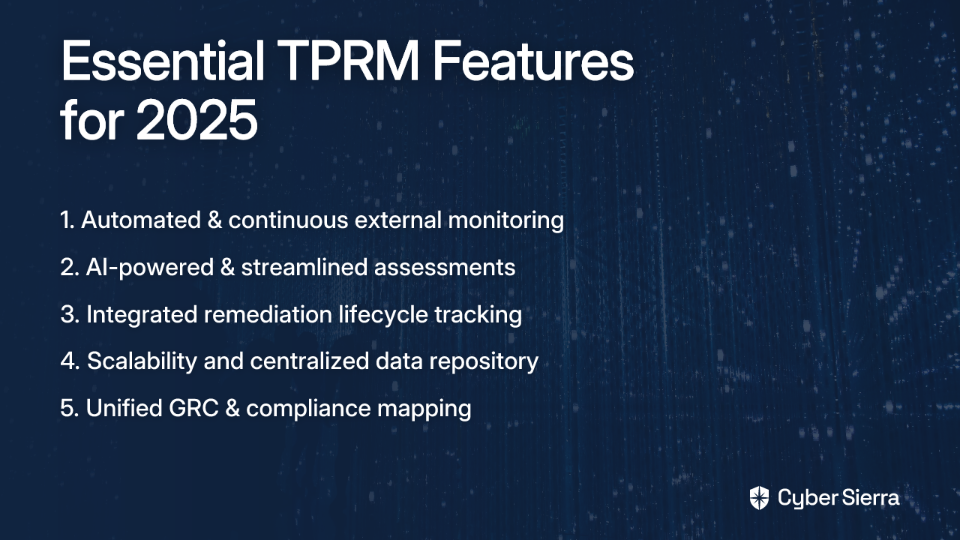
1. Automated & Continuous External Monitoring
Problem Solved: "Difficulty in verifying vendor controls" and "need for validation of vendor claims."
What to Look For: Real-time scanning of the vendor's external attack surface, security ratings (e.g., A-F grades), dark web monitoring, and automated alerts for posture degradation. This provides an objective, outside-in view of your vendors' security practices, rather than relying solely on their self-attestations.
2. AI-Powered & Streamlined Assessments
Problem Solved: "Overly complex questionnaires leading to analysis paralysis" and the "need for more efficient tools that reduce time investment."
What to Look For: AI assistance to analyze vendor documentation and questionnaires, customizable risk-based assessment templates, and automated evidence collection.
The impact can be significant: Vanta's platform reports "up to 50% less time spent on vendor security reviews" and "62% faster vendor evidence collection" through automation. Modern tools should adapt to your risk framework rather than forcing you to adapt to them.
3. Integrated Remediation Lifecycle Tracking
Problem Solved: "Lack of effective tracking for remediated findings."
What to Look For: A closed-loop workflow that allows you to flag risks, assign remediation tasks to vendors, track progress, and validate the fix—all within the platform. This ensures identified issues are actually resolved and don't reappear in future assessments.
Without robust tracking, critical security gaps can fall through the cracks even after they've been identified, leaving your organization vulnerable despite your best efforts.
4. Scalability and a Centralized "Source of Truth"
Problem Solved: "Concerns about scalability of TPRM tools for large supplier bases" and "difficulty managing external data sources."
What to Look For: A platform that can handle hundreds or thousands of vendors without performance degradation. It should act as a single repository for all vendor data, assessments, documents, and communication, preventing data silos and confusion.
As one Reddit user noted, many organizations struggle with TPRM solutions that "can't keep up with their growing vendor ecosystem," leading to incomplete risk coverage.
5. Unified GRC & Compliance Mapping
Problem Solved: "Audit fatigue" and the need to prove vendor due diligence for compliance frameworks.
What to Look For: The ability to map vendor controls and assessments to multiple frameworks (e.g., SOC 2, ISO 27001, HIPAA, GDPR). This streamlines compliance reporting and satisfies auditor requests efficiently, turning vendor assessments from a burden into a compliance asset.
Top Vendor Risk Management Tools for 2025: A Comparative Review
Based on extensive research and user feedback, here are the leading TPRM solutions poised to dominate in 2025:
UpGuard
Core Features: Real-time vendor scanning, AI-assisted questionnaires, integrated remediation planning, and presentation-ready reporting.
Ideal For: Mid-to-large organizations seeking a comprehensive, all-in-one VRM lifecycle tool with strong reporting capabilities.
UpGuard stands out for its robust external scanning capabilities and intuitive user interface, making it accessible even to teams new to formal TPRM. The platform's questionnaire management capabilities help streamline the assessment process while maintaining rigor.
SecurityScorecard
Core Features: A-F security grades, deep threat intelligence, dark web monitoring, and vendor questionnaire management.
Ideal For: Tech-forward organizations that need detailed, granular threat intelligence as part of their vendor assessment process.
SecurityScorecard's rating system provides an at-a-glance view of vendor security posture, making it easier to prioritize high-risk vendors for deeper assessment. Their threat intelligence capabilities are particularly strong for organizations in highly regulated industries.
Bitsight
Core Features: Daily security ratings, risk quantification in financial terms, and performance-based KPIs.
Ideal For: Mature enterprises focused on data-driven, risk-based management and communicating risk in financial terms to the board.
Bitsight differentiates itself by quantifying third-party risk in financial terms, helping security teams translate technical findings into business impact for executive stakeholders. This approach bridges the gap between security and business decision-makers.
Vanta
Core Features: Strong focus on automation and AI-powered reviews to speed up the process, automated evidence gathering.
Ideal For: Companies, especially in the tech sector, looking to dramatically reduce the manual effort and time spent on vendor security reviews.
Vanta has gained popularity for its ability to automate much of the vendor assessment process, making it a good fit for resource-constrained teams that need to scale their TPRM program efficiently.
Cybersierra
Core Features: An integrated platform combining Third-Party Risk Management (TPRM) with Continuous Control Monitoring (CCM) and a full Governance, Risk, and Compliance (GRC) suite.
Unique Value: Cybersierra addresses the core challenge of vendor validation by connecting questionnaires to live evidence. Rather than treating TPRM as a standalone function, it integrates vendor risk into a broader security and compliance ecosystem, providing a single source of truth.
The platform automates vendor assessments, provides near real-time visibility into vendor compliance, and centralizes control repositories across multiple frameworks. This approach directly tackles the user pain of verifying vendor claims and reduces audit fatigue by automating evidence collection for frameworks like SOC 2 and ISO 27001.
Ideal For: Organizations of all sizes looking to overcome manual GRC processes and vendor risk complexities with a single, AI-enabled platform that delivers automation and a unified security view.
Learn more about Cybersierra's approach to Third-Party Risk Management.
A Practical 8-Step Guide to Implementing Your VRM Program
Selecting the right tool is only half the battle. Here's how to ensure successful implementation:
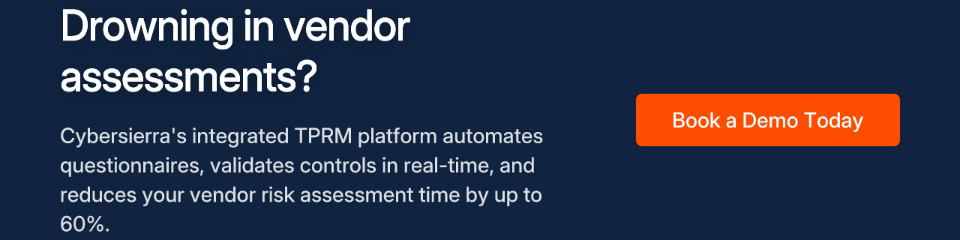
- Set Clear Goals: Define objectives and KPIs for your vendor risk program (e.g., reducing high-risk vendors by 30% in 6 months).
- Define Your Framework: Choose a risk framework (e.g., NIST) and define your organization's risk tolerance levels.
- Standardize Processes: Create consistent risk assessment and evidence collection procedures that apply to all vendors.
- Automate Assessments: Set up automated, recurring review schedules based on vendor risk tiers.
- Integrate Your Ecosystem: Connect your VRM tool with other systems like Jira or Slack to streamline workflows.
- Enable Daily Monitoring: Configure alerts to notify you immediately of significant drops in a vendor's security score.
- Train Your Team: Ensure all stakeholders understand the platform's functionality and your internal processes.
- Adapt and Improve: Regularly review your VRM strategy and adjust based on performance and the evolving threat landscape.
This practical approach, recommended by UpGuard, helps organizations maximize the value of their TPRM investment.
Conclusion: The Future of TPRM is Continuous and Integrated
As we move toward 2025, managing third-party risk requires moving beyond static, trust-based assessments. The new standard is a dynamic, evidence-based approach centered on continuous monitoring and integrated with broader security operations.
The best TPRM tool isn't just a risk register; it's an integrated platform that automates the entire vendor lifecycle, from onboarding and assessment to remediation and continuous validation. Solutions that bridge the gap between GRC, TPRM, and security operations—like Cybersierra's unified platform—are positioned to deliver the most value.
By selecting a TPRM solution that addresses the core challenges of validation, automation, and integration, you can build a more resilient and secure supply chain that stands up to increasingly complex threats. After all, your security is only as strong as your weakest link—but with the right tools and processes, those weak links become much easier to identify and strengthen before they become your next headline breach.
Frequently Asked Questions
What is Third-Party Risk Management (TPRM)?
Third-Party Risk Management (TPRM) is the process of identifying, assessing, and mitigating risks associated with using third-party vendors, suppliers, and service providers. It involves evaluating a vendor's security posture and compliance to ensure they don't introduce vulnerabilities into your organization's ecosystem. With a significant percentage of data breaches caused by third parties, a robust TPRM program is crucial for protecting your organization from supply chain attacks.
Why are traditional vendor questionnaires and annual audits insufficient?
Traditional vendor assessments like annual questionnaires and SOC 2 reports are insufficient because they only provide a static, point-in-time snapshot of a vendor's security posture. A vendor's security can change daily, leaving significant visibility gaps between assessments. This is why modern TPRM is shifting towards continuous, evidence-based validation to monitor a vendor's security controls in near real-time and identify risks before they can be exploited.
What is Continuous Controls Monitoring (CCM) in TPRM?
Continuous Controls Monitoring (CCM) is a technology-driven approach that automates the process of monitoring and auditing a vendor's security controls in near real-time, rather than relying on periodic checks. CCM is a game-changer for TPRM because it shifts the paradigm from "trusting" vendor self-attestations to "validating" their claims with objective, real-world data. This allows security teams to proactively identify and address control gaps.
What are the key features of a modern vendor risk management tool?
A modern vendor risk management tool must include automated external monitoring, AI-powered assessments, integrated remediation tracking, scalability for a large vendor base, and the ability to map controls to various compliance frameworks. These features directly address common pain points like the difficulty of verifying vendor claims, analysis paralysis from complex questionnaires, and audit fatigue. The goal is to move towards a centralized, automated, and continuous approach to managing the entire vendor risk lifecycle.
How can a TPRM solution help with compliance and audits?
A modern TPRM solution helps with compliance and audits by mapping vendor controls and assessments directly to multiple regulatory frameworks like SOC 2, ISO 27001, HIPAA, and GDPR. This capability streamlines compliance reporting and makes it easy to provide evidence of vendor due diligence to auditors. By automating evidence collection and maintaining a centralized repository, a TPRM tool transforms vendor management from a manual burden into a strategic compliance asset.
How do I get started with implementing a vendor risk management program?
To start a vendor risk management program, you should begin by setting clear goals, defining your risk framework, and standardizing your assessment processes. A successful implementation involves a structured approach: set objectives, choose a framework (like NIST), create consistent procedures, automate where possible, integrate the tool with your ecosystem (e.g., Jira, Slack), enable continuous monitoring, and train your team. Regularly reviewing and adapting your strategy is key to long-term success.
