3.5B Whatsapp Phone Number Leaked - What does it mean for CISOs?

Join thousands of professionals and get the latest insight on Compliance & Cybersecurity.
Summary
- The leak of 3.5 billion WhatsApp accounts exposed not just phone numbers but 3.8TB of profile pictures and sensitive personal data from 30% of users, including government and military emails.
- This data provides the perfect fuel for hyper-targeted phishing and social engineering attacks, turning a consumer app breach into a direct threat to corporate security.
- CISOs must shift from a prevention-only mindset to a proactive containment strategy by implementing Zero Trust architecture and updating employee security training to reflect this new threat landscape.
- Strengthen your organization's resilience with a unified Governance, Risk, and Compliance (GRC) platform that automates monitoring and helps you adapt to emerging threats.
You've probably seen the headlines or heard the discussions: "3.5 billion WhatsApp phone numbers leaked." Perhaps your initial reaction was similar to what many are saying across Reddit and other forums: "So what? It's just a phone book being leaked," or "Does this leak contain any information other than 'yes this number exists and uses WhatsApp'?"
This dismissive reaction dangerously underestimates what may be the most extensive data leak in history. According to researchers from the University of Vienna, this isn't merely a list of phone numbers but the successful enumeration and download of WhatsApp's complete user directory—creating a massive, publicly accessible directory of global communication patterns and personal data that presents an entirely new category of threat vector for corporations.
As a CISO, understanding the full implications of this breach is critical to developing an appropriate security response. This article will deconstruct the true scope of the exposed data, analyze the immediate threat vectors for your enterprise, and provide a strategic framework for shifting from a reactive to a proactive, containment-focused security posture.
Deconstructing the Data: More Than Just Numbers
When examining what actually happened, it's important to note this wasn't a traditional database breach. According to Heise.de's detailed report, researchers successfully enumerated and downloaded WhatsApp's entire user directory, retrieving all phone numbers and associated public profile data without encountering any meaningful obstacles or rate limiting.
The exposed information goes far beyond a simple list of numbers:
Sensitive Personal Information (PII) in Plain Sight
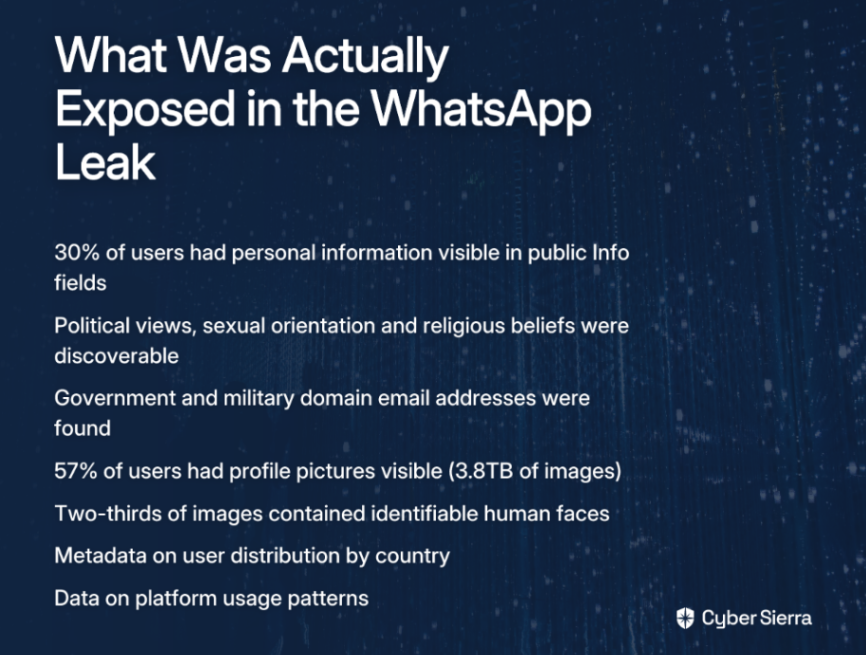
- Approximately 30% of users had personal information visible in their public "Info" field
- Researchers discovered explicit mentions of political views, sexual orientation, religious beliefs, and even confessions of drug use
- Most alarming for enterprise security: hyperlinks to social media and email addresses from highly sensitive domains were found, including
bund.de(German federal government),state.gov(U.S. State Department), andmil(U.S. military domains)
This transforms what might appear to be a consumer app leak into a potential national security and corporate espionage issue—especially for organizations whose employees use WhatsApp for work-related communications.
The Profile Picture Goldmine
- 57% of users had uploaded profile pictures visible to everyone, resulting in a staggering 3.8 terabytes of retrieved images
- Two-thirds of these images contained identifiable human faces
- This creates an unprecedented dataset for facial recognition, doxxing, and the creation of sophisticated deepfakes that could be used in targeted social engineering attacks against your organization
Strategic Intelligence for Threat Actors
The leak also exposed valuable metadata including:
- User distribution by country (including 2.3 million active accounts in China and 60 million in Iran, where the service is officially banned)
- Platform usage patterns (Android vs. iOS)
- Business account data
This information allows threat actors to build geographically and technologically targeted campaigns, potentially focusing on regions or device types where your organization has the strongest presence.
The Fallout: How a Consumer App Leak Becomes a Corporate Threat Vector
While users across social media platforms like Reddit express concerns about receiving "WhatSpam" or "WhatSmishing" messages, the implications for your organization extend far beyond nuisance communications.
The Fuel for Hyper-Targeted Phishing and SMShing
With the leaked data, threat actors can now move beyond generic phishing attempts to create highly convincing targeted attacks:
- Consider this scenario: An attacker now has your employee's phone number, their face from their profile picture, and potentially their political views or other personal details from their "Info" field
- Armed with this information, they can craft personalized SMShing attacks designed specifically to harvest corporate credentials
- This capability becomes even more concerning in light of recent findings that hundreds of U.S. Department of Defense credentials were found for sale on the dark web, some with active session cookies that could bypass multi-factor authentication, as reported by CSHub.com
The WhatsApp data essentially provides the perfect entry point for such sophisticated social engineering attacks against your organization.
The Phone Number as a Failing Security Anchor
This leak highlights a critical vulnerability in modern security architecture:
- Phone numbers are frequently used as identity anchors for password resets and two-factor authentication
- The comprehensive nature of this leak makes large-scale attacks on these systems significantly more feasible
- The situation grows even more complex with the rise of eSIM technology. According to USENIX research on eSIM security, GSMA projects that 50% of smartphones will be eSIM-enabled by 2028
- These digital provisioning methods introduce new risks like phishing and spoofing that CISOs must factor into their mobile security strategy
The Blurring Lines of BYOD (Bring Your Own Device)
With the boundaries between personal and professional device usage becoming increasingly blurred:
- An attack on an employee's personal WhatsApp is effectively an attack on your corporate perimeter
- The security of employee-owned devices that access corporate resources must now be treated as a top priority in your security strategy
- Despite end-to-end encryption of messages, the exposed metadata and profile information create numerous attack vectors
As one Reddit user accurately noted, "Whoever gets your data will harness information from your contacts and send them phishing and SMShing messages, trying to steal their payment information." In a corporate context, these attacks are likely to target business credentials and access to sensitive systems.
The CISO's Strategic Imperative: A Shift to Proactive Containment
In light of this unprecedented data leak, CISOs must adapt their security approach. The traditional focus on prevention—while still important—is insufficient. As highlighted in CSOOnline's analysis, modern CISOs must pivot from total prevention to effective containment and rapid response.
Embrace the "Breach is Inevitable" Mindset
The WhatsApp leak is an external event that you couldn't have prevented, but its internal impact can and must be managed:
- Accept that your corporate security posture must account for the fact that employees' personal information is now accessible to threat actors
- Shift resources from pure prevention to detection, containment, and response capabilities
- Develop specific playbooks for addressing social engineering attacks that leverage personal WhatsApp data
Implement a Zero Trust Architecture
Zero Trust validates trust at every layer of access, not just the perimeter. This approach assumes an employee's device or credentials will be compromised via a phishing attack stemming from this leak:
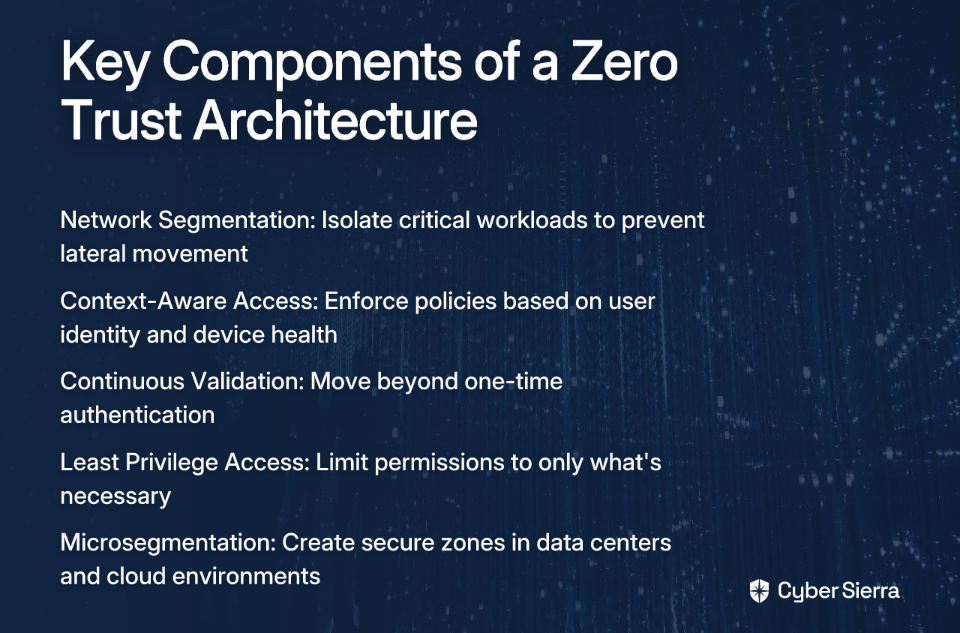
- Network Segmentation: Isolate critical workloads to prevent lateral movement if initial defenses are breached. Over 70% of successful breaches involve lateral movement techniques—the goal is to ensure a breach in one "compartment" doesn't sink the entire ship
- Context-Aware Access: Enforce policies based on user identity, device health, location, and other signals to continuously validate access requests. This is particularly important when phone numbers (now widely exposed) are used as authentication factors
- Continuous Validation: Move beyond one-time authentication to systems that continuously verify legitimacy throughout a session
For a deeper understanding of Zero Trust implementation, see CSO Online's comprehensive guide.
Revamp Security Awareness Training
One of the CISO's core responsibilities is education, as highlighted by Elastic's guide on the CISO role. The WhatsApp leak creates a perfect opportunity to make security training more relevant and impactful:
- Move beyond generic phishing warnings
- Use the WhatsApp leak as a specific, relatable case study in training materials
- Show employees exactly how their public WhatsApp profile could be weaponized to create a convincing fake email or text message from HR or IT
- Develop and share clear guidelines on what information employees should remove from their WhatsApp profiles
Pre-Emptive Collaboration with Legal Counsel
As emphasized in the Spencer Fane cybersecurity roundtable, the relationship between the CISO and general counsel must be established before an incident occurs:
- Schedule discussions with your legal team to address questions like:
- What are the company's disclosure obligations if a breach is traced back to an employee compromised via this leak?
- What are the GDPR implications if employees used their work numbers on WhatsApp?
- How should the company respond to attacks leveraging this leaked data?
Conclusion: From Threat Intelligence to Corporate Resilience
The 3.5 billion WhatsApp account leak is a landmark event that fundamentally changes the threat landscape. It's not a distant problem for a social media giant—it's an immediate source of actionable intelligence for threat actors targeting your organization.
As a CISO, your role is to translate this intelligence into a robust, forward-looking security strategy. This means championing a shift towards containment, operationalizing Zero Trust principles, and fostering a culture of hyper-awareness among employees.
Use this event as a catalyst to review and stress-test your incident response plans, re-evaluate your mobile device security policies, and strengthen the critical partnership between security, IT, and legal teams. While many users may dismiss this as "just a phone book being leaked," the reality is far more complex and dangerous. Understanding and preparing for the true implications of this data leak is now an essential component of corporate security resilience.
Frequently Asked Questions
What information was exposed in the 3.5 billion WhatsApp account leak?
The leak exposed the entire WhatsApp user directory, not just phone numbers. This includes public profile information from "Info" fields (found in 30% of users), 3.8 terabytes of profile pictures (57% of users), and valuable metadata on user distribution by country and platform usage (Android vs. iOS). This rich dataset provides a comprehensive toolkit for attackers.
How does a consumer app leak like WhatsApp threaten corporate security?
This leak directly threatens corporate security by arming attackers with personal data to create hyper-targeted phishing and SMShing attacks against your employees. By leveraging an employee's phone number, face, and personal details, attackers can craft highly convincing messages designed to steal corporate credentials, bypass multi-factor authentication, and gain access to your network.
Why is this WhatsApp leak more dangerous than a simple phone number list?
This leak is significantly more dangerous because it combines phone numbers with a trove of contextual personal data. Unlike a simple list, it includes profile pictures (enabling facial recognition and deepfakes), self-disclosed PII in "Info" fields (political views, religious beliefs, even work emails), and usage patterns. This combination allows threat actors to move from generic spam to sophisticated, personalized social engineering campaigns.
What are the most important immediate steps a CISO should take?
A CISO should immediately prioritize three actions: First, revamp security awareness training to use this leak as a real-world example of how personal data can be weaponized against the company. Second, accelerate the implementation of a Zero Trust architecture to contain breaches when they occur. Third, conduct a thorough review of all authentication processes that rely on phone numbers, as they are now a compromised security anchor.
How does a Zero Trust architecture help mitigate risks from this leak?
A Zero Trust architecture mitigates these risks by operating on a "never trust, always verify" principle. It assumes an attacker will successfully compromise an employee's device or credentials via a phishing attack stemming from this leak. By enforcing strict network segmentation, context-aware access, and continuous validation, Zero Trust contains the breach, preventing an attacker from moving laterally across your network to access critical assets.
Are we still at risk if our company policy prohibits using WhatsApp for business?
Yes, your organization remains at significant risk even if WhatsApp is not used for work. The threat vector is not official communication but the weaponization of employees' personal data. Attackers will use the leaked information from an employee's personal WhatsApp account to craft attacks targeting their corporate identity, such as sending a convincing fake message from "IT" to their phone to harvest their work login credentials.