



How to Build a Continuous Compliance Roadmap for 2026



Join thousands of professionals and get the latest insight on Compliance & Cybersecurity.
You're all too familiar with the scene: the panicked scramble two weeks before an audit. The frantic hunt for documentation. The discovery of security gaps that should have been addressed months ago. The growing mountain of technical debt that keeps you awake at night.
If you're nodding in recognition, you're not alone. As compliance requirements grow increasingly complex and cloud environments expand, the traditional "point-in-time" approach to compliance is breaking under its own weight.
The solution? Continuous compliance - a strategic shift from periodic, reactive audits to proactive, real-time, and automated monitoring that makes compliance an ongoing part of daily operations.
This article provides a clear, actionable 7-step roadmap to help your organization build a mature continuous compliance program by 2026. The urgency is real: non-compliance penalties cost organizations approximately 2.7 times more than maintaining compliance.
The Inevitable Shift: Why Continuous Compliance is No Longer Optional
The Driving Forces
Several factors are accelerating the move toward continuous compliance:
- Regulatory Complexity: The web of regulations like GDPR, HIPAA, SOC 2, and ISO 27001 continues to grow more intricate.
- Technological Acceleration: Rapid cloud adoption introduces new compliance challenges that manual processes simply can't handle.
- Sophisticated Cyber Threats: Evolving threats demand a proactive security posture rather than reactive measures.
The Business Case & Benefits
Continuous compliance delivers tangible benefits that directly address common pain points:
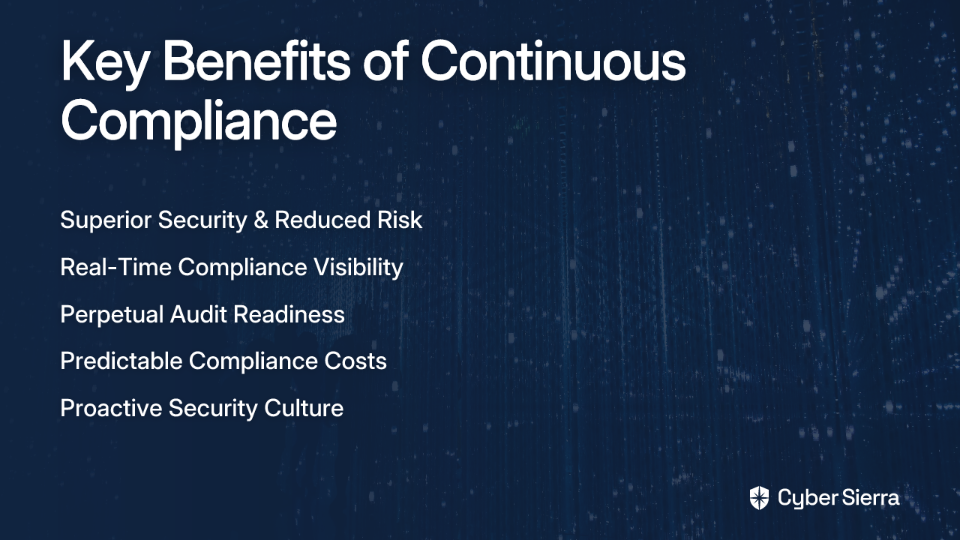
- Superior Security & Reduced Risk: Move beyond checkbox compliance to active policy enforcement, addressing constant worries about exposed assets.
- Real-Time Visibility: Gain an immediate understanding of your compliance status at any moment.
- Perpetual Audit Readiness: Eliminate fire drills by integrating compliance into daily workflows, creating the simplification and ease in audit reporting that teams desperately want.
- Predictable Costs: Address compliance issues as they arise, avoiding expensive emergency remediation and making resource planning more effective.
- Proactive Culture: Shift your organization's mindset from reactive to proactive, establishing a strong information security culture.
Your 7-Step Roadmap to Continuous Compliance for 2026
Step 1: Foundational Assessment & Goal Setting
Establish Culture First: Before implementing any tool or process, cultivate an organization-wide commitment to information security. As Kelsercorp emphasizes, a strong security culture forms the foundation for all compliance efforts.
Perform a Compliance Assessment: Identify all applicable regulations (e.g., SOC 2, ISO 27001, HIPAA) and conduct a thorough gap analysis to "surface all the messed up security debt that's been accumulating," as one IT professional candidly put it in a recent forum discussion.
Define Clear Objectives: Involve stakeholders from legal, IT, and business units to define goals for your GRC automation initiative and build a solid business case that resonates with leadership.
Step 2: Document, Plan, and Prioritize
Create the Roadmap: Document the gaps from your assessment and develop a prioritized plan with clear timelines and owners. This becomes your blueprint for the next two years.
Develop Policies and Processes: Update internal policies to align with regulatory standards. Crucially, establish a "robust change management policy and procedure" as recommended by cybersecurity professionals. This ensures that every change post-audit is documented, maintaining continuous compliance rather than point-in-time adherence.
Document Workflows: Create standardized processes for continuous monitoring, incident response, and internal audits that will serve as the operational backbone of your program.
Step 3: Implement the Right Tools & Technologies
Key Selection Criteria: When choosing a compliance automation tool, look for these five essential capabilities:
- Continuous Monitoring: For real-time status updates
- Audit Management: To streamline evidence collection
- Data Analysis: To detect patterns and risks
- Effective Risk Management: To assess and prioritize risks
- Automated Alerts and Remediation: To notify stakeholders of violations
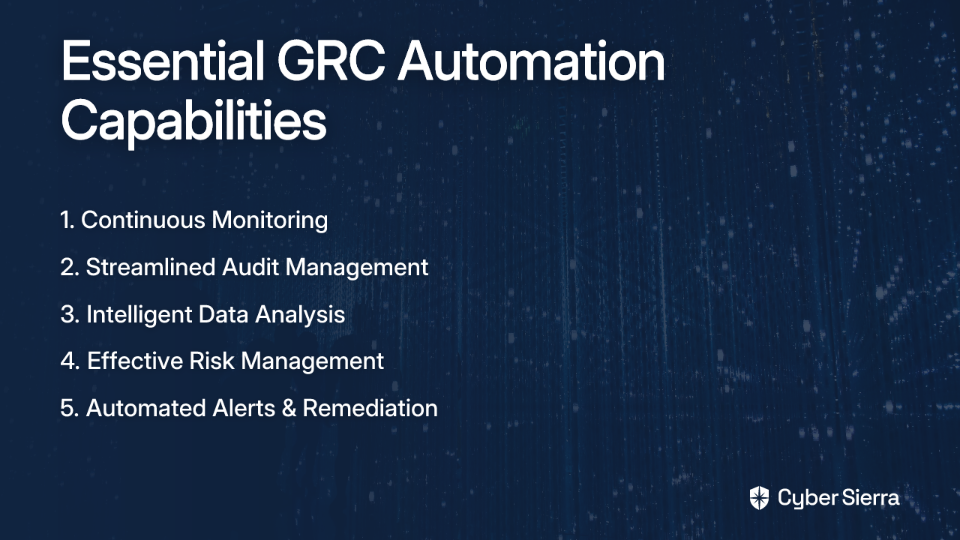
According to research from Zluri, these capabilities form the foundation of effective compliance automation.
Introduce GRC/CCM Platforms: This is where you centralize your efforts. Platforms like Cyber Sierra's Governance, Risk & Compliance (GRC) and Continuous Control Monitoring (CCM) modules automate data collection from your tech stack, build a central controls repository, and provide a single source of truth for your security posture across multiple frameworks, making you audit-ready at all times.
Step 4: Integrate and Automate GRC Processes
Configuration and Customization: Configure your chosen platform to fit your organization's specific needs, controls, and frameworks. Conduct pilot tests before a full rollout to ensure adoption.
Deep Integration: Ensure the technology integrates with your existing IT infrastructure, especially your cloud environments, to provide complete coverage of your digital assets.
Unlock Efficiency: Embrace the power of automation to transform compliance. As users have experienced, tasks that "took days now take minutes," freeing up your team for more strategic work rather than tedious documentation.
Step 5: Empower Your People: Training & Awareness
Address the Human Element: Technology alone isn't enough. Address the common pain of teams feeling unprepared by implementing a continuous training program that builds security awareness.
Conduct Regular Training: Ensure all employees understand their compliance responsibilities and stay current on the latest threats. Security is everyone's responsibility, not just the IT department's.
Fostering a security-conscious culture is a continuous effort. Solutions like Cyber Sierra's Employee Security Training help build this "human firewall" through interactive modules and simulated phishing campaigns that reinforce learning and measure your team's security quotient.
Step 6: Widen the Lens: Integrate Third-Party Risk Management (TPRM)
Why TPRM Matters: Your compliance boundary extends to your vendors. A data breach from a third party is still your problem. According to BlueVoyant, TPRM involves identifying, assessing, and controlling these supply chain risks that could impact your security posture.
Key TPRM Steps:
- Vendor Evaluation: Assess risks before onboarding new vendors
- Risk Tiering: Classify vendors by criticality to focus resources
- Continuous Monitoring: Move beyond point-in-time questionnaires to ongoing assessment of vendor security postures
Manually tracking hundreds of vendors is impossible. Modern Third-Party Risk Management (TPRM) platforms from providers like Cyber Sierra automate vendor assessments, provide 24/7 visibility into their security posture, and streamline the entire due diligence process.
Step 7: The Continuous Loop: Monitor, Improve, and Repeat
Establish a Feedback Loop: Use the data and reports from your GRC platform to evaluate the effectiveness of your compliance program and identify areas for improvement.
Conduct Regular Internal Audits: Proactively find and fix issues before external auditors do. This dramatically reduces audit stress and potential findings.
Continuously Improve: Compliance is not a "one-and-done" project. As Kelsercorp advises, you must "Repeat Steps 2-6" to adapt to new regulations, technologies, and threats. This creates a cycle of continuous improvement that addresses the "recurring compliance issues" that frustrate so many teams.
Navigating the Roadblocks: Overcoming Common Hurdles
Challenge 1: Lack of Management Support
This is consistently cited as a top frustration in user research. The solution? Build a strong business case. Use data on the high cost of non-compliance and the operational efficiencies gained through automation.
Highlight the growth of the GRC market—valued at USD 32.2 billion in 2021 with a projected 14.5% CAGR through 2030—to show it's a strategic imperative, not just a cost center.
Challenge 2: Organizational Silos
GRC is a team sport, yet many organizations struggle with departmental silos. The solution? Emphasize that effective GRC requires cross-departmental collaboration between IT, security, legal, and procurement. Your GRC platform should serve as the central hub for this collaboration, breaking down information barriers.
Challenge 3: Skepticism About New Tools
Security professionals are understandably wary of tools that promise more than they deliver. Address this pain point by starting with a pilot program or a comprehensive demo to prove the tool's value and build trust. Let the results speak for themselves.
Conclusion: From Compliance Chaos to Continuous Confidence
Building a continuous compliance roadmap for 2026 is more than a technical project—it's a strategic journey toward business resilience. By following the seven-step roadmap outlined here, you can transform compliance from a source of stress and risk into a competitive advantage that enables trust and growth.
Getting started on your 2026 roadmap today will save you from the fire drills of tomorrow. With the right strategy and a unified platform, achieving continuous compliance is within reach.
Platforms like Cyber Sierra are designed to simplify this journey by integrating GRC, Continuous Control Monitoring, TPRM, and Threat Intelligence into a single, automated system.
The result? A resilient, audit-ready organization where compliance becomes a business enabler rather than a burden.
Frequently Asked Questions
What is continuous compliance?
Continuous compliance is a proactive approach where organizations continuously monitor, assess, and enforce compliance with regulatory and security standards in real-time. Instead of treating compliance as a periodic event (like an annual audit), it integrates automated checks and controls directly into daily operations, ensuring the organization remains audit-ready at all times.
Why is continuous compliance important?
Continuous compliance is important because it significantly reduces security risks, lowers the high cost of non-compliance, and eliminates the stress of last-minute audit preparation. By providing real-time visibility into your security posture, it allows you to address issues as they arise, maintain perpetual audit readiness, and foster a proactive security culture. This approach turns compliance from a reactive burden into a strategic business advantage.
What are the first steps to starting a continuous compliance program?
The first steps to starting a continuous compliance program are to perform a foundational assessment and set clear goals. This involves identifying all applicable regulations (like SOC 2, HIPAA, or ISO 27001), conducting a gap analysis to understand your current security posture, and defining clear objectives with key stakeholders from legal, IT, and business departments.
How is continuous compliance different from a traditional audit?
Continuous compliance is an ongoing, proactive process, while a traditional audit is a reactive, "point-in-time" assessment. Traditional audits provide a snapshot of your compliance status on a specific date, often leading to frantic preparation and leaving security gaps unaddressed between audits. Continuous compliance embeds monitoring and policy enforcement into daily workflows, providing constant visibility and ensuring you are always prepared for an audit.
What kind of tools do I need for continuous compliance?
To effectively implement continuous compliance, you need specialized tools like Governance, Risk & Compliance (GRC) and Continuous Control Monitoring (CCM) platforms. These tools automate evidence collection, centralize control management, and provide real-time alerts. Key features to look for include continuous monitoring, audit management, risk assessment, and automated remediation capabilities.
How does continuous compliance help with third-party vendor risk?
Continuous compliance extends to your supply chain by integrating Third-Party Risk Management (TPRM). Instead of relying on static, point-in-time vendor questionnaires, a continuous approach involves ongoing monitoring of your vendors' security postures. This allows you to identify and mitigate risks from third parties in real-time, protecting your organization from breaches originating within your supply chain.
