



How to Use Telemetry and Log-Data for Real-Time Control Validation



Join thousands of professionals and get the latest insight on Compliance & Cybersecurity.
Summary
- Traditional control validation relies on manual, point-in-time checks that are ineffective in modern, dynamic environments, leaving security gaps undetected for weeks or months.
- Effective validation combines telemetry data (the 'what') with log data (the 'why') to achieve continuous, real-time visibility into control effectiveness.
- Organizations can start by implementing a five-step framework: define objectives, collect data, centralize it, analyze for failures, and automate remediation.
- Automating this process with a Continuous Control Monitoring (CCM) platform transforms compliance from periodic audits into a state of continuous assurance.
You've spent months building your security controls framework. Your team has carefully mapped compliance requirements, implemented technical controls, and designed a robust security program. But now you're drowning in the reality: your security controls are only as good as your ability to verify they're working—all the time, not just during quarterly audits.
When you check your systems, you discover firewall rules that mysteriously changed last week, MFA exceptions that were quietly granted to executives, and cloud misconfigurations that have left sensitive data exposed for who knows how long. Sound familiar?
The struggle is real. As one engineering leader put it: "I spent more time fighting our monitoring systems than building features. It just fell apart at scale—brokers kept crashing, lost data everywhere." Their frustration reflects the breaking point many security and compliance teams face with traditional control validation approaches.
There's a better way: using telemetry and log data to enable real-time control validation. This approach transforms security from periodic, manual checks to automated, continuous monitoring—giving you confidence that your controls are working exactly as designed, all the time.
The Breaking Point: Why Traditional Control Validation Fails
Traditional control validation is fundamentally flawed in today's dynamic environments:
- Point-in-time snapshots become instantly outdated: Manual checks only verify controls at specific moments. A control could fail minutes after your audit and remain broken for weeks or months before detection.
- Complex environments overwhelm manual processes: As one IT manager lamented about their monitoring system, "management became a full-time job, needed way more hardware than budgeted, and configuration issues between sites meant I spent more time fighting it than building features."
- Connectivity challenges create blind spots: Particularly in distributed environments, unreliable connectivity means that cloud-dependent validation approaches are inherently fragile. As one factory engineer bluntly put it: "factory internet sucks."
- Scale breaks conventional approaches: What works for validating 10 controls often collapses when scaled to hundreds or thousands. Tools like Kafka that seem promising initially can become overwhelming as you grow.
These challenges have pushed organizations to seek more reliable approaches, with one engineering team noting they "went way simpler—didn't need maximum speed, just reliable data collection with minimal babysitting that handles network failures."

The Building Blocks: Understanding Telemetry and Log Data
To build an effective real-time control validation system, you need to understand the two essential data streams that power it:
Telemetry Data: The "What" of Your Systems
Telemetry is the automatic collection and transmission of data from remote sources. It tells you what is happening in your environment in near real-time.
Key types of telemetry data include:
- IT Infrastructure Telemetry: CPU usage, memory utilization, network traffic patterns
- Security Telemetry: Authentication attempts, access control decisions, configuration changes
- Application Telemetry: Transaction rates, response times, error rates
- Cloud Resource Telemetry: Resource provisioning, routing changes, storage access patterns
Log Data: The "Why" Behind System Behaviors
While telemetry tells you what's happening, logs provide the critical context of why something occurred. Logs are chronological, immutable records of discrete events with timestamps and contextual details.
For example, telemetry might show an unusual spike in data leaving your network (the what), while logs reveal that a terminated employee's account accessed sensitive files at 2 AM (the why).
The Synergy: Complete Visibility
The magic happens when you combine these two data sources. Telemetry provides broad, continuous monitoring of your environment, while logs deliver the detailed context needed to understand specific events, investigate incidents, and validate control effectiveness.
Without both elements, you'll have blind spots in your control validation approach.
A Practical Framework for Real-Time Control Validation
Now let's walk through a step-by-step framework for implementing real-time control validation using telemetry and log data:
Step 1: Define Control Objectives and Data Requirements
Start by clearly defining what each control should accomplish and how you'll measure its effectiveness:
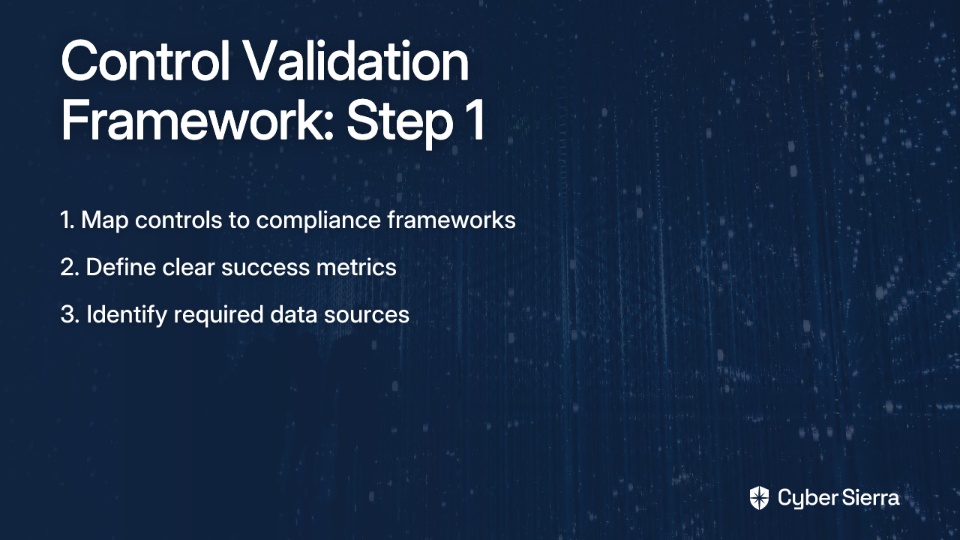
- Map controls to frameworks: Identify which controls map to specific compliance frameworks (NIST, ISO 27001, PCI DSS, etc.)
- Define success metrics: For each control, establish clear metrics that indicate proper functioning
- Identify data sources: Determine which systems generate the telemetry and logs needed to validate each control
For example, if validating an access control requiring MFA, you'll need authentication logs showing successful MFA completions and telemetry showing any MFA bypass attempts.
Step 2: Instrument Systems and Map Data Sources
Next, ensure your systems are properly configured to generate and collect the necessary data:
- Deploy collectors and agents: Install the necessary tools to gather telemetry and logs from each system
- Configure proper logging levels: Ensure systems are set to record the right detail level without excessive noise
- Implement local buffering: As one engineer recommended, "devices should work independently and sync when they can, not depend on constant cloud" – this ensures data integrity even during connectivity issues
This phase addresses a common pain point expressed by an IT manager: "we needed something that saves data so we don't lose anything when connections drop."
Step 3: Centralize, Store, and Process Data
Once collected, data needs a central repository where it can be analyzed:
- Select appropriate platforms: Choose tools that can handle your data volume and analysis needs
- For smaller environments: ELK Stack (Elasticsearch, Logstash, Kibana) or Graylog
- For enterprise scale: Splunk, Datadog, or specialized security platforms
- Implement data pipelines: Create reliable data flows from sources to your central platform
- Normalize and enrich data: Standardize formats and add context to make analysis more effective
Step 4: Analyze, Visualize, and Alert
This is where validation actually happens:
- Create baselines: Establish normal patterns for each control's telemetry
- Build dashboards: Develop visualizations showing control health at a glance
- Configure alerts: Set up notifications for potential control failures
- Correlate data sources: Connect telemetry anomalies with log events for complete context
For example, if your firewall rule telemetry shows an unexpected change, your system should automatically correlate this with change management logs to determine if this was authorized or potentially malicious.
Step 5: Remediate and Optimize
The final step closes the loop:
- Automate response workflows: Create predefined playbooks for common control failures
- Integrate with ticketing systems: Ensure alerts generate trackable tickets
- Document findings: Maintain auditable records of control validation
- Continuously improve: Use insights to refine controls and validation processes
The Evolution to Automation: Continuous Control Monitoring (CCM)
The framework above represents the foundation of what's now recognized as Continuous Control Monitoring (CCM) - a formalized approach that uses automation to continuously validate and verify that security controls are operating effectively.
CCM transforms security and compliance from periodic, reactive activities into a continuous, proactive state. It provides several key benefits:
- Near real-time visibility: Detect control failures as they happen, not weeks or months later
- Reduced audit fatigue: Automatically collect evidence instead of scrambling before audits
- Improved risk posture: Continuously verify controls align with frameworks like NIST, ISO 27001, PCI DSS, and HIPAA
- Enhanced decision-making: Provide stakeholders with accurate, current data about security posture
Implementing effective CCM requires specialized tools designed for this purpose. Platforms like Cyber Sierra's Continuous Control Monitoring module are specifically built to operationalize this approach, offering:
- A central controls repository with near real-time updates
- Automated control testing and validation across multiple frameworks
- Exception and anomaly detection with actionable insights
- Streamlined evidence collection for audits
As one user who adopted such an approach noted, "it handles 500 machines without drama," a stark contrast to their previous experience where systems "fell apart at scale."
The Future is Intelligent: Leveraging AI for Predictive Compliance
While real-time control validation through telemetry and logs represents a significant advancement, the future lies in predictive compliance powered by artificial intelligence.
How AI Transforms Control Validation
AI and machine learning add powerful capabilities to control validation:
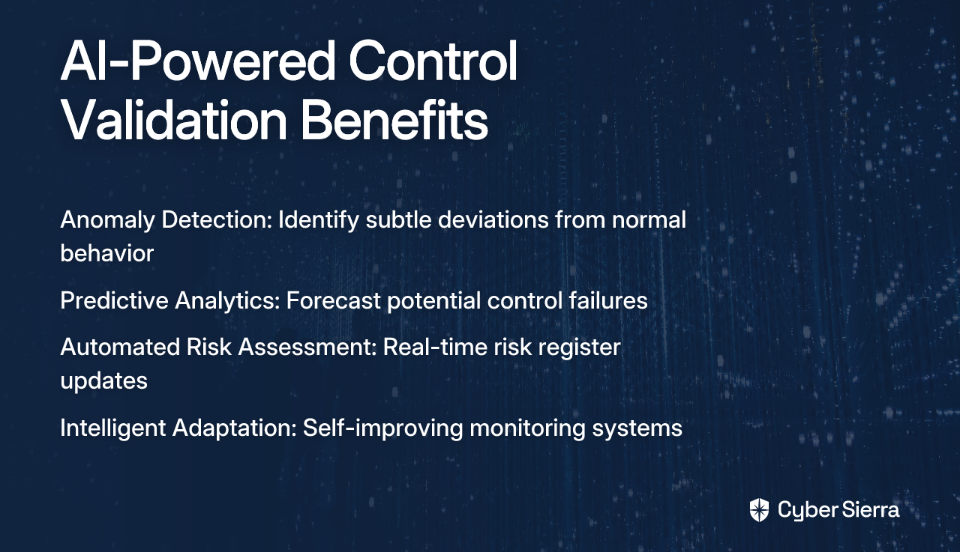
- Anomaly Detection: Advanced algorithms establish baselines of normal behavior and automatically identify subtle deviations that might indicate control failures or security incidents.
- Predictive Analytics: By analyzing historical patterns, AI can forecast potential control failures before they occur, enabling truly proactive security.
- Automated Risk Assessment: Machine learning can automatically map telemetry data to specific controls, assess their effectiveness, and update risk registers in real-time.
- Intelligent Adaptation: AI systems can learn from past incidents and automatically adjust monitoring parameters to improve detection.
According to Gartner, "by 2026, over 70% of companies will require vendors to provide transparency regarding the AI they use for compliance." This underscores the growing importance of AI in the compliance landscape.
Considerations for AI Implementation
When incorporating AI into your control validation strategy:
- Start small: Begin with well-defined use cases before expanding
- Maintain human oversight: AI should augment, not replace, human judgment
- Address bias: Ensure training data represents diverse scenarios
- Secure the AI systems: The tools themselves must be protected from manipulation
Conclusion: From Manual Checks to Continuous Assurance
The era of point-in-time control validation is over. Organizations that continue to rely on manual, periodic checks face increasing risk as the gap between validation points creates dangerous blind spots.
By implementing a comprehensive approach that leverages telemetry and log data, you can transform control validation from a periodic activity into a continuous state of assurance. The key steps we've outlined—defining objectives, instrumenting systems, centralizing data, analyzing results, and remediating issues—provide a practical roadmap for this journey.
For organizations seeking to accelerate this transition, platforms like Cyber Sierra offer integrated solutions that simplify the implementation of Continuous Control Monitoring. These tools help automate the complex work of collecting, analyzing, and responding to control validation data across multiple compliance frameworks.
The ultimate goal is to create a security and compliance program that doesn't just pass audits but continuously ensures your controls are working as designed—protecting your organization every minute of every day, not just when auditors are looking.
By embracing this data-driven approach to control validation, you move from merely checking compliance boxes to creating genuine, ongoing security assurance. And in today's threat landscape, that difference could determine whether your security controls actually protect you when it matters most.
Frequently Asked Questions
What is real-time control validation?
Real-time control validation is the process of using automated systems to continuously monitor telemetry and log data to ensure security controls are functioning correctly at all times, rather than only during periodic audits. This approach transforms security from manual, point-in-time checks into a proactive, ongoing process. By analyzing data streams from IT infrastructure, security tools, and applications, organizations can detect control failures, misconfigurations, or unauthorized changes as they happen, significantly reducing the window of exposure.
Why is traditional control validation failing in modern environments?
Traditional control validation fails because its manual, point-in-time nature cannot keep up with the complexity, scale, and dynamic pace of modern IT environments. These methods provide snapshots that become instantly outdated, are overwhelmed by the sheer number of controls in complex systems, create blind spots due to connectivity issues in distributed environments, and ultimately break down when scaled to hundreds or thousands of controls. This leads to undetected vulnerabilities and a reactive security posture.
What is the difference between telemetry and log data?
Telemetry data tells you what is happening in your systems in near real-time (e.g., CPU usage, network traffic), while log data provides the contextual why behind those events (e.g., a user login record, an error message). For effective control validation, you need both. Telemetry offers a continuous, high-level view of system health and performance, allowing for broad monitoring. Logs provide the detailed, chronological records of specific events needed to investigate anomalies, confirm control actions (like an MFA success), and prove compliance.
How can my organization start with real-time control validation?
Your organization can start by following a structured, five-step framework: define control objectives, instrument systems to collect data, centralize and process that data, analyze it for anomalies, and create workflows to remediate issues. This process begins with mapping controls to compliance frameworks and identifying necessary data sources. Then, you deploy agents to collect telemetry and logs, sending them to a central platform like an ELK stack or Splunk. Finally, you build dashboards and alerts to monitor control health and establish automated responses to failures, closing the loop from detection to remediation.
What is Continuous Control Monitoring (CCM)?
Continuous Control Monitoring (CCM) is the formalized, technology-driven approach that automates the process of real-time control validation to continuously verify that security controls are effective. CCM platforms institutionalize the framework of collecting and analyzing data for control validation. They provide near real-time visibility into your security posture, reduce audit fatigue by automatically gathering evidence, and help align your operations with compliance frameworks like NIST, ISO 27001, and PCI DSS on an ongoing basis.
Looking to implement real-time control validation for your organization? Learn more about Cyber Sierra's Continuous Control Monitoring platform and how it can help automate your control validation process.
