Top 5 Cloud-Native GRC Platforms vs Legacy Solutions


Join thousands of professionals and get the latest insight on Compliance & Cybersecurity.
Summary
- Legacy GRC platforms are often 2-3 times more expensive than modern cloud-native solutions due to high total cost of ownership, manual processes, and lack of scalability.
- Cloud-native GRC shifts compliance from periodic audits to continuous, automated monitoring, which can improve efficiency by up to 62%.
- To successfully transition to a modern GRC platform, organizations must first evaluate and refine their internal compliance processes before selecting a new tool.
- Cybersierra's AI-enabled platform helps automate this transition with Continuous Control Monitoring (CCM) and streamlined GRC management to simplify audits and reduce compliance fatigue.
You've likely experienced it—spending countless hours manually collecting evidence for an audit, struggling with spreadsheets that grow more unwieldy by the day, or battling with a clunky legacy GRC platform that seems determined to make compliance as painful as possible. As one compliance manager aptly put it, "Tools can't fix poorly defined processes," but the right tools can certainly make good processes work more efficiently.
In today's rapidly evolving regulatory landscape, legacy Governance, Risk, and Compliance (GRC) solutions are becoming increasingly obsolete. The modern enterprise needs something more agile, automated, and intelligent to keep pace with expanding regulations and sophisticated cyber threats.
This is where cloud-native GRC platforms enter the picture, offering a fundamental shift from periodic, manual checks to continuous, automated monitoring. But what exactly separates these modern solutions from their legacy counterparts, and which platforms are leading the charge?
In this article, we'll explore the key differences between legacy and cloud-native GRC platforms, showcase five leading solutions that are transforming how businesses approach risk and compliance, and provide practical guidance for making the transition.
The Great Divide: Why Legacy GRC Can't Keep Up
Before diving into specific platforms, it's important to understand what makes cloud-native GRC solutions so different from their legacy predecessors.
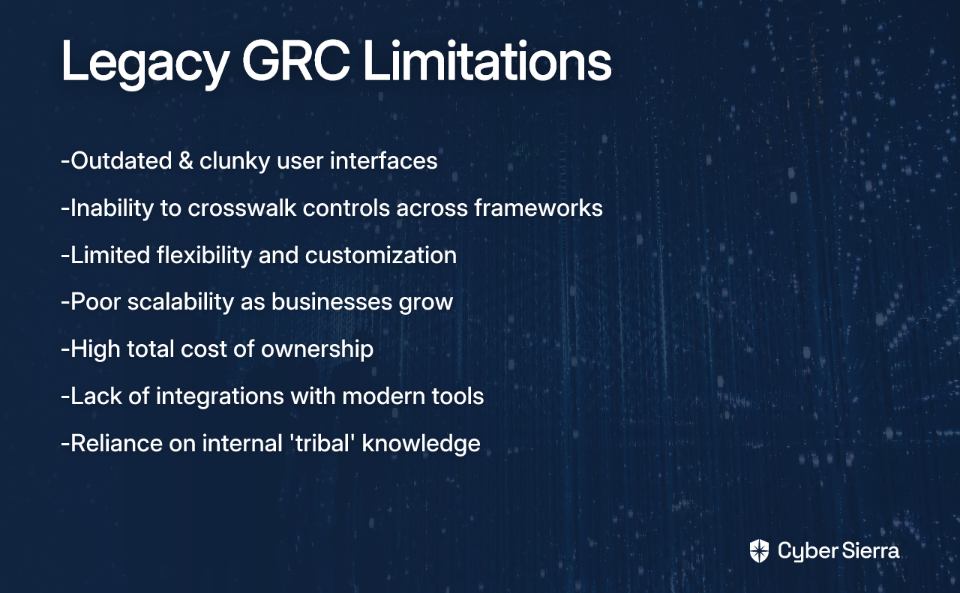
Common Challenges with Legacy GRC Solutions:
- Outdated & Clunky User Interfaces: Legacy GRC platforms often feature interfaces that feel like they're from another era. This poor UX hinders productivity and discourages user adoption across the organization. According to Hyperproof, many legacy systems require specialized knowledge just to navigate basic functions.
- Inability to Crosswalk Controls: When you're managing multiple compliance frameworks (SOC 2, ISO 27001, GDPR, etc.), legacy systems typically require manual mapping of controls across frameworks. This creates duplicate work and increases the risk of inconsistencies.
- Limited Flexibility and Customization: As Reddit users have noted, rigid templates from legacy GRC tools often fail to accommodate unique organizational needs, forcing businesses to adapt their processes to the tool rather than the other way around.
- Lack of Scalability: Legacy GRC systems struggle to grow with the business, making it difficult to add new users, incorporate additional frameworks, or expand into new markets or business units.
- Higher Total Cost of Ownership (TCO): On-premise legacy systems typically come with hefty upfront licensing fees plus ongoing costs for maintenance, upgrades, and specialized IT support. According to G2, these hidden costs can make legacy systems 2-3 times more expensive than their cloud-native counterparts over a five-year period.
- Lack of Integrations: Legacy platforms often create data silos by failing to connect with other essential business tools, such as cloud environments, security technologies, and business applications.
- Reliance on Internal "Tribal" Knowledge: Many legacy systems become dependent on the knowledge of a few key individuals, creating significant risk if those employees leave the organization. Hyperproof notes that this "tribal knowledge" problem makes it difficult to maintain continuity in compliance programs.
The Cloud-Native Advantage: Addressing Legacy Limitations
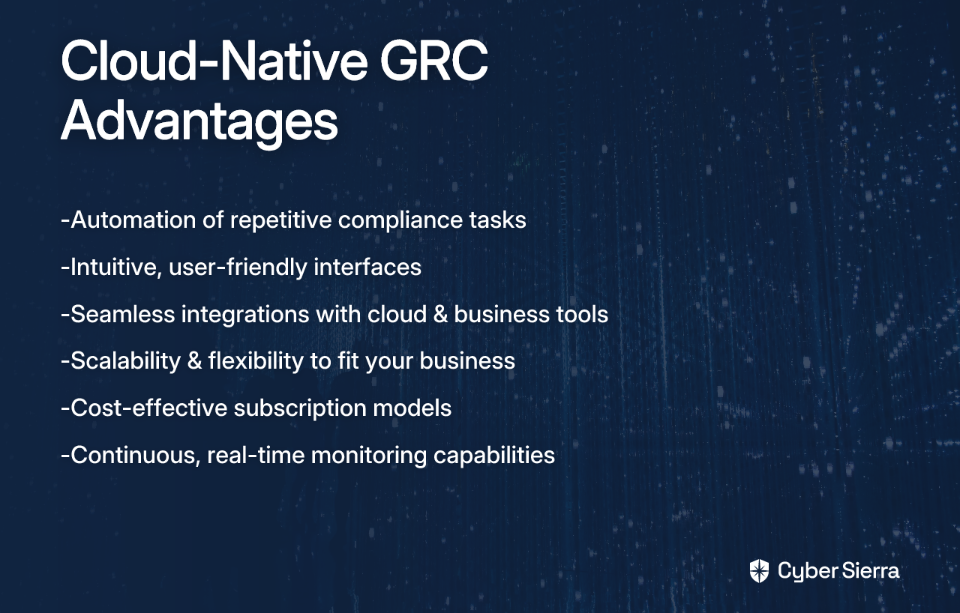
In contrast to these challenges, cloud-native GRC platforms offer several distinct advantages:
- Automation: Modern platforms automate administrative and repetitive tasks like evidence collection, control testing, and reporting. Organizations using AI in GRC report up to a 62% improvement in compliance efficiency.
- Intuitive Interfaces: Cloud-native solutions are designed with usability in mind, enhancing productivity and reducing the training burden for new users.
- Seamless Integrations: They connect easily with cloud environments (AWS, Azure, GCP), security tools, and business applications, creating a single source of truth for compliance data.
- Scalability & Flexibility: Cloud-native platforms scale on demand and offer customization to fit specific business workflows, allowing them to grow with your organization.
- Cost-Effectiveness: Typically offered via a subscription model (SaaS), these platforms provide more predictable costs and lower initial investment, making them more accessible for startups and SMBs.
- Continuous Monitoring: Perhaps the most significant differentiator is the shift from point-in-time assessments to continuous, near real-time monitoring of controls and risks.
Top 5 Cloud-Native GRC Platforms for the Modern Enterprise
Now that we understand the advantages of cloud-native GRC, let's look at five leading platforms that exemplify these benefits:
1. Cybersierra
Overview: Cybersierra provides an AI-enabled cybersecurity platform designed to simplify and automate security compliance for enterprises. Recently recognized as a Sample Vendor in the 2024 Gartner® Hype Cycle™ for Cyber Risk Management for both Cyber GRC and Continuous Controls Monitoring (CCM).
Key Features & Modules:
- Continuous Control Monitoring (CCM): Provides ongoing, near real-time visibility into security controls across multiple frameworks (NIST, ISO 27001, PCI DSS, GDPR). It builds a central controls repository and automates testing to proactively fix security gaps.
- Governance, Risk & Compliance (GRC): Automates data collection, risk assessments, and reporting for frameworks like SOC2, ISO 27001, and HIPAA, making enterprises audit-ready faster.
- Third-Party Risk Management (TPRM): Simplifies vendor risk assessment by moving beyond static questionnaires to continuously monitor vendor security posture.
- Threat Intelligence: Offers an outside-in view of the attack surface with network and cloud vulnerability scanning to prioritize remediation.
- Integrated Add-ons: Employee Security Training and Cyber Insurance modules to address the human firewall and streamline insurance applications.
Who it's for: CISOs, Compliance Managers, and IT Managers looking to move from periodic checks to proactive, continuous risk management and reduce audit fatigue.
2. AuditBoard
Overview: A user-friendly platform focused on centralizing risk-related information for auditors and compliance teams.
Strengths:
- Praised for its intuitive interface and AI-powered dashboard for insights
- Strong integration capabilities with existing business systems like CRMs and ERPs
Potential Drawbacks:
- Users report that dashboard setup can be time-consuming
- Frequent automatic updates can sometimes be confusing for users
According to G2's research on GRC software, AuditBoard is particularly well-regarded for its collaborative features that facilitate communication between audit teams and business units.
3. Vanta
Overview: A leading compliance automation platform, particularly popular with startups and tech companies.
Strengths:
- Automates over 1,200 compliance checks and monitors 35+ frameworks
- Highly regarded for its user-friendly interface and powerful automation for achieving certifications like SOC 2 and ISO 27001
Potential Drawbacks:
- Can be priced high for very early-stage startups
- Some users report that certain integrations lack depth
4. LogicGate (now part of Riskonnect)
Overview: A flexible GRC platform known for its customizable workflows.
Strengths:
- Highly adaptable to unique business needs and regulatory requirements
- Streamlines workflows for risk and compliance management with no-code automation
User Feedback: Praised for its flexibility, as noted in user forums: "We've recently transitioned from Archer to LogicGate risk cloud... it's very flexible and the dashboards are nice."
5. ServiceNow GRC
Overview: Integrates GRC functions directly into its widely used IT Service Management (ITSM) platform.
Strengths:
- Excellent for enterprises already invested in the ServiceNow ecosystem
- Provides real-time reporting and unifies risk data across IT and business functions
- Enhances decision-making by correlating risk data with business processes (Source)
Who it's for: Larger enterprises looking for a single platform to manage IT operations and GRC, particularly those who already use ServiceNow for other functions.
Making the Switch: A Practical Guide to Transitioning
As one Reddit user aptly noted, "Transitioning to a new GRC platform can be challenging without good processes defined." This sentiment echoes a common challenge: even the best GRC tool can't fix a broken process.
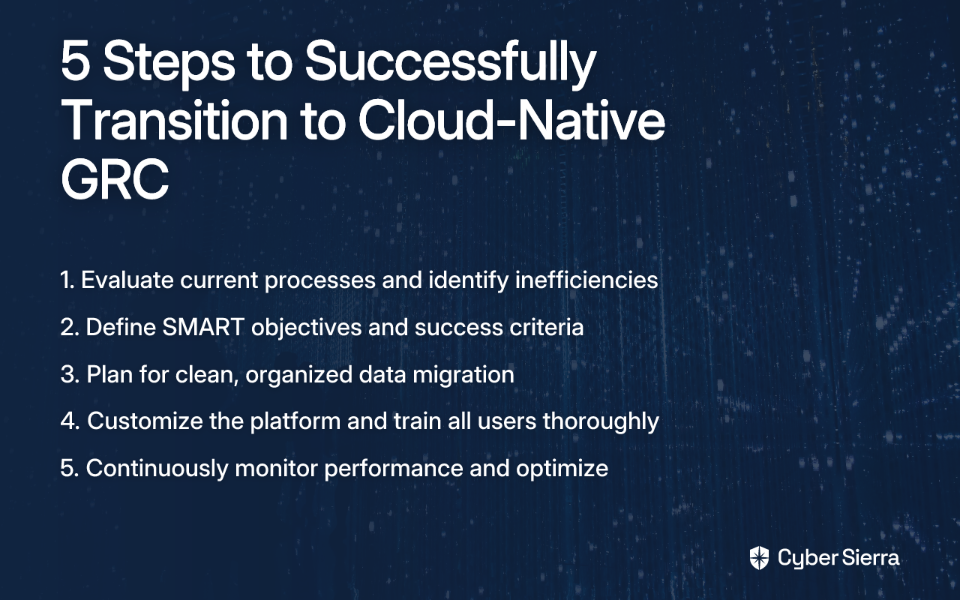
Here's a step-by-step plan for a successful transition from legacy to cloud-native GRC, based on best practices from Hyperproof:
- Evaluate Current Processes: Before choosing a tool, map your existing workflows. Identify bottlenecks, manual touchpoints, and areas of inefficiency. Remember that a tool is only as good as the process it supports.
- Define Objectives and Success Criteria: Use the SMART goals framework to set clear targets. Example: "Reduce audit evidence collection time by 40% within six months."
- Plan for Data Migration: Ensure a clean and complete transfer of data. This involves cleaning and organizing data before uploading to eliminate duplicates and standardize formats.
- Customize and Train: Configure the new platform to meet your specific needs. Provide comprehensive, tailored training to all users to ensure adoption and effective use.
- Continuously Monitor and Optimize: Post-implementation, regularly track performance metrics and gather user feedback to fine-tune the platform and processes.
Conclusion
The era of manual, spreadsheet-based GRC and clunky legacy systems is drawing to a close. Modern cloud-native platforms offer the automation, integration, and continuous monitoring capabilities needed to manage today's complex risk and compliance landscape effectively.
By transitioning to a cloud-native GRC solution, organizations can transform compliance from a periodic, resource-intensive burden into a continuous, strategic function that provides real-time visibility into risk posture.
Whether you choose Cybersierra for its AI-enabled continuous monitoring, AuditBoard for its user-friendly interface, Vanta for its compliance automation, LogicGate for its flexibility, or ServiceNow for its integrated approach, the key is to select a platform that aligns with your specific business needs and processes.
Remember that even the best platform is only as effective as the processes it supports. Take the time to evaluate and optimize your GRC processes before implementation, and you'll be well on your way to a more efficient, effective compliance program.
As regulatory requirements continue to evolve and cyber threats grow more sophisticated, the organizations that thrive will be those that leverage modern GRC platforms to stay ahead of risks and turn compliance into a competitive advantage.
Frequently Asked Questions
What is a cloud-native GRC platform?
A cloud-native GRC platform is a software-as-a-service (SaaS) solution designed specifically for modern cloud environments. Unlike legacy on-premise systems, it leverages the cloud to provide continuous monitoring, automation, and scalability for managing governance, risk, and compliance. These platforms integrate directly with your cloud infrastructure (like AWS, Azure, GCP) and business applications to automate evidence collection and provide real-time visibility into your compliance posture.
Why should my organization switch from a legacy GRC system?
Your organization should switch from a legacy GRC system to improve efficiency, gain real-time risk visibility, and lower the total cost of ownership. Legacy systems are often characterized by manual processes, clunky interfaces, and data silos, leading to audit fatigue and a reactive security posture. Cloud-native platforms solve these issues by automating repetitive tasks, providing seamless integrations, and enabling continuous control monitoring, which turns compliance into a strategic, proactive function.
How does a cloud-native GRC tool automate compliance?
A cloud-native GRC tool automates compliance by connecting directly to your tech stack via APIs. It continuously pulls data from your cloud providers, security tools, and HR systems to automatically gather evidence for controls. For example, instead of manually taking screenshots of firewall configurations, the tool can automatically verify the settings against your compliance requirements (like SOC 2 or ISO 27001) and flag any deviations, saving hundreds of hours of manual work.
What is Continuous Control Monitoring (CCM) and why is it important?
Continuous Control Monitoring (CCM) is an automated process that continuously tests and validates the effectiveness of your security controls in near real-time. It is important because it replaces periodic, point-in-time audits with an ongoing assessment of your compliance and security posture. This proactive approach allows you to identify and remediate control gaps as they occur, rather than discovering them months later during an audit, significantly reducing your risk exposure.
How do I choose the right cloud-native GRC platform for my business?
To choose the right cloud-native GRC platform, you should start by evaluating your organization's specific needs, existing processes, and required compliance frameworks (e.g., SOC 2, HIPAA, GDPR). Key factors to consider include the platform's integration capabilities with your current tech stack, its ease of use, its scalability to support future growth, and its ability to automate evidence collection for your key controls. Always request a personalized demo to see how the platform would work in your environment.
What is the typical implementation time for a cloud-native GRC solution?
The typical implementation time for a cloud-native GRC solution can range from a few weeks to a few months. The timeline depends on several factors, including the size and complexity of your organization, the number of compliance frameworks you need to manage, the quality of your existing data for migration, and the number of required integrations. Platforms designed for rapid deployment can often get you started with key frameworks like SOC 2 in under a month.