



Top 8 Ways to Streamline Compliance Across Multiple Frameworks (ISO, NIST, SOC 2)


Join thousands of professionals and get the latest insight on Compliance & Cybersecurity.
Summary
- With 70% of organizations now managing multiple compliance frameworks, static checklists create redundant work and fail to address evolving threats.
- An effective security program requires shifting from point-in-time "checklist compliance" to a continuous, risk-first approach that mitigates real-world vulnerabilities.
- Key strategies include mapping overlapping controls ("test once, comply many"), automating evidence collection, and implementing continuous monitoring to maintain constant readiness.
- A unified Governance, Risk & Compliance (GRC) platform streamlines these efforts, simplifying audits and making your organization perpetually audit-ready.
You've implemented the necessary controls. You've checked all the boxes. Your organization is technically "compliant" with ISO 27001, NIST, and SOC 2. Yet, that gnawing feeling of vulnerability persists.
As one security professional candidly shared, "I've seen friends' companies go down due to data breach—and yet they checked all the boxes..." This sentiment echoes across boardrooms and security teams worldwide: checklist compliance isn't enough.
The challenge is clear: every day, new vulnerabilities emerge, yet frameworks remain static. Managing multiple compliance frameworks has become increasingly burdensome, with 70% of service organizations in 2023 indicating they must comply with multiple frameworks. This creates redundant work, "audit fatigue," and stretches already limited resources thin.
The solution isn't more checkboxes—it's transforming compliance from a series of disconnected, manual tasks into an integrated, automated, and continuous process. Here are eight actionable strategies to streamline multi-framework compliance while actually strengthening your security posture.

1. Unify Your Approach with Control Mapping
Instead of tackling each framework in isolation, identify and map overlapping controls. Many requirements across ISO 27001, SOC 2, and NIST are conceptually identical.
How it works:
- Create a master set of controls for your organization
- Map each control to the specific requirements of each framework
- Implement a "test once, comply many" approach
For example, a single access control policy can simultaneously satisfy requirements in ISO 27001 (A.9.4.1), SOC 2 (CC6.1), and the NIST Cybersecurity Framework (PR.AC-4). This approach drastically reduces redundant evidence collection and testing efforts.
Modern GRC platforms now offer AI-assisted control mapping features that can automate this process, significantly reducing the manual effort involved in creating and maintaining these mappings.
2. Lead with a Risk-First Mentality
Move beyond the checklist. A robust compliance program should be a byproduct of a strong risk management strategy, not the other way around.
As one security professional noted, "Compliance is driven by checklists that were created with no knowledge of your environment." This disconnect is at the heart of why many compliant organizations still suffer breaches.
How to implement:
- Begin with a comprehensive risk assessment tailored to your specific operations, technology stack, and threat landscape
- Link every security control directly to identified risks
- Prioritize compliance efforts based on your highest-risk areas
This approach ensures your security investments actually mitigate real threats, transforming compliance from a costly obligation into a value-driven security initiative.
3. Implement Continuous Control Monitoring (CCM)
Replace periodic, manual checks with automated, real-time monitoring of your security controls. This addresses the point-in-time nature of traditional audits that leaves gaps between assessment periods.
Continuous Control Monitoring (CCM) is a proactive approach that uses technology for ongoing, automated oversight of controls to ensure they remain effective. Instead of scrambling before an audit, you maintain constant compliance readiness.
Key benefits include:
- Early threat detection through near real-time identification of irregular activities
- Improved compliance through ongoing reviews rather than point-in-time assessments
- Reduced risk of regulatory penalties through proactive risk mitigation
Platforms like Cyber Sierra's Continuous Control Monitoring (CCM) module provide this capability, building a central controls repository with near real-time updates and delivering actionable risk intelligence to transform security from a periodic chore to a continuous, automated process.
4. Embrace Intelligent Automation for Repetitive Tasks
Free your team from the manual drudgery of compliance tasks. According to industry research, companies that leverage automation report a 70% reduction in time spent on routine compliance tasks.
Areas prime for automation:
- Evidence collection: Automate gathering screenshots, logs, and configuration files required for audits
- Reporting: Implement tools with dynamic dashboards for real-time visibility into compliance status
- Workflows: Streamline internal approvals for policies and procedures
Automation doesn't replace human judgment—it enhances it by freeing your skilled personnel to focus on strategic security initiatives rather than repetitive documentation.
5. Centralize Policy, Procedure, and Evidence Management
Establish a single source of truth for all compliance-related documentation. Disorganized documentation leads to confusion, version control issues, and audit panic.
Implementation approach:
- Utilize a centralized document management system or GRC platform
- Ensure all teams access the most current, approved documentation
- Simplify audit preparation with readily accessible evidence
This centralization is particularly valuable for regulatory change management. When a framework gets updated (which happens frequently), you can quickly identify and update all affected policies and controls from one central location instead of hunting through disparate systems.
6. Integrate and Automate Third-Party Risk Management (TPRM)
Your compliance posture is only as strong as your weakest vendor. Managing this risk with spreadsheets and annual questionnaires is no longer sufficient in today's interconnected business environment.
Effective TPRM requires:
- Automated vendor assessment and onboarding processes
- Continuous monitoring of vendor security posture
- Integration of vendor risks into your overall security program
Your supply chain is part of your compliance boundary. A dedicated Third-Party Risk Management (TPRM) solution is essential. Cyber Sierra's platform, for example, provides 24/7 visibility into vendor compliance, automates risk assessments, and streamlines the entire vendor lifecycle, ensuring your partners don't become your biggest liability.
7. Foster a Proactive Security Culture
Technology is only part of the solution. As highlighted in security forums, "people are probably the better investment" than an over-reliance on tools. A security-aware workforce is your first line of defense against emerging threats that frameworks haven't yet addressed.
Actionable culture-building steps:
- Implement continuous training: Move beyond annual, check-the-box training to engaging, scenario-based learning
- Run phishing simulations: Regularly test employee awareness with realistic scenarios
- Encourage stakeholder collaboration: Involve IT, security, legal, and business leaders in compliance processes
This cultural approach addresses a fundamental gap in traditional compliance: the human element. When combined with technical controls, a security-conscious workforce creates a more resilient organization capable of adapting to threats faster than frameworks can evolve.
8. Consolidate Efforts with a Unified GRC Platform
The most effective way to implement the previous seven strategies is to bring them together under a single, integrated platform. A modern Governance, Risk, and Compliance (GRC) platform serves as the central nervous system for your compliance program.
A unified GRC platform connects:
- Control mapping and risk registers
- Continuous monitoring and evidence automation
- Policy management and vendor assessments
- Real-time reporting and audit trails
An AI-enabled platform like Cyber Sierra's Governance, Risk & Compliance (GRC) suite is designed to unify these disparate functions. By automating data collection, providing a single source of truth for controls across frameworks like SOC 2 and ISO 27001, and integrating with modules for threat intelligence and TPRM, it simplifies the entire compliance lifecycle, reduces audit fatigue, and makes your organization audit-ready, always.
Moving Beyond Checklist Compliance
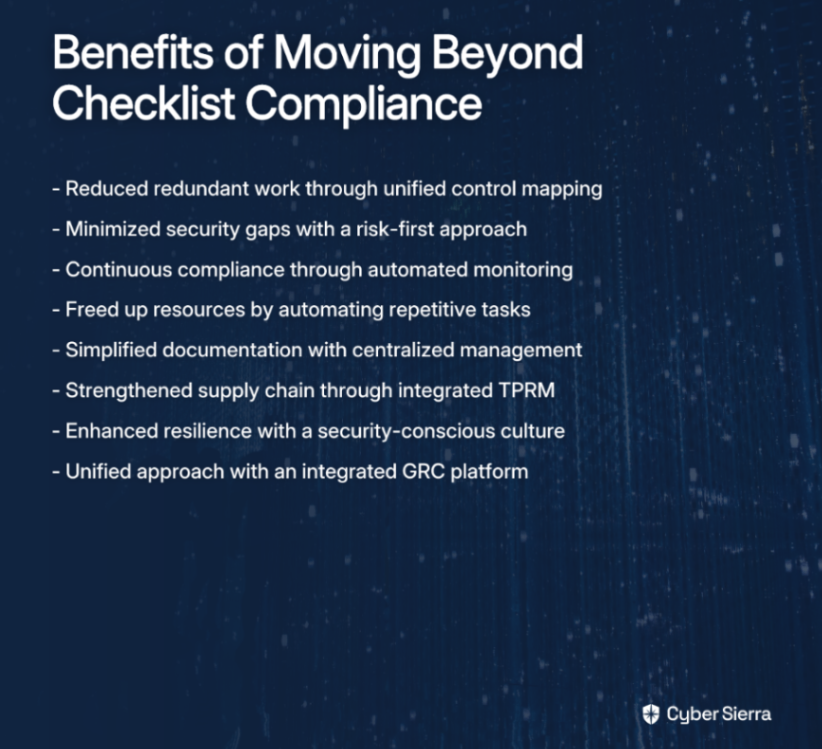
Streamlining compliance across multiple frameworks isn't just about efficiency—it's about building a more resilient and trustworthy organization. By implementing these eight strategies, you can:
- Reduce redundant work through unified control mapping
- Minimize security gaps with a risk-first approach
- Maintain continuous compliance through automated monitoring
- Free up valuable resources by automating repetitive tasks
- Simplify documentation with centralized management
- Strengthen your supply chain through integrated TPRM
- Build resilience with a security-conscious culture
- Unify your approach with an integrated GRC platform
The stakes couldn't be higher. With 89% of consumers prioritizing data privacy and expecting robust security programs from companies they do business with, compliance has become a competitive advantage, not just a regulatory requirement.
By moving beyond "checklist compliance," you create a robust security program that protects your data, builds customer confidence, and supports business growth—all while streamlining the complex demands of multiple frameworks.
Ready to transform your compliance program from a burden into a strategic advantage? Book a demo of Cyber Sierra to see how an AI-enabled, unified platform can streamline your efforts across ISO, NIST, SOC 2, and more.
Frequently Asked Questions
What is multi-framework compliance?
Multi-framework compliance refers to the process of adhering to the requirements of multiple security and privacy standards simultaneously, such as ISO 27001, SOC 2, NIST, and GDPR. This is often necessary for organizations that operate in different regions, serve diverse industries, or want to demonstrate a comprehensive security posture to various stakeholders.
Why is "checklist compliance" considered insufficient for security?
Checklist compliance is often insufficient because it represents a static, point-in-time assessment against a generic set of rules, which may not address an organization's specific risks or the latest evolving threats. A truly effective security program goes beyond checking boxes by adopting a risk-first mentality, enabling continuous monitoring, and fostering a proactive security culture to build genuine resilience.
How can I start simplifying compliance across multiple frameworks like ISO 27001 and SOC 2?
The best way to start simplifying multi-framework compliance is by performing control mapping. This process involves identifying overlapping requirements across different frameworks (e.g., access control policies required by both ISO 27001 and SOC 2) and creating a unified set of controls. This "test once, comply many" approach eliminates redundant work, saves time, and reduces audit fatigue.
What is the role of a GRC platform in managing multi-framework compliance?
A Governance, Risk, and Compliance (GRC) platform acts as a central system to unify and automate the management of multiple frameworks. It helps by centralizing control mapping, automating evidence collection, enabling continuous control monitoring, managing policies, and providing real-time dashboards for a consolidated view of your compliance posture, which streamlines audits and reduces manual effort.
What is the difference between continuous compliance and traditional audits?
The primary difference is their timing and scope. Traditional audits are periodic, point-in-time assessments (e.g., annually) that provide a snapshot of compliance. Continuous compliance, often enabled by Continuous Control Monitoring (CCM), involves automated, ongoing checks of security controls in near real-time. This proactive approach helps maintain compliance readiness at all times and allows for immediate remediation of issues as they arise, rather than discovering them during an audit.
How does a risk-first approach improve multi-framework compliance?
A risk-first approach improves compliance by ensuring that security efforts are prioritized based on the actual threats and vulnerabilities specific to your organization, rather than just following a generic checklist. By linking every control to an identified risk, you can allocate resources more effectively, address your most critical security gaps first, and build a more resilient security program where compliance becomes a natural outcome of strong risk management.
Note: This article focuses on streamlining compliance processes, but it's important to remember that compliance alone doesn't guarantee security. A truly effective security program combines compliance with active threat monitoring, skilled personnel, and a culture of continuous improvement.
