



How to Implement AI-Driven Alert Prioritization for Security Teams


Join thousands of professionals and get the latest insight on Compliance & Cybersecurity.
Summary
- Alert fatigue is overwhelming security teams, with analysts spending over 64% of their time on manual tasks, causing critical threats to be missed.
- AI-driven prioritization solves this by automating alert enrichment and applying multi-factor risk scoring, allowing teams to focus on genuine threats instead of false positives.
- Key steps for implementation include centralizing security data, automating contextual enrichment, and defining response workflows based on business impact.
- Platforms like Cyber Sierra's Threat Intelligence integrate these capabilities to help teams proactively manage their attack surface and reduce alert noise from the start.
You're staring at your dashboard, watching alerts pile up from ten different security tools. Each notification demands attention, yet you know at least half are likely false positives. The sheer volume "drives you crazy," and you can't shake the feeling that critical threats are falling through the cracks while you're busy chasing ghosts.
Sound familiar? You're experiencing alert fatigue – one of the biggest threats to modern Security Operations Centers (SOCs). With SOC analysts spending over 64% of their time on tedious, manual tasks, the traditional approach to alert management has reached its breaking point.
But there's a solution: AI-driven alert prioritization. This isn't about replacing your analysts with robots – it's about empowering your team to work smarter, focus on genuine threats, and reclaim their time from the alert avalanche.
The Breaking Point: Why Traditional Alert Management Fails
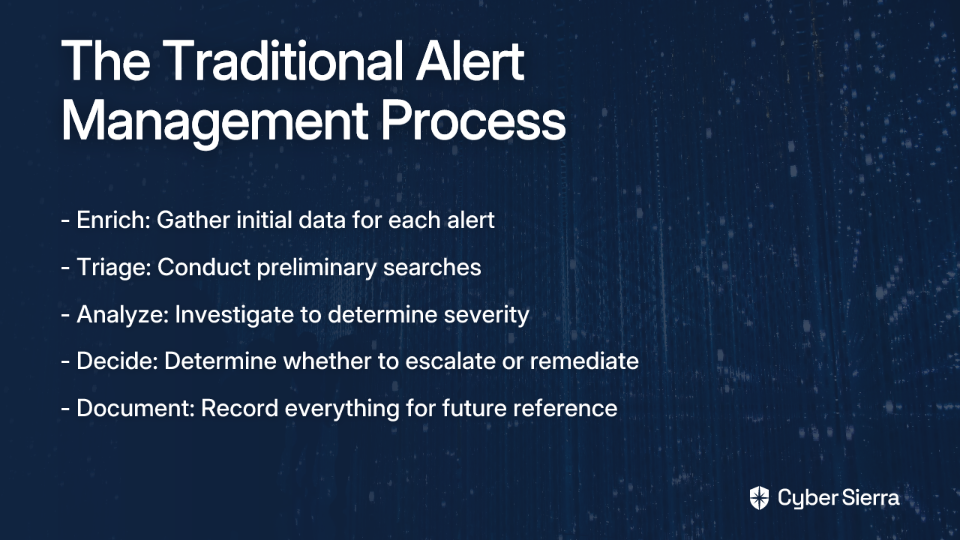
The manual triage process is painfully inefficient. For each alert, analysts must:
- Enrich by gathering initial data
- Triage by conducting preliminary searches
- Analyze and investigate to determine severity
- Decide whether to escalate or remediate
- Document everything for future reference
This approach simply can't scale with today's threat landscape.
As one security professional put it on Reddit: "The data variety and types have gone well beyond the capacity and capabilities of SIEMs to effectively triage even with extensive fine-tuning."
Legacy tools like traditional SIEMs struggle because they weren't designed for the volume and complexity of modern security data. Many teams report they "could not find one that can integrate and ingest vulnerabilities easily from other tools," creating dangerous blind spots.
Meanwhile, the high volume of false positives buries legitimate threats, increases response times, and contributes to analyst burnout – creating a perfect storm of security vulnerability.
The AI Revolution in the SOC: How AI Changes the Game
AI transforms alert management from a manual, step-by-step process into an intelligent, automated cycle:
- Phase 0 - Detect: AI consolidates threats in real-time, analyzing events to identify anomalies automatically
- Phase 1 - Enrich: Instead of manual lookups, AI instantly provides contextual information to help prioritize responses
- Phase 2 - Investigate: Automated investigations run against pre-defined rules and ML models to assess threats
- Phase 3 - Remediate: The system mitigates threats through automated actions or escalates highly-contextualized alerts to the SOC team
This revolution is powered by three key capabilities:
- Hyperautomation: Integrating security tools and automating processes to accelerate threat response
- AI Agents: Automating incident response by triaging alerts, analyzing patterns, and executing remediation playbooks
- AI-Powered Summarization: Generating concise, evidence-backed summaries for faster human decision-making
A Practical Blueprint: 6 Steps to Implement AI-Driven Alert Prioritization
Step 1: Centralize Your Alert Ingestion
Your first challenge is to create a single pipeline for all security data from your various tools (EDR, cloud scanners, firewalls, etc.). This requires a platform with strong integration capabilities.
Security teams on Reddit consistently cite the need to "centralize alerts" as their top priority. Look for solutions with:
- Pre-built connectors for common security tools
- API-first architecture for custom integrations
- The ability to parse and normalize data from disparate sources
Step 2: Automate Contextual Enrichment
Every alert must be automatically enriched with critical context:
- Asset Information: What is the affected asset? Is it a critical production database or a developer's laptop?
- User Information: Who is the user involved? What is their role and access level?
- Vulnerability Data: Does the alert correlate with a known CVE? Is there an active exploit for it?
- Threat Intelligence: Is the IP address or domain associated with a known malicious actor or campaign?
Without this enrichment, you're forcing analysts to manually gather this information for every single alert – a massive time sink that AI can eliminate.
Step 3: Apply Multi-Factor Risk Scoring
Move beyond simple CVSS scores. AI models should calculate risk based on a combination of factors. This directly solves the user pain that "a vulnerability for a technology that you don't have is not a significant risk despite its scoring high."
Effective risk scoring should consider:

- Threat Severity: How dangerous is this threat objectively?
- Asset Criticality: How important is the affected system to your business?
- Business Impact: What could happen if this threat is exploited?
- Exploitability: How easy is it to exploit? Is there evidence of active exploitation?
Step 4: Define and Automate Response Workflows
Based on the risk score and alert type, trigger automated workflows:
- Low-Risk: Automatically close the ticket and log for reporting
- Medium-Risk: Create a ticket in a system like JIRA or ServiceNow and assign it to a Tier-1 analyst
- High-Risk/Critical: Trigger an immediate action (e.g., isolate the host via an XDR solution, block an IP at the firewall) AND escalate to the IR team with a full summary
This automation dramatically reduces Mean Time to Respond (MTTRe) for critical threats while filtering out noise.
Step 5: Integrate Continuous Monitoring Feedback
Prioritization shouldn't just be based on external threats. It needs internal context.
This is where Continuous Control Monitoring (CCM) becomes critical. An AI system can use data on the effectiveness of your existing security controls to adjust risk scores. For example, an alert for a vulnerability might be down-prioritized if the CCM system verifies a compensating control is in place and working effectively.
Platforms like Cyber Sierra's CCM provide this "single source of truth for controls" by building a central repository with near real-time updates, detecting exceptions, and delivering actionable risk intelligence for more accurate prioritization.
Step 6: Establish a Human-in-the-Loop Feedback System
The system must learn and improve. When an analyst re-prioritizes an alert or marks a finding as a false positive, this feedback should be used to retrain the ML models.
This reinforces the idea that "AI helps most when it's used to speed up analysis instead of replace the analyst." The goal is augmentation, not replacement.
Choosing Your Arsenal: Tools and Technologies for AI-Powered Triage
The tool landscape for AI-driven alert prioritization includes:
- SIEM (Security Information and Event Management): Collects and correlates logs and alerts
- SOAR (Security Orchestration, Automation and Response): Automates incident response workflows
- XDR (Extended Detection and Response): Provides unified visibility and response across endpoints, network, and cloud
When evaluating solutions, look for these key features:

- Broad, API-first Integrations: The ability to "integrate and ingest" data easily is a top user requirement.
- Context-Based Analysis: The tool must go beyond basic log aggregation.
- Workflow Automation: Look for flexibility and ease of use, such as the ability to build workflows with natural language.
- Unified Visibility: A single dashboard to manage alerts and posture.
While standalone tools can solve parts of the puzzle, integrated platforms provide a more holistic solution. For example, Cyber Sierra's Threat Intelligence module doesn't just prioritize alerts; it provides proactive defense by combining a holistic attack surface analysis, network vulnerability scanning, and cloud infrastructure assessment in one place. This allows teams to identify and fix security gaps before they generate high-priority alerts, fulfilling the need for a truly proactive security posture.
The Ripple Effect: Broader Benefits of AI-Driven Prioritization
Implementing AI-driven alert prioritization creates benefits far beyond just managing alerts:

- Reduced Mean Time to Respond (MTTRe): Minimizes the exposure window for attackers. CloudGuard.ai reports customers reducing response time by up to 90%.
- Improved SOC Efficiency: Frees analysts for threat hunting and other strategic tasks. In one case study by CloudGuard.ai, Amazon Filters saved 52 days of work through alert automation.
- Bridging the Talent Gap: Automation acts as a force multiplier, allowing smaller teams to achieve more with existing headcount – critical in today's cybersecurity talent shortage.
- Cost Reduction: A more efficient operation can reduce the need for a larger SOC team, allowing organizations to optimize their security budget.
The Reality Check: Challenges and Key Considerations
While AI-driven alert prioritization offers tremendous benefits, it's important to approach it with realistic expectations:
- AI is an Augment, Not a Replacement: As one security professional on Reddit noted, "Bad guys work very hard at not following patterns," so human intuition remains invaluable. AI should enhance, not replace, your human analysts.
- Implementation Can Be Resource-Intensive: Success requires "custom models, lots of dev time... and a bunch of trial and error." This is why choosing a mature platform can be more effective than building from scratch.
- Handling Novel Threats: AI models are trained on past data and may struggle with zero-day attacks. This highlights the importance of integrating real-time third-party threat intelligence and maintaining human oversight.
Conclusion
Transitioning from manual, chaotic alert management to an AI-driven, context-aware prioritization model is no longer a luxury—it's a necessity for survival in today's threat landscape.
By centralizing data, automating enrichment, applying intelligent risk-scoring, and establishing a feedback loop, security teams can conquer alert fatigue and focus on protecting the organization from genuine threats.
The goal isn't 100% automation, but rather creating a powerful partnership between human expertise and machine efficiency. This partnership leads to a more secure, resilient, and proactive defense posture – and a SOC team that can finally break free from alert fatigue.
Remember: AI doesn't replace your analysts – it empowers them to be more effective by focusing their expertise where it matters most.
Frequently Asked Questions
What is alert fatigue and why is it a problem for SOCs?
Alert fatigue is a state of exhaustion and desensitization experienced by security analysts due to an overwhelming volume of security alerts, many of which are false positives. It's a significant problem because it leads to slower response times, analyst burnout, and an increased risk of missing genuine, critical threats that get lost in the noise.
How does AI prioritize security alerts more effectively than manual methods?
AI prioritizes security alerts by automatically enriching them with business context, threat intelligence, and vulnerability data, then applying multi-factor risk scoring to determine their true urgency. Unlike manual triage, which is slow and inconsistent, AI can process thousands of alerts in real-time, considering factors like asset criticality and potential business impact to ensure analysts focus on the most significant threats first.
Will AI-driven alert prioritization replace the need for human SOC analysts?
No, AI-driven alert prioritization is designed to augment, not replace, human SOC analysts. AI excels at handling the repetitive, high-volume tasks of data gathering and initial triage. This frees up human experts for higher-value activities like complex threat hunting, strategic analysis, and responding to novel attacks that don't fit known patterns.
What is the first step to implementing AI-driven alert prioritization?
The first and most critical step is to centralize your alert ingestion. This involves creating a single pipeline for all security data from your various tools (e.g., EDR, cloud scanners, firewalls). You cannot effectively prioritize what you cannot see, so a platform with strong integration capabilities is essential to create a unified view of all security events.
How is an AI-powered security platform different from a traditional SIEM?
While a traditional SIEM primarily collects and correlates logs, an AI-powered platform automates more of the incident lifecycle, including enrichment, multi-factor risk scoring, and response orchestration. Modern AI platforms (often part of SOAR or XDR solutions) don't just present data; they provide contextualized, prioritized, and actionable insights, significantly reducing the manual workload on analysts.
Looking to implement AI-driven alert prioritization in your organization? Cyber Sierra's integrated platform combines threat intelligence, continuous control monitoring, and automated workflows to help security teams prioritize what matters and reduce alert fatigue. Book a demo today to learn more.
