



Top 5 No-Code Cybersecurity Platforms for Non-Technical Teams

Join thousands of professionals and get the latest insight on Compliance & Cybersecurity.
Summary
- No-code cybersecurity platforms allow teams without dedicated engineers to automate security operations and manage compliance using visual, code-free interfaces.
- These tools are essential for automating critical tasks like audit evidence collection, managing third-party vendor risk, and streamlining security workflows.
- To choose the right platform, first identify your primary pain point—such as audit readiness, SaaS management, or repetitive tasks—to find the best fit for your needs.
- For teams struggling with compliance, an all-in-one platform like Cyber Sierra's GRC solution automates evidence gathering and simplifies the entire audit process.
You've set up your company's cloud infrastructure, connected multiple business-critical SaaS applications, and now you're being asked about ISO27001 compliance or SOC2 readiness. Your team is small, you have no dedicated security engineer, and the thought of manually gathering evidence for an audit has you breaking into a cold sweat.
"The most painful part of an audit is typically evidence gathering. You end up on long calls with engineers who may or may not speak GRC and hope they remember where to find a config and take a screenshot with a timestamp. It's painful and sucks up a lot of time, especially when you're running lean teams," shares one cybersecurity manager on Reddit.
If this sounds familiar, you're not alone. The good news? A new generation of no-code cybersecurity platforms is revolutionizing how non-technical teams manage security operations, compliance, and risk—without writing a single line of code.
What is No-Code Cybersecurity and Why is it Essential?
No-code cybersecurity platforms use visual interfaces, drag-and-drop functionality, and pre-built templates to enable security management without programming knowledge. These tools facilitate security risk management, automate critical workflows to prevent unauthorized access, and integrate security stacks to manage vulnerabilities in one platform.
For businesses without large, dedicated tech teams, these platforms offer several critical advantages:
- Accessibility: Empowers non-technical staff to implement robust security measures
- Cost-Effectiveness: Reduces the need for specialized security engineers
- Speed: Allows for quick deployment of security measures and faster audit readiness
- Automation: Eliminates repetitive tasks and reduces human error
With cyber threats constantly evolving and AI-powered attacks becoming more sophisticated, traditional code-heavy security tools can't keep up or are too complex for smaller teams. No-code platforms democratize cybersecurity, making enterprise-grade protection accessible to organizations of all sizes.
Let's explore the top five platforms that are changing the game for non-technical teams.
The Top 5 No-Code Cybersecurity Platforms
1. Cyber Sierra: The All-in-One Compliance and Risk Automation Hub
Overview: Cyber Sierra provides an AI-enabled cybersecurity platform designed to simplify and automate security compliance, vendor risk assessment, and continuous control monitoring for enterprises. It transforms security from periodic, manual checks to proactive, near real-time risk management.
Key No-Code Features:
- Governance, Risk & Compliance (GRC): Automates data collection, risk assessments, and reporting across multiple frameworks (SOC2, ISO 27001, HIPAA, etc.)
- Continuous Control Monitoring (CCM): Maintains a central repository of security controls with automated testing and near real-time updates
- Third-Party Risk Management (TPRM): Streamlines vendor assessments with 24/7 visibility into vendor security compliance
- Employee Security Training: Delivers interactive training and simulated phishing campaigns through an intuitive dashboard
How It Empowers Non-Technical Teams: Cyber Sierra directly addresses the pain of evidence gathering by automating the collection and organization of audit artifacts. For compliance managers struggling with "the steep learning curve and up to $10k annual cost" of traditional compliance platforms, it offers a more intuitive interface and comprehensive automation.
The platform also solves the frustration of "trying to validate actual controls and processes inside vendors" by providing continuous monitoring capabilities that go beyond static questionnaires, giving deeper insights into vendor security practices.
Unique Selling Point: A unified platform that simplifies complex GRC requirements through automation and continuous monitoring, making enterprises audit-ready faster and with significantly less manual effort.
2. Tines: For Automating Security Operations Workflows
Overview: Tines is a no-code automation platform that enables security teams to automate repetitive manual tasks without any coding knowledge, using a simple drag-and-drop interface. It's particularly effective for security operations teams dealing with alert fatigue and manual response processes.
Key No-Code Features:
- Visual, drag-and-drop workflow builder for creating security automations
- Hundreds of pre-built templates for common security tasks
- Ability to connect to virtually any tool with an API
- Automated processes for phishing response, employee onboarding/offboarding, and suspicious login alerts
How It Empowers Non-Technical Teams: Tines allows security analysts with no development background to build and maintain their own automations. In a case study with OpenTable, the platform saved the security team 40 hours of work per week by automating routine tasks—a game-changer for lean teams already stretched thin.
Unique Selling Point: Empowers frontline security analysts to become automators, reducing Mean Time to Respond (MTTR) to security incidents and eliminating the bottleneck of relying on engineering resources.
3. Nokod Security: For Securing Your No-Code Applications
Overview: Nokod Security is a platform designed specifically to govern and secure the no-code/low-code apps, robotic process automation (RPA), and AI agents being built by citizen developers within an organization.
Key No-Code Features:
- Automatically discovers and maps all no-code/low-code applications in your environment
- Detects security vulnerabilities, compliance issues, and suspicious activities
- Provides straightforward, actionable guidance for risk mitigation
- Integrates with popular no-code development platforms
How It Empowers Non-Technical Teams: Nokod Security directly addresses a common concern voiced by one Reddit user: "I'd imagine like every other platform you're going to run into security lapses when it comes to integrating third-party plugins." It provides guardrails for citizen developers to build securely from the start.
The platform also prevents situations where insecure practices are unwittingly followed, such as when "SAP AppGyver tutorials show how to connect to an API via an HTTP request where the token is fully exposed."
Unique Selling Point: Integrates security directly into the no-code application lifecycle, making security an enabler for citizen development rather than a blocker.
4. Zylo: For Managing SaaS and Third-Party Risk
Overview: Zylo is a no-code SaaS management platform that provides complete visibility and governance over an organization's software applications, with a focus on risk assessment and compliance.
Key No-Code Features:
- Automates the discovery and inventory management of all SaaS applications, including "shadow IT"
- Offers risk scoring and assessments for applications based on a comprehensive data library
- Streamlines license management and cost optimization
- Provides insights into user adoption and usage patterns
How It Empowers Non-Technical Teams: Non-technical teams (like IT, Finance, and Procurement) can easily identify redundant, unused, or risky applications without deep security expertise. It helps manage the "technical debt" that security managers cite as a major frustration, with one former security manager sharing that they "quit my last sec mgr job out of frustration with this very issue."
Unique Selling Point: Provides a single source of truth for an organization's entire SaaS stack, allowing non-technical teams to proactively manage cost, risk, and compliance associated with third-party software.
5. Zapier: For Universal Workflow Automation
Overview: While not a dedicated cybersecurity platform, Zapier is the quintessential no-code tool for connecting thousands of web apps to automate workflows. Its power lies in its versatility for security-adjacent tasks and its ability to connect virtually any security tool with an API.
Key No-Code Features:
- Intuitive "trigger-and-action" workflow builder ("Zaps")
- Connects to over 5,000 applications
- Allows for multi-step, conditional logic without code
- Extensive template library for common automation scenarios
How It Empowers Non-Technical Teams: Teams can create simple security automations, such as:
- Receiving a Slack notification when a high-priority security alert is triggered
- Automatically creating a Jira ticket when a suspicious email is reported
- Adding a user to a "remedial training" list in an LMS after they fail a simulated phishing test
- Archiving compliance documentation in a centralized repository
Unique Selling Point: Its massive library of integrations makes it the "glue" of the internet, allowing non-technical teams to create custom, lightweight security automations connecting the specific tools they already use.
How to Choose the Right No-Code Cybersecurity Platform
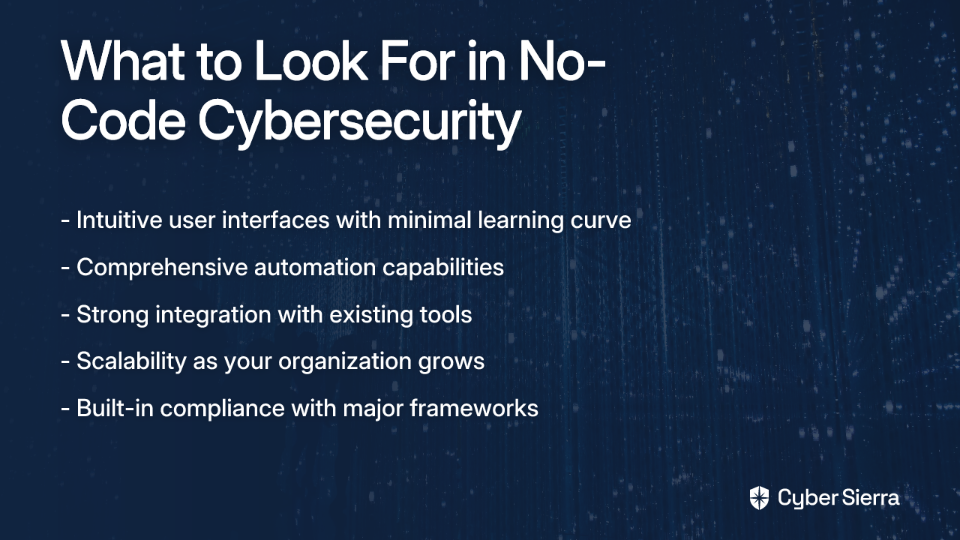
When selecting a no-code cybersecurity platform for your team, consider these critical factors:
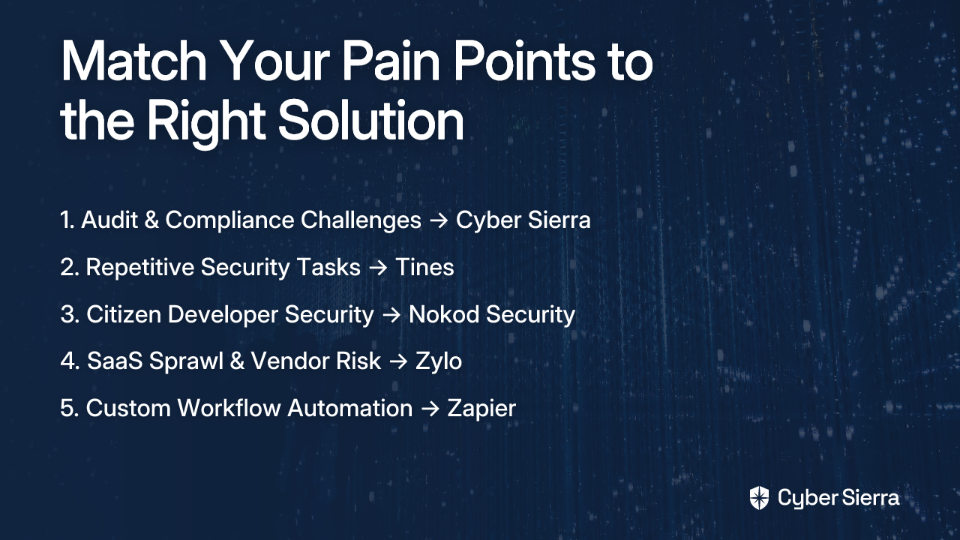
1. Identify Your Core Pain Point
Different platforms excel at solving different problems:
- Audit & Compliance Hell? You need a GRC-focused platform like Cyber Sierra.
- Repetitive Security Tasks? Look at automation engines like Tines.
- Worried About What Citizen Developers Are Building? You need an application security tool like Nokod Security.
- Uncontrolled SaaS Sprawl? A SaaS management platform like Zylo is your answer.
2. Consider the Learning Curve
User research highlights that some tools have a "steep learning curve." Look for platforms with intuitive UIs, good documentation, and strong customer support. Request demos and free trials to evaluate ease of use before committing.
3. Check for Key Integrations
The platform must connect to your core systems (cloud provider, identity provider, HRIS, etc.) to enable true automation and provide a single source of truth. Review the integration catalog carefully and confirm compatibility with your existing tech stack.
4. Evaluate Scalability and Cost
Think about your future needs. Will the platform grow with you? Be clear on pricing to avoid unexpected costs as you scale. Some platforms start affordable but become expensive as you add users or features.
Conclusion
No-code cybersecurity platforms are revolutionizing how non-technical teams build, manage, and secure their operations. They transform complex, code-heavy processes into simple, automated workflows that anyone can manage—without sacrificing security.
By adopting these tools, organizations can enhance their security posture, achieve audit readiness faster, and free up their teams to focus on strategic initiatives instead of manual, repetitive work. The democratization of cybersecurity means that robust security is no longer the exclusive domain of large enterprises with dedicated security engineering teams.
Frequently Asked Questions
What is a no-code cybersecurity platform?
A no-code cybersecurity platform is a tool that allows non-technical users to manage security tasks using visual interfaces, drag-and-drop builders, and pre-built templates instead of programming. These platforms simplify complex processes like compliance audits, risk assessments, and security workflow automation, making robust security accessible to teams without specialized engineering skills.
Can no-code security tools handle complex compliance like SOC 2 or ISO 27001?
Yes, many no-code security platforms are specifically designed to handle complex compliance frameworks like SOC 2 and ISO 27001. Platforms such as Cyber Sierra automate evidence collection, continuously monitor security controls, and provide pre-built templates for these frameworks, significantly reducing the manual effort and time required to become audit-ready.
How do I choose the right no-code cybersecurity tool for my business?
To choose the right no-code cybersecurity tool, first identify your primary pain point, such as audit preparation, repetitive security tasks, or managing SaaS vendor risk. Then, evaluate platforms based on their ease of use, integration capabilities with your existing tech stack, and ability to scale with your business. For example, if compliance is your biggest challenge, a GRC-focused platform like Cyber Sierra would be the best fit.
Are no-code cybersecurity platforms secure?
Yes, reputable no-code cybersecurity platforms are built with security as a top priority. These platforms undergo rigorous security testing, maintain their own compliance certifications (like SOC 2), and employ robust security measures to protect customer data. They provide a secure environment for you to build and automate your own security processes, often enhancing your security posture compared to manual or ad-hoc methods.
Do no-code platforms replace the need for a security expert?
No-code platforms do not entirely replace the need for a security expert, but they significantly augment their capabilities and empower non-technical teams to handle many day-to-day security operations. They act as a "force multiplier," automating routine tasks so that security professionals can focus on strategic initiatives and complex threat analysis. For small businesses, they can bridge the gap until a dedicated expert is hired.
Ready to streamline compliance and automate your security program without writing a single line of code? Explore how Cyber Sierra's unified platform centralizes GRC, vendor risk, and control monitoring to make your security program proactive, not reactive. With its no-code approach, even teams without technical expertise can implement enterprise-grade security measures that scale with their business.
The future of cybersecurity is accessible, automated, and code-free—and it's available today.
