



Top 5 Healthcare Cybersecurity Challenges in 2025

Join thousands of professionals and get the latest insight on Compliance & Cybersecurity.
Summary
- Cyberattacks are now a direct threat to patient safety, with 72% of healthcare organizations reporting that breaches have impacted patient care.
- Key challenges for 2025 include securing an expanding attack surface of connected devices and cloud services, navigating complex compliance frameworks, and managing increasing risks from third-party vendors.
- Actionable strategies include adopting automated compliance monitoring, implementing continuous third-party risk management, and strengthening the 'human firewall' through ongoing employee training.
- Platforms like Cyber Sierra help automate GRC processes, continuously monitor vendor risks, and streamline compliance to protect patient data and ensure operational continuity.
In 2024, healthcare data breaches hit a staggering all-time high, with breaches affecting approximately 237 million people in the United States—representing nearly 70% of the population. But these aren't just numbers on a spreadsheet. Behind each statistic are real healthcare professionals struggling with the impossible task of balancing robust security with efficient patient care.
"Current systems inadequately balance security needs with patient care efficiency," notes one healthcare IT professional. "Policies created without practical input can lead to real-world issues."
As we look ahead to 2025, healthcare cybersecurity is evolving beyond mere data theft into a direct threat to patient safety and operational continuity. The stakes have never been higher—72% of healthcare organizations have experienced cyberattacks that directly affected patient care, according to Healthcare IT News.
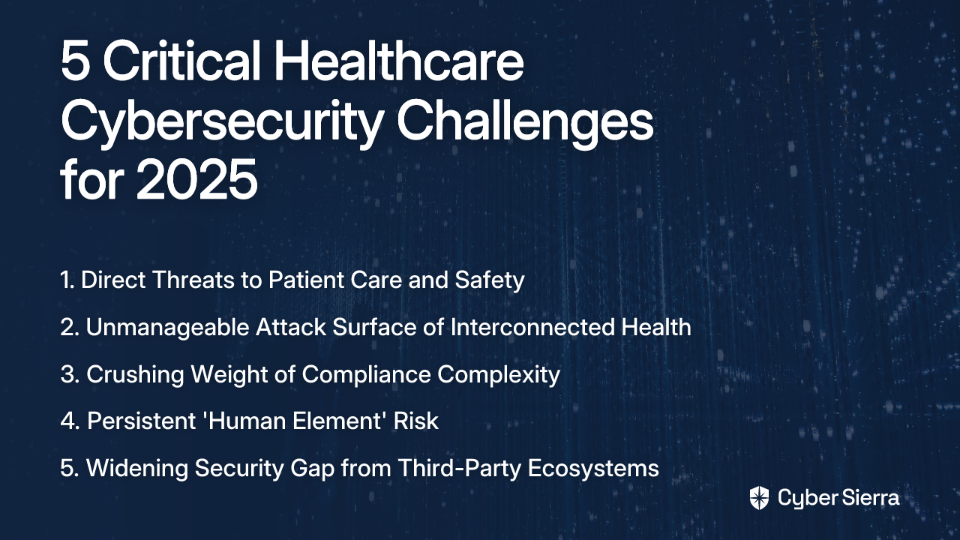
In this article, we'll examine the five most critical cybersecurity challenges healthcare organizations will face in 2025, followed by actionable strategies to build resilience against these emerging threats.
Challenge 1: Direct Threats to Patient Care and Safety
The era when data breaches only resulted in compromised personal information and regulatory fines is over. Today's cyberattacks directly disrupt clinical operations and endanger patient outcomes.
In a sobering statistic, 54% of healthcare organizations reported increased medical procedure complications due to cyber disruptions. Ransomware attacks led to longer patient stays for 67% of victims, according to Healthcare IT News.
While the volume of ransomware incidents has decreased, their severity has intensified. The average ransom payment has risen to $1.2 million, with one notable attack costing a hospital network an estimated $100 million in damages.
The February 2024 Change Healthcare ransomware attack exemplifies this escalation, compromising the data of an estimated 100 million individuals and causing massive, nationwide disruptions to prescriptions and payments, as reported by Scrut.io.
The most concerning development is that supply chain attacks are now the most likely threat vector to disrupt care delivery, with 87% of affected organizations reporting disruptions to patient care.
Challenge 2: The Unmanageable Attack Surface of Interconnected Health
The rapid adoption of telehealth, Internet of Medical Things (IoMT) devices, and cloud services has exponentially expanded potential entry points for attackers, while legacy systems remain a persistent vulnerability.
Cloud account compromises have emerged as the most prevalent threat, affecting 72% of healthcare organizations. Even more troubling, 61% reported increased complications in medical procedures due to these cloud attacks, according to Healthcare IT News.
The proliferation of connected medical devices—from EHRs to infusion pumps and monitors—creates an expanding attack surface. This reflects a common pain point among healthcare professionals: "Critical life-saving devices often lack sufficient security measures," as one practitioner notes.
Legacy systems compound this challenge. Many organizations continue to use outdated technology due to budget constraints, compliance hurdles with new tech, and training costs. These systems often lack modern security features and serve as easy entry points for attackers, according to Maryville University.
Challenge 3: The Crushing Weight of Compliance Complexity and Governance
Healthcare organizations are buried under a complex web of overlapping regulations, making continuous compliance a significant operational and financial burden.
Organizations must simultaneously navigate multiple frameworks, including HIPAA, HITRUST CSF, NIST, ISO 27001, and GDPR, according to Scrut.io. This "framework overload" stretches already thin resources to their breaking point.
The financial stakes are enormous. The average cost of a healthcare data breach rose to $9.77 million—the highest of any industry for the 13th consecutive year, according to the IBM Data Breach Report. Meanwhile, HIPAA penalties for non-compliance can reach up to $12.84 million, as noted by Rubrik.
Perhaps most exhausting is the process of manually gathering evidence, conducting risk assessments, and preparing for audits. This time-consuming and error-prone approach leads to a state of "compliance fatigue" that diverts resources from addressing actual security threats.
Challenge 4: The Persistent "Human Element" Risk
Both malicious insiders and negligent employees continue to be primary causes of data breaches, exacerbated by increasingly sophisticated social engineering attacks.
The scale of this problem is staggering: 96% of healthcare organizations experienced data loss incidents, with 35% caused by an employee's failure to follow company policies, according to Healthcare IT News. In 2020, insider breaches accounted for 48% of incidents, nearly rivaling external attacks, as reported by Maryville University.
Attackers are targeting healthcare professionals with increasingly convincing tactics. Email phishing (used in 63% of attacks), SMS phishing (34%), and spear phishing (34%) remain the preferred methods, according to Rubrik.
Business Email Compromise (BEC) attacks are particularly dangerous, causing significant delays in procedures for 65% of affected organizations and leading to poor patient outcomes.
Challenge 5: The Widening Security Gap from Third-Party Ecosystems
The healthcare supply chain has emerged as a critical vulnerability. Organizations' increasing reliance on third-party vendors for software and services creates a distributed risk that is difficult to manage with traditional methods.
This growing concern is reflected in user feedback: "Security practices of third-party vendors and their role in data breaches" is a top worry, according to discussions among healthcare professionals.
Traditional vendor risk management relies on point-in-time questionnaires and self-assessments, which fail to provide a continuous, real-time view of a vendor's security posture. As supply chain attacks are now the most likely to disrupt patient care, this approach is increasingly inadequate.
Building a Resilient Healthcare Security Posture for 2025
With these challenges in mind, healthcare organizations need a strategic framework to build resilience against emerging threats. Here are four key principles to guide this transformation:
Principle 1: Adopt a Proactive, Automated GRC Strategy
The time has come to shift from periodic, manual audits to Continuous Control Monitoring (CCM). This approach automates the validation of security controls against frameworks like HIPAA, NIST, and ISO 27001 in near real-time.
Platforms like Cyber Sierra's GRC and CCM modules are designed to address this challenge directly. They automate data collection, centralize control repositories, and provide ongoing visibility into security posture, transforming compliance from a periodic scramble into a continuous, managed process. This helps enterprises become audit-ready faster and reduces compliance fatigue.
Principle 2: Secure the Entire Ecosystem (IoMT, Cloud, and Vendors)
Implement a robust Third-Party Risk Management (TPRM) program that goes beyond initial onboarding. Utilize tools for continuous monitoring of your vendors' attack surfaces.
A modern TPRM solution, such as Cyber Sierra's TPRM platform, automates vendor assessments and provides "near real-time, 24/7 visibility into vendor security compliance," allowing organizations to proactively manage supply chain risks.
Additionally, leverage Threat Intelligence to proactively scan your own network and cloud infrastructure for vulnerabilities and misconfigurations. Cyber Sierra's Threat Intelligence module provides this "outside-in" view, helping teams identify and prioritize risks across their entire attack surface before they can be exploited.
Principle 3: Strengthen the Human Firewall
Move beyond annual, check-the-box training. Implement a continuous security awareness program with interactive content and realistic, simulated phishing campaigns.
Purpose-built tools like Cyber Sierra's Employee Security Training help foster a security-conscious culture by educating employees on evolving threats and using simulated attacks to reinforce learning, directly addressing the risks of human error and social engineering.
Principle 4: Bridge the Gap Between Security and Clinical Operations
Foster collaboration between IT security teams and clinical staff when developing security policies. The goal is to create protocols that are both secure and practical in high-stakes clinical environments.
Implement streamlined access controls like Single Sign-On (SSO) combined with risk-based Multi-Factor Authentication (MFA) to reduce login fatigue without compromising security. For critical, life-saving devices, explore alternative, rapid authentication methods to prevent lockouts during emergencies, directly addressing a key pain point from user research.
Conclusion
As we look ahead to 2025, it's clear that healthcare cybersecurity has fundamentally shifted from an IT issue to a patient safety imperative. The five challenges outlined above—direct threats to patient care, expanding attack surfaces, compliance complexity, human risk, and third-party vulnerabilities—require a proactive, integrated approach.
By adopting the four principles of resilience—automated GRC, ecosystem security, human firewall strengthening, and security-clinical collaboration—healthcare organizations can better protect both sensitive Protected Health Information (PHI) and, most importantly, patient lives.
The future of healthcare security lies not in reactive, siloed measures but in proactive, integrated, and automated strategies that balance robust protection with the practical needs of healthcare delivery.
Frequently Asked Questions
What is the biggest cybersecurity threat to healthcare in 2025?
The biggest threat is the direct impact of cyberattacks on patient care and safety. This has evolved beyond simple data breaches to include severe disruptions in clinical operations, which can lead to increased medical complications, longer hospital stays, and poor patient outcomes.
How are cyberattacks on healthcare organizations changing?
Cyberattacks are shifting from data theft to severe operational disruptions that endanger patients. While the volume of ransomware incidents has decreased, their severity has intensified with higher ransom demands. Furthermore, supply chain attacks targeting third-party vendors have become the most likely threat vector to disrupt patient care delivery.
Why is cybersecurity compliance so complex in the healthcare industry?
Healthcare cybersecurity compliance is complex due to the requirement to adhere to multiple, overlapping regulations like HIPAA, HITRUST, NIST, and GDPR. This "framework overload," combined with the industry's highest data breach costs and the manual, time-consuming nature of audit preparation, creates a significant operational and financial burden.
What are the most common entry points for cyberattacks in healthcare?
The most common entry points are compromised cloud accounts, vulnerabilities in the expanding network of Internet of Medical Things (IoMT) devices, and outdated legacy systems. Additionally, the "human element" remains a primary vector, with attackers using social engineering tactics like email phishing to exploit employees and gain initial access.
What is the role of third-party vendors in healthcare security risks?
Third-party vendors are a critical and growing security vulnerability in the healthcare supply chain. Because healthcare organizations rely on numerous vendors for software and services, an attack on a single vendor can disrupt care delivery across multiple organizations. Traditional vendor risk management methods are often inadequate for managing this distributed and continuous threat.
How can healthcare organizations improve their cybersecurity posture?
Healthcare organizations can improve their security posture by adopting a proactive and integrated strategy. Key actions include: implementing an automated Governance, Risk, and Compliance (GRC) program for continuous monitoring; securing the entire ecosystem of cloud services, IoMT, and third-party vendors; strengthening the "human firewall" with ongoing employee training; and fostering close collaboration between security and clinical teams to ensure policies are both secure and practical.
