
How to Protect Payment Card Data with AI-Powered PCI DSS Monitoring


Join thousands of professionals and get the latest insight on Compliance & Cybersecurity.
Summary
- Traditional periodic PCI DSS audits are inefficient and fail to provide continuous security insight, a challenge amplified by the upcoming PCI DSS 4.0 deadline.
- Adopting Continuous Controls Monitoring (CCM) transforms compliance from a quarterly scramble into an automated, real-time process that constantly validates security controls.
- AI supercharges CCM by automatically assessing configurations and logs and proactively detecting anomalies to prevent security incidents.
- A platform like Cybersierra's Continuous Control Monitoring automates these processes, providing a centralized view to keep your organization audit-ready and secure.
You've just finished your quarterly PCI DSS compliance audit. After weeks of scrambling to gather evidence, chasing down system owners for documentation, and manually reviewing countless access logs, you finally submit everything to your QSA. You breathe a sigh of relief—until you remember you'll need to do it all over again next quarter.
Meanwhile, your team is already feeling the mounting pressure of PCI DSS 4.0. With new requirements for customized implementation and the 2025 deadline approaching fast, that brief moment of post-audit relief quickly evaporates.
Sound familiar? If you're responsible for payment card security, you know that traditional, periodic compliance checks are no longer sustainable. They're overwhelming, error-prone, and fail to provide real-time visibility into your security posture.
But what if there was a better way? What if you could transform PCI DSS compliance from a quarterly fire drill into a continuous, automated process that actually strengthens your security posture?
The Escalating Challenge of PCI DSS Compliance
The Payment Card Industry Data Security Standard (PCI DSS) establishes the baseline technical and operational requirements to protect payment account data. It applies to all entities that store, process, or transmit cardholder data—from global enterprises to small merchants.
But compliance is becoming increasingly complex for several reasons:
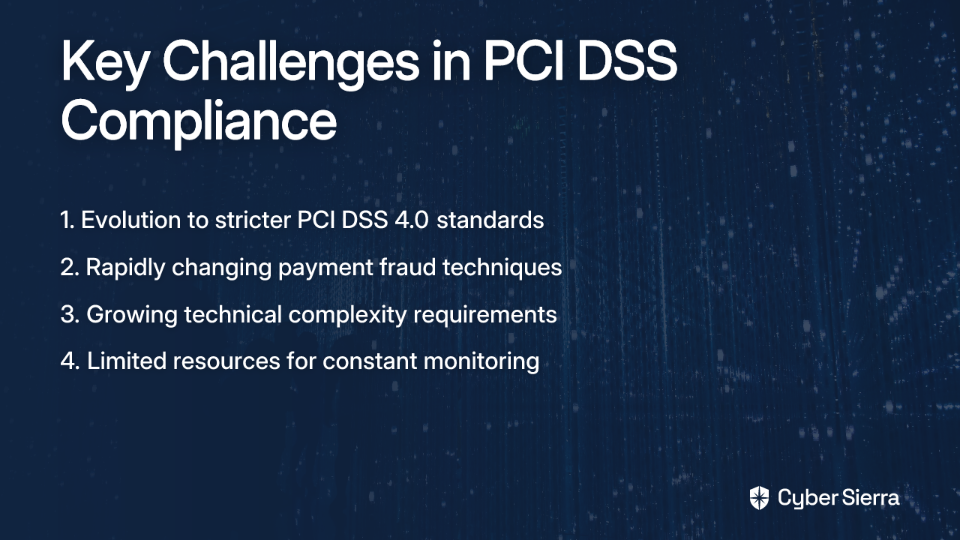
- The Evolution to PCI DSS 4.0: The latest version introduces more stringent requirements, customized implementation options, and places greater emphasis on security as a continuous process rather than a point-in-time assessment.
- Dynamic Threat Landscape: As payment fraud techniques evolve, compliance standards must keep pace—leaving organizations constantly playing catch-up with new requirements.
- Technical Complexity: Many organizations are unprepared for the technical requirements needed to maintain compliance. As one compliance professional noted in a recent discussion: "The required technology for compliance is overlooked by many organizations."
- Resource Constraints: Maintaining compliance requires constant monitoring and updates, which quickly becomes overwhelming with limited resources.
Traditional compliance approaches—characterized by periodic, manual assessments—simply can't keep pace with these challenges. That's where Continuous Controls Monitoring (CCM) and AI-powered automation enter the picture.
From Periodic Audits to Continuous Compliance: The Power of CCM
Continuous Controls Monitoring (CCM) represents a fundamental shift in approach—from periodic, point-in-time assessments to automated, real-time monitoring of your security controls.
Instead of scrambling quarterly to gather compliance evidence, CCM platforms continuously validate that your security controls are functioning effectively. This provides several key benefits for PCI DSS compliance:
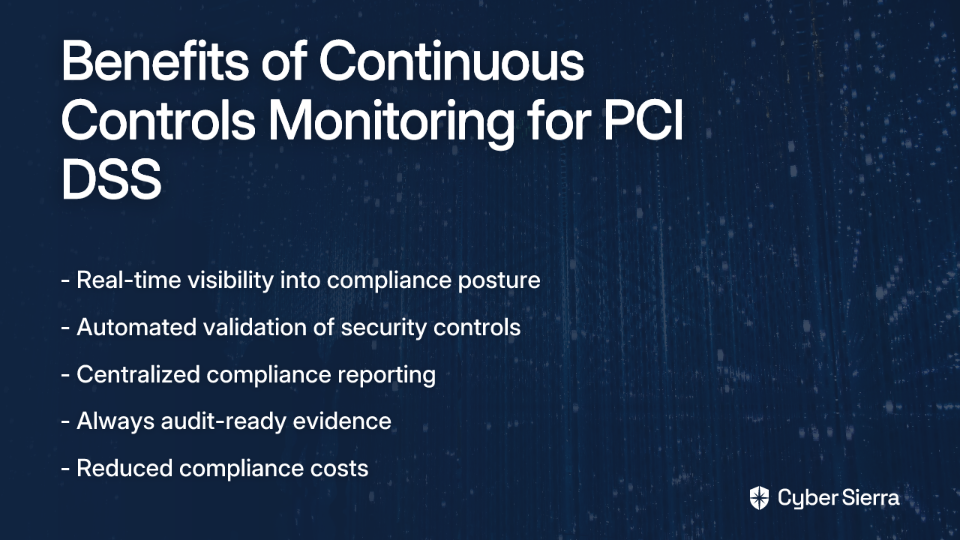
- Real-time Visibility: CCM offers immediate insight into your compliance posture, allowing you to identify and address gaps before they become audit findings or, worse, security incidents.
- Automated Compliance Checks: The system automatically tests and validates security controls like access restrictions, network segmentation, and encryption implementation—reducing manual effort and human error.
- Centralized Reporting: All compliance data is collected, analyzed, and presented in centralized dashboards, giving stakeholders a unified view of your compliance status at any moment.
- Audit-Ready Evidence: When audit time comes, you already have pre-compiled, time-stamped evidence ready to present—no more last-minute scrambling.
Organizations implementing CCM report significant reductions in compliance costs and audit preparation time, while simultaneously improving their overall security posture.
How AI Supercharges PCI DSS Monitoring
While CCM establishes the foundation for continuous compliance, artificial intelligence takes it to the next level. The PCI Security Standards Council (PCI SSC) has recognized this potential, recently releasing official guidance on integrating AI into PCI assessments.
According to this guidance, AI can significantly enhance the efficiency, accuracy, and consistency of PCI DSS compliance efforts. Here's how:
Automated Control Assessment
AI excels at processing vast amounts of data from diverse sources—precisely what's needed to monitor complex PCI DSS environments. AI-powered systems can:
- Analyze System Configurations: Continuously scan system configurations to ensure they align with PCI DSS requirements, such as secure password parameters, proper network segmentation, and encryption standards.
- Review Access Logs: Monitor user access patterns in real-time to identify potential violations of least-privilege principles or suspicious behaviors that may indicate a breach.
- Monitor Data Flows: Track cardholder data movements throughout the environment to ensure they remain within defined boundaries and maintain appropriate security controls.
Proactive Threat Detection
Beyond basic compliance checking, AI enhances security through advanced threat detection:
- Pattern Recognition: Identify abnormal user behaviors or system activities that may indicate a security incident before it impacts cardholder data.
- Anomaly Detection: Flag unusual transactions or access patterns that deviate from established baselines, potentially revealing compromise attempts.
- Predictive Analysis: Forecast potential vulnerabilities based on system changes or emerging threat intelligence, allowing preemptive action.
The Human Element Remains Critical
Despite AI's power, the PCI SSC emphasizes that human oversight remains non-negotiable. AI should assist human assessors, not replace them. As noted in the PCI SSC guidance, AI outputs must be validated by qualified personnel who understand both the technology and compliance requirements.
This addresses common concerns raised by users about "lack of accuracy and potential data alteration when using AI models for cardholder data," as discussed in community forums.

A Practical Guide to Implementing AI-Powered Monitoring
Ready to transform your PCI DSS compliance approach? Here's a step-by-step framework to get started:
Step 1: Conduct a Thorough Gap Analysis
Before implementing any new technology, assess your current state. As one PCI compliance professional advises, "It's a whole process to perform the gap analysis, since you need to know everything (people, process and technology) intimately." This assessment should:
- Evaluate existing manual processes and identify automation opportunities
- Document current compliance tools and their limitations
- Identify skill gaps in your team that may need to be addressed
- Establish baseline metrics to measure improvement
Step 2: Select an AI-Powered Platform
Look for a solution that offers comprehensive coverage of PCI DSS requirements and integrates smoothly with your existing technology stack. Platforms like Cyber Sierra's Continuous Control Monitoring (CCM) module are designed specifically for this purpose, building a central controls repository with near real-time updates and automated control testing to ensure you are always audit-ready for frameworks like PCI DSS.
When evaluating platforms, prioritize those that:
- Connect to all critical systems in your cardholder data environment
- Provide predefined PCI DSS control mappings and automation
- Offer customizable dashboards and reporting
- Include workflow capabilities for managing exceptions and remediation
Step 3: Configure Automated Monitoring for Key Controls
Once your platform is in place, prioritize automation of the most critical PCI DSS controls:
- Vulnerability Management: Implement continuous vulnerability scanning rather than relying solely on quarterly assessments. As one expert notes, "The PCI standard recommends vulnerability scans at least once every three months for compliance purposes. However, they also state that more frequent scans are better for security."
- Access Control Monitoring: Configure real-time monitoring of user access rights, privileged account usage, and authentication mechanisms.
- Network Security Checks: Automate testing of firewall rules, network segmentation, and secure configuration standards.
- Log Management: Establish automated collection and analysis of security logs across all in-scope systems.
Step 4: Establish Human-in-the-Loop Workflows
Remember that AI is a tool, not a replacement for human expertise. Create clear processes for:
- Validating AI-generated findings before remediation
- Regularly reviewing and refining AI detection rules
- Documenting the rationale behind compliance decisions
- Maintaining proper segregation of duties between automation and oversight
Addressing Key Concerns: AI, Data Security, and Third-Party Risk
As you implement AI-powered monitoring, you'll likely encounter several important concerns:
Protecting Cardholder Data
One of the most common fears about using AI for PCI compliance is the potential exposure of sensitive cardholder data. To address this:
- Ensure AI systems process data in compliance with PCI DSS requirements
- Implement strong access controls and encryption for any data used in AI training or analysis
- Consider tokenization or masking of cardholder data before processing
- Maintain clear audit trails of all AI interactions with sensitive data
The PCI SSC guidelines are clear: AI tools must adhere to strict data handling protocols and must not be trained on sensitive cardholder data unless appropriate security measures are in place.
Managing Third-Party Risk
The use of third-party AI introduces additional compliance challenges. According to community discussions, there are significant "concerns about the risks of partnering with suppliers who do not meet certification standards."
To mitigate these risks:
- Conduct Thorough Due Diligence: Before adopting any AI solution, verify that the provider maintains appropriate security certifications and follows PCI DSS requirements.
- Implement Robust Vendor Management: A strong Third-Party Risk Management (TPRM) program is essential. Solutions like Cyber Sierra's TPRM platform can simplify this by automating vendor assessments and providing 24/7 visibility into vendor security compliance.
- Maintain Transparency: The PCI SSC mandates that assessors must inform clients about the use of AI and obtain their consent. Apply this principle to your own operations by maintaining clear documentation about where and how AI is used in your compliance processes.
Conclusion: From Compliance Burden to Security Advantage
By implementing AI-powered continuous monitoring for PCI DSS, you transform compliance from a periodic, reactive burden into a strategic security advantage. The benefits extend far beyond just "checking the box" for compliance:
- Reduced Manual Effort: Automation eliminates much of the tedious evidence gathering and control testing.
- Enhanced Security Posture: Real-time monitoring catches potential issues before they become security incidents.
- Continuous Compliance: Stay audit-ready year-round rather than scrambling before assessments.
- Data-Driven Insights: Gain valuable intelligence about your security operations and risk landscape.
As we move further into the era of PCI DSS 4.0, organizations that embrace AI-powered continuous monitoring will not only achieve compliance more efficiently but will also establish more resilient security programs that truly protect cardholder data. The key is to approach AI as a powerful tool that enhances—rather than replaces—human expertise, ensuring that technology serves your security and compliance goals within a well-defined framework of policies and oversight.
By combining the right technology with appropriate human guidance, you can turn the challenge of PCI DSS compliance into an opportunity to strengthen your overall security posture, protect your customers' data, and safeguard your organization's reputation in an increasingly complex threat landscape.
Frequently Asked Questions
What is the difference between traditional PCI compliance and continuous monitoring?
The primary difference lies in the approach to validation. Traditional compliance relies on periodic, point-in-time audits that are manual and labor-intensive, while continuous monitoring uses automated technology to validate security controls in real-time, providing constant visibility into your compliance posture.
How does AI specifically help with PCI DSS compliance?
AI helps automate and enhance PCI DSS compliance by continuously analyzing vast amounts of data from system configurations, access logs, and data flows. This allows for automated control assessments, real-time identification of policy violations, and proactive threat detection through pattern recognition and anomaly detection, making compliance more efficient and accurate.
Is AI a replacement for human auditors in PCI DSS compliance?
No, AI is not a replacement for human auditors. The PCI Security Standards Council (PCI SSC) guidance emphasizes that AI should be used as a tool to assist human assessors, not replace them. Human oversight is critical to validate AI-generated findings, interpret complex scenarios, and ensure the accuracy of compliance assessments.
What are the first steps to implementing AI-powered PCI DSS monitoring?
The first step is to conduct a thorough gap analysis to understand your current processes, tools, and resources. Following this, you should select a suitable AI-powered platform, configure automated monitoring for critical controls like vulnerability management and access control, and establish clear human-in-the-loop workflows for validation and remediation.
Why is continuous monitoring so important for PCI DSS 4.0?
Continuous monitoring is crucial for PCI DSS 4.0 because the new standard shifts focus from periodic assessments to security as a continuous, ongoing process. It supports the customized implementation options in 4.0 and provides the real-time visibility needed to keep pace with an evolving threat landscape and maintain a strong security posture year-round.
How can I ensure AI tools don't expose sensitive cardholder data?
To protect cardholder data, ensure that any AI tool processes data in full compliance with PCI DSS requirements. This includes implementing strong encryption and access controls, using tokenization or data masking where possible, and verifying that AI models are not trained on sensitive data unless appropriate security measures are in place. Always conduct thorough due diligence on third-party AI providers.