



Top 6 Use Cases Where AI Agents Excel in Cybersecurity Compliance

Join thousands of professionals and get the latest insight on Compliance & Cybersecurity.
Summary
- With 69% of enterprises viewing AI as essential for cybersecurity, traditional manual compliance methods are becoming obsolete.
- AI agents automate critical, time-consuming tasks such as continuous control monitoring (CCM), evidence collection for audits like SOC 2, and third-party risk management (TPRM).
- The shift to AI enables a proactive security posture, providing real-time violation alerts and predictive risk insights instead of relying on outdated, periodic snapshots.
- Implementing an AI-enabled GRC platform like Cyber Sierra unifies these functions, helping you stay continuously compliant and audit-ready.
You've spent countless hours manually collecting evidence for your upcoming SOC 2 audit. Your team is drowning in vendor security questionnaires that provide, at best, a months-old snapshot of your partners' security posture. Meanwhile, the regulatory landscape keeps shifting beneath your feet, with new frameworks like the EU AI Act on the horizon.
If this sounds painfully familiar, you're not alone. Traditional compliance approaches—manual, periodic, and reactive—are crumbling under the weight of today's cybersecurity challenges.
The good news? AI agents are transforming this landscape, shifting cybersecurity compliance from a reactive burden to a proactive, continuous advantage.
The Rise of AI in Cybersecurity Compliance
The numbers tell a compelling story: The Global AI Market is projected to grow with a CAGR of 36.6% by 2030. More tellingly, 69% of enterprises now consider AI essential for cybersecurity.
This isn't just hype—it's a necessary evolution. With data breaches increasing at an alarming rate (Time.com), organizations need more intelligent, scalable approaches to compliance and security.
Let's explore six high-impact use cases where AI agents are revolutionizing cybersecurity compliance today.
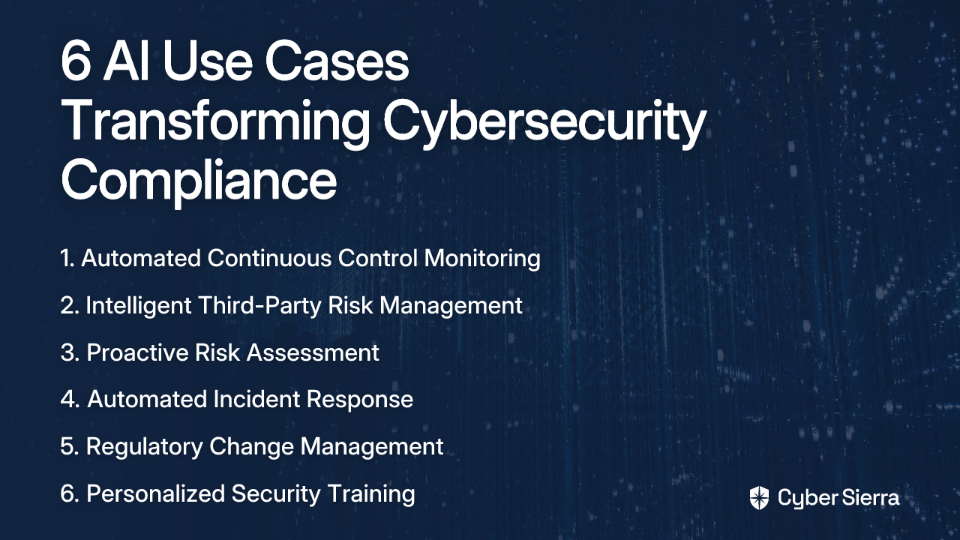
1. Automated Continuous Control Monitoring (CCM) and Evidence Collection
Manual evidence gathering for frameworks like SOC 2 or ISO 27001 isn't just tedious—it's dangerously outdated. By the time you've collected screenshots and logs for your quarterly audit, the evidence is already stale, providing only a historical snapshot rather than your current security posture.
AI agents are transforming this process by automating control validation and evidence collection on a continuous, 24/7 basis:
- Real-Time Validation: AI agents connect directly to cloud environments, code repositories, and SaaS tools to test controls automatically against established frameworks. According to the Cybersierra blog, this ensures you have an always-current view of your compliance posture.
- Instant Violation Alerts: Instead of waiting for a quarterly audit to discover issues, AI agents generate reports and tickets for violations the moment they occur. This creates an effective feedback loop that drastically reduces the risk of audit surprises.
- Reduced False Positives: AI-enhanced CCM learns from historical data to provide better contextual understanding, significantly reducing alert fatigue and the noise from false positives over time.
Platforms like Cyber Sierra's Continuous Control Monitoring (CCM) centralize this entire process. They build a unified controls repository that serves as a single source of truth, transforming security from periodic spot-checks into a continuous, automated function that keeps you perpetually audit-ready.

2. Intelligent and Continuous Third-Party Risk Management (TPRM)
Traditional TPRM, based on static, annual questionnaires, is fundamentally broken in an interconnected world where a vendor's breach can quickly become your breach. The complexity of ensuring compliance with vendor security and privacy laws has become overwhelming for many organizations.
AI agents enable a shift from periodic assessments to continuous, real-time monitoring of your entire vendor ecosystem:
- Beyond Questionnaires: AI agents continuously scan a wide array of external data sources—including public breach data, dark web chatter, and security posture ratings—to provide a live view of vendor risk. According to EY, this approach enables "57% of organizations to now prioritize operational risk over previous metrics like concentration risk when assessing subcontractors."
- Automated Risk Assessment: AI automates the initial vendor onboarding, due diligence, and risk categorization, allowing your team to focus efforts on high-risk partners rather than treating all vendors with the same level of scrutiny.
- Proactive Alerts: AI can alert your organization to a vendor's deteriorating security posture before it leads to an incident, enabling proactive engagement and risk mitigation.
Specialized TPRM solutions address these challenges comprehensively. For instance, Cyber Sierra's TPRM platform automates the entire vendor risk lifecycle, from onboarding to continuous monitoring, providing 24/7 visibility into vendor compliance and moving organizations beyond outdated questionnaires to a proactive supply chain security strategy.
3. Proactive Risk Assessment and Predictive Compliance
Traditional risk management is reactive—it identifies problems after they've already occurred. This approach fails to meet the growing need for tools that can "proactively identify and resolve compliance issues" before they impact your business.
AI leverages predictive analytics to forecast potential compliance gaps and security incidents before they materialize:
- Pattern Recognition: AI models analyze vast amounts of historical compliance and security data to identify subtle patterns and precursors that often lead to control failures or breaches.
- Behavioral Analysis: AI-powered User and Event Behavior Analytics (UEBA) establish baselines of normal activity for users and systems. They can then flag anomalous behavior—like unusual data access patterns or logins from strange locations—as potential indicators of risk before they escalate to compliance violations.
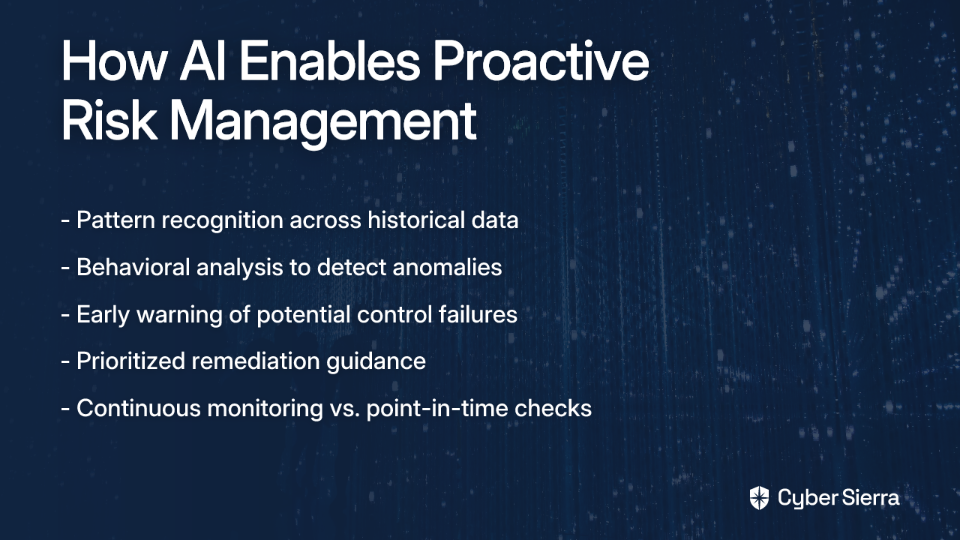
- Prioritized Remediation: By predicting high-risk areas, AI helps teams prioritize their remediation efforts, allocating finite resources to the most critical vulnerabilities rather than spreading efforts too thin.
This predictive capability is a core tenet of modern Governance, Risk, and Compliance (GRC). AI-driven platforms like Cyber Sierra integrate threat intelligence and vulnerability scanning to provide a forward-looking view of risk, turning compliance from a reactive chore into a strategic, proactive discipline.
4. Automating Incident Response for Compliance
During a security incident, teams are overwhelmed with technical containment. Critical compliance obligations, such as GDPR's 72-hour breach notification rule, can be missed, leading to heavy fines and reputational damage.
AI agents can automate and streamline incident response workflows to ensure compliance requirements are baked into the process from the start:
- Automated Containment: Based on predefined playbooks, AI agents can take immediate action to contain a threat, such as isolating an infected machine from the network or forcing a password reset for a compromised account.
- Automated Documentation: As the AI agent responds, it simultaneously documents every action taken—timestamping events, logging affected systems, and identifying potentially compromised data. This creates a detailed, immutable audit trail required for post-incident reporting and regulatory compliance.
- Faster Analysis: AI can rapidly analyze incident data, helping to identify the root cause and scope of a breach far faster than human analysts, which is crucial for meeting tight regulatory deadlines.
Integrated GRC platforms are essential for this orchestration. The incident response documentation and audit trail features within Cyber Sierra's GRC module ensure that all evidence is captured automatically, streamlining regulatory reporting and reducing the risk of non-compliance during a crisis.
5. Navigating Regulatory Complexity and Change Management
The regulatory landscape is in constant flux. Manually tracking changes to frameworks like NIST, GDPR, or the upcoming EU AI Act, and then mapping those changes to hundreds of internal controls, is an immense, error-prone burden for compliance teams.
AI, particularly Natural Language Processing (NLP), can automate the interpretation of complex regulatory text and its application to an organization's control framework:
- Automated Interpretation: AI technologies can "interpret complex legal language, simplifying compliance processes". This means automatically scanning new regulations, identifying key obligations, and extracting the relevant requirements without extensive manual review.
- Dynamic Control Mapping: Once a new requirement is identified, the AI agent can suggest updates to the organization's existing controls, policies, and procedures, ensuring the compliance posture remains current without requiring compliance teams to manually cross-reference every change.
A unified GRC platform is the engine for this adaptability. When powered by AI, platforms like Cyber Sierra help organizations manage multiple overlapping frameworks simultaneously. They automatically map new regulatory requirements across SOC 2, ISO 27001, and HIPAA, dramatically reducing the manual effort required to stay compliant in a dynamic world.
6. Personalized Employee Security Training and Awareness
One-size-fits-all annual security training is boring, ineffective, and fails to address the "human firewall," which is a mandatory component of many compliance frameworks. As Reddit users note, "phishing scams continue to be a prevalent threat," especially to less tech-savvy individuals.
AI creates dynamic, personalized security awareness programs that demonstrably reduce human-related risk:
- Adaptive Learning: AI can "tailor employee training based on specific needs and learning progress". For example, if an employee in finance repeatedly clicks on simulated invoice-themed phishing emails, the AI can automatically assign them targeted micro-training modules on that specific threat vector.
- Realistic Simulations: AI can generate highly realistic and targeted simulated phishing campaigns that mimic the evolving tactics of real-world attackers, providing a much more effective test of employee vigilance.
- Demonstrable Compliance: This data-driven approach provides compliance managers with clear metrics and reporting to prove to auditors that the organization has an effective, ongoing security awareness program in place.
Building a security-conscious culture is a compliance imperative. Solutions like Cyber Sierra's Employee Security Training leverage this AI-driven approach, using interactive quizzes and hyper-realistic phishing simulations to strengthen the human firewall and give organizations the evidence they need to satisfy audit requirements.
From Reactive to Proactive: The AI Advantage
AI agents are fundamentally shifting cybersecurity compliance from a reactive, periodic, and manual burden to a proactive, continuous, and intelligent business function. By automating tedious tasks, providing predictive insights, and enabling real-time monitoring, AI is helping organizations stay ahead of both auditors and attackers.
It's important to note that AI isn't replacing human expertise but augmenting it. It automates the data-intensive tasks, freeing up compliance and security professionals to focus on high-level strategy, risk management, and critical decision-making.
Frequently Asked Questions
What is AI-powered cybersecurity compliance?
AI-powered cybersecurity compliance uses artificial intelligence to automate, monitor, and manage compliance processes in real-time. Instead of relying on manual, periodic checks, AI agents continuously validate security controls, collect audit evidence, and identify potential risks before they become breaches. This transforms compliance from a reactive, time-consuming task into a proactive, intelligent function that strengthens an organization's overall security posture.
How does AI automate evidence collection for audits like SOC 2?
AI automates evidence collection by directly integrating with your cloud services, code repositories, and SaaS tools to gather proof of compliance 24/7. AI agents are programmed to understand the requirements of frameworks like SOC 2 or ISO 27001. They continuously test controls—such as MFA configurations or data encryption settings—and automatically capture logs, screenshots, and configuration data as evidence. This eliminates the manual, error-prone process of gathering evidence before an audit and ensures you are always prepared.
Why is continuous monitoring better than traditional compliance checks?
Continuous monitoring is better because it provides a real-time, accurate view of your security posture, whereas traditional checks only offer an outdated snapshot. Traditional quarterly or annual audits can miss critical vulnerabilities that appear between checks. AI-powered Continuous Control Monitoring (CCM) identifies and alerts on control failures the moment they happen. This allows for immediate remediation, drastically reducing the window of risk and preventing surprises during an official audit.
Will AI replace the role of a human compliance professional?
No, AI does not replace compliance professionals; it augments their capabilities by handling repetitive, data-intensive tasks. AI automates tasks like evidence collection, control testing, and data analysis, freeing up human experts to focus on strategic initiatives. This includes interpreting complex regulatory nuances, managing high-level risk, making critical decisions during incidents, and communicating with stakeholders—all areas where human judgment is irreplaceable.
How does AI help organizations keep up with new regulations?
AI helps by automatically interpreting new regulatory texts and mapping the new requirements to an organization's existing security controls. Using Natural Language Processing (NLP), AI can scan new laws and standards, identify key obligations, and suggest necessary updates to your policies and procedures. This dramatically reduces the manual effort required for regulatory change management and helps ensure your compliance framework remains current and comprehensive.
Ready to make your compliance program proactive, intelligent, and perpetually audit-ready? Explore how an AI-enabled, unified platform like Cyber Sierra can streamline your GRC, TPRM, and continuous monitoring efforts into a single, cohesive strategy that keeps you secure and compliant in an increasingly complex world.
