



Top 10 Integrated GRC and CCM Solutions for Financial Services

Join thousands of professionals and get the latest insight on Compliance & Cybersecurity.
Summary
- The financial services industry faces increasing regulatory complexity and cyber threats, making traditional, manual GRC and compliance management unsustainable.
- Integrated GRC and Continuous Control Monitoring (CCM) platforms automate evidence collection and provide real-time visibility, transforming compliance into a continuous, data-driven program.
- Before selecting a tool, define your internal processes and prioritize platforms with strong automation, multi-framework support, and integration capabilities.
- Cybersierra offers a unified GRC and CCM platform that automates compliance tasks across multiple frameworks, helping enterprises become audit-ready faster.
You've spent countless hours manually gathering evidence for your latest compliance audit. Your team is drowning in spreadsheets tracking vendor risks. And just when you think you're on top of one regulatory framework, another one emerges demanding your attention. If you're nodding along, you're not alone in the financial services industry.
The days of managing governance, risk, and compliance through disconnected tools and manual processes are rapidly becoming untenable. With increasing regulatory scrutiny and evolving cyber threats, financial institutions need a more integrated, automated approach to security and compliance.
Governance, Risk, and Compliance (GRC) platforms help align IT with business objectives while managing risks and meeting regulatory requirements. When paired with Continuous Control Monitoring (CCM) capabilities that provide real-time visibility into control effectiveness, these integrated solutions transform compliance from a periodic, audit-driven exercise into an ongoing, data-driven program.
In this article, we'll explore the top 10 integrated GRC and CCM solutions that are helping financial services organizations streamline compliance, enhance security posture, and reduce the headaches associated with audit preparation.

1. Cybersierra
Overview: Cybersierra offers an AI-enabled cybersecurity platform specifically designed to simplify and automate security compliance for enterprises in highly regulated industries like financial services. Recently recognized as a Sample Vendor in the 2024 Gartner Hype Cycle for Cyber-Risk Management in both Cyber GRC and CCM categories, Cybersierra is pioneering the integration of these critical functions.
Key Features:
- Governance, Risk & Compliance (GRC): Automates data collection, risk assessments, and reporting for frameworks like SOC 2, ISO 27001, GDPR, and PCI DSS, making enterprises audit-ready faster and reducing compliance fatigue.
- Continuous Control Monitoring (CCM): Provides a central controls repository with near real-time updates and ongoing visibility into security posture, automating control testing and validation while detecting exceptions proactively.
- Third-Party Risk Management (TPRM): Simplifies vendor risk assessment, onboarding, and continuous monitoring, moving beyond point-in-time questionnaires to provide 24/7 visibility into vendor security compliance.
- Threat Intelligence: Offers a comprehensive security scorecard, performs network and cloud vulnerability scanning, and helps prioritize remediation efforts.
What Sets It Apart: Cybersierra stands out for its unified approach that transforms security from periodic checks to continuous, automated monitoring. The platform provides a single source of truth for controls and enables proactive risk management across multiple compliance frameworks simultaneously, addressing a common pain point for financial institutions juggling diverse regulatory requirements.
2. MetricStream
Overview: A well-established leader in the GRC space, MetricStream is recognized by both Gartner and Forrester for its "Connected GRC" solution that enhances organizational agility and resilience, particularly in the financial sector.
Key Features:
- Strong AI and advanced analytics for enterprise-wide risk visibility
- Centralized repository for risk, compliance, and policy management
- Tailored solutions for emerging financial regulations like DORA (Digital Operational Resilience Act)
What Sets It Apart: MetricStream excels in providing solutions specifically designed for the banking, financial services, and insurance (BFSI) sector, with robust capabilities for managing regulatory change and operational resilience.
3. ServiceNow GRC
Overview: An ideal solution for organizations already embedded in the ServiceNow ecosystem for IT service management (ITSM), ServiceNow GRC extends familiar workflows into compliance and risk management.
Key Features:
- Seamless integration with existing IT workflows for a unified operational view
- No-code playbooks and automated workflows for customizing risk and compliance processes
- Real-time monitoring and customizable dashboards
What Sets It Apart: The platform leverages its strong foundation in IT service management to create a seamless experience where compliance activities become an extension of regular operational workflows, reducing friction in adoption.
4. Archer
Overview: Known for its deep customization capabilities, Archer provides a comprehensive, integrated risk management approach that has long been a staple in large financial institutions.
Key Features:
- Provides a suite of tools for managing risk, compliance obligations, and audit management
- Dynamic dashboards for real-time risk visibility
- Extensive content libraries for various regulatory frameworks
What Sets It Apart: Archer offers unparalleled depth in its customization capabilities, allowing financial institutions to tailor the platform to their specific organizational structures and complex regulatory environments, though user feedback suggests this can lead to a more complex setup process.
5. Drata
Overview: A leader in the compliance automation space, Drata is particularly popular with high-growth technology and cloud-native financial services companies.
Key Features:
- Excels at automated evidence collection across over 20 frameworks
- Designed for scalability, making it suitable for organizations from startups to enterprises
- Focuses on making companies "audit-ready" continuously
What Sets It Apart: Drata's user-friendly interface and streamlined evidence collection process directly addresses one of the most painful aspects of compliance work—gathering documentation for audits—making it especially valuable for lean compliance teams.
6. LogicGate
Overview: A flexible platform known for its user-friendly, no-code environment for building and automating risk and compliance programs in financial services.
Key Features:
- Features a drag-and-drop workflow builder that is highly intuitive
- Provides a suite of modular applications for different GRC needs
- Strong analytics capabilities to help tailor compliance efforts
What Sets It Apart: LogicGate's Risk Cloud platform empowers business users to create and modify workflows without technical expertise, addressing the common frustration that "a poorly defined process can make any GRC tool ineffective" by allowing continuous process refinement.
7. AuditBoard
Overview: A cloud-native platform designed to unify audit, risk, compliance, and ESG processes in a single, collaborative workspace, ideal for financial institutions managing multiple audit streams.
Key Features:
- Strong collaborative features for document management and audit workflows
- User-friendly design aimed at addressing the confusion that comes from using multiple, disconnected GRC tools
- Focused on streamlining the audit process and reducing preparation time
What Sets It Apart: AuditBoard was built by former auditors specifically to address the communication challenges between audit teams and business units, creating a more streamlined experience for all stakeholders in the audit process.
8. Vanta
Overview: A compliance automation platform that helps financial companies streamline the process of achieving certifications like SOC 2, ISO 27001, and HIPAA.
Key Features:
- Automates up to 90% of the work for security and privacy frameworks
- Provides continuous monitoring and integrates with a wide range of cloud services and tools
- Strong focus on evidence collection and audit readiness
What Sets It Apart: Vanta excels at continuous control monitoring, with automated testing and validation that detects control failures in near real-time, reducing the risk of audit findings and security breaches.
9. Workiva
Overview: A unified platform that is particularly strong in integrating financial reporting, ESG, and GRC—a crucial capability for public financial institutions.
Key Features:
- Connects financial data directly to compliance and risk reporting, ensuring consistency
- Excellent for organizations where GRC is closely tied to financial and SEC reporting
- Strong document control and version management
What Sets It Apart: Workiva uniquely addresses the intersection of financial reporting and compliance, making it particularly valuable for publicly traded financial institutions that must meet both SEC requirements and industry-specific regulations.
10. Pathlock
Overview: A platform that focuses on identity security and application controls, unifying user access governance with broader GRC functions—critical in financial environments.
Key Features:
- Automates user access reviews, SoD (Segregation of Duties) analysis, and compliance reporting
- Integrates deeply with major ERP systems like SAP, Oracle, and Workday for real-time compliance
- Focuses on transaction monitoring to prevent fraud and financial misstatement risks
What Sets It Apart: Pathlock's strong focus on access governance and transaction monitoring directly addresses key financial control requirements, making it particularly valuable for institutions concerned with fraud prevention and financial integrity.
How to Choose the Right Integrated GRC/CCM Solution
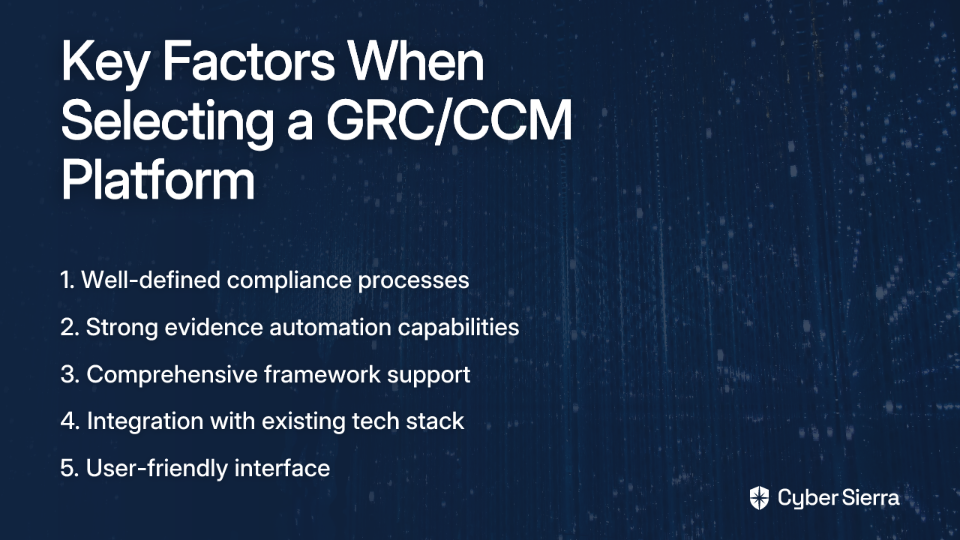
Selecting the right platform for your financial institution requires careful consideration of your specific needs and processes. Based on common industry challenges, here are key factors to evaluate:
1. Define Your Processes Before Your Purchase
As one compliance professional noted on Reddit, "a poorly defined process can make any GRC tool ineffective." No software, no matter how sophisticated, can fix broken or overly complex processes. Before evaluating platforms:
- Map your current workflows for risk assessment, control testing, and evidence gathering
- Identify bottlenecks and inefficiencies in your existing approach
- Define clear objectives for what you want the GRC platform to accomplish
2. Prioritize Automation for Evidence Management
The most painful part of an audit is typically evidence gathering—a tedious, time-consuming process, especially for lean compliance teams. Look for a platform that:
- Automates evidence collection by integrating with your cloud providers, code repositories, and HR systems
- Provides robust evidence protection and sharing features to maintain data integrity
- Supports continuous evidence collection rather than point-in-time snapshots
3. Ensure Comprehensive Framework Support and Customization
Your chosen tool must support the specific frameworks required in financial services (PCI DSS, SOC 2, ISO 27001, etc.) while remaining flexible enough to adapt to your organization's unique needs:
- Evaluate how well the platform handles framework mapping and control overlap
- Look for the ability to manage custom controls alongside standard frameworks
- Consider how the platform will adapt to emerging regulations specific to financial services
4. Evaluate Integration and Scalability
Many financial organizations struggle with "juggling multiple GRC platforms," leading to confusion and inefficiency. A good solution should:
- Integrate with your existing tech stack to become a single source of truth
- Scale with your organization's compliance maturity and growing regulatory requirements
- Support expanding to additional frameworks without significant reconfiguration
5. Focus on User Experience (UX)
A tool is useless if your team won't use it. Ineffective search functionalities and clunky interfaces can create bottlenecks, "especially during audits." Prioritize platforms with:
- Intuitive dashboards and clear reporting
- Effective search capabilities to quickly locate evidence and controls
- Easy navigation and a short learning curve for new users
Conclusion
The financial services landscape demands a proactive, automated, and integrated approach to risk and compliance. Manual, periodic checks are no longer sufficient in an environment of increasing regulatory scrutiny, evolving cyber threats, and customer expectations for data protection.
By adopting an integrated GRC and CCM platform like Cybersierra, financial institutions can transform security from a reactive, audit-driven exercise into a continuous, data-driven program. This not only strengthens security posture but also builds trust with regulators, customers, and partners.
The right platform empowers your organization to move beyond compliance checklists and achieve true cyber resilience—turning what was once a burdensome overhead activity into a strategic advantage that protects your reputation and bottom line.
As you evaluate the options presented in this article, consider how each solution addresses your specific challenges and aligns with your long-term compliance strategy. The goal isn't just to pass the next audit but to build a sustainable approach to governance, risk, and compliance that evolves with your business and the regulatory landscape.
Frequently Asked Questions (FAQ)
What are GRC and CCM, and why are they crucial for financial services?
GRC (Governance, Risk, and Compliance) is a strategy for managing an organization's overall governance, risk management, and compliance with regulations, while CCM (Continuous Control Monitoring) is the technology used to automate the testing and validation of security controls in real-time. For financial services, which face intense regulatory scrutiny and constant cyber threats, integrating GRC and CCM is crucial. This approach transforms compliance from a manual, periodic task into an automated, ongoing program, helping institutions proactively manage risks and prove compliance to auditors.
How does an integrated GRC and CCM platform simplify the audit process?
An integrated GRC and CCM platform dramatically simplifies audits by automating evidence collection and providing a single source of truth for all compliance activities. Instead of manually gathering screenshots and documents, the platform continuously collects evidence from your tech stack (like cloud providers and HR systems). This reduces audit preparation time from weeks to hours and minimizes friction between teams.
What is the main benefit of a unified platform over separate tools?
The main benefit of a unified GRC and CCM platform is that it provides a single, real-time view of your entire security and compliance posture. Juggling separate tools often leads to data silos and inefficiencies. A unified solution connects these functions, allowing you to map a single control to multiple frameworks (e.g., SOC 2, ISO 27001, PCI DSS) simultaneously, which eliminates redundant work and improves accuracy.
Can these platforms help with new and emerging financial regulations?
Yes, a key strength of modern GRC platforms is their ability to adapt to new and emerging regulations. Most top-tier platforms maintain extensive libraries of regulatory frameworks and update them as new rules, like the Digital Operational Resilience Act (DORA), are introduced. Their flexible design allows you to add custom controls and map existing ones to new requirements, ensuring your compliance program can evolve with the regulatory landscape.
What should I do before buying a GRC tool?
Before buying a GRC tool, you must clearly define and document your internal compliance and risk management processes. A GRC platform is a powerful enabler, but it cannot fix a broken or undefined process. Start by mapping your current workflows, identifying bottlenecks, and clarifying roles. Having well-defined processes ensures you can configure the tool effectively and get the maximum return on your investment.
How does Continuous Control Monitoring (CCM) work?
Continuous Control Monitoring (CCM) works by automatically and continuously testing your security controls against your defined policies. CCM platforms integrate directly with your technology stack (e.g., AWS, Azure, GitHub) and run automated tests to verify that controls are implemented correctly. If a control fails, the system generates an alert, allowing you to remediate the issue proactively long before an auditor finds it.
