



AI GRC Tools Explained: What CISOs Should Look For in 2026

Join thousands of professionals and get the latest insight on Compliance & Cybersecurity.
Summary
- Traditional GRC is failing due to manual processes; by early 2024, 72% of companies were already using AI in GRC, reporting up to a 62% improvement in compliance efficiency.
- AI will not replace GRC professionals but will augment them, automating routine tasks so they can focus on strategic work like stakeholder engagement and risk management.
- By 2026, essential GRC platforms must provide continuous control monitoring, predictive risk intelligence, and automated evidence collection to enable a proactive security posture.
- Prepare for 2026 by automating routine tasks and upskilling your team; a unified platform like Cyber Sierra streamlines this transition by integrating essential AI-powered GRC capabilities.
You've spent another weekend preparing for an audit, manually collecting screenshots and chasing stakeholders for evidence. Your inbox is bursting with vendor questionnaires, and the board is asking about AI risks while expecting you to leverage AI for efficiency. Sound familiar?
The reality for many GRC professionals echoes this sentiment from a practitioner: "90% of my job is nudging (shoving) people to do the right thing" while spending too much time on "mundane repetitive admin stuff."
By 2026, AI-powered GRC tools won't just be nice-to-have—they'll be essential. But they won't replace GRC professionals. Instead, they'll augment capabilities, handling data-heavy lifting so you can focus on what AI can't do: strategic risk management and stakeholder engagement.
The Inevitable Shift: Why Traditional GRC is Failing
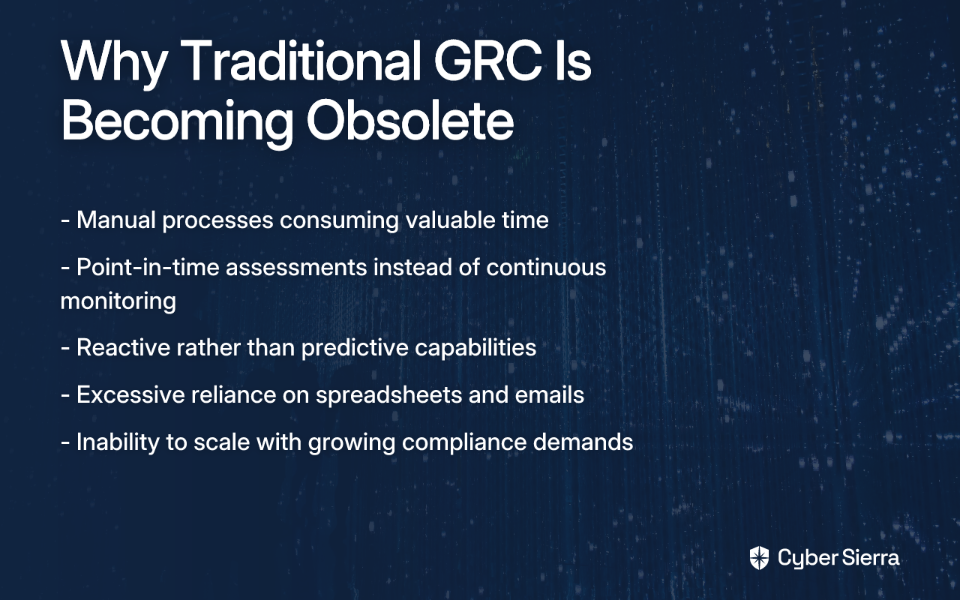
Traditional GRC relies on manual processes, periodic audits, and countless spreadsheets. This approach is slow, error-prone, and provides only a point-in-time snapshot of compliance. As one Reddit user bluntly put it: "GRC is a deeply problematic field built on shaky grounds and slowly failing to be the efficient solution to the problems it declares to be designed to solve."
In contrast, AI-driven GRC offers:
- Continuous monitoring rather than periodic assessments
- Predictive capabilities instead of reactive responses
- Automated workflows replacing manual tasks
The shift is already happening. Organizations leveraging AI in GRC report up to a 62% improvement in compliance efficiency. By early 2024, 72% of companies reported using AI in their GRC functions. The risk is real: 1 out of every 80 prompts (1.25%) from enterprise devices risks sensitive data leakage, highlighting the need for robust AI governance.

The 2026 CISO Checklist: 8 Essential Capabilities of an AI GRC Platform
1. Continuous Control Monitoring (CCM)
The days of point-in-time assessments are ending. By 2026, continuous control monitoring will be the standard, providing near real-time visibility into the effectiveness of security controls across your organization.
This capability is essential because it provides proactive assurance of security and compliance, allowing teams to fix gaps before they become breaches or audit findings. Research shows that CCM can reduce duplicative controls by up to 66%.
Key AI-driven features to look for:
- Automated control testing and validation against frameworks like NIST, ISO 27001, and PCI DSS
- Predictive analytics to forecast potential control failures
- Real-time detection of exceptions and anomalies
Platforms like Cyber Sierra's Continuous Control Monitoring (CCM) provide a central repository for controls, automating data collection across cloud environments and SaaS tools to give CISOs a single source of truth on their security posture.
2. Intelligent Third-Party Risk Management (TPRM)
Supply chain attacks continue to be a massive threat vector. By 2026, static vendor questionnaires will be obsolete, replaced by continuous, dynamic monitoring of third-party risks.
AI-powered TPRM platforms will:
- Automate vendor due diligence and risk scoring using external data sources
- Provide real-time alerts on significant changes in a vendor's security posture
- Help answer up to 80% of incoming security questionnaires with 95% accuracy
Tools like Cyber Sierra's TPRM platform automate this process, offering continuous visibility into vendor compliance and security, ensuring that third-party risk is managed proactively rather than reactively.
3. Predictive Risk Intelligence
By 2026, leading GRC platforms will use AI/ML models to forecast potential compliance issues, vulnerabilities, and security threats before they materialize. This capability enables a truly proactive security posture, allowing CISOs to prioritize resources on the most probable and high-impact risks.
Look for platforms that:
- Analyze historical data and current trends to forecast compliance gaps
- Simulate threat scenarios to test control resilience
- Prioritize vulnerability remediation based on real-time threat intelligence
This is where a Threat Intelligence module, like the one offered by Cyber Sierra, becomes critical. By combining outside-in vulnerability scanning with security posture insights, it helps teams identify and mitigate risks before they can be exploited.
4. Automated Evidence Collection & Workflow Automation
If there's one pain point that resonates with every GRC professional, it's the tedious task of gathering evidence for audits. By 2026, this process will be largely automated, addressing what one user described as the "mundane repetitive admin stuff."
Essential capabilities include:
- Integration with cloud services, security tools, and HR systems for automatic evidence collection
- Mapping a single piece of evidence to multiple controls across different frameworks
- Automating task assignments and reminders for control owners
This automation will free up significant hours spent on audit preparation and reduce human error, allowing GRC professionals to focus on strategic initiatives instead of administrative tasks.
5. Natural Language Processing (NLP) for Policy Management
By 2026, AI will transform how organizations create and manage GRC documentation. NLP capabilities will:
- Generate consistent policy drafts based on regulatory requirements
- Analyze vendor contracts and documents for security and compliance clauses
- Map policies to specific controls within GRC frameworks
While AI can draft policies, human expertise remains crucial for review. As one GRC professional noted: "The difference between 'should,' and 'shall' cannot be interpreted. AI does not understand business context."
6. Robust Framework Library & Seamless Integrations
In 2026, your GRC platform must come pre-loaded with common industry frameworks (SOC 2, ISO 27001, HIPAA, PCI DSS, GDPR) and offer strong APIs to connect with your existing tech stack.
This capability prevents vendor lock-in and reduces manual data entry. A strong framework library allows for quick adaptation to new compliance obligations without starting from scratch, something especially important as regulatory requirements continue to multiply.
7. AI Governance & Explainability
As regulations like the EU AI Act emerge, AI governance is becoming a compliance issue itself. Only 24% of organizations have comprehensive AI GRC policies in place.
By 2026, your GRC platform should not only use AI but also help you govern AI use across your organization. Look for:
- Transparency in how the AI reaches conclusions (explainability)
- Alignment with frameworks like NIST AI Risk Management Framework and ISO/IEC 42001
- Controls to prevent AI hallucinations and ensure data privacy
8. Intuitive UI/UX for Stakeholder Adoption
GRC is a team sport. If your tool is clunky, control owners and other stakeholders won't use it, undermining your entire program. This directly relates to the challenge of "nudging people to do the right thing."
By 2026, look for platforms with:
- Intuitive interfaces that require minimal training
- Role-based dashboards that show stakeholders only what they need
- Mobile accessibility for on-the-go approvals and tasks
Beyond the Hype: Practical AI Use Cases in GRC Today
While we've focused on future capabilities, several practical AI applications are already transforming GRC today:
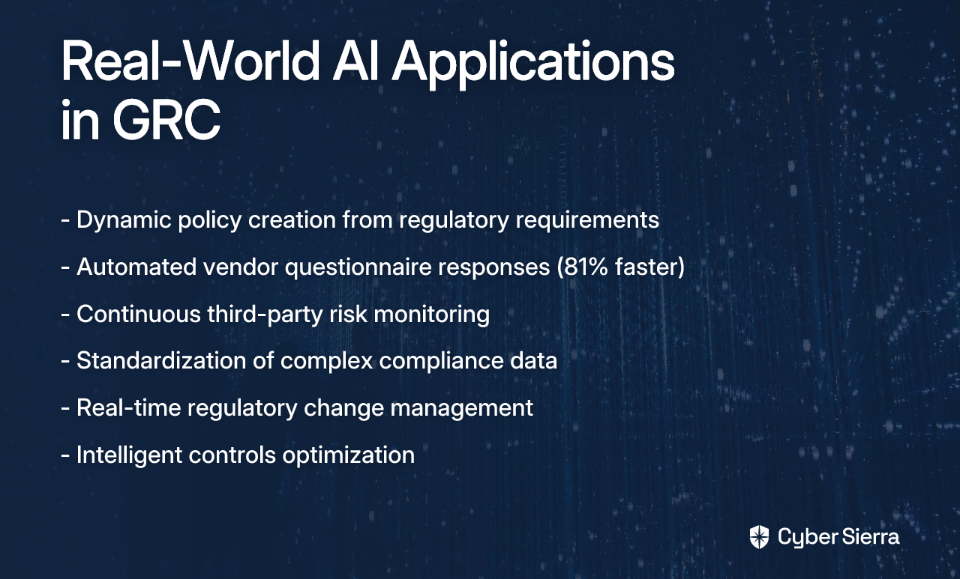
- Dynamic Policy Creation: Using LLMs to generate policy drafts based on regulatory requirements, allowing human experts to focus on review and customization.
- Automating Vendor Questionnaires: AI tools are accelerating security reviews by up to 81%.
- Third-Party App Risk Management: AI platforms continuously analyze vendor risk profiles rather than relying on point-in-time assessments.
- Streamlining Compliance Data: AI parses complex scan data into standardized, actionable formats for remediation.
- Regulatory Change Management: AI monitors regulatory feeds and maps changes to internal controls, ensuring ongoing compliance.
- Internal Controls Optimization: AI performs automated gap analyses to find control weaknesses and redundancies.
The critical caveat: human review is essential to mitigate AI hallucinations and ensure data privacy. AI is a tool, not a replacement for expert judgment.
AI Augments, Not Replaces: The Irreplaceable Human Element
Let's address the elephant in the room: Will AI replace GRC professionals?
The consensus from practitioners is clear: "AI has no people skills. GRC requires it."
By 2026, AI will handle data collection and analysis, freeing up humans to focus on high-value tasks requiring uniquely human skills:
- Stakeholder Engagement: Negotiating with and convincing business leaders remains the hardest part of GRC and cannot be automated. As one professional put it: "The hardest part of GRC is the stakeholder engagement, primarily the negotiating and convincing business to go along the journey."
- Contextual Judgment: Understanding business context, risk appetite, and the nuances of a specific environment requires human insight.
- Strategic Planning: Building relationships, fostering a security culture, and advising the board on risk strategy remain fundamentally human activities.
GRC roles will become more technical and strategic. The focus will shift from being a "box-checker" to a "risk advisor," with AI handling the routine tasks that currently consume too much time.
Conclusion: Preparing Your GRC Strategy for 2026 and Beyond
The future of GRC is a partnership between human experts and intelligent automation. The key for CISOs is to look for tools that offer continuous monitoring, predictive intelligence, and workflow automation while empowering their teams to focus on strategic risk management.
Here are actionable steps to prepare for this future:
- Evaluate Your GRC Maturity: Understand where manual processes are causing the most friction. Focus on automating these areas first.
- Define Specific Requirements: Don't get caught in AI hype. Focus on practical benefits that solve your biggest problems, such as audit prep time or vendor onboarding.
- Embrace Automation for Routine Tasks: Start with low-hanging fruit like evidence collection to build momentum.
- Upskill Your Team: Invest in training for both technical skills and strategic risk management.
A comprehensive, AI-enabled platform like Cyber Sierra can provide a unified starting point, integrating modules for GRC, CCM, TPRM, and more to streamline this transition.

As one GRC professional wisely noted: "Some parts of GRC can definitely be automated, like basic policy writing or risk questionnaires, but there's still a lot that needs human judgment." The most successful organizations in 2026 will be those that find the right balance—leveraging AI for efficiency while elevating their GRC teams to strategic risk advisors.
Frequently Asked Questions
What is AI GRC?
AI GRC refers to the use of artificial intelligence and machine learning to automate and enhance governance, risk, and compliance processes. Unlike traditional GRC, which relies on manual, point-in-time assessments, AI-driven GRC provides continuous monitoring, predictive risk intelligence, and automated workflows. This allows organizations to manage risk proactively, improve compliance efficiency, and free up GRC professionals to focus on strategic initiatives.
Will AI replace GRC professionals?
No, AI is not expected to replace GRC professionals; it is designed to augment their capabilities. AI excels at data-heavy, repetitive tasks like evidence collection, control testing, and data analysis. However, it lacks the uniquely human skills essential for GRC, such as stakeholder engagement, strategic negotiation, and contextual business judgment. The future role of a GRC professional will shift from administrative tasks to that of a strategic risk advisor, with AI handling the manual work.
What are the key features of an AI-powered GRC platform?
An effective AI-powered GRC platform should offer continuous monitoring, intelligent third-party risk management, predictive risk intelligence, and workflow automation. Essential features include Continuous Control Monitoring (CCM) for real-time visibility, automated vendor risk scoring, predictive analytics to forecast threats, automated evidence collection to streamline audits, and AI governance tools to manage AI use within the organization.
How does AI improve GRC efficiency?
AI dramatically improves GRC efficiency by automating manual, time-consuming tasks. For example, AI can automate the collection of evidence for audits, reducing preparation time significantly. It can also accelerate vendor security reviews by automatically answering incoming questionnaires and continuously monitoring third-party risk profiles. By handling this "mundane repetitive admin stuff," AI allows GRC teams to operate more strategically and scale their efforts effectively.
Why is traditional GRC no longer effective?
Traditional GRC is no longer effective because its reliance on manual processes and point-in-time assessments cannot keep up with the speed and complexity of modern business and cyber threats. This manual approach is slow, prone to human error, and provides a reactive, outdated snapshot of an organization's compliance posture. In contrast, today's dynamic regulatory and threat landscapes require the continuous, proactive, and scalable capabilities that AI-driven GRC solutions provide.
