



Why Modern GRC Must Support Multi-Framework Compliance

Join thousands of professionals and get the latest insight on Compliance & Cybersecurity.
Summary
- With 70% of organizations needing to comply with six or more frameworks, managing each separately leads to duplicated work, audit fatigue, and increased risk.
- Adopt a unified strategy by mapping controls across frameworks like SOC 2, ISO 27001, and PCI DSS to eliminate redundant efforts.
- Leverage Continuous Control Monitoring (CCM) to automate evidence gathering and maintain a constant state of audit readiness, rather than scrambling periodically.
- Unified GRC platforms like Cyber Sierra automate these processes, simplifying multi-framework compliance and turning it into a business enabler.
You've created solid security policies. You've implemented strong controls. You're ready for your next audit. Then the reality hits: your US clients want SOC 2 certification, European partners require ISO 27001, your healthcare division needs HIPAA compliance, and the finance team is asking about PCI DSS.
Sound familiar? If you're in a regulated industry, you've likely felt the pressure of managing multiple frameworks simultaneously, wondering how to put all these requirements together efficiently without drowning in documentation and duplicative work.
The truth is, traditional, siloed Governance, Risk, and Compliance (GRC) approaches are no longer viable in today's complex regulatory landscape. Modern organizations need a unified, multi-framework strategy powered by automation and continuous monitoring.
Why One Framework Is Never Enough
The Reality of Today's Compliance Landscape
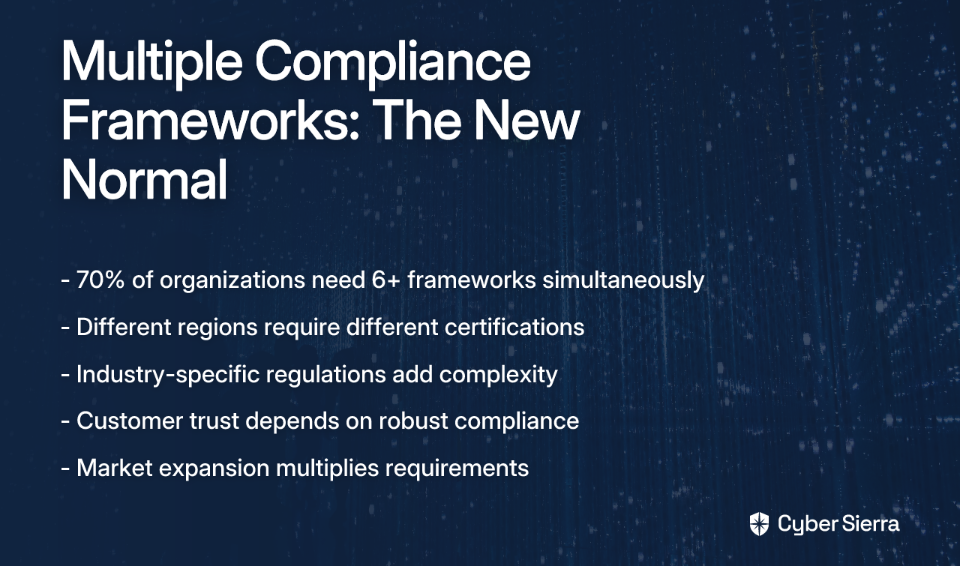
According to industry research, 70% of service organizations need to demonstrate compliance with at least six frameworks simultaneously. This isn't just about regulatory checkbox-ticking—it's about business growth and customer trust.
When expanding into new markets or targeting new customer segments, compliance requirements multiply. For example:
- SaaS & Technology companies typically need SOC 2 for US clients, ISO 27001 for international operations, plus GDPR and CCPA/CPRA for data privacy.
- Healthcare organizations must navigate HIPAA for protected health information, while potentially also requiring HITRUST certification.
- Financial services need to balance PCI DSS for payment data with SOC 2 for financial information security.
- Government contractors face FISMA, NIST 800-53, FedRAMP, and CMMC requirements.
This multi-framework reality is driven by two powerful forces:
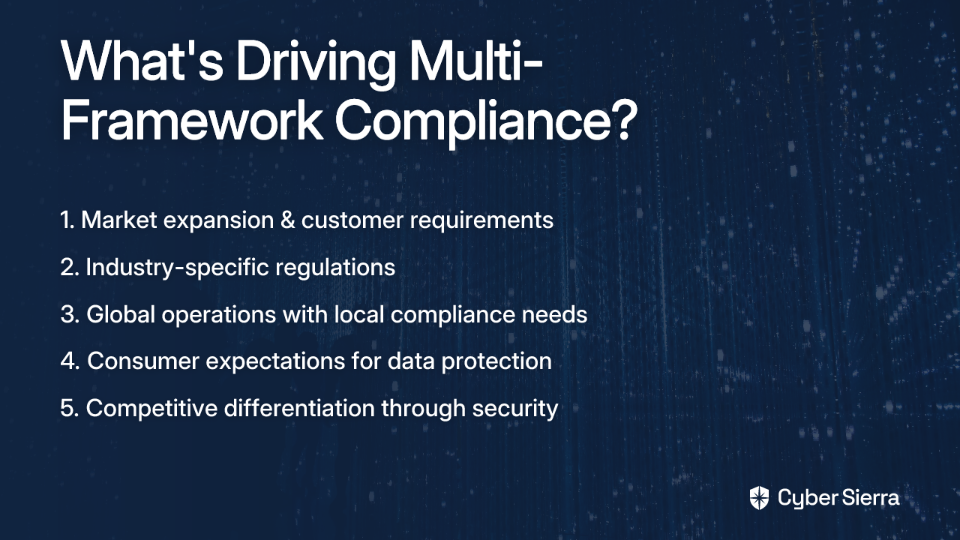
- Market expansion and customer requirements - To operate globally, you must comply locally. When 71% of consumers report they would stop doing business with a company that mishandles sensitive data, robust compliance becomes a competitive necessity.
- Industry-specific regulations - Different sectors have their own specialized frameworks, often requiring organizations to address overlapping yet distinct requirements simultaneously.
The High Cost of the Siloed "Spreadsheet" Approach
Many organizations attempt to manage multiple frameworks using disconnected spreadsheets, documents, and manual processes. This approach creates significant problems:
Audit Fatigue and Duplication of Effort
When each framework is managed separately, teams end up testing the same control multiple times for different audits. For example, your access control requirements might be validated once for SOC 2, again for ISO 27001, and yet again for PCI DSS.
As one compliance professional on Reddit noted: "The certs, risk docs, and endless follow-ups became a full-time job." This duplicative effort drains resources and creates audit fatigue across the organization.
Operational Bottlenecks
Managing security questionnaires, compliance certifications, and risk assessments for each framework separately creates what many practitioners describe as a "massive operational bottleneck."
This challenge is particularly acute in vendor management, where the same security controls might need to be verified repeatedly through different lenses for different frameworks—a process that quickly becomes unsustainable without the right tools.
Documentation Chaos and "Tribal Knowledge"
Perhaps most concerning is the fragmentation of compliance documentation. Without a centralized approach, critical information often exists only as "tribal knowledge" held by individual team members. As one security professional explained: "Not everything is documented and mostly tribal knowledge, so in my first year it was getting documentation down."
This reliance on undocumented knowledge creates significant risk when team members leave and makes passing audits unnecessarily difficult.
The Solution: A Unified Strategy with Continuous Monitoring
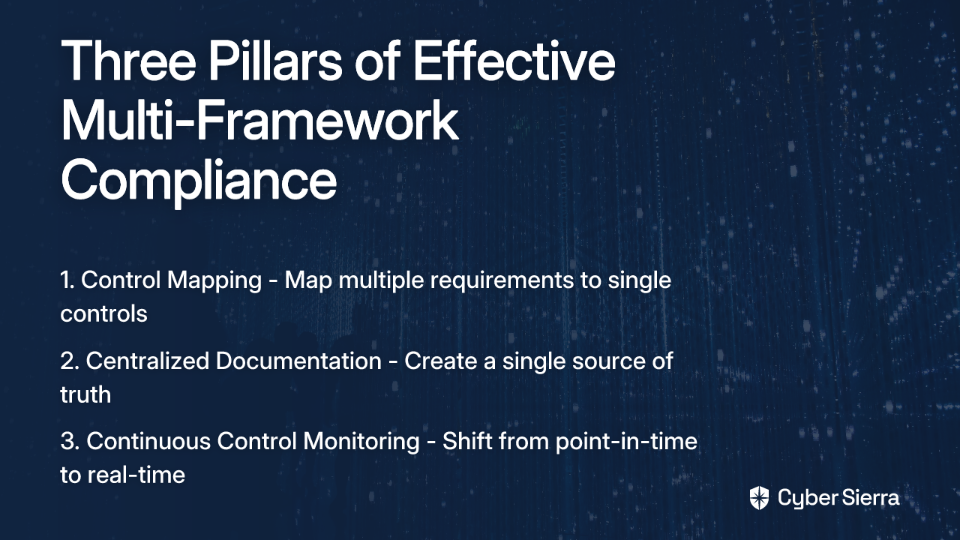
To effectively manage multi-framework compliance, organizations need a unified approach built on three key pillars:
1. Control Mapping: The Foundation of Efficiency
Control mapping is the process of identifying overlaps between different frameworks and mapping them to a common set of internal controls. This "write once, comply many" approach drastically reduces redundant work.
As one practitioner recommended: "I've taken to using the NIST framework control mapping to map multiple frameworks to a single control."
For example, a password policy might satisfy requirements across SOC 2 (CC6.1), ISO 27001 (A.9.4.3), and NIST CSF (PR.AC-1) simultaneously. By understanding these relationships, you can implement one robust control that satisfies multiple requirements.
2. Centralized Documentation
To overcome "tribal knowledge" problems, organizations need a central repository for all policies, procedures, and evidence. This ensures consistency across frameworks and provides a single source of truth for auditors.
3. Continuous Control Monitoring (CCM)
Continuous Control Monitoring represents a fundamental shift from point-in-time compliance to ongoing assurance. According to the Cloud Security Alliance, CCM is a proactive approach that provides automated, near real-time oversight of an organization's controls to ensure they effectively mitigate risks and maintain compliance.
Unlike traditional methods that check controls periodically, CCM acts as a "digital watchdog" that constantly evaluates your security posture. This brings several critical benefits:
- Early Detection of Risks: Near real-time monitoring allows for immediate identification of control failures or degradation, transforming risk management from reactive to proactive.
- Reduced Manual Work: By automating data collection and reporting across frameworks, CCM frees up compliance professionals for more strategic tasks.
- Improved Compliance Maturity: Organizations move from scrambling before audits to maintaining continuous compliance readiness.
Supercharging GRC: The Role of AI and Automation
While CCM represents a significant advancement, artificial intelligence takes multi-framework compliance to the next level. Traditional GRC methods are becoming obsolete as the volume and complexity of compliance requirements grow.
Organizations using AI for security automation report up to a 62% improvement in compliance efficiency, making it increasingly essential for modern GRC programs.
AI-powered capabilities enhance multi-framework compliance through:
- Predictive Risk Intelligence: Forecasting compliance issues before they lead to audit failures or breaches.
- Automated Evidence Collection: Gathering, validating, and mapping compliance evidence across multiple frameworks like NIST, ISO 27001, and PCI DSS.
- Natural Language Processing: Analyzing unstructured data like policy documents to identify gaps and map them to controls.
Modern GRC Platforms: Bringing it All Together
To implement this advanced approach, organizations need modern GRC platforms that support multi-framework compliance through automation and continuous monitoring.
Platforms like Cyber Sierra exemplify this approach through:
- A Governance, Risk & Compliance (GRC) module that automates data collection and manages multiple frameworks (SOC 2, ISO 27001, HIPAA, PCI DSS) from a single dashboard, simplifying audits.
- A Continuous Control Monitoring (CCM) module that provides near real-time visibility into security controls, automating control testing and detecting anomalies to make compliance an ongoing, not periodic, activity.
These capabilities transform what would be overwhelming manual effort into a streamlined, automated process that scales with your compliance needs.
Transforming Compliance from a Burden to a Business Enabler
The modern business environment demands a multi-framework approach to compliance. Trying to manage this with manual, siloed processes leads to inefficiency, increased risk, and burnout among security and compliance teams.
A unified GRC strategy, built on the principles of control mapping and enabled by Continuous Control Monitoring and AI, transforms compliance from a reactive cost center into a proactive, strategic asset that:
- Builds customer trust through demonstrable security practices
- Accelerates market entry by streamlining certification processes
- Strengthens overall security posture through continuous visibility
Is your GRC program ready for the complexities of modern compliance? It's time to move beyond spreadsheets and embrace a unified platform that turns multi-framework compliance into a competitive advantage.
Frequently Asked Questions
What is multi-framework compliance?
Multi-framework compliance is the process of adhering to the requirements of multiple security and privacy frameworks simultaneously. This is necessary for organizations that operate in different regions, serve various industries, or need to meet diverse customer demands, such as complying with SOC 2, ISO 27001, and HIPAA all at once.
Why is managing multiple compliance frameworks so challenging?
Managing multiple compliance frameworks is challenging due to the significant overlap in requirements, which leads to duplicated efforts and audit fatigue when handled in silos. This traditional "spreadsheet" approach often results in documentation chaos, operational bottlenecks, and a reliance on inconsistent "tribal knowledge," making audits inefficient and increasing compliance risk.
What is control mapping and how does it simplify compliance?
Control mapping is the practice of identifying overlapping requirements across different frameworks and linking them to a single, unified internal control. This "write once, comply many" approach drastically simplifies compliance by eliminating redundant work. For example, a single access control policy can be mapped to satisfy requirements in SOC 2, ISO 27001, and PCI DSS, saving significant time and resources.
How does Continuous Control Monitoring (CCM) improve multi-framework compliance?
Continuous Control Monitoring (CCM) improves compliance by automating the process of testing and verifying security controls in near real-time, rather than just before an audit. This provides ongoing assurance that controls are effective across all applicable frameworks. It transforms compliance from a periodic, reactive task into a proactive, continuous process, enabling early risk detection and reducing manual audit preparation.
How can AI and automation streamline GRC processes?
AI and automation streamline Governance, Risk, and Compliance (GRC) processes by automating evidence collection, performing predictive risk analysis, and mapping controls across multiple frameworks automatically. This reduces manual effort, improves accuracy, and provides teams with the intelligence to foresee compliance gaps before they become issues, leading to significant improvements in efficiency and a stronger security posture.
What are the benefits of using a unified GRC platform for multi-framework compliance?
A unified GRC platform centralizes all compliance activities, providing a single source of truth for policies, controls, and evidence across multiple frameworks. Key benefits include reduced audit fatigue through control mapping, improved efficiency via automation and continuous monitoring, and enhanced visibility into the organization's overall compliance posture. This transforms compliance from a business burden into a strategic enabler for growth and customer trust.
