



The Hidden Cost of Spreadsheet-Driven GRC Programs


Join thousands of professionals and get the latest insight on Compliance & Cybersecurity.
Summary
- While spreadsheets are a common starting point for GRC, 88% contain errors, leading to significant hidden costs from flawed risk assessments and compliance failures.
- Manual GRC management in spreadsheets creates data silos and a reactive security posture, making it impossible to gain the real-time risk visibility that modern leadership demands.
- Transitioning to an automated GRC framework can cut audit preparation time by up to 60% and empowers your team to focus on strategic risk analysis instead of manual data entry.
- A unified platform like Cyber Sierra's Governance, Risk & Compliance (GRC) module replaces fragmented spreadsheets by automating data collection and centralizing controls into a single source of truth.
You've set up your first compliance program with a trusty Excel spreadsheet. It seemed like the perfect solution—free, familiar, and flexible enough to track your SOC 2 or ISO 27001 requirements. Your small team of 10 people diligently maintains it, and for now, it works.
That is, until it doesn't.
"A spreadsheet can do the job if you are trying to stay low budget... and if you have the time and patience," notes one GRC professional on Reddit. But therein lies the trap that countless organizations fall into—what begins as a pragmatic solution evolves into what industry experts call "spreadsheet hell" as your organization scales and compliance needs multiply.
While spreadsheets appear free on the surface, they impose significant hidden costs that silently erode your security posture, operational efficiency, and strategic capabilities. These costs aren't immediately visible on a balance sheet, but they're real—and they're substantial.
The Allure and Inevitable Breaking Point of "Spreadsheet GRC"
It's easy to understand why spreadsheets are the default starting point for GRC programs. With an estimated 1 billion people using Excel globally, they're ubiquitous, require no additional procurement approval, and offer a seemingly low-cost entry point for initial compliance needs like your first PCI or HIPAA audit.
However, as your compliance requirements grow, spreadsheets reach a tipping point where they no longer serve your needs. This breakdown manifests in three critical failures:
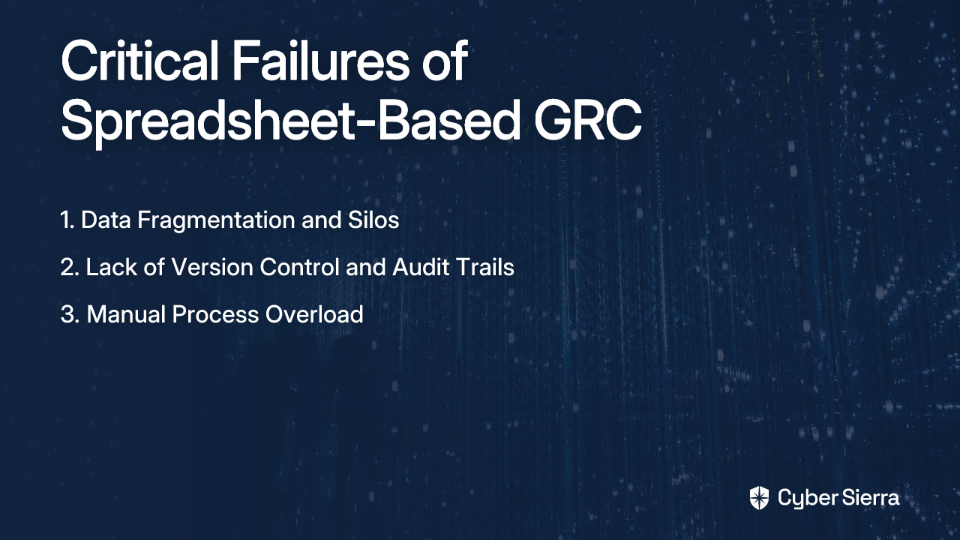
1. Data Fragmentation and Silos
GRC data naturally spans multiple domains—internal audits, risk assessments, control testing, third-party assessments—but in a spreadsheet environment, this information lives in disconnected files. The result? A fragmented view that makes holistic risk management impossible.
2. Lack of Version Control and Audit Trails
Which version of the spreadsheet is current? Who made the last change to this risk rating? When was this control last tested? In a spreadsheet-driven GRC program, these questions often go unanswered—creating accountability gaps that are major red flags for auditors and leaving you vulnerable to outdated information driving critical decisions.
3. Manual Process Overload
As one compliance manager lamented, "everyone else is swamped with other GRC oversight work" and "it's up to us to sort through it and make it readable." The manual nature of spreadsheet management means your most valuable team members spend countless hours on low-value tasks: data entry, formatting, and basic reporting rather than strategic risk analysis.
Exposing the Hidden Costs: Beyond Inefficiency
The true price of spreadsheet-driven GRC extends far beyond mere inefficiency, imposing both tangible financial burdens and intangible strategic costs.
Tangible Financial & Operational Costs
The High Probability of Errors: A startling 88% of business spreadsheets contain errors, according to research cited by Riskonnect. These errors aren't just annoying—they lead to flawed risk assessments, inaccurate compliance status reporting, and ultimately, poor decision-making that exposes your organization to preventable threats.
The Astronomical Cost of Non-Compliance: When errors lead to compliance failures, the consequences can be severe. One global manufacturer faced fines of $21.3 billion for non-compliance issues, according to Riskonnect. While your organization may not face penalties of this magnitude, the principle remains: spreadsheet errors that lead to compliance gaps create financial exposure that far exceeds the cost of proper GRC tools.
Productivity Loss Across the Organization: The problem isn't confined to the GRC team. When evidence collection and control verification rely on manual processes, the burden cascades throughout the organization. IT teams, department managers, and executives all face "business operations interference and productivity losses" as they're pulled into the labor-intensive process of providing evidence and updates.
Intangible Strategic & Risk-Related Costs
Actually Increasing Risk: Counter-intuitively, a poorly managed spreadsheet system can "increase risk through higher error rates, inaccurate risk assessments, and lack of audit trails," according to Lynx Technology Partners. The very tool intended to help you manage risk becomes a source of risk itself.
A Permanently Reactive Posture: Spreadsheet-based GRC is backward-looking by nature. You're always compiling what happened yesterday instead of monitoring what's happening now. This reactive approach leaves you vulnerable in a threat landscape that demands proactive risk management.
Loss of Board and Leadership Confidence: Modern boards and executives demand real-time visibility into organizational risk. According to Diligent, legal and compliance leaders now rate business risk at 7.9 out of 10—a 36% increase in concern levels. Quarterly reports compiled from spreadsheets are no longer sufficient to maintain leadership confidence in your risk management capabilities.
The Alternative: Shifting to a Strategic, Automated GRC Framework
It's important to note that implementing a GRC platform isn't a magic bullet. As one GRC professional cautioned, "I don't like that some people think GRC tools can actually build your program for you." A GRC tool enables a strategy; it doesn't replace it.
The goal isn't simply to digitize your spreadsheets but to fundamentally shift from periodic, manual activities to a continuous, intelligence-driven approach. This transformation involves understanding two key concepts:
GRC Automation
GRC automation replaces manual processes (spreadsheets) with automated workflows to enhance accuracy, enforce policies, and reduce costs. It standardizes procedures, centralizes data collection, and ensures consistent application of controls across the organization.
Continuous Controls Monitoring (CCM)
CCM takes automation a step further by providing real-time data monitoring of controls, enabling organizations to move from a reactive to a proactive stance. Rather than discovering control failures during an annual audit, CCM alerts you to issues as they emerge, allowing for immediate remediation.
The Quantifiable Benefits of Automation
The shift from spreadsheets to an automated GRC approach delivers measurable benefits:
Dramatically Reduced Audit Prep Time: Automation can cut audit preparation time by up to 60%, according to RegScale. Instead of scrambling to gather evidence before an audit, your system continuously collects and validates it.
A Centralized, Unified View: Automation provides what Sprinto describes as a "centralized view of risk profiles, facilitating informed decision-making." This holistic perspective enables you to understand relationships between risks, controls, and assets that remain hidden in disconnected spreadsheets.
Proactive Risk Mitigation: Continuous oversight allows for the early detection and mitigation of operational, financial, and compliance risks before they escalate into significant issues or breaches.
Making the Transition from Manual to Automated GRC
Moving away from spreadsheet-driven GRC doesn't happen overnight. Here's a practical framework from Sprinto for making the transition:
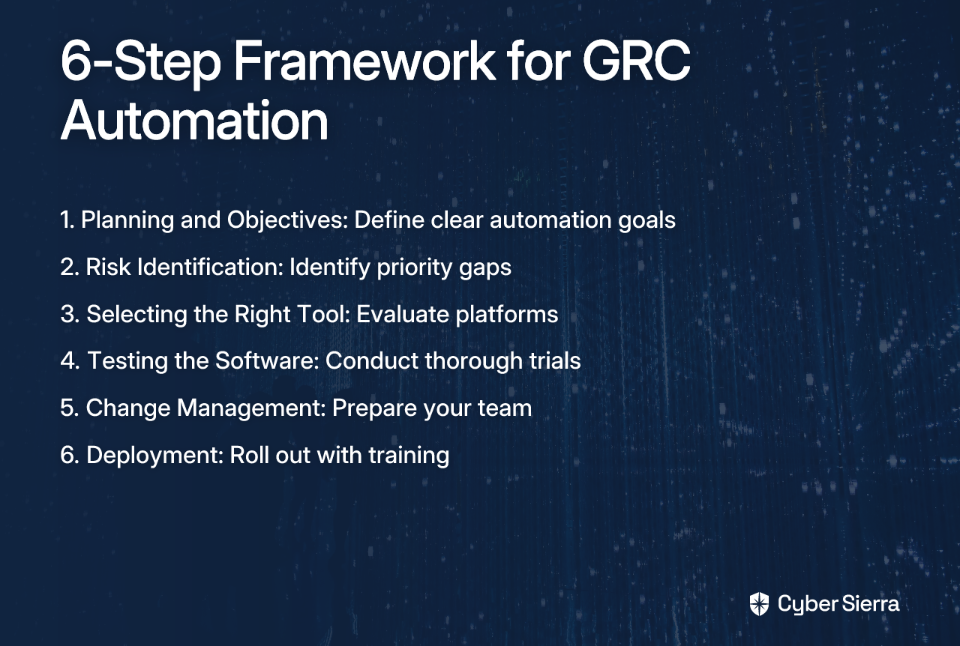
A 6-Step Framework for GRC Automation
- Planning and Objectives: Define clear goals for what automation should achieve in your specific context.
- Risk Identification: Identify priority risks and performance gaps in your current spreadsheet system.
- Selecting the Right Tool: Evaluate GRC platforms based on your defined requirements.
- Testing the Software: Conduct trials to ensure the tool meets your organizational needs.
- Change Management: Prepare your team for new workflows to avoid cultural resistance.
- Deployment: Roll out the software with adequate training.
How a Unified Platform Solves the Core Problems
When evaluating GRC platforms, look for comprehensive solutions that address the fundamental limitations of spreadsheet-driven programs:
Tackling Data Silos: Instead of juggling dozens of spreadsheets, a unified GRC platform like Cyber Sierra centralizes control management for multiple frameworks (SOC2, ISO 27001, HIPAA, etc.) into a single repository. Its Governance, Risk & Compliance (GRC) module automates data collection and risk assessments, creating a single source of truth.
Enabling Real-Time Visibility: To move beyond outdated, static reports, Cyber Sierra's Continuous Control Monitoring (CCM) module provides ongoing, near real-time visibility into your security posture, detecting exceptions and anomalies as they happen.
Streamlining Vendor Risk: Managing third-party risk in spreadsheets is particularly chaotic. A dedicated Third-Party Risk Management (TPRM) module automates vendor assessments and provides continuous monitoring, replacing manual questionnaires and guesswork.
Conclusion: Beyond the Spreadsheet Era
The transition from spreadsheets to a dedicated GRC platform represents more than a technology upgrade—it's a strategic shift in how your organization approaches risk and compliance.
Let's recap the true costs of spreadsheet-driven GRC programs:
- Error-Proneness: 88% of spreadsheets contain errors that compromise decision quality
- Compliance Risk: Potential for significant fines and penalties ($21.3B example)
- Productivity Drain: Valuable resources diverted to manual, low-value tasks
- Strategic Blindness: Lack of real-time visibility into emerging risks
For growing organizations, the question isn't whether you can afford a GRC platform—it's whether you can afford to continue with spreadsheets. The hidden costs of your current approach likely far outweigh the investment in a proper solution.

Escaping "spreadsheet hell" is the first step toward building a mature, proactive GRC program. If you're ready to see how automation can transform your compliance efforts, explore how Cyber Sierra simplifies Governance, Risk, and Compliance while providing the real-time visibility modern organizations need.
As your organization grows, remember that what got you here (spreadsheets) won't get you there (mature GRC). The right platform doesn't just digitize your existing processes—it transforms how you manage risk, engage with stakeholders, and build organizational resilience in an increasingly complex compliance landscape.
Frequently Asked Questions
Why are spreadsheets bad for managing GRC?
Spreadsheets are ineffective for managing Governance, Risk, and Compliance (GRC) because they lead to data fragmentation, lack version control, and create a significant manual workload. This "spreadsheet GRC" approach results in disconnected data silos, making a holistic view of risk impossible. Without clear audit trails, it's difficult to track changes or verify information, which is a major red flag for auditors. As your company scales, the time spent on manual data entry and report creation diverts your team from strategic risk management to low-value administrative tasks.
What are the hidden costs of using spreadsheets for compliance?
The hidden costs of using spreadsheets for compliance include a high probability of manual errors, the risk of significant financial penalties for non-compliance, and widespread productivity loss. Research shows that 88% of business spreadsheets contain errors, which can lead to flawed risk assessments and compliance gaps. These gaps can result in substantial fines, while the manual effort for evidence collection pulls resources from IT, operations, and management, creating a company-wide productivity drain.
When should a company switch from spreadsheets to a GRC tool?
A company should switch from spreadsheets to a GRC platform when its compliance requirements grow, manual processes become overwhelming, or a real-time, holistic view of risk is needed. Key indicators include managing multiple compliance frameworks (like SOC 2 and ISO 27001), struggling with version control, spending excessive time preparing for audits, or when leadership requires more immediate and reliable risk data than static reports can provide.
What is GRC automation?
GRC automation is the use of software to replace manual compliance processes with automated workflows that enhance accuracy, centralize data, and reduce costs. It standardizes procedures for tasks like evidence collection, control testing, and risk assessments. By connecting directly to your tech stack, GRC automation platforms can provide Continuous Controls Monitoring (CCM), offering real-time visibility into your security posture and alerting you to issues as they happen.
Can a GRC tool build my entire compliance program for me?
No, a GRC tool cannot build your entire compliance program, but it is a powerful enabler for executing your strategy. The strategy itself—defining risk appetite, selecting controls, and establishing governance policies—must be led by your team. A GRC platform provides the framework, automation, and visibility to implement that strategy efficiently, transforming it from a static plan into a dynamic, continuous operation.
