



How to Maintain SOX Compliance Without Manual Evidence Collection

Join thousands of professionals and get the latest insight on Compliance & Cybersecurity.
Summary
- Manual SOX compliance is inefficient and risky, with 65% of controls tested manually, leading to rising audit costs and the potential for undetected control failures.
- Shifting to an automated approach using Continuous Controls Monitoring (CCM) allows for 100% transaction coverage and real-time evidence collection, drastically reducing manual effort.
- A practical roadmap to automation involves scoping key controls, integrating a GRC platform with source systems (e.g., HRIS, AWS), and configuring automated tests and alerts.
- Cybersierra's GRC platform unifies and automates SOX compliance by combining continuous control monitoring with a centralized, audit-ready evidence repository.
You've just received an email: "The SOX auditors are coming next month. We need all the evidence ready." Your heart sinks as you envision the weeks ahead—manually exporting data, taking screenshots, updating spreadsheets, and chasing colleagues for approvals. The tedious cycle of manual evidence collection begins again.
If this scenario sounds painfully familiar, you're not alone. SOX compliance, while necessary, has become synonymous with overwhelming manual documentation requirements and significant time loss due to inefficient data processes.
The Alarming Costs and Risks of Manual SOX Compliance
The Sarbanes-Oxley Act of 2002 was enacted to protect investors by improving the accuracy and reliability of corporate disclosures. Two decades later, its importance remains undisputed—but the way organizations comply with it is desperately outdated.
Consider these sobering statistics:
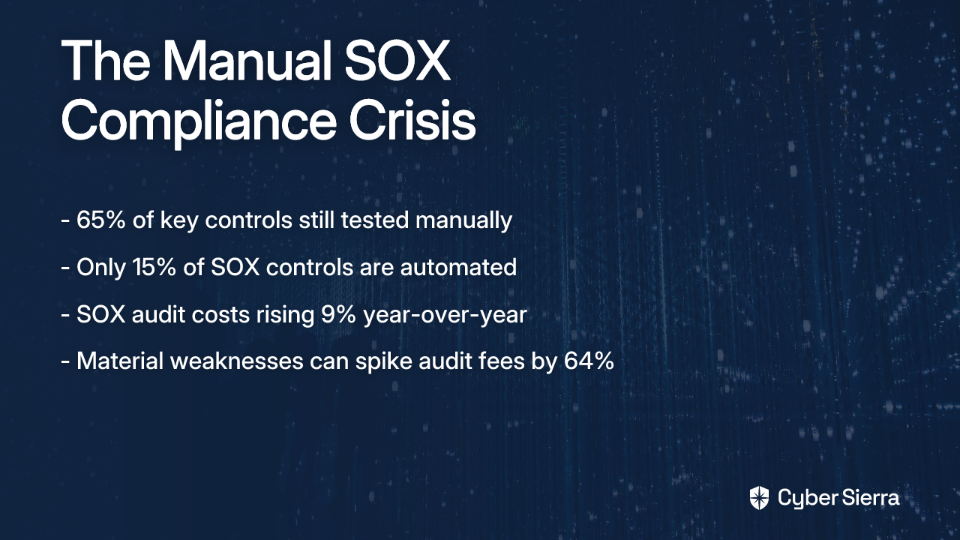
- A staggering 65% of key controls are still tested manually
- Only 15% of SOX controls are automated, leaving a massive efficiency gap
- SOX audit costs are rising by an average of 9% year-over-year, largely driven by manual labor
- A single material weakness can cause audit fees to spike by 64%
Beyond the financial impact, manual SOX compliance creates three critical problems:
1. Crippling Operational Inefficiency
Manual processes trap highly skilled compliance teams in low-value tasks instead of focusing on strategic risk management. According to a Deloitte poll, 31% of compliance professionals cited the lack of a standardized process, and 30% cited the lack of efficient technology as major challenges.
One compliance manager on Reddit expressed their frustration: "The tedious manual requirements for documentation are causing dissatisfaction across our entire team. We're spending days just exporting data that could be automated."
2. Unacceptable Levels of Risk
Manual sampling is inherently flawed; auditors often fail to test up to 90% of transactions. This creates a high probability that control failures will go undetected.
Annually, 5% of publicly traded companies report a material weakness. The market's reaction is severe: a material weakness filing is typically followed by an average stock price drop of 19%.
3. Limited Strategic Value
When compliance teams are buried in manual evidence collection, they cannot provide the strategic insights that leadership needs. The opportunity cost is enormous—instead of identifying emerging risks and trends, teams are stuck taking screenshots and updating spreadsheets.
The Modern Approach: Automation and Continuous Monitoring
The solution to these challenges lies in transforming SOX compliance from a periodic, manual scramble into an automated, continuous process. This transformation rests on two foundational pillars:
1. Continuous Controls Monitoring (CCM)
CCM refers to technology-enabled processes that provide real-time validation of financial and IT controls. Rather than testing controls once a quarter or year, CCM constantly evaluates them, immediately flagging exceptions.
The benefits are transformative:
- 100% transaction coverage (versus limited sampling)
- Up to 95% reduction in manual testing labor and costs
- Immediate detection of control failures
- Evidence automatically collected in real-time
2. Centralized GRC Platform
A Governance, Risk, and Compliance (GRC) platform acts as the command center for automated compliance. It addresses the pain of "managing compliance across various platforms" by creating a single source of truth.
Key capabilities include:
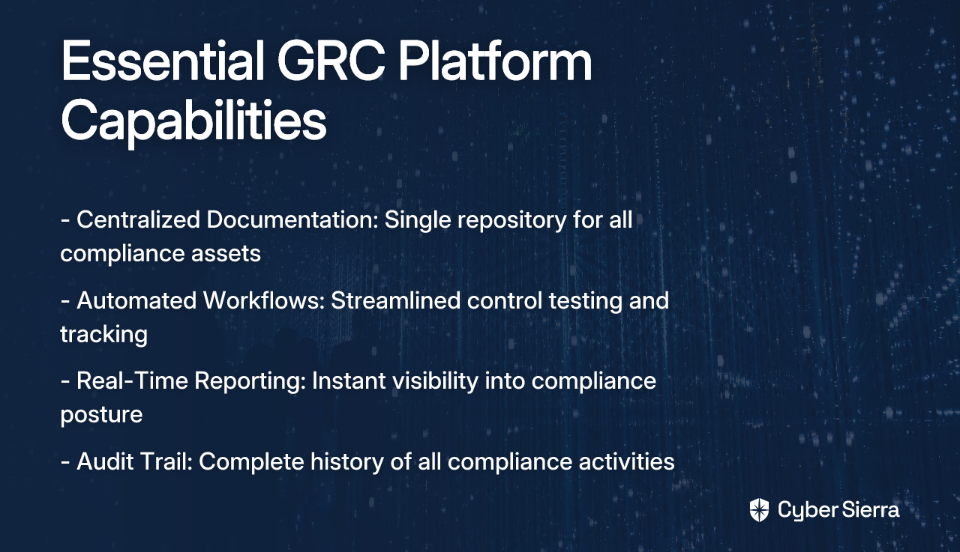
- Centralized Documentation: A single repository for all policies, procedures, and evidence
- Automated Workflows: Systems that manage control testing and remediation tracking
- Real-Time Reporting: Dashboards that provide stakeholders with instant visibility into compliance posture
A Step-by-Step Guide to Automating SOX Evidence Collection
Transitioning from manual to automated SOX compliance is not an overnight process, but the following steps provide a roadmap:

Step 1: Scope and Map Key Controls
Begin with a risk-based approach to identify which controls truly matter. Follow a structured process:
- Calculate materiality
- Scope significant accounts and locations
- Map financial statement line items (FSLIs) to business processes
- Perform risk analysis
- Scope relevant IT systems for IT General Controls (ITGCs)
This foundational step ensures you're automating the right things.
Step 2: Integrate with Authoritative Source Systems
Automation relies on connecting your GRC/CCM platform to source systems via APIs. Examples include:
- HRIS (e.g., Workday, BambooHR): To automate user access reviews
- Cloud Infrastructure (AWS, Azure, GCP): To continuously monitor for critical misconfigurations
- Identity Providers (Okta, Azure AD): To verify MFA enforcement
- IT Service Management (Jira, ServiceNow): To validate that all production changes have documented approval
Step 3: Configure Automated Tests and Evidence Capture
Here's where the magic happens. Let's look at concrete examples:
User Access Control Example: The system automatically compares active user accounts in financial applications against the employee list in the HRIS. Any account belonging to a terminated employee is flagged, and evidence (screenshots, user lists) is automatically logged.
Change Management Control Example: The system scans commits to a production code repository and automatically verifies that each commit has a corresponding, approved change ticket in Jira. It captures the ticket number and approval status as evidence.
Step 4: Establish Continuous Reporting and Alerting
The platform should automatically compile the collected evidence into an audit-ready format. Dashboards provide real-time visibility into control status, exceptions, and remediation progress, making the organization "always audit-ready."
Building Trust in Automation: Overcoming Auditor Skepticism
One of the biggest challenges in transitioning to automated SOX compliance is auditor skepticism. As one professional noted on Reddit, there's often "frustration about the perception of automation versus manual processes by auditors" and "concerns regarding automation and data integrity."
To overcome this challenge:
Provide an Immutable Audit Trail
A core feature of a reliable GRC platform is a detailed, unchangeable audit trail. Every test performed, every piece of evidence collected, and every user action should be logged with a timestamp. This provides greater assurance than a manually curated spreadsheet.
Ensure Data Integrity
Highlight that automation reduces human error. By pulling data directly from source systems via read-only APIs, the process eliminates the risk of manual data entry mistakes or manipulation.
Collaborate with Auditors
As recommended by compliance professionals, "engage in conversations with the auditors to establish a collaborative approach." Proactively demonstrate how the automated tests work, show them the completeness of the audit trail, and walk them through the evidence repository.
How Cybersierra Unifies and Automates SOX Compliance
For organizations ready to embrace automated SOX compliance, Cybersierra offers an integrated platform that puts these principles into practice.
Continuous Control Monitoring (CCM)
Cybersierra's CCM module provides the engine for automation. It builds a central controls repository with near real-time updates and automates control testing and validation. This directly replaces the need for manual evidence collection.
Key features include:
- Ongoing visibility into security controls
- Automated control testing and validation
- Real-time detection of exceptions and anomalies
- Management of controls across multiple compliance frameworks (NIST, ISO 27001, SOX)
Governance, Risk & Compliance (GRC)
Cybersierra's GRC platform acts as the central hub. It automates data collection, risk assessments, and maintains detailed audit trails, creating the single source of truth that auditors require.
The platform simplifies managing multiple frameworks (SOX, SOC2, ISO 27001), making compliance efforts more efficient and reducing the burden of manual documentation that causes so much frustration among compliance teams.
Moving Forward: From Manual Burden to Strategic Asset
Manual SOX compliance is no longer sustainable due to its high costs, inefficiencies, and inherent risks. By embracing automation through a unified CCM and GRC platform, organizations can achieve several transformative outcomes:
- Redirect skilled resources from manual evidence collection to strategic risk management
- Increase control effectiveness through 100% transaction testing versus limited sampling
- Reduce compliance costs by eliminating manual labor and streamlining the audit process
- Enhance stakeholder confidence with real-time visibility into control effectiveness
- Transform from reactive to proactive by identifying and addressing issues before they become material weaknesses
The future of SOX compliance isn't about taking more screenshots or updating more spreadsheets. It's about leveraging technology to provide continuous assurance while freeing up human expertise for what it does best—strategic thinking and risk management.
By embracing automation, compliance teams are empowered to evolve from reactive evidence chasers into strategic partners who proactively manage risk and add tangible value to the business.
Discover how Cybersierra's AI-enabled platform can transform your SOX compliance program and make you audit-ready, 365 days a year.
Frequently Asked Questions
What is SOX compliance and why is it important?
SOX (Sarbanes-Oxley) compliance refers to adhering to the Sarbanes-Oxley Act of 2002, a federal law that mandates certain practices in financial record keeping and reporting for public companies. It is critically important because it aims to protect investors from fraudulent financial reporting by improving the accuracy and reliability of corporate disclosures.
Why is manual SOX evidence collection a problem?
Manual SOX evidence collection is a significant problem because it is highly inefficient, prone to human error, and costly. This traditional approach consumes thousands of hours in low-value tasks like taking screenshots and updating spreadsheets, introduces risks through limited sample testing (which can miss up to 90% of transactions), and drives up audit costs.
How can automation improve SOX compliance?
Automation dramatically improves SOX compliance by replacing periodic, manual checks with Continuous Controls Monitoring (CCM). This technology-driven approach provides real-time validation of controls, offers 100% transaction coverage, and automatically collects audit-ready evidence. The result is a massive reduction in manual labor, immediate detection of control failures, and a stronger, more reliable compliance posture.
What are the first steps to automate SOX compliance?
The first step is to scope and map your key controls using a risk-based approach to ensure you focus on what truly matters. From there, the process involves integrating a GRC/CCM platform with your key business systems (like HRIS, cloud infrastructure, and ITSM), configuring automated tests to capture evidence, and establishing continuous reporting and alerting dashboards.
What is the difference between a GRC platform and Continuous Controls Monitoring (CCM)?
A GRC (Governance, Risk, and Compliance) platform acts as the central command center for managing overall compliance activities, creating a single source of truth for policies, risk assessments, and audit trails. Continuous Controls Monitoring (CCM) is the engine within that system; it's the specific technology that automates the testing and validation of controls in real-time by connecting to other business systems.
How do you get auditors to trust automated SOX evidence?
Auditor trust is built by demonstrating the reliability and integrity of the automated system. This is achieved by providing an immutable, time-stamped audit trail for every action, ensuring data integrity by pulling information directly from source systems via read-only APIs, and proactively collaborating with auditors to walk them through the automated processes and evidence repository.
