



Step-by-Step Guide: ISO 27001 Compliance Report for Enterprise Teams


Join thousands of professionals and get the latest insight on Compliance & Cybersecurity.
Summary
- A successful ISO 27001 compliance report relies on foundational steps like defining your ISMS scope, conducting a risk assessment, and meticulously documenting your Statement of Applicability (SoA).
- A comprehensive report must clearly outline the audit scope, key findings, identified non-conformities, and a corrective action plan to address security gaps.
- Transition from periodic manual checks to continuous compliance by using automation to monitor controls and collect evidence in real-time.
- Cybersierra’s GRC platform automates data collection and control monitoring, helping you stay continuously audit-ready for ISO 27001.
You've been tasked with preparing an ISO 27001 compliance report, and now you're staring at a mountain of requirements, controls, and documentation. Where do you even begin? If you're feeling overwhelmed, you're not alone.
"The process is by no means 'efficient' and will require a good amount of documentation," as one IT professional noted in a recent discussion. This sentiment resonates with many enterprise teams grappling with ISO 27001 compliance, especially those without prior Information Security Management experience.
This step-by-step guide will demystify the ISO 27001 compliance report creation process, providing you with a clear roadmap to follow.
Understanding ISO 27001 and the ISMS Foundation
Before diving into report creation, let's establish what we're working with:
ISO/IEC 27001 is the leading international standard for Information Security Management Systems (ISMS), created by the International Organization for Standardization. With over 70,000 certificates issued worldwide, it's globally recognized as the benchmark for information security.
At its core, ISO 27001 is built around the CIA triad:
- Confidentiality: Ensuring information is accessible only to authorized individuals
- Integrity: Maintaining the accuracy and completeness of data and processing methods
- Availability: Guaranteeing authorized users have access to information when needed
An ISMS is the systematic approach to managing sensitive company information through a framework of policies, procedures, and controls. ISO 27001 doesn't just verify that you have certain security technologies in place—it confirms you have a comprehensive system for managing information security risks.
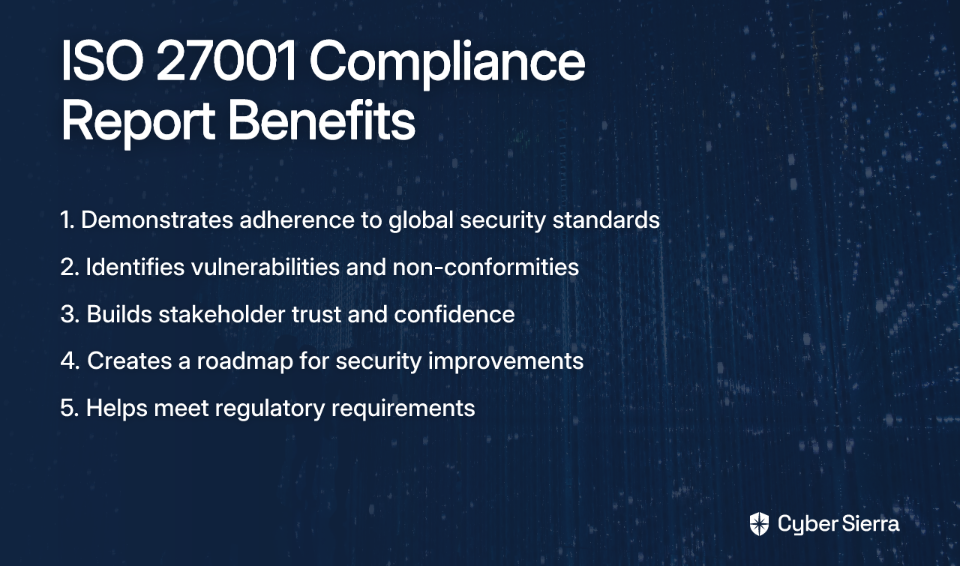
Why is the compliance report crucial? It serves as:
- A demonstration of your adherence to the standard
- A tool for identifying security vulnerabilities and non-conformities
- A seal of trust that builds confidence among customers, partners, and stakeholders
The Pre-Reporting Phase: Audit Readiness Checklist
Before you can create a meaningful compliance report, you need to have the right foundations in place. Here's your pre-reporting checklist:
Step 1: Secure Management Buy-In
"Get the management on your side," advises an experienced ISO implementer from the Reddit discussion. This is non-negotiable. Without leadership support, you'll struggle to secure the necessary resources and authority to implement required changes.
Step 2: Define the Scope of Your ISMS
Many teams struggle with this critical step. As one professional noted, "It's still unclear how to start with step 3: Define the scope."
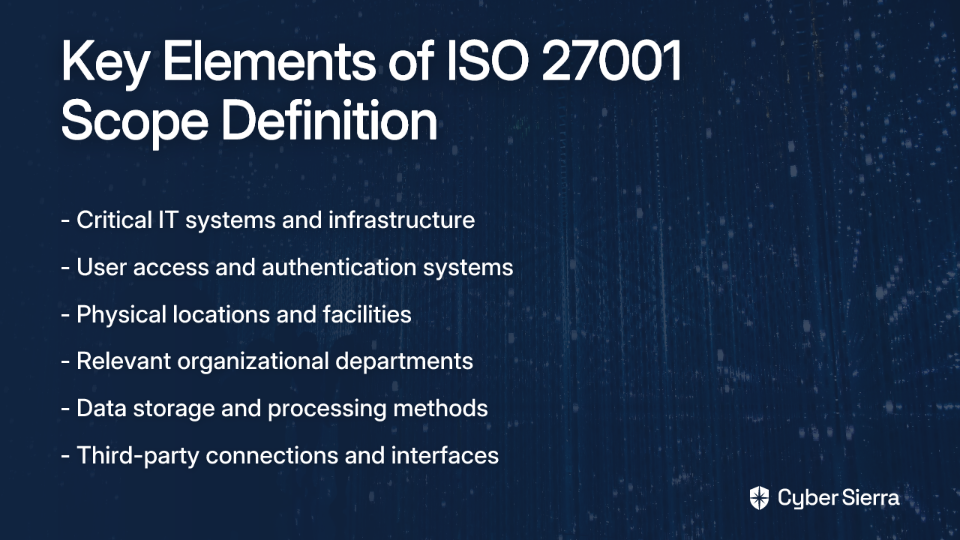
The scope defines the boundaries of your ISMS—what's included and what's excluded. To clearly define your scope, consider:
- Which IT systems are covered
- Which users (internal and external) interact with these systems
- Which physical locations are included
- Which existing company policies apply
Document this scope definition clearly, as it will be a cornerstone of your compliance report.
Step 3: Conduct a Risk Assessment & Gap Analysis
Two separate but related processes form the backbone of your ISMS:
- Risk Assessment: This is the systematic process of identifying information assets, determining threats and vulnerabilities, analyzing potential impacts, and prioritizing risks. According to ISO 27001 guidelines, you'll need to document your methodology and create a comprehensive risk treatment plan.
- Gap Analysis: This involves comparing your current security controls against ISO 27001 requirements to identify gaps. This analysis will highlight areas that need attention before you can achieve compliance.
Step 4: Implement Annex A Controls & Create a Statement of Applicability (SoA)
Annex A of ISO 27001 provides a catalog of 114 security controls across 14 domains. You don't need to implement all of them—only those relevant to your identified risks.
The Statement of Applicability (SoA) is a mandatory document that:
- Lists which Annex A controls you have implemented
- Provides justification for any controls you've excluded
- Explains how you've implemented each applicable control
This document is often scrutinized during audits and forms a critical component of your compliance report.
Step 5: Document Everything
As one IT professional bluntly stated, "The process is by no means 'efficient' and will require a good amount of documentation." This extensive documentation includes:
- ISMS Scope Statement
- Information Security Policy
- Risk Assessment Report
- Risk Treatment Plan
- Statement of Applicability
- Security control procedures
- Evidence of control implementation and effectiveness
Anatomy of a Comprehensive ISO 27001 Compliance Report
Now that you have the groundwork in place, let's break down what goes into the actual compliance report. According to Sprinto's ISO 27001 guide, a well-structured report typically includes:
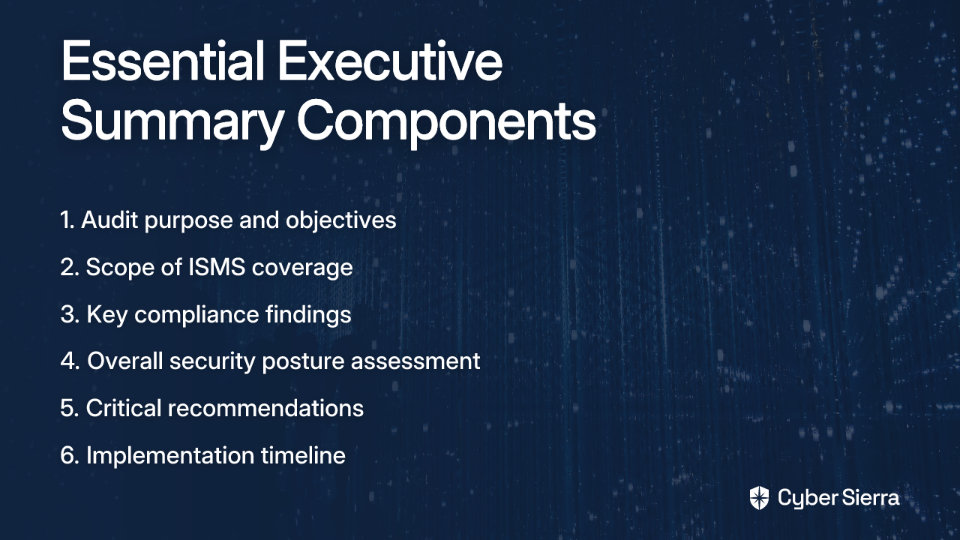
1. Executive Summary
This high-level overview provides busy stakeholders with the essential information:
- Purpose and scope of the audit
- Key findings and their significance
- Overall compliance status
- Major recommendations
Keep this section concise but informative—ideally no more than one or two pages.
2. Scope and Audit Plan
This section clearly defines:
- What was audited (departments, locations, systems)
- Who conducted the audit
- The audit timeline and methodology
- Any limitations or exclusions
3. Audit Methodology
Detail the techniques used during the audit:
- Document review processes
- Interview approaches
- Sampling methods for evidence collection
- Testing procedures
- Vulnerability assessment tools
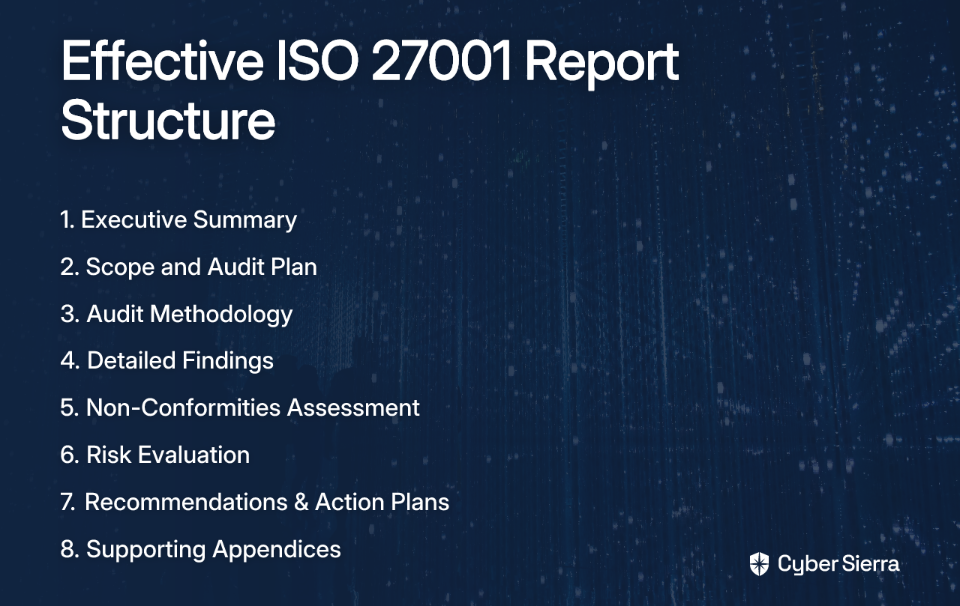
4. Audit Findings
This forms the core of your report, presenting factual findings supported by evidence. For each ISO 27001 requirement, provide:
- Compliance status
- Supporting evidence
- Observations
- Any relevant context
5. Vulnerabilities and Non-Conformities
List all identified weaknesses and deviations from the ISO 27001 standard. Typically, non-conformities are categorized as:
- Major Non-Conformities: Significant failures that pose immediate risk to information security
- Minor Non-Conformities: Smaller issues that require correction but don't represent significant risk
- Observations: Areas for improvement that aren't strict non-conformities
6. Recommendations & Corrective Action Plan
This section provides actionable suggestions to address identified non-conformities and improve the ISMS. Each recommendation should include:
- Reference to the specific finding
- Proposed action
- Priority level
- Responsible party
- Target completion date
Creating Your Report: A Step-by-Step Process
Now that you understand what goes into the report, here's a practical workflow for creating it, based on guidance from Sprinto:
Step 1: Documentation Review
Start by collecting and reviewing all necessary documents:
- ISMS scope statement
- Information security policies
- Risk assessments and treatment plans
- Statement of Applicability
- Previous audit reports (if available)
- Evidence of control implementation
Step 2: Evidential Sampling & Interviews
Collect evidence through:
- Interviews with relevant staff
- Review of documentation
- Testing of controls
- Direct observation of security practices
Step 3: Analysis of Findings
Assess your findings to determine:
- Major and minor non-conformities
- Observations and improvement opportunities
- Root causes of issues
- Potential remediation approaches
Step 4: Report Writing and Finalization
When writing the report:
- Use clear, straightforward language
- Incorporate visual aids like charts to show trends
- Cross-reference findings directly to ISO 27001 clauses
- Prioritize recommendations based on risk
- Include appendices for detailed evidence
Streamlining Compliance with Automation and Continuous Monitoring
The traditional approach to ISO 27001 compliance involves periodic, often manual checks that can lead to "compliance debt" and last-minute scrambling before audits. There's a better way.
Continuous Controls Monitoring (CCM) transforms compliance from a point-in-time exercise to an ongoing, automated process. Research shows that CCM provides:
- Real-time compliance monitoring
- Automated evidence collection
- Proactive alerts when controls fail
- On-demand compliance reporting
Cybersierra's Governance, Risk & Compliance (GRC) platform addresses these exact challenges by automating data collection, risk assessments, control monitoring, and reporting for ISO 27001. The platform's Continuous Control Monitoring (CCM) module provides ongoing visibility into security controls and maintains a single source of truth, transforming security from periodic checks to a state of continuous, audit-ready compliance.
Conclusion
Creating an ISO 27001 compliance report is undoubtedly challenging, but following this structured approach will make the process manageable and produce a comprehensive, audit-ready report.
Remember that the compliance report isn't just a bureaucratic requirement—it's a valuable tool for understanding your security posture and driving continuous improvement. By documenting your compliance journey, you create a roadmap for ongoing security enhancement.
Ready to make your ISO 27001 journey more efficient and effective? See how Cybersierra's AI-enabled platform transforms compliance management with automation and continuous monitoring, helping you stay audit-ready at all times rather than scrambling before certification deadlines.
Frequently Asked Questions
What is an ISO 27001 compliance report?
An ISO 27001 compliance report is a formal document that details the findings of an audit against the ISO 27001 standard. It serves as official evidence of your organization's Information Security Management System (ISMS), outlining its scope, the results of risk assessments, the status of security controls, and any identified non-conformities. The report demonstrates your adherence to global security standards and provides a roadmap for continuous improvement.
Why is a Statement of Applicability (SoA) so important for ISO 27001?
The Statement of Applicability (SoA) is a mandatory and critical document for ISO 27001 compliance because it links your risk assessment to your implemented security controls. It lists all 114 controls from Annex A and requires you to document whether each control is applicable, how it has been implemented, and provide a justification for any controls that have been excluded. Auditors scrutinize the SoA to ensure your security measures are comprehensive and relevant to your specific risks.
How do you define the scope of an ISMS for ISO 27001?
To define the scope of your ISMS, you must clearly establish its boundaries by identifying what information and assets you intend to protect. This involves documenting which specific business processes, physical locations, IT systems, departments, and third-party connections are included within the ISMS. A well-defined scope is crucial as it sets the foundation for your risk assessment and the entire compliance audit.
What is the difference between a risk assessment and a gap analysis?
A risk assessment focuses on identifying, analyzing, and evaluating potential threats and vulnerabilities to your information assets to prioritize them for treatment. In contrast, a gap analysis compares your existing security controls and processes directly against the requirements of the ISO 27001 standard. While both are crucial, risk assessment is about managing risk, whereas gap analysis is about measuring your readiness for certification.
How can automation help with ISO 27001 compliance?
Automation significantly streamlines ISO 27001 compliance by replacing periodic, manual checks with continuous monitoring of security controls. Platforms with automation can automatically collect evidence, provide real-time alerts when a control fails, and generate on-demand compliance reports. This reduces the manual effort, minimizes human error, and ensures your organization remains in a state of continuous, audit-ready compliance rather than scrambling before an audit.
What are the most common challenges when creating an ISO 27001 report?
The most common challenges include securing management buy-in, accurately defining the ISMS scope, and managing the extensive documentation required. Without leadership support, it's difficult to get the necessary resources. An unclear scope can lead to a failed audit. Finally, the sheer volume of policies, procedures, risk assessments, and evidence can be overwhelming to create and maintain without a structured approach or automation tools.
