



7 Anti-Phishing Solutions That Integrate With Your Existing Security Stack



Join thousands of professionals and get the latest insight on Compliance & Cybersecurity.
Summary
- Phishing remains a top threat, initiating 91% of cyber attacks and costing businesses an average of $4.8 million per breach.
- Effective defense relies on an integrated security ecosystem, not just more siloed tools, to reduce alert fatigue and enable automated responses.
- When selecting solutions, prioritize API availability and automated remediation capabilities to build a cohesive security stack that shares intelligence.
- A platform like Cyber Sierra's Continuous Control Monitoring can unify disparate security tools, providing the central visibility and automation needed to move from reactive to proactive defense.
Your security team is drowning in alerts while employees continue opening malicious PDFs and entering credentials on untrusted sites. You've implemented multiple security tools, but they operate in silos, creating more noise than actionable intelligence. Sound familiar?
The harsh reality is that 91% of cyber attacks start with a phishing email, and in 2023 alone, phishing attempts increased by a staggering 58% compared to the previous year. With the average cost of a data breach now reaching $4.8 million, phishing isn't just an IT problem—it's an existential business threat.
The challenge? As one security professional put it, "No single tool can completely prevent human error in security practices," and "striking a balance between false positives and effective coverage is challenging." A multi-layered approach is necessary, but simply adding more disconnected tools creates operational chaos.
The solution isn't just adding more tools—it's integrating them effectively. This article explores seven anti-phishing solutions specifically chosen for their ability to connect with your existing security stack, enabling automated workflows and providing a unified view of your security posture.
Key Considerations for Integrated Anti-Phishing Platforms
Before diving into specific solutions, here are the critical factors we evaluated:

- API Availability & Data Sharing: The ability to push and pull data between your security tools seamlessly
- Automated Remediation: Functionality that moves beyond alerts to automatically resolve security issues
- Implementation Timelines: How quickly the solution can be deployed and integrated
- Ecosystem Compatibility: How well it works with common tools like SIEMs, SOARs, and ITSM platforms
7 Anti-Phishing Solutions for a Cohesive Security Stack
1. Cyber Sierra: The Unified Command Center for Security Controls
Primary Focus: Cyber Sierra goes beyond being just an anti-phishing tool—it serves as the central integration and visibility platform that makes your entire security stack more effective through Continuous Control Monitoring (CCM).
Integration Capabilities:
- Provides a unified security view by ingesting data from disparate security tools
- Acts as a single source of truth, monitoring the effectiveness of all controls in near real-time
- Automates cross-platform remediation workflows to close security gaps quickly
Key Features:
- Central controls repository with real-time updates: Eliminates dashboard-hopping to understand your security posture
- Automated control testing and validation: Reduces manual work required for compliance frameworks like NIST, ISO 27001, and PCI DSS
- Actionable risk intelligence: Provides context to help prioritize remediation efforts
- Real-time anomaly detection: Moves security from periodic checks to a proactive, continuous model
Implementation Timeline: 2-4 weeks for initial deployment with pre-built integrations for most common security tools.
Cyber Sierra's CCM directly addresses the pain point voiced by security teams struggling with "a lack of unified security view" and the challenge of manual evidence collection for audits. By providing a central command center for all security controls, it transforms how organizations detect and respond to phishing threats across their entire environment.
Learn more about Cyber Sierra's Continuous Control Monitoring
2. Microsoft Defender for Office 365: Deep Ecosystem Integration
Primary Focus: Native, seamless integration for organizations heavily invested in the Microsoft ecosystem.
Integration Capabilities:
- Integrates natively with Azure Sentinel for advanced threat hunting and SIEM capabilities
- Works directly with Azure Active Directory to enforce conditional access policies based on threat signals
- Shares threat intelligence across the Microsoft 365 Defender suite (Endpoint, Identity, Cloud Apps)
Key Features:
- Safe Links and Attachments: Real-time scanning of URLs and file attachments in emails
- Anti-phishing policies: Customizable protection against impersonation and spoofing
- Attack Simulator: Built-in phishing simulation for training and testing
- Threat Explorer: Advanced investigation tools for security teams
Implementation Timeline: 1-2 weeks for basic configuration; 4-6 weeks for full optimization and integration with conditional access policies.
As noted by cybersecurity practitioners, while Defender for Office 365 is powerful, "it requires proper configuration to be effective." When properly set up and integrated with your broader Microsoft security ecosystem, it provides robust protection with minimal friction.
3. Proofpoint Email Protection: SIEM-Friendly, People-Centric Intelligence
Primary Focus: Correlating email-based threats with other security events through robust SIEM integration.
Integration Capabilities:
- Feeds rich threat data directly into leading SIEM platforms (Splunk, IBM QRadar, etc.)
- Provides APIs for SOAR platform integration to automate responses to specific phishing attacks
- Connects user behavior analytics with technical threat intelligence
Key Features:
- Targeted Attack Protection (TAP): Advanced detection of sophisticated phishing attacks
- Threat Response Auto-Pull (TRAP): Automatically quarantines malicious messages after delivery
- Smart Search: Advanced threat hunting capabilities within email traffic
- SIEM integration: Correlates email threats with broader security events
Implementation Timeline: 4-6 weeks for full deployment and SIEM integration.
Proofpoint's greatest strength is its ability to provide context around threats, enabling security teams to see the relationship between email attacks and other security events within their existing SIEM platform.
4. Mimecast Email Security: The Resilient and API-Driven Gateway
Primary Focus: A highly effective email gateway with a strong API framework for custom integrations.
Integration Capabilities:
- Comprehensive API that allows organizations to integrate Mimecast's threat intelligence into their SIEM, SOAR, and other security tools
- Enables automated workflows, such as automatically blocking a sender across the enterprise
- Enriches alerts in security dashboards with Mimecast data
Key Features:
- Targeted Threat Protection: Multi-layered defense against malicious URLs, attachments, and impersonation attacks
- DMARC Analyzer: Simplifies email authentication implementation
- Case Review: Streamlines security team investigation workflows
- Extensive API support: Enables custom integration with your security stack
Implementation Timeline: 2-3 weeks for initial deployment; additional 2-4 weeks for custom API integrations.
Praised by the security community as "a strong contender when it comes to email security," Mimecast combines effectiveness with extensibility, making it ideal for organizations with complex integration requirements.
5. Veriti: The Automated Remediation Engine
Primary Focus: Automatically resolving security issues with minimal human intervention, a direct answer to alert fatigue.
Integration Capabilities:
- Integrates with over 70 security tools, including SIEM, SOAR, EDR, and ITSM platforms
- Its "unified remediation engine" correlates vulnerabilities with compensating controls across the stack
- Verifies if an endpoint is protected by other controls before recommending a patch, preventing business disruption
Key Features:
- Contextual analysis: Ensures remediation actions are safe and aligned with business operations
- Cross-platform automation: Takes action across multiple security tools
- Risk-based prioritization: Focuses remediation on the most critical issues first
- Closed-loop verification: Confirms that remediation actions were successful
Implementation Timeline: 3-4 weeks for deployment and initial integration with key security tools.
Veriti's approach to automated remediation directly addresses the pain of alert fatigue and the challenge of coordinating actions across multiple security tools.
6. Barracuda Email Protection: Rapid Deployment and Framework Integration
Primary Focus: Fast, easy integration with existing IT frameworks for organizations that need to deploy protection quickly.
Integration Capabilities:
- Designed for quick deployment and straightforward integration with Microsoft 365 and Google Workspace
- Provides reporting and analytics that can be exported or pulled via API into centralized management dashboards
- Integrates with SIEM solutions for unified threat visibility
Key Features:
- Impersonation Protection: Defends against business email compromise attacks
- Account Takeover Protection: Detects and remedies compromised accounts
- Automated Incident Response: Takes immediate action on threats
- Data Loss Prevention: Prevents sensitive information from leaving via email
Implementation Timeline: 1-2 weeks for full deployment and basic integration.
Barracuda's strength lies in its balance of effectiveness and implementation speed, making it ideal for organizations that need to quickly bolster their phishing defenses without extensive configuration work.
7. KnowBe4: Integrating the Human Firewall
Primary Focus: Addressing the human element of phishing through integrated security awareness training.
Integration Capabilities:
- Integrates with email systems (Office 365, G Suite) to launch realistic, simulated phishing campaigns
- APIs allow for pulling user training and phishing test results into GRC platforms or HR systems
- Connects with Active Directory and SCIM for user management
Key Features:
- PhishER: Security orchestration, automation, and response for user-reported phishing
- Smart Groups: Automatically assigns training based on phishing test performance
- Security Roles: Delegates phishing management to department leaders
- Risk Score: Provides measurable metrics on human vulnerability
Implementation Timeline: 1-2 weeks for initial setup; ongoing management for phishing campaigns and training.
KnowBe4 directly addresses the universally acknowledged pain point that "ongoing user training is necessary as employees remain the primary vulnerability in security." It provides a measurable way to improve the human firewall and integrate that improvement data with your broader security program.
Beyond Tools: Building an Integrated Defense Ecosystem
The fight against phishing has evolved beyond simple email filters. Today's most resilient security postures are built not on a collection of individual tools, but on an integrated ecosystem where solutions share intelligence and automate action.
This shift from siloed alerts to a unified defense is essential for moving from a reactive state (drowning in false positives) to a proactive one. The goal is to achieve continuous monitoring and automated remediation that reduces risk while freeing up security teams for more strategic work.
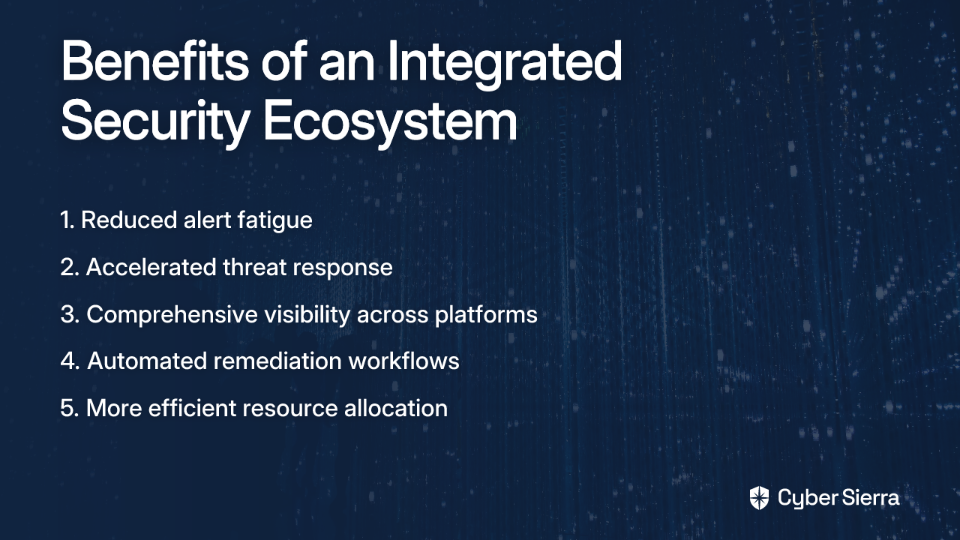
While specialized tools are crucial for tasks like email filtering and training, a platform like Cyber Sierra's Continuous Control Monitoring provides the essential overarching visibility and automation fabric. It serves as your command center, ensuring all security controls work together effectively while providing a single, reliable source of truth for your entire security posture.
Ready to Transform Your Phishing Defense?
The most effective anti-phishing strategy isn't about having the most tools—it's about having the right tools working together seamlessly. By focusing on integration capabilities, you can build a cohesive security ecosystem that's greater than the sum of its parts.
Ready to build a truly integrated and automated security defense against today's sophisticated phishing threats?
Contact us today to see how Cyber Sierra can unify your security stack and provide proactive protection from phishing and beyond.
Frequently Asked Questions
What is the most important feature in an anti-phishing solution?
The most critical feature is not just threat detection but strong integration capabilities, such as APIs and robust data sharing. While advanced email filtering is standard, a solution's ability to connect with your existing SIEM, SOAR, and other security tools allows for automated remediation and a unified view of threats, which is essential for moving from a reactive to a proactive security posture.
Why is an integrated security stack better for fighting phishing?
An integrated security stack is better because it provides comprehensive visibility and enables automated, cross-platform responses to threats. Instead of operating in silos, integrated tools share intelligence, allowing your security team to correlate a phishing email with endpoint behavior or network anomalies, reduce alert fatigue, and automate remediation workflows, which significantly accelerates response times.
How does Continuous Control Monitoring (CCM) help with phishing?
Continuous Control Monitoring (CCM) helps by ensuring all your anti-phishing controls are configured and operating effectively in near real-time. A platform like Cyber Sierra acts as a central command center, ingesting data from all your tools (email gateways, EDR, training platforms) to validate their performance, detect gaps in your defenses, and automate remediation before a phishing attack can succeed.
Can I rely solely on Microsoft Defender for Office 365?
While Microsoft Defender for Office 365 is a powerful tool, relying on it solely may not be sufficient for all organizations. It provides excellent protection within the Microsoft ecosystem, but a multi-layered defense often requires specialized tools for security awareness training (like KnowBe4) or a unifying platform (like Cyber Sierra) to integrate signals from non-Microsoft tools and provide a complete view of your security posture.
What role does security awareness training play alongside automated tools?
Security awareness training is a crucial layer that addresses the human element, which automated tools cannot fully prevent. Platforms like KnowBe4 create a "human firewall" by educating employees to spot and report suspicious emails. Integrating this training data with your security stack allows you to identify high-risk users and measure the effectiveness of your human-centric controls as part of your overall defense strategy.
How can I reduce alert fatigue from my anti-phishing tools?
You can reduce alert fatigue by shifting from siloed tools that generate individual alerts to an integrated system that correlates data and automates responses. Solutions like Veriti focus on automated remediation, while platforms like Cyber Sierra provide a unified view, correlating data from multiple sources to provide high-fidelity, actionable intelligence instead of a high volume of noise. This allows your team to focus only on the most critical threats.
